Micro-listening
On Friday or in Friday: which is correct?
Is on Friday or in Friday correct?
Use on Friday to name the day an event happens. In Friday does not fit that meaning. Other time expressions use different patterns, such as in August and in the morning.
Key points
- Use on Friday for actions happening on that day.
- Add times of day directly after the weekday name, as in on Friday evening.
- Drop on before this, next, last, and every.
This lesson has 5 stages. You can stop at any time and continue later.

At a glance
| Expression Type | Preposition | Examples |
|---|---|---|
| Days and dates | on | on Friday, on Monday, on October 14 |
| Months, years, and seasons | in | in May, in 2026, in summer |
| Clock times and noon | at | at noon, at five o'clock |
| Parts of the day | in (exception: at) | in the morning, in the afternoon, in the evening (exception: at night) |
Stage 1 of 5
Understand
What it means, when to use it, and mistakes to avoid.
The full explanation
On connects an event to a specific day or calendar date. It answers the question about which day something happens. In refers to an enclosed space, a document, or a longer stretch of time like a month or a season. When Friday names the day an action takes place, on is the only standard choice. Saying in Friday does not match English grammar.
I will collect my bike on Friday.
Why it works: Friday names the day of the collection, so on connects the action to the weekday.
3 more examples
-
The mechanic finishes the repair on Friday afternoon.
On remains before the weekday even when afternoon specifies the time of day.
-
The shop is always closed on Sundays.
The plural weekday with on indicates a recurring weekly schedule.
-
We discussed the invoice in Friday's email.
In belongs to email rather than the day name, showing where the information appears.
Read the full guide
Choose on Friday to say which day something happens
Use on before a day name to say when an event happens: on Friday, on Monday, or on Saturday. Do not use in Friday for this meaning. The same pattern works for past events and future appointments. In casual speech, especially American English, you may also hear the day without on.
-
The technician replaces the brake cables on Friday.
Why it works: On connects the repair task to Friday.
-
She bought the new lock on Monday.
Why it works: Past actions also take on with named days.
Your turn
Which sentence correctly states the day of an appointment?
Answer: I will visit the workshop on Friday.
Show the answer
Answer: I will visit the workshop on Friday.
Named days of the week always take the preposition on when stating when an event happens.
Confirm a bike collection with on Friday
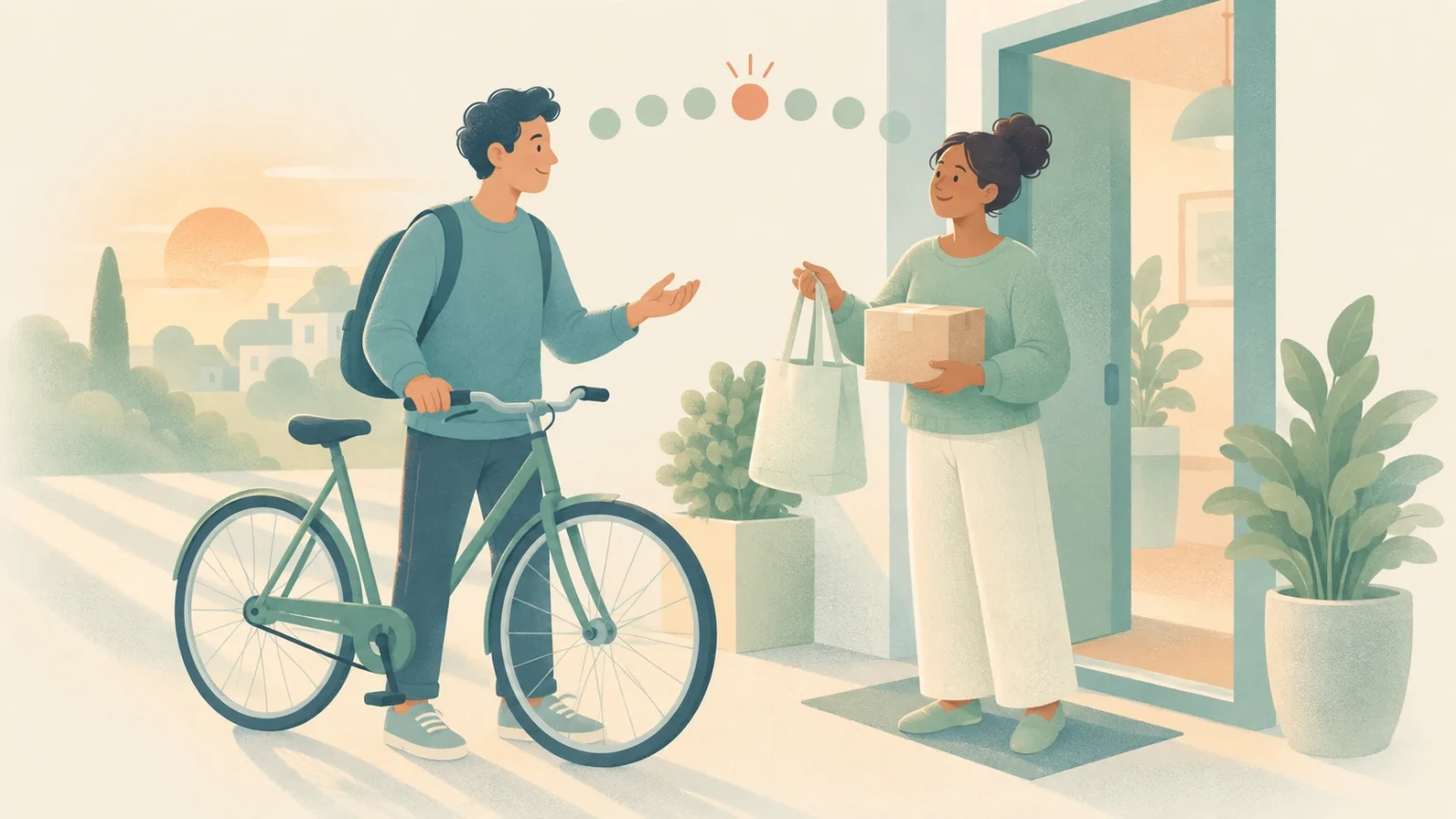
When you coordinate a bike repair pickup, conversations often follow a natural sequence. You first ask the technician when the repair will be ready. The mechanic answers by confirming the day with on Friday. Finally, you reply by narrowing your pickup time to on Friday afternoon. Notice how verb tenses establish the timing, while on Friday identifies the specific day of the collection.
-
Customer: When will my bike repair be ready?
Why it works: The customer asks when the technician will finish the repair.
-
Mechanic: It will be ready on Friday.
Why it works: The mechanic confirms Friday as the completion day.
-
Customer: Great, I can collect it on Friday afternoon.
Why it works: The customer narrows the collection window to Friday afternoon.
You can practise this again in Equipment or Equipments: Which Is Correct? and Discuss or discuss about: Which is correct?.
Your turn
How should you reply if the mechanic asks when you can collect your bicycle?
Answer: I can pick it up on Friday afternoon.
Show the answer
Answer: I can pick it up on Friday afternoon.
Combining a named day with a part of the day still requires on, with no extra preposition between them.
Compare on Friday, in May and at noon
Prepositions in time expressions follow clear grammatical patterns rather than a universal rule about length of time. For example, an afternoon is shorter than a day, but English uses in the afternoon and on Friday. When a day combines with a specific clock time, each expression retains its own preposition, as in on Friday at noon. Use this reference table to match prepositions with their expression categories.
-
The shop reopens on October 14.
Why it works: Specific calendar dates take on.
-
Our workshop opens in May.
Why it works: Months take the preposition in.
-
The mechanic takes lunch at noon.
Why it works: Clock times and points like noon take at.
-
We service bikes in the morning, but the shop closes at night.
Why it works: Parts of the day take in, while night takes at as an exception.
-
I will meet the technician on Friday at noon.
Why it works: Each time expression retains its own preposition when combined.
Your turn
Which preposition completes the schedule note: The shop reopens ___ noon on Friday?
Answer: at
Show the answer
Answer: at
Clock points and words like noon take at, while the day takes on.
Use on Friday morning but omit on before this Friday
When you add a part of the day after Friday, keep on at the beginning: on Friday morning, on Friday evening, or on Friday night. Notice that you drop the word the in these combinations. However, do not use on if the weekday has words like this, next, last, or every directly in front of it. Saying on next Friday is an error; say next Friday instead. In practical scheduling arrangements, phrases like this Friday and next Friday can cause confusion because speakers sometimes disagree on whether next Friday means the nearest Friday or the Friday of the following week. Adding the calendar date prevents missed appointments.
-
I will inspect the gears on Friday morning.
Why it works: On Friday morning specifies the morning of that single day without using the.
-
I will return the borrowed pump next Friday.
Why it works: Next replaces the preposition on entirely.
-
Can we confirm the pickup for this Friday, October 16?
Why it works: Adding a calendar date clarifies the exact day in real arrangements.
-
Incorrect: I will see you on next Friday. -> Correct: I will see you next Friday.
Why it works: Drop on when next comes directly before the weekday.
Your turn
Which phrase contains an unnecessary preposition?
Answer: on next Friday
Show the answer
Answer: on next Friday
Words like next, this, last, and every stand alone before weekdays without on.
Distinguish on Fridays from in Friday's email
Learners sometimes confuse the plural word Fridays with the possessive form Friday's. When you add s without an apostrophe, you describe a repeated weekly routine: The shop tests batteries on Fridays. When you add an apostrophe and s, Friday's describes a following noun, such as Friday's email or Friday's schedule. In that situation, the preposition belongs to the object noun: You read the invoice in Friday's email. In English writing, always capitalise the names of weekdays, including Friday, Fridays, and Friday's, regardless of where they appear in a sentence.
-
The courier delivers spare parts on Fridays.
Why it works: On Fridays with a plural s shows a recurring weekly routine.
-
I found the repair estimate in Friday's email.
Why it works: In relates to email, while Friday's shows which message.
-
We always capitalise Friday and Fridays in writing.
Why it works: Weekday names are proper nouns and must begin with a capital letter.
Your turn
Which sentence describes an event repeated every week?
Answer: The shop owner orders new tires on Fridays.
Show the answer
Answer: The shop owner orders new tires on Fridays.
The plural form Fridays without an apostrophe names recurring days.
Recognise Friday without on in everyday speech
In fast casual conversation, native speakers often omit on before a day name. You will frequently hear people say I will bring the bike Friday instead of on Friday. This omission is especially common in American English, though speakers in Britain and Australia use it informally as well. In professional writing and careful speaking, keeping on Friday remains the standard and most dependable choice across all regions.
-
Can you bring your bike Friday?
Why it works: Casual spoken conversation often leaves out on.
-
Please collect your bicycle on Friday.
Why it works: Written confirmations and standard messages retain on.
Your turn
Why might a coworker say: Let us discuss the project Friday?
Answer: It is an informal conversational shortcut where on is omitted.
Show the answer
Answer: It is an informal conversational shortcut where on is omitted.
Casual spoken English frequently omits on before day names while keeping the single-day meaning.
Hear the short on and the ending of Fridays
When you listen to natural speech, the word on is rarely stressed. Speakers pronounce it rapidly and connect it directly to Friday: on-Friday. You must also listen carefully to the ending of the word. Friday ends with a vowel sound, while Fridays ends with a voiced /z/ sound. Because Friday's and Fridays sound identical in speech, the rest of the sentence tells you whether someone means a routine or a written message.
-
We service brakes on Friday.
Why it works: On is short and unstressed, followed by the stressed first syllable of Friday.
-
We service brakes on Fridays.
Why it works: The final /z/ sound indicates a recurring weekly service.
Your turn
What phonetic clue distinguishes the plural word Fridays from the singular word Friday?
Answer: A voiced /z/ sound at the end of Fridays.
Show the answer
Answer: A voiced /z/ sound at the end of Fridays.
The plural ending adds a voiced /z/ sound, while singular Friday ends with a vowel diphthong.
Recall the rule and write a Friday arrangement
Before writing your own scheduling messages, work through a three-step retrieval sequence to test your memory. In Step 1, select among on, in, at, or zero preposition for each time expression. Remember that single weekdays take on, clock points take at, and words like next take no preposition. In Step 2, identify and correct errors in preposition usage before sending your draft. In Step 3, write a collection arrangement and a recurring weekly routine from memory. This multi-step recall practice ensures you apply preposition rules accurately in real conversations.
-
Step 1 (Select preposition): The courier arrives on Friday at noon, but the manager leaves next Monday.
Why it works: Select on for Friday, at for noon, and zero preposition before next Monday.
-
Step 2 (Identify and correct): Incorrect: We will meet on next Friday. -> Correct: We will meet next Friday.
Why it works: Identify the unnecessary preposition on and remove it before next Friday.
-
Step 3 (Write arrangement): I can collect my bicycle on Friday afternoon after work.
Why it works: Write an arrangement combining on Friday with afternoon from memory.
-
Step 3 (Write routine): Our workshop services commuter bicycles on Fridays.
Why it works: Write a recurring routine using on Fridays with a plural s from memory.
Your turn
Which option correctly fills the gap in the sentence: The courier will deliver the package ___ next Friday?
Answer: no preposition
Show the answer
Answer: no preposition
When a weekday is preceded by next, you select no preposition.
Use it naturally
How people really use “on Friday”
Neutral Fine almost anywhere, at work or with friends.
Words it often goes with
- on Friday morningI'll buy the vegetables on Friday morning.
- on Friday afternoonMy friends will leave on Friday afternoon.
- on Friday eveningWe're having dinner together on Friday evening.
What people also say
- “this Friday” instead of “on this Friday” Leave out on before this Friday.
- “next Friday” instead of “on next Friday” Leave out on before next Friday.
Questions about "On Friday or in Friday: which is correct?"
Is on Friday or in Friday correct?
Use on Friday to name the day an event happens. In Friday does not fit that meaning. Other time expressions use different patterns, such as in August and in the morning.
The shop reopens on Friday.
We will travel in August.
Why do we say in the morning but on Friday morning?
When morning stands alone as a general period of the day, it takes in the morning. When you add a specific day name such as Friday, the day rule takes over, so the entire phrase uses on Friday morning without the word the.
I drink tea in the morning.
I will attend the meeting on Friday morning.
Do I need on before next Friday or this Friday?
No. Words like this, next, last, and every replace the preposition on before weekday names. Saying on next Friday is a grammatical mistake in standard English.
We will inspect the brakes next Friday.
I bought a helmet last Friday.
What is the difference between on Friday and on Fridays?
Use on Friday to refer to one specific calendar day in the past or future. Use on Fridays with a plural s to describe a repeated weekly habit or regular schedule.
I will collect my bike on Friday.
The workshop cleans its tools on Fridays.
Why is in Friday's email correct?
In this phrase, the preposition in belongs to the noun email, not to Friday. Friday's functions as a possessive adjective showing which email contains the information.
I found the receipt in Friday's email.
The schedule is printed in Friday's bulletin.
Can I say I'll see you Friday without on?
Yes, in casual conversation speakers often leave out on, especially in American English. While I will see you Friday is natural in spoken settings, keeping on Friday is recommended for formal and written communication.
I will see you Friday at the shop.
The final report is due on Friday.
Before you go
Remember this
Use on Friday for actions happening on that day. Add times of day directly after the weekday name, as in on Friday evening. Drop on before this, next, last, and every. Use on Fridays with an s for weekly repeated routines, and reserve in Friday's email for when you refer to the contents of that message.
Stage 2 of 5
Listen
Hear it in real sentences, from short to long, and write what you hear.
0 of 4 done
Listening 1 of 4
Listening 2 of 4
Try a longer clip. Listen once, then replay the part you missed.
Listening 3 of 4
This clip is longer. Follow the instruction above the answer field.
Listening 4 of 4
Listen, then type the missing words. The rest of the text is already there.
0:00
Practice complete
You listened closely.
Your result is saved in this browser.
Keep your progress. Your practice is saved on this device only. Create a free account to keep it everywhere.
Create a free accountThat was today's free lesson. Tomorrow you get another one. Want more today? See membership.
Create a free SubLearn account to keep this progress across devices.
Save my progressStage 3 of 5
Speak
Say it with the speaker, then use it in your own answer.
Shadow
Say it along with the speaker
Play the line slowly, then speak at the same time as the speaker. Copy the rhythm, not just the words.
Your turn
Say it your way
Speak for 30 to 60 seconds from memory about a meal you are planning at home for friends. Explain what will happen on Friday, when your guests should arrive, and how this meal differs from your usual Friday routine.
Use: on Friday on Fridays at noon
Take ten seconds to think, then answer out loud without looking at the lesson. Speak for the time shown in the task above. Nothing is sent unless you ask for feedback.
0:00
Hear how someone else might say it
I'm having some friends over for lunch on Friday. They should arrive at noon, so I need to start cooking early. I usually eat a quick sandwich on Fridays because I work all day. This week, I have a day off, and I want to make something special. I'll cook chicken with rice and a big bowl of vegetables. My friend Sam will bring dessert. After lunch, we can play a few games or take a walk if the weather is nice.
Try once more and answer this: What food will you make for everyone?
Stage 4 of 5
Write
Use what you've learned to write about your day or week, then write a message.
Write
Put it in your own words
- I used “on Friday”.
- It is about my life, not the lesson’s example.
- I read it once aloud to check it sounds right.
Write your own response
Choose a situation and write 30–50 words of your own. In this activity, you decide what to say rather than copy the words in a recording.
Check your own writing
Read one possible response
Use these checks to revise your message. Grammar and meaning are not automatically graded. Each task keeps its own draft in this browser tab.

You finished the free part of this lesson
- Understand
- Listen
- Speak
- Write
- CheckPart of membership
Worth another look
With a free account, the lessons you finish come back for review to help you remember them.Create a free account
Stage 5 of 5 · Part of membership
Check
New clips without hints.
Listening tests are included with membership. Try the free dictation first, then decide whether to continue.
Listening 1 of 2 Part of membership
Listening 2 of 2 Part of membership
Follow MicroEnglish
Find lesson updates, short videos and quick quizzes. Pick the app you already use.
Questions & comments
Ask about this lesson, share an example, or help another learner.
Example
Memory tip
Goes with
Related forms
Not to be confused with
In this lesson
This word isn't in our dictionary. Check the spelling, or try another form of the word.
We couldn't load this word. Try again.
