Micro-listening
Meeting times across time zones
How do meeting times differ across time zones?
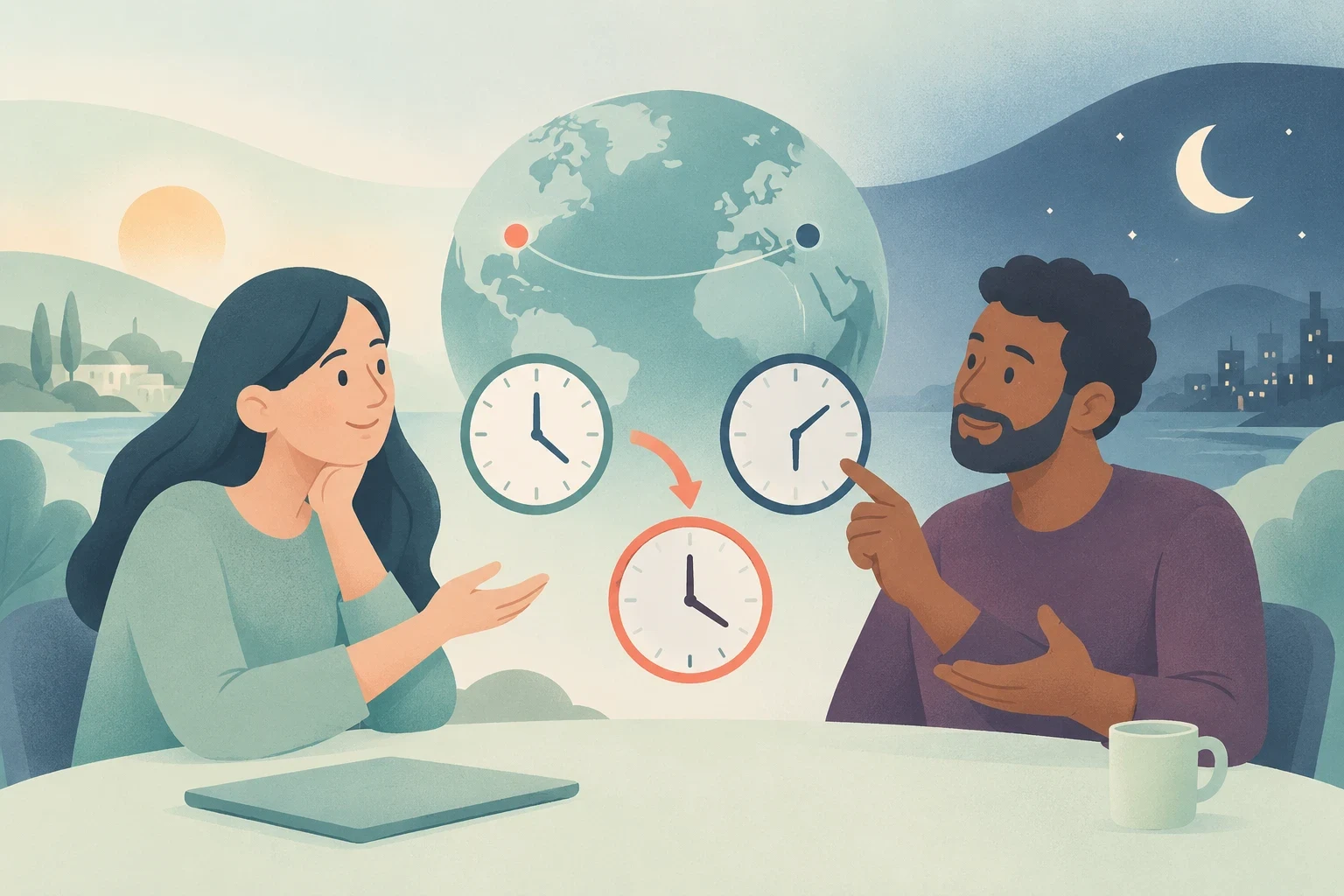
The same meeting has different local clock times in different cities. If a London meeting moves from two to three, it may start at nine in the morning in Chicago. Listen for 'from', 'to', and 'by', connect every number with its city, and check the updated calendar invitation before joining.
Key points
- Local time is the official clock time in a specific place.
- 'Push back' means move an event to a later hour.
- 'From' marks the old time; 'to' marks the new time.
- 'By' describes the amount of the schedule change.
This lesson has 5 stages. You can stop at any time and continue later.

At a glance
| Form | Use it for | Example |
|---|---|---|
| from two to three | Shows the old and new hours. | The call moved from two to three in London. |
| to three | Shows the new target hour. | The session was rescheduled to three in London. |
| by one hour | Shows the amount of the delay. | The rehearsal was delayed by one hour. |
| your time | Identifies the listener's local clock. | Do you mean nine your time in Chicago? |
Stage 1 of 5
Understand
What it means, when to use it, and mistakes to avoid.
The full explanation
Pushing a meeting back moves it to a later hour. A single event takes place at three in the afternoon in London and nine in the morning in Chicago.
We pushed the music rehearsal back from two to three in London.
Why it works: From indicates the previous time and to indicates the new time.
2 more examples
-
Three in the afternoon in London is nine in the morning in Chicago.
Both clock numbers describe the same real-world event in different cities.
-
Do you mean nine in the morning my time in Chicago?
A polite confirmation question prevents showing up at the wrong hour.
Read the full guide
Decide which clock your meeting follows
People in different places can have different times on their clocks. A call can start at ten in the morning for one person and later in the day for another. Listen for both the time and the place. Local time means the official hour shown on clocks in a specific city or town. Because one online call happens everywhere at the same physical moment, participants who live far apart will see different clock numbers on their screens. For example, clocks in London are six hours ahead of clocks in Chicago. When an organizer announces a schedule, you must immediately notice whether that hour belongs to your clock or their clock.
-
Our rehearsal starts at nine in Chicago, which equals three in the afternoon in London.
Why it works: Both times name the same meeting moment for people living in different places.
-
Please confirm your local time before adding the call to your calendar.
Why it works: Local time reminds the listener to check the clocks in their own city.
Your turn
What does 'local time' mean when arranging an international video call?
Answer: The time shown on clocks in a specific city or region
Show the answer
Answer: The time shown on clocks in a specific city or region
Local time refers to the official clock time in a particular location, so different participants may join at different clock hours.
Listen first for words that show a schedule change
You are about to join an online rehearsal when a voice message changes the start time. You need to confirm what time to join where you live. When you listen to an announcement for the first time, do not worry about calculating foreign time differences immediately. Your primary job during this first pass is to answer one central question: does the existing arrangement stay the same, or does the plan change? Listen for transition verbs and delay phrases such as 'push back', 'move', 'reschedule', or 'delay'. If the speaker uses these expressions, prepare your notes for a new hour.
-
We need to push our rehearsal back by one hour.
Why it works: The phrase push back tells you the original plan has changed to a later time.
-
Our previous schedule cannot work because the hall opens late.
Why it works: The reason explains why the organizer decided to change the rehearsal.
You can practise this again in Swapping a volunteer shift and Renewing library items.
Your turn
What is your main goal during the first listen to a rescheduling message?
Answer: Decide whether the event stays as planned or moves to a new time
Show the answer
Answer: Decide whether the event stays as planned or moves to a new time
On the first listen, focus on the overall outcome to identify whether a schedule change occurred before recording specific numbers.
Match each spoken time with its city
On your second listen, prepare a two-column note page so you can match every number to its city and status. Follow three progressive steps: first, identify the change phrase; second, catch the specific number that follows 'to'; third, link that number to the location phrase that follows it. Speakers often mention the old hour and the new hour in the same sentence. If you write numbers down without attaching city names immediately, you can easily join hours early or miss the call entirely.
-
The meeting moves from two to three in London.
Why it works: Two is the cancelled starting hour and three is the updated hour in London.
-
That means nine in the morning for you in Chicago.
Why it works: The pronoun you connects nine in the morning directly to the listener in Chicago.
Your turn
Why should you immediately write the city name beside every number you hear?
Answer: To avoid mixing up the host city hour with your own local joining time
Show the answer
Answer: To avoid mixing up the host city hour with your own local joining time
Writing the city name next to each time ensures you know which location uses that clock reading.
Use from, to and by to follow time changes
English uses three prepositions to explain how a schedule shifts. The preposition 'from' marks the starting point or replaced time. The preposition 'to' marks the destination or replacement hour. The preposition 'by' describes the size or duration of the shift, not the final hour on the clock. For instance, moving a call 'from two to three' shifts the start time by one hour. The phrasal verb 'push back' always means moving an event to a later hour. You can review similar future updates on our lesson for [changing a plan](/micro-listenings/1-2/).
-
We pushed the session back from two to three.
Why it works: From marks the original time and to marks the new time.
-
Marcus pushed the music rehearsal back by one hour.
Why it works: By one hour names the amount of added time, not a clock hour.
-
Our team will reschedule the session to Thursday.
Why it works: To introduces the new day chosen for the rehearsal.
Your turn
In the sentence 'We pushed the call back by two hours', what does 'by two hours' mean?
Answer: The event begins two hours later than originally planned
Show the answer
Answer: The event begins two hours later than originally planned
The preposition 'by' indicates the difference or amount of time added to the previous schedule.
Hear the number, day and city together
Spoken English groups time, day, and place into a single rhythmic unit. Content words like numbers and city names receive strong stress and clear vowels. In contrast, prepositions like 'at' and 'to' usually take weak forms with reduced neutral vowels. If you listen only for isolated words, you may miss these small connecting sounds. Instead, listen for the entire phrase as one package: 'at nine in Chicago' or 'on Saturday in London'. Always verify whether the speaker says morning or afternoon to prevent twelve-hour misunderstandings.
-
Elena joins at nine in the morning on Saturday.
Why it works: The preposition at links to the hour, while on introduces the day of the week.
-
The choir gathers online at three in the afternoon London time.
Why it works: Strong stress falls on three, afternoon, and London, while at and in remain weak.
Your turn
Which words usually receive the strongest stress in a scheduling message?
Answer: Key numbers, parts of the day, and city names
Show the answer
Answer: Key numbers, parts of the day, and city names
English speakers place primary stress on meaningful content words like numbers, times of day, and location names.
Check the final schedule in a clear table
Now review the exact spoken transcript: 'Hello Elena, Marcus here from London. The hall will open late on Saturday, so we must push our rehearsal back by one hour. Our call was originally at two in London, but our new London time is three. That means nine in the morning your time in Chicago. Please send a message if this new hour works for you.' Checking the spoken words against a reference table makes the arrangements clear. Keep in mind that seasonal daylight saving changes can alter the hour difference between cities during spring and autumn, so always trust an updated digital calendar invitation for live events.
-
Status: Final | London: 3:00 p.m. Saturday | Chicago: 9:00 a.m. Saturday.
Why it works: This row summarizes the active schedule confirmed in the voicemail.
-
Status: Replaced | London: 2:00 p.m. Saturday | Chicago: 8:00 a.m. Saturday.
Why it works: This row shows the cancelled time that volunteers must disregard.
Your turn
According to the final schedule table, what is Elena's confirmed joining time in Chicago?
Answer: 9:00 a.m. on Saturday
Show the answer
Answer: 9:00 a.m. on Saturday
The updated schedule moves the rehearsal to 3:00 p.m. in London, which corresponds to 9:00 a.m. local time in Chicago.
Avoid showing up at the wrong local hour
Two frequent errors cause people to miss international meetings. The first error is joining at the old time because you remembered the first number mentioned rather than the revised hour. The second error is confusing the organizer's clock with your own clock. If Elena logged in at three o'clock Chicago time, Marcus would already be finished, as that would be nine at night in London! When you feel unsure, ask a brief confirmation question before the call: 'Do you mean nine in the morning my time in Chicago?'
-
Do you mean nine in the morning my time?
Why it works: Using my time makes the recipient confirm your local city clock.
-
I will join at nine Chicago time, which equals three your time.
Why it works: Stating both local times leaves no room for confusion between partners.
Your turn
What would happen if Elena logged in at three in the afternoon Chicago time?
Answer: She would be six hours late because London would already be at nine at night
Show the answer
Answer: She would be six hours late because London would already be at nine at night
Three in the afternoon in Chicago corresponds to nine in the evening in London, long after the three o'clock London rehearsal.
Reconstruct the final schedule from memory
To consolidate your learning, complete six spoken dictations and then summarize the final arrangement without looking back at the transcript. The dictations begin with single time-and-place phrases, progress through the schedule change, and finish with a full confirmation message. After you write down each sentence, check your spelling and punctuation against the model. Once you finish all six, write down the final hour, day, and city for both participants from memory. Testing your recall ensures you can process time changes quickly during real conversations.
-
Our choir rehearsal begins at nine in Chicago, so Marcus can log in at three in London.
Why it works: This complete sentence expresses the entire agreement in one balanced statement.
-
Elena confirmed the Saturday rehearsal time without looking at her notes.
Why it works: Active recall helps you retain scheduling details under real-world pressure.
Your turn
Why is reconstructing the schedule from memory a useful final step?
Answer: It proves you can identify and hold key scheduling facts without relying on written prompts
Show the answer
Answer: It proves you can identify and hold key scheduling facts without relying on written prompts
Recalling the details from memory trains you to process spoken scheduling information accurately during spontaneous workplace calls.
Common mistakes
What learners often say, what to say instead, and why.
-
Not this:
We pushed the meeting back to one hour.Say: We pushed the meeting back by one hour.
'By one hour' gives the amount of the delay, not the meeting's new clock time.
-
Not this:
The call moved from two by three in London.Say: The call moved from two to three in London.
'From' introduces the old time, while 'to' introduces the new time.
-
Not this:
I do not know whether nine is my time or your.Say: I do not know whether nine is my time or your time.
Repeat 'time' after 'your' to make the two local clocks clear.
Use it naturally
How people really use “my time”
Neutral Fine almost anywhere, at work or with friends.
Words it often goes with
- at nine my timeThe class starts at nine my time.
- three in the afternoon my timeIt will be three in the afternoon my time when we join the call.
- my time or your timeDo you mean ten o'clock my time or your time?
What people also say
- “Is that nine my time?” instead of “Is that nine according to the clock in my city?” Use this short question when the other person knows where you are.
Questions about "Meeting times across time zones"
Does 'push the meeting back' mean earlier or later?
'Push back' always means moving an event to a later time or date. If a rehearsal scheduled for two o'clock is pushed back by one hour, the new start time is three o'clock. Do not confuse this with moving an event forward, which can sometimes mean making it earlier.
We need to push the meeting back by thirty minutes.
The coordinator pushed our Saturday rehearsal back to three.
What is the difference between 'to three' and 'by three hours'?
'To three' identifies the specific target number on the clock where the event will now begin. In contrast, 'by three hours' tells you the amount of time added to the previous schedule. If a one o'clock call moves 'to three', it shifts 'by two hours'.
The director changed the rehearsal to three in the afternoon.
We delayed our rehearsal by two hours.
How do I know if they mean my time or their time?
Speakers usually identify the reference clock by naming the city or using pronouns like 'my time' and 'your time'. If Marcus in London tells Elena in Chicago that a call is 'at nine your time', he means nine o'clock in Chicago. When someone mentions an hour without naming a location, ask for immediate clarification.
Marcus said the call starts at nine your time.
Let us make sure whether you mean your time or my time.
Why do they give two different times for one meeting?
An online meeting happens simultaneously for all participants, but wall clocks in different parts of the world show different numbers. Stating both times helps both the host and the guest verify their personal calendars without needing to make mathematical conversions on their own.
The webinar is at seven in Berlin, which is one in the afternoon in New York.
I gave both times so nobody joins at the wrong hour.
How can I check the final time politely?
You can ask a direct clarification question using 'Do you mean' followed by the hour, day, and your city name. Another natural approach is to state your understanding and request confirmation: 'Just to confirm, we are meeting at nine a.m. Chicago time on Saturday, correct?'
Do you mean nine in the morning Chicago time?
Just to confirm, we meet at three in London on Saturday.
Can the time difference change during the year?
Yes. Many regions observe daylight saving time, but countries switch their clocks on different calendar dates in spring and autumn. This means the time gap between two cities can expand or shrink by one hour for several weeks. Always check the updated calendar invite for specific dates.
London and Chicago do not change their clocks on the same weekend in autumn.
The six-hour difference shifted to five hours for two weeks in March.
Before you go
Remember this
The rehearsal moves back by one hour from two to three in London, meaning volunteers in Chicago join at nine in the morning on Saturday.
Stage 2 of 5
Listen
Hear it in real sentences, from short to long, and write what you hear.
0 of 4 done
Listening 1 of 4
Listening 2 of 4
Try a longer clip. Listen once, then replay the part you missed.
Listening 3 of 4
This clip is longer. Follow the instruction above the answer field.
Listening 4 of 4
Listen, then type the missing words. The rest of the text is already there.
0:00
Practice complete
You listened closely.
Your result is saved in this browser.
Keep your progress. Your practice is saved on this device only. Create a free account to keep it everywhere.
Create a free accountThat was today's free lesson. Tomorrow you get another one. Want more today? See membership.
Create a free SubLearn account to keep this progress across devices.
Save my progressStage 3 of 5
Speak
Say it with the speaker, then use it in your own answer.
Shadow
Say it along with the speaker
Play the line slowly, then speak at the same time as the speaker. Copy the rhythm, not just the words.
Your turn
Say it your way
Leave a 20-30 second voicemail for a partner explaining that your rehearsal is pushed back by one hour to three in London, which is nine in Chicago.
You could start with “Hello, I am calling to update our rehearsal time…”
Take ten seconds to think, then answer out loud without looking at the lesson. Speak for the time shown in the task above. Nothing is sent unless you ask for feedback.
0:00
Stage 4 of 5
Write
Write your own response
AI feedback · it can make mistakes · Part of membership See membership
Check your own writing
Read one possible response
Draft saved on this device.
Use these checks to revise your message. Grammar and meaning are not automatically graded. Each task keeps its own draft in this browser tab.

You finished the free part of this lesson
- Understand
- Listen
- Speak
- Write
- CheckPart of membership
Worth another look
With a free account, the lessons you finish come back for review to help you remember them.Create a free account
Stage 5 of 5 · Part of membership
Check
New clips without hints.
Listening tests are included with membership. Try the free dictation first, then decide whether to continue.
Listening 1 of 2 Part of membership
Listening 2 of 2 Part of membership
Follow MicroEnglish
Find lesson updates, short videos and quick quizzes. Pick the app you already use.
Questions & comments
Ask about this lesson, share an example, or help another learner.
Example
Memory tip
Goes with
Related forms
Not to be confused with
In this lesson
This word isn't in our dictionary. Check the spelling, or try another form of the word.
We couldn't load this word. Try again.
