Micro-listening
Sentence Variety: Write Better Paragraphs
Can I begin a sentence with words like because, although, or but in everyday English writing?
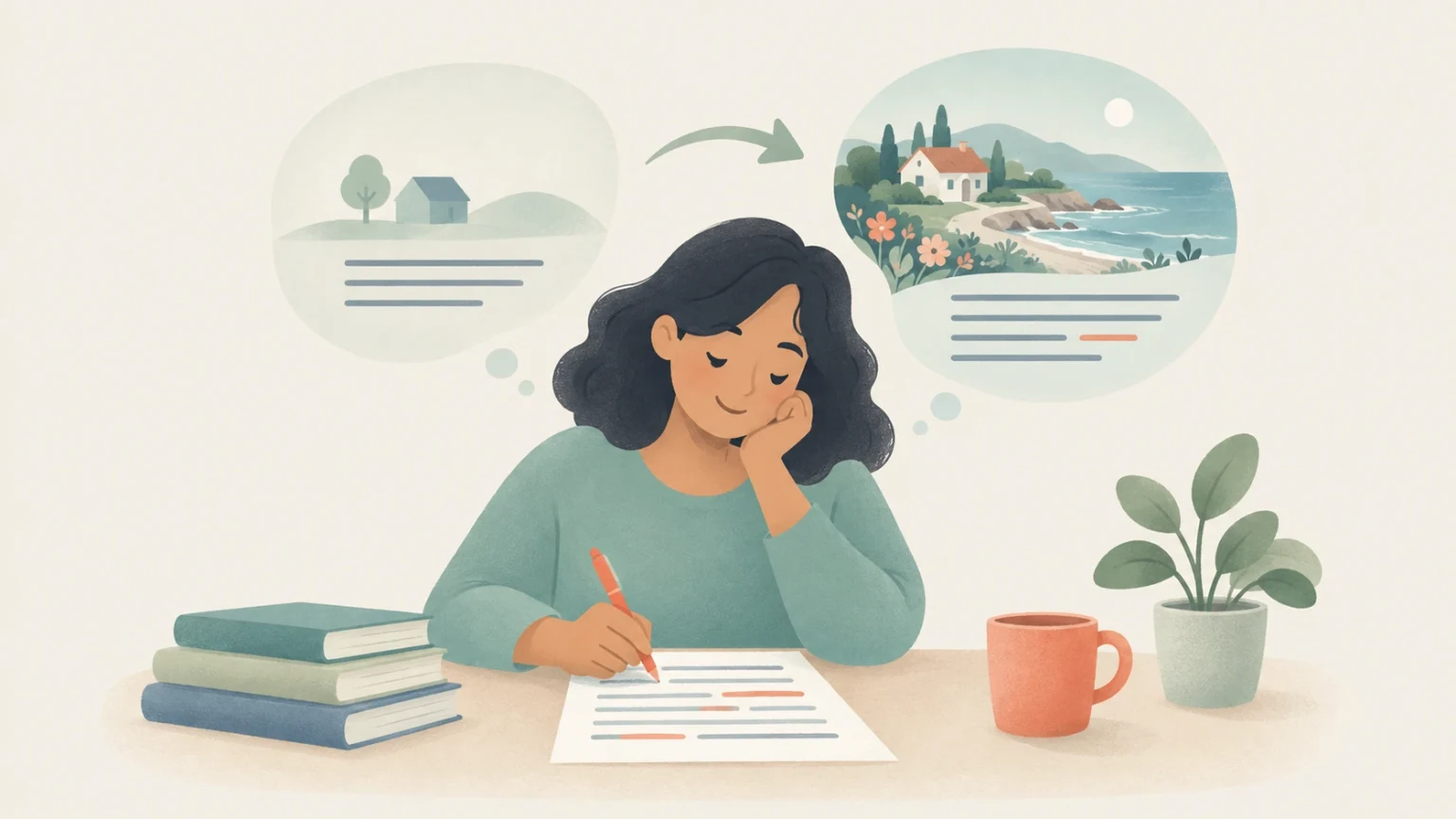
Sentence variety refers to changing the structure, opening words, and length of sentences across a paragraph while maintaining clarity. Rather than starting every line with a subject pronoun, writers introduce time markers, physical locations, or logical connectors. Concrete detail refers to measurable, verifiable information, such as numbers, names, and exact objects, that allows a reader to picture the situation.
Key points
- Begin revising by reading your draft to identify patterns.
- Look for repeated openings such as 'we did' or 'the team was'.
- Replace vague verbs like 'went' or 'got' with specific actions such as 'walked', 'received', or 'purchased'.
This lesson has 5 stages. You can stop at any time and continue later.

Stage 1 of 5
Understand
What it means, when to use it, and mistakes to avoid.
Examples
Before the morning shift, technician David inspected five assembly machines.
Why it works: Opening with a time phrase sets the scene, while inspected and five assembly machines provide exact action and measurable detail.
2 more examples
-
In the conference room, the committee debated the proposed safety policy for forty minutes.
The location phrase begins the sentence, debated names the specific action, and forty minutes provides concrete time data.
-
The network server crashed at noon; consequently, our support team restored customer accounts from an offline backup.
Consequently establishes the cause-and-effect relationship, while restored and offline backup specify the technical response.
Read the full guide
Notice Repetitive Sentence Openings
When writers draft an explanation quickly, they often start every sentence with the same subject and verb pattern. In a report about a person or a project, reading five lines in a row that start with he or we creates a monotonous rhythm that numbs the reader. Identifying this repetition is the first step toward clearer communication. Look at the first two words of each sentence in your paragraph to check whether you have built an accidental chain of identical openings.
-
We arrived at eight. We unlocked the doors. We organized the sign-in sheets.
Why it works: Repeating the subject we three times creates a flat, mechanical rhythm.
-
We arrived at eight and unlocked the doors before organizing the sign-in sheets.
Why it works: Combining actions removes the repeated opening while preserving the sequence.
Your turn
Why should a writer examine the first two words of each sentence in a draft?
Answer: To spot accidental chains of identical subjects that create a monotonous rhythm.
Show the answer
Answer: To spot accidental chains of identical subjects that create a monotonous rhythm.
Checking sentence beginnings reveals whether you have repeated the same subject pattern too many times in a row.
Choose Concrete Action Verbs
Vague verbs force readers to guess what actually happened. Words such as did, got, went, or made tell the reader that an event occurred, but they leave out the method and quality of the action. Choosing an exact verb sharpens your meaning and often removes the need for empty adverbs. Instead of writing that an employee did a survey, state that she drafted, distributed, or evaluated the survey.
-
Marcus did a presentation about the quarterly budget.
Why it works: The verb did fails to show how Marcus delivered the financial information.
-
Marcus presented the quarterly budget to regional directors.
Why it works: Presented names the exact communicative action and clarifies the audience.
You can practise this again in Paranoid: Meaning and Better Alternatives and Caveat Meaning: One Condition to Remember.
Your turn
Which revision replaces a vague verb with an exact action?
Answer: The technician repaired the damaged power cable.
Show the answer
Answer: The technician repaired the damaged power cable.
Repaired identifies the exact mechanical action rather than using a general phrase like did work.
Open Sentences With Time Expressions
Moving a time expression to the start of a sentence establishes chronological order before introducing the action. Phrases such as before the shift, yesterday afternoon, or by noon help the reader track when steps occurred in a sequence. This shift also breaks the habit of starting every statement with a personal pronoun, providing a natural transition between related tasks without altering the core factual message.
-
After the team meeting, Carlos sent the revised agenda to all attendees.
Why it works: The introductory time phrase establishes the timeline before naming the action.
-
By three o'clock, the technicians had restored internet connectivity throughout the building.
Why it works: Opening with the completion time highlights the milestone achieved by the team.
Your turn
What is the primary benefit of opening a sentence with a time phrase?
Answer: It establishes chronological context before describing the main action.
Show the answer
Answer: It establishes chronological context before describing the main action.
Starting with a time phrase immediately informs the reader when the event occurred in the narrative.
Anchor the Scene With Location Phrases
When an event depends on its physical environment, introducing the setting at the beginning of the sentence creates an immediate mental image. Prepositional phrases indicating place, such as in the conference room, across the main lobby, or at the front desk, prepare the audience for what follows. Placing the location first separates the background context from the actor, giving your paragraph spatial variety.
-
At the security gate, visitors presented their photo identification badges.
Why it works: Starting with the physical location sets the scene before introducing the requirement.
-
Inside the warehouse, workers sorted shipping crates into numbered rows.
Why it works: The place phrase orients the reader before describing the physical task.
Your turn
Which sentence successfully uses an introductory place phrase to set the scene?
Answer: Behind the reception desk, Angela filed incoming registration forms.
Show the answer
Answer: Behind the reception desk, Angela filed incoming registration forms.
The sentence begins with the prepositional phrase 'Behind the reception desk', establishing the location first.
Add Concrete Details That Clarify Meaning
Adjectives that convey emotional judgment, like nice, great, or terrible, rarely provide actionable information. Professional writing gains credibility when general descriptions are replaced with verifiable facts, numbers, or specific objects. Instead of claiming that a meeting was productive, specify that the committee approved two policies and scheduled next month's audit. Clear details answer practical questions about how, where, or to what extent an action succeeded.
-
The maintenance crew cleaned the cafeteria nicely.
Why it works: The adverb nicely gives a personal opinion rather than measurable proof of work.
-
The maintenance crew sanitized twenty tables and mopped the cafeteria floor.
Why it works: Concrete numbers and exact objects tell the reader exactly what tasks were finished.
Your turn
Why are factual details more effective than evaluative adjectives like 'nice' or 'good'?
Answer: They provide checkable, concrete information that shows what actually occurred.
Show the answer
Answer: They provide checkable, concrete information that shows what actually occurred.
Checkable facts answer specific questions about what happened instead of relying on subjective judgment.
Link Ideas With Logical Transitions
Connectors indicate how two adjacent thoughts interact. Words like however signal an unexpected contrast, as a result marks a consequence, and for example introduces supporting evidence. Adding transition words mechanically without a genuine relationship confuses readers rather than helping them. Only insert a connector when you need to make the cause, contrast, or progression between two sentences unmistakable.
-
Heavy rain flooded the access road; consequently, delivery trucks arrived two hours late.
Why it works: Consequently signals the direct cause-and-effect relationship between weather and delay.
-
The software tutorial was brief. However, several instructions were difficult to follow.
Why it works: However contrasts the short format with the difficulty of following its instructions.
Your turn
When should a writer add a linking word such as 'however' or 'as a result'?
Answer: Only when an explicit relationship like contrast or consequence exists between two ideas.
Show the answer
Answer: Only when an explicit relationship like contrast or consequence exists between two ideas.
Connectors must reflect real logical relationships, not serve as decorative filler.
Vary Length to Control Reading Rhythm
A paragraph where every sentence contains twenty words feels just as exhausting as one built entirely from five-word fragments. Pairing a short, direct sentence with a longer explanatory sentence keeps readers engaged. Use a concise statement to deliver an important fact, emphasize a decision, or conclude an argument. Save longer, multi-clause structures for explaining background context, comparing options, or detailing interconnected steps.
-
The fire alarm sounded. Everyone exited the building immediately.
Why it works: Two punchy sentences communicate emergency action without unnecessary delay.
-
Although the project faced supply shortages throughout August, our manufacturing team completed every client order on schedule. Quality remained high.
Why it works: The short final sentence delivers a strong, emphatic conclusion after a complex clause.
Your turn
What is the strategic purpose of placing a short sentence after a long one?
Answer: To emphasize a key point or conclusion with direct, punchy clarity.
Show the answer
Answer: To emphasize a key point or conclusion with direct, punchy clarity.
A brief sentence after complex explanation stands out sharply and emphasizes the core takeaway.
Read Aloud to Test Overall Flow
Silent reading often masks clumsy phrasing because your eyes jump over awkward transitions. Reading your revised paragraph aloud forces you to hear unnatural pauses, repeated sounds, and breathless sentence lengths. If you run out of air before finishing a clause, that sentence is likely overloaded. If your speech sounds robotic, you may need to vary your openings or connect related ideas more smoothly.
-
I checked the figures, and then I called the supplier, and then I wrote an email, and then I left.
Why it works: Reading aloud immediately reveals the monotonous repetition of 'and then'.
-
After checking the figures, I called the supplier and wrote an email. Then I left.
Why it works: The revision varies the connections while preserving the original actions and their order.
Your turn
Why is reading a draft aloud an effective proofreading method?
Answer: It highlights awkward pauses, breathless clauses, and repetitive sentence rhythms.
Show the answer
Answer: It highlights awkward pauses, breathless clauses, and repetitive sentence rhythms.
Speaking the text reveals rhythmic flaws and clumsy transitions that silent reading easily overlooks.
Use it naturally
How people really use “consequently”
Formal Fits reports, emails to clients and speeches.
Words it often goes with
- consequently neededWe missed the last bus and consequently needed a ride home.
- consequently becameThe path flooded and consequently became unsafe.
- consequently lostThe restaurant doubled its prices and consequently lost several regular customers.
What people also say
- “so” instead of “consequently” Use so for a more casual way to introduce a result in conversation.
- “as a result” instead of “as a consequence of this fact” This shorter phrase clearly connects an event to its result.
A stronger way to say it
looked at → inspected
Before the picnic, Maya inspected the basket for broken straps.
Related forms
- consequence nounOne consequence of the storm was a three-hour delay.
- consequent adjectiveThe storm and consequent flooding closed two roads.
Questions about "Sentence Variety: Write Better Paragraphs"
Can I begin a sentence with words like because, although, or but in everyday English writing?
Yes, you can begin sentences with subordinating conjunctions like because or although, provided you include a complete main clause. In informal and business writing, starting an occasional sentence with but or and is also acceptable for emphasis, though you should avoid overusing it.
Although the training was brief, every participant learned the new software.
Because traffic was heavy, we delayed the start by fifteen minutes.
Can a paragraph have too much variety in sentence structure?
Yes. Forcing every single sentence to take an unusual shape makes writing feel unnatural and tiring to read. Direct subject-verb sentences are clear and effective. Aim for natural variety across a paragraph rather than trying to invent a different structure for every single line.
David wrote the report. He sent copies to everyone.
After reviewing the numbers, David emailed the report to the entire division.
Do I always need a comma after an introductory time or place phrase?
Use a comma after an introductory time or place phrase when it helps the reader see where the main sentence begins. Longer phrases often benefit from a comma. After short phrases such as today or at noon, it is often optional. Follow any style guide required for your writing.
Before the morning shift, staff sanitized every workstation.
Today we welcome two new assistants.
How do I know if a verb is too vague for my sentence?
Look for general verbs like did, made, got, or was when they describe an important action. If a reader cannot visualize what happened, replace the phrase with an exact verb that names the physical movement, mental decision, or business transaction.
We did some work on the website.
We updated the product images on the website.
Before you go
Remember this
Effective paragraph revision focuses on four core adjustments: replace vague verbs with exact actions, vary openings using time and place expressions, substantiate claims with concrete facts, and read the draft aloud to verify natural pacing.
Stage 2 of 5
Listen
Hear it in real sentences, from short to long, and write what you hear.
0 of 4 done
Listening 1 of 4
Listening 2 of 4
Try a longer clip. Listen once, then replay the part you missed.
Listening 3 of 4
This clip is longer. Follow the instruction above the answer field.
Listening 4 of 4
Listen, then type the missing words. The rest of the text is already there.
0:00
Practice complete
You listened closely.
Your result is saved in this browser.
Keep your progress. Your practice is saved on this device only. Create a free account to keep it everywhere.
Create a free accountThat was today's free lesson. Tomorrow you get another one. Want more today? See membership.
Create a free SubLearn account to keep this progress across devices.
Save my progressStage 3 of 5
Speak
Say it with the speaker, then use it in your own answer.
Shadow
Say it along with the speaker
Play the line slowly, then speak at the same time as the speaker. Copy the rhythm, not just the words.
Your turn
Say it your way
Speak from memory for 30 to 60 seconds about a picnic that changed because of unexpected weather. Explain what happened and what your friends did next. Include specific details, begin some sentences with time or place phrases, and vary your sentence lengths.
Use: consequently
Take ten seconds to think, then answer out loud without looking at the lesson. Speak for the time shown in the task above. Nothing is sent unless you ask for feedback.
0:00
Hear how someone else might say it
Before our picnic, I checked the forecast and packed sandwiches for six people. At the park, Maya spread two blankets under a large tree while Ben unpacked the food. Everything looked perfect. Ten minutes later, dark clouds appeared, and heavy rain soaked both blankets. We had no shelter; consequently, we carried our bags to a nearby café. Inside the café, we ordered hot chocolate and shared a small table by the window. The picnic ended early, but we stayed together for another hour and planned a second attempt for the following weekend.
Try once more and answer this: What did everyone do while waiting for the weather to improve?
Stage 4 of 5
Write
Use what you've learned to write about your day or week, then write a message.
Write
Put it in your own words
- I used “consequently”.
- It is about my life, not the lesson’s example.
- I read it once aloud to check it sounds right.
Write your own response
Choose a situation and write 30–50 words of your own. In this activity, you decide what to say rather than copy the words in a recording.
Check your own writing
Read one possible response
Use these checks to revise your message. Grammar and meaning are not automatically graded. Each task keeps its own draft in this browser tab.

You finished the free part of this lesson
- Understand
- Listen
- Speak
- Write
- CheckPart of membership
Worth another look
With a free account, the lessons you finish come back for review to help you remember them.Create a free account
Stage 5 of 5 · Part of membership
Check
New clips without hints.
Listening tests are included with membership. Try the free dictation first, then decide whether to continue.
Listening 1 of 2 Part of membership
Listening 2 of 2 Part of membership
Follow MicroEnglish
Find lesson updates, short videos and quick quizzes. Pick the app you already use.
Questions & comments
Ask about this lesson, share an example, or help another learner.
Example
Memory tip
Goes with
Related forms
Not to be confused with
In this lesson
This word isn't in our dictionary. Check the spelling, or try another form of the word.
We couldn't load this word. Try again.
