Micro-listening
Choose and, but, because, or so
How do I choose and, but, because or so?
Use 'and' to add information, 'but' to show contrast, 'because' before a reason, and 'so' before a result. Use 'or' for alternatives and 'when' for time. For example, 'The shop is busy, but we can wait.' A written sentence beginning with 'because' normally needs a main action too.
Key points
- 'And' adds information or joins items.
- 'But' clearly marks a contrast or difference.
- 'Because' introduces the reason for an action.
- 'So' introduces the result of a situation.
This lesson has 5 stages. You can stop at any time and continue later.

At a glance
| Form | Use it for | Example |
|---|---|---|
| and | Adds information or joins items | I bought apples and bananas. |
| but | Shows a contrast or unexpected difference | The room is small, but comfortable. |
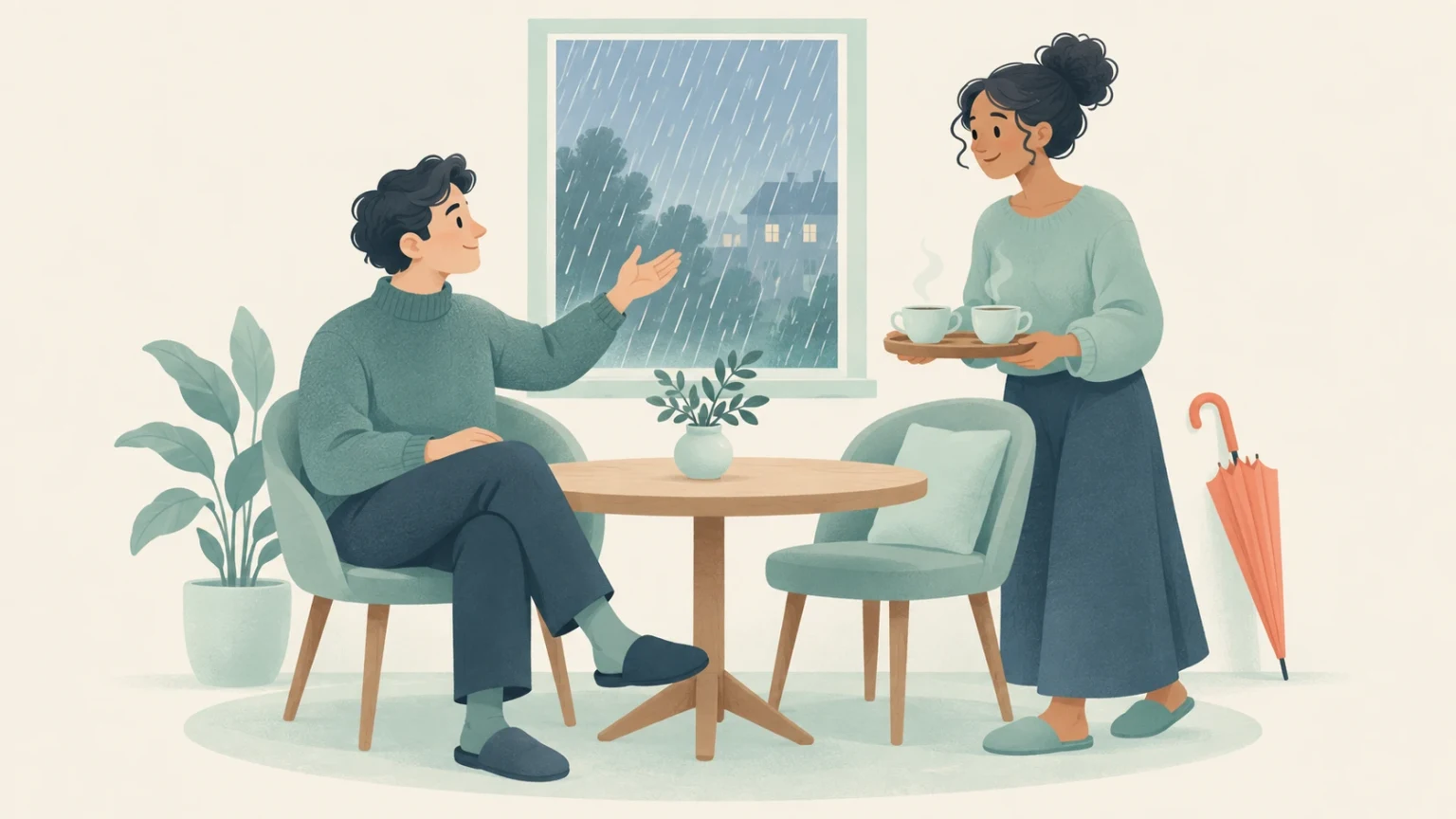
| because | Introduces a reason | I stayed because it was raining. |
| so | Introduces a result | It was raining, so I stayed home. |
| or | Offers alternatives or choices | We can walk or take a bus. |
| when | Shows the time something happens | Text me when you arrive. |
Stage 1 of 5
Understand
What it means, when to use it, and mistakes to avoid.
Watch & learn
Choose and, but, because, or so
Choose a linking word that shows addition, contrast, a reason, or a result. Hear these links in everyday messages and use them in complete sentences.
Line 1 of 8 · Bella
to the . we choose and, but,
Say this line out loud, then continue.
The video could not continue. Try again or use the transcript below.
Your session
Learn with the video 15 min
Watch a short part, answer a question and practice what you heard. Then talk it through with the tutor.
The first part is free. Members continue to part 2 and can ask for more.
Key words in this video
Example
Memory tip
Goes with
Related forms
Not to be confused with
From this video
We couldn't load this word. Try again.
The full explanation
And adds information. But marks a contrast. Because introduces a reason. So introduces a result. The facts may stay the same, but your linking word tells the listener how to understand their relationship.
I brought bread and cheese.
Why it works: And joins two things in a list.
3 more examples
-
The kitchen is small, but six people can eat there.
But marks a contrast between the size and the space available.
-
We moved the lunch inside because the chairs were wet.
Because introduces the reason for moving.
-
The soup was hot, so I waited before eating.
So introduces the result of the soup being hot.
Read the full guide
Use and to add information
You are planning lunch with people in your building. Use and when you add another item or action. It can join two things, such as bread and cheese, or two complete thoughts. If one person does both actions, you can often say the person only once. And adds information without directly naming a reason or contrast.
-
Nina washed the cups and put them on the table.
Why it works: Nina does both actions, so her name appears once.
Your turn
Which word simply adds a second item: We need plates ___ cups?
Answer: and
Show the answer
Answer: and
Plates and cups are two items on the same list. And joins them.
Use but when the second fact contrasts
Use but when the second fact differs from what someone might expect after the first. A person may want to join lunch and still be unable to come. But makes that difference clear. And could connect the facts too, although it would leave the listener to work out the contrast from the situation.
-
Omar wants to eat with us, but he has to work.
Why it works: His work prevents him from doing what he wants.
You can practise this again in So or such: choose the right pattern and because although so however: connect your ideas.
Your turn
Which sentence directly marks a contrast?
Answer: The bag looks small, but it holds six plates.
Show the answer
Answer: The bag looks small, but it holds six plates.
Holding six plates is presented as surprising for a small bag.
Put because before the reason
When someone asks why, because introduces your reason. Think about what made the action happen. At the shared lunch, the wet table is the reason for eating inside. You can say the action first and then explain it. After because, include someone or something and what they do or what they are like.
-
We are eating inside because the outside table is wet.
Why it works: The words after because answer why we are eating inside.
Your turn
Why did Nina buy more bread?
Answer: She bought more bread because two extra guests were coming.
Show the answer
Answer: She bought more bread because two extra guests were coming.
The extra guests explain the decision to buy more bread.
Put so before the result
So moves from a cause to its result. Start with the situation, then say what happened because of it. You can often express the same connection with because by changing the order. This is useful when repairing a message: check which event caused the other before choosing the link. Changing only the connector can change the meaning.
-
We had no clean bowls, so we washed some.
Why it works: Washing bowls is the result.
-
We washed some bowls because we had no clean ones.
Why it works: The same reason and result appear in a different order.
Your turn
Complete the message with a result: The juice was warm, ___.
Answer: so we put it in the fridge
Show the answer
Answer: so we put it in the fridge
Putting the juice in the fridge follows as a response to its being warm.
Choose one link for one reason and result
For one simple reason and result, choose because or so. Do not begin with because and then add so before the result. Both words would mark the same connection. Longer sentences can contain both when they connect different events, but begin by making each simple connection clear. Check how many events your sentence actually contains.
-
Because the lunch started late, we ate quickly.
Why it works: Because already links the reason to the result.
-
I stayed because lunch was late, so I missed my bus.
Why it works: Lunch being late explains staying; staying leads to missing the bus.
Your turn
Which sentence correctly joins one reason and one result?
Answer: The plate broke, so I got another one.
Show the answer
Answer: The plate broke, so I got another one.
So alone connects the broken plate with the action that followed.
Complete a sentence that starts with because
In a written notice or email, a sentence starting with because normally needs the main action too. Put a comma after an opening reason. When the reason follows the main action, a comma is usually unnecessary. In conversation, a short because answer is natural after a why question because the question supplies the missing information.
-
Because our kitchen is busy, please leave the cake in the hall.
Why it works: The instruction completes the opening reason.
-
Please leave the cake in the hall because our kitchen is busy.
Why it works: The reason comes last, without a comma.
Your turn
Which is a complete sentence for a written notice?
Answer: Because the floor is wet, please use the other door.
Show the answer
Answer: Because the floor is wet, please use the other door.
The instruction completes the sentence without doubling the link.
Listen between the stronger words
In everyday speech, linking words may be shorter and quieter than nearby nouns and verbs. And can sound like a quick unstressed syllable. But and because may also be unstressed. Listen once for the message, then again for the exact link. Meaning helps you predict a word, but the sound must support what you write.
-
The rice is ready, but the vegetables need more time.
Why it works: Listen between ready and the for the short contrast word.
- Nina
Can we serve lunch now?
- Omar
We can serve the salad, but the soup isn't ready.
Your turn
Which word in Omar's answer signals that only part of lunch is ready?
Answer: but
Show the answer
Answer: but
But contrasts the available salad with the soup that is not ready.
Use or for choices and when for time
Some messages need a choice or a time link instead of addition, contrast, or cause. Or offers alternatives. When tells someone at what time to act. After listening, recall two facts and say how they connect. This checks your understanding before you write. Keep each link clear; a long chain of and can hide the relationship.
-
You can bring fruit or buy some juice.
Why it works: Or offers two possible contributions.
-
Call me when you reach the building.
Why it works: When identifies the time to call.
Your turn
Which sentence asks someone to choose between two jobs?
Answer: You can wash the cups or dry the plates.
Show the answer
Answer: You can wash the cups or dry the plates.
Or presents washing cups and drying plates as alternatives.
Common mistakes
What learners often say, what to say instead, and why.
-
Not this:
The café is full, so because we will eat outside.Say: The café is full, so we will eat outside.
Do not put 'because' after 'so' for one simple reason-and-result connection.
-
Not this:
Because the bus was late.Say: Because the bus was late, I missed the meeting.
A written sentence starting with 'because' normally needs a main action.
-
Not this:
The plate broke because so I got another one.Say: The plate broke, so I got another one.
Use one linking word for one simple reason-and-result connection.
Use it naturally
How people really use “because”
Neutral Fine almost anywhere, at work or with friends.
Words it often goes with
- because II took a break because I was tired.
- because weWe walked home because we missed the bus.
- because itShe wore a coat because it was cold.
Questions about "Choose and, but, because, or so"
Can and and but both be correct between the same facts?
Sometimes. And adds the second fact without directly marking a contrast. But tells your listener to notice a difference or something unexpected. Choose the word that expresses your intended meaning, even when both sentences are grammatical.
The room is small, and it has two windows.
The room is small, but it has two windows.
Can I start a written sentence with because?
Yes. Include the main action after the reason so that the sentence is complete. Put a comma between the opening reason and the main part. Starting with because does not make a sentence incorrect.
Because my bike was dirty, I cleaned it outside.
Why do people give short answers starting with because?
A why question already identifies the action being discussed, so a speaker can answer with only the reason. In connected formal writing, normally attach that reason to a main part that can stand as a sentence.
I took a taxi because my bags were heavy.
Are because and so always wrong in the same sentence?
No. Avoid using both to mark the same simple reason-and-result link. They can appear in a longer sentence when they connect different events. Check which reason because introduces and which result follows so.
I went outside because I heard a noise, so I saw the delivery truck arrive.
Should I replace and with but if but seems clearer?
In your own writing, choose the link that best expresses your meaning. In dictation, recover the speaker's actual words. A different connector may produce a correct sentence, but it changes what you are transcribing.
I checked the drawer, and it was empty.
Before you go
Remember this
Use and to add, but to contrast, because before a reason, and so before a result. Use or for alternatives and when for time. Before finishing, identify the relationship and check that each written sentence expresses a complete thought.
Stage 2 of 5
Listen
Hear it in real sentences, from short to long, and write what you hear.
Continue with the four activities from the video: listening, reading, speaking and writing. Back to the video
0 of 4 done
Listening 1 of 4
Listening 2 of 4
Try a longer clip. Listen once, then replay the part you missed.
Listening 3 of 4
This clip is longer. Follow the instruction above the answer field.
Listening 4 of 4
Listen, then type the missing words. The rest of the text is already there.
0:00
Practice complete
You listened closely.
Your result is saved in this browser.
Keep your progress. Your practice is saved on this device only. Create a free account to keep it everywhere.
Create a free accountThat was today's free lesson. Tomorrow you get another one. Want more today? See membership.
Create a free SubLearn account to keep this progress across devices.
Save my progressStage 3 of 5
Speak
Say it with the speaker, then use it in your own answer.
Shadow
Say it along with the speaker
Play the line slowly, then speak at the same time as the speaker. Copy the rhythm, not just the words.
Your turn
Say it your way
Speak for 30 to 60 seconds from memory about learning to swim at a pool. Say why you want to learn, what is difficult, and what you will do next. You can invent the details.
Use: because but so
Take ten seconds to think, then answer out loud without looking at the lesson. Speak for the time shown in the task above. Nothing is sent unless you ask for feedback.
0:00
Hear how someone else might say it
I want to learn to swim because I love the water. My sister swims every week, but I can't swim very well yet. Yesterday, I went to the pool for my first lesson. The teacher was friendly and showed me how to move my arms. I was a little afraid, so I stayed near the side. Next week, I will have another lesson. I want to practice with my sister on Saturday. After swimming, we can have lunch together.
Try once more and answer this: Who do you want to practice with?
Stage 4 of 5
Write
Use what you've learned to write about your day or week, then write a message.
Write
Put it in your own words
- I used “because”.
- It is about my life, not the lesson’s example.
- I read it once aloud to check it sounds right.
Write your own response
Choose a situation and write 30–50 words of your own. In this activity, you decide what to say rather than copy the words in a recording.
Check your own writing
Read one possible response
Use these checks to revise your message. Grammar and meaning are not automatically graded. Each task keeps its own draft in this browser tab.

You finished the free part of this lesson
- Understand
- Listen
- Speak
- Write
- CheckPart of membership
Worth another look
With a free account, the lessons you finish come back for review to help you remember them.Create a free account
Stage 5 of 5 · Part of membership
Check
New clips without hints.
Listening tests are included with membership. Try the free dictation first, then decide whether to continue.
Listening 1 of 2 Part of membership
Listening 2 of 2 Part of membership
Follow MicroEnglish
Find lesson updates, short videos and quick quizzes. Pick the app you already use.
Questions & comments
Ask about this lesson, share an example, or help another learner.
Example
Memory tip
Goes with
Related forms
Not to be confused with
In this lesson
This word isn't in our dictionary. Check the spelling, or try another form of the word.
We couldn't load this word. Try again.
