Micro-listening
Whose bag is it? Describing people and their belongings
Can I use whose when I am describing an object?
Whose connects a person or thing to something that belongs to it or is associated with it. In 'The cook whose apron is green needs a spoon,' the apron helps us identify the cook.
Key points
- Find the person or thing being described, then listen for whose and the connected noun.
- Keep the clause beside its noun, avoid extra possessive words, and check whether a written who's really means who is or who has.
- Place the whose clause directly after the person or thing it describes.
This lesson has 5 stages. You can stop at any time and continue later.

Stage 1 of 5
Understand
What it means, when to use it, and mistakes to avoid.
Examples
The woman whose soup we tasted runs the evening class.
Why it works: Whose soup connects the woman with the food she made.
2 more examples
-
Please bring the container whose lid is yellow.
The lid identifies which container to bring.
-
The guests whose coats got wet waited near the heater.
Whose stays the same with a plural owner.
Read the full guide
Identify someone through a belonging
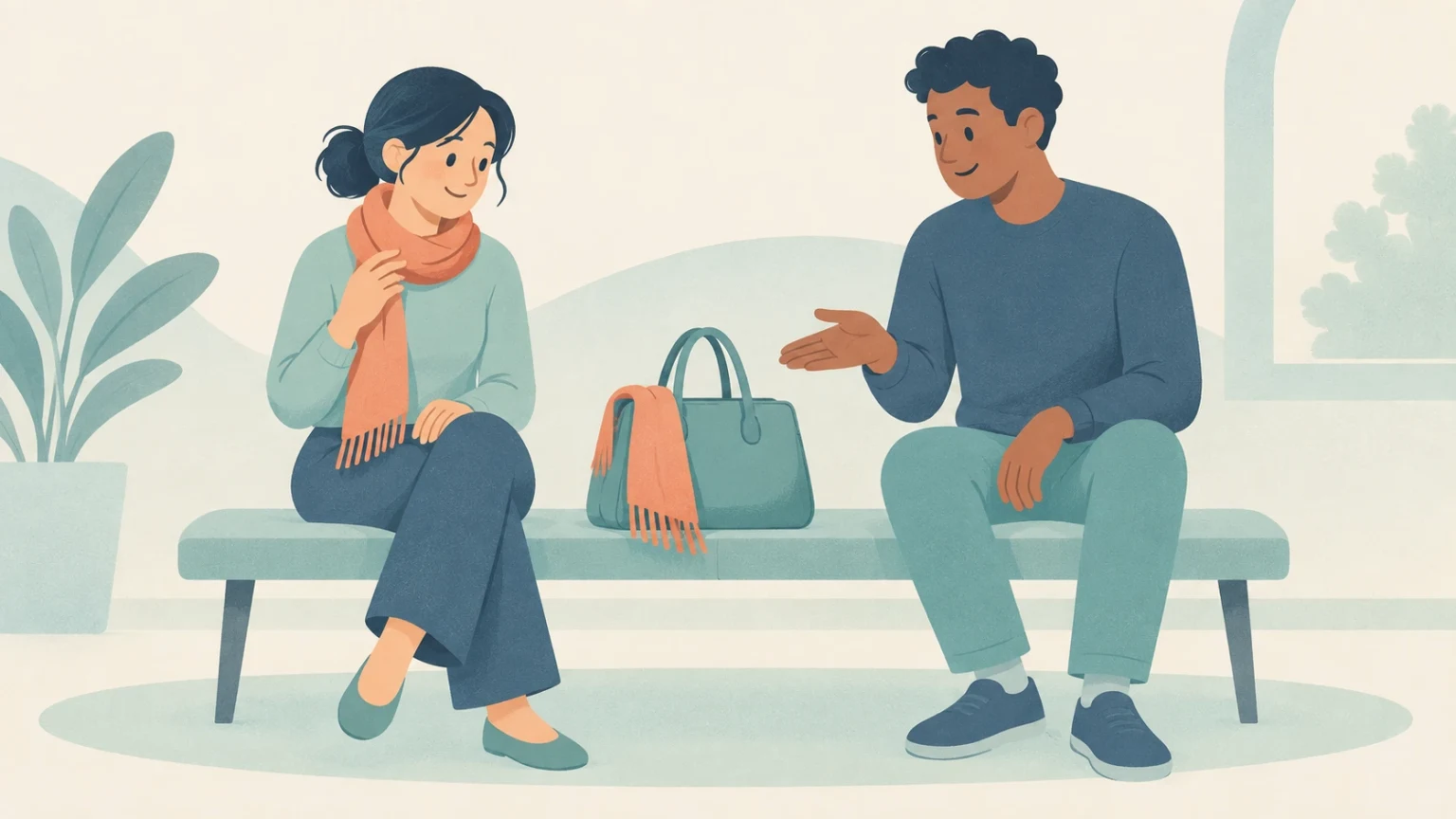
Imagine that you need to return a scarf during a cooking class. You do not know the owner's name, but you remember her silver bag. A whose clause lets you connect the woman with that bag. The clause answers 'Which woman?' by describing something connected to her. This is useful when names are unknown or several people fit a general description.
-
Give the scarf to the woman whose bag is silver.
Why it works: The bag helps the listener choose the right woman.
-
The man whose hands are covered in flour needs a towel.
Why it works: Whose also connects people with parts of their bodies.
Your turn
In 'The woman whose bag is silver is leaving,' what is silver?
Answer: The woman's bag
Show the answer
Answer: The woman's bag
The noun after whose is bag, and the clause says that the bag is silver.
Build a clause from two ideas
Start with two short ideas: a participant needs help, and her cake is burning. Replace her with whose and put the cake information after participant. Whose already does the job of her, so you do not need both words. A describing word can come between whose and the noun: whose small cake. Keep the whole description together when you build your sentence.
-
The participant whose cake is burning needs help.
Why it works: Whose replaces her and joins the information.
-
The participant whose small cake is ready can turn off the oven.
Why it works: Small describes cake inside the phrase whose small cake.
You can practise this again in Describing lost property and Grow apart.
Your turn
Which sentence joins the ideas correctly?
Answer: The cook whose bread is ready can leave.
Show the answer
Answer: The cook whose bread is ready can leave.
Whose shows the connection to bread and replaces a possessive word such as her.
Keep the description beside its noun
Put the whose clause directly after the noun you want to describe. If another person appears between that noun and whose, the listener may connect the belonging to the wrong person. Long descriptions can also hide the main message. First build a clear short sentence, then add only the detail your listener needs to identify the person or understand the situation.
-
I called the teacher whose keys were on the counter.
Why it works: The clause sits beside teacher, the person connected with the keys.
-
The teacher whose keys were missing asked the manager for help.
Why it works: The placement makes it clear that the teacher's keys were missing.
Your turn
Which sentence clearly says that the teacher's phone rang?
Answer: The teacher whose phone rang thanked the assistant.
Show the answer
Answer: The teacher whose phone rang thanked the assistant.
The whose clause immediately follows teacher, so it describes the teacher's phone.
Choose between who and whose
Use who when the person performs an action in the clause: the cook who made lunch. Use whose when you introduce something connected to that person: the cook whose lunch we enjoyed. Notice that we performs the action in the second description. The cook is connected to lunch. After whose and its noun, you may therefore hear another subject before the verb.
-
The friend who brought dessert is washing the plates.
Why it works: The friend performed the action of bringing dessert.
-
The friend whose dessert we shared is washing the plates.
Why it works: We shared the dessert; whose connects it to the friend.
Your turn
Complete the sentence: 'The neighbour ___ recipe I tried is coming tonight.'
Answer: whose
Show the answer
Answer: whose
Recipe is connected to the neighbour, while I is the subject of tried.
Describe connections, things and groups
Whose can express a connection without actual ownership. A learner's class, a passenger's train and a worker's shift are useful examples. It can also introduce part of an object, such as a cupboard's door. The word whose never changes for plural owners. If the noun after whose is the subject of the clause, choose the verb to match that noun.
-
The cupboard whose door is broken holds the cleaning cloths.
Why it works: Whose connects an object with one of its parts.
-
The cooks whose dishes are ready can take a break.
Why it works: Whose does not change; plural dishes takes are.
Your turn
Which sentence has the correct verb?
Answer: The chef whose knives are missing is worried.
Show the answer
Answer: The chef whose knives are missing is worried.
Knives is the plural subject inside the clause, so it takes are.
Hear whose and recover the message
Whose and who's normally sound the same. To choose the spelling in dictation, follow the sentence structure and meaning. Whose blue bowl introduces a connected object; who's bringing bowls means who is bringing bowls. Listen beyond the first word. On a second listen, recover small words such as the and is. For recall practice, pause afterward and say who owns or is connected to what.
-
The helper whose bowl broke needs another one.
Why it works: Bowl is connected to the helper, so write whose.
-
The helper who's carrying bowls needs some space.
Why it works: Who's expands to who is before carrying.
Your turn
You hear 'The guest ... coat is wet needs a chair.' Which spelling fits?
Answer: whose
Show the answer
Answer: whose
Coat belongs to the guest; replacing the missing word with who is would not work.
Use whose in practical writing
In a message, use a whose clause when the detail helps your reader identify someone. Essential identifying information usually has no commas. When the person is already identified, a whose clause can add extra information between commas. Learn the clear identifying pattern first. Before sending your message, check the connection, remove any repeated possessive word, and make sure the reader can still find the main action.
-
Please contact the volunteer whose number is on the notice.
Why it works: The clause identifies the volunteer, so there are no commas.
-
Rosa, whose number is on the notice, will open the kitchen.
Why it works: The name identifies Rosa; commas mark the added information.
Your turn
Which message uses a clause to identify the person to contact?
Answer: Please contact the helper whose name is on the kitchen door.
Show the answer
Answer: Please contact the helper whose name is on the kitchen door.
The name on the door gives the reader a specific way to identify the helper.
Use it naturally
How people really use “whose”
Neutral Fine almost anywhere, at work or with friends.
Words it often goes with
- whose bagThe boy whose bag is on the bench has joined our team.
- whose namePlease call the player whose name is first on the list.
- whose brotherI invited a friend whose brother is a soccer coach.
- whose lidWe need a box whose lid closes properly.
Questions about "Whose bag is it? Describing people and their belongings"
Can I use whose when I am describing an object?
Yes. Whose can connect an object to one of its parts or features. This is useful when the feature identifies the object. You can also choose a simpler with phrase when it communicates the same information clearly.
Choose the box whose handle is stronger.
Choose the box with the stronger handle.
How can I tell whose and who's apart when I listen?
They normally sound the same, so use the words around them. Whose introduces a connected noun or noun phrase. Who's means who is or who has. Try expanding the contraction and check whether the whole sentence still makes sense.
The neighbour whose parcel arrived is away.
The neighbour who's just arrived is carrying a parcel.
Is whose used in the same way in questions and descriptions?
Both uses express a connection, but they do different jobs. A question such as 'Whose gloves are these?' asks you to identify the owner. A relative clause gives information about a noun that has already been mentioned in the sentence.
Whose gloves are these?
The gardener whose gloves I found is outside.
Why does a sentence sometimes have I or we after whose and a noun?
The connected noun can receive an action rather than perform it. In 'whose sandwich I ate,' I performs the action and sandwich receives it. The whole clause still describes the person connected with the sandwich.
The colleague whose sandwich I ate accepted my apology.
The baker whose cakes we ordered called this morning.
Before you go
Remember this
Find the person or thing being described, then listen for whose and the connected noun. Keep the clause beside its noun, avoid extra possessive words, and check whether a written who's really means who is or who has.
Stage 2 of 5
Listen
Hear it in real sentences, from short to long, and write what you hear.
0 of 4 done
Listening 1 of 4
Listening 2 of 4
Try a longer clip. Listen once, then replay the part you missed.
Listening 3 of 4
This clip is longer. Follow the instruction above the answer field.
Listening 4 of 4
Listen, then type the missing words. The rest of the text is already there.
0:00
Practice complete
You listened closely.
Your result is saved in this browser.
Keep your progress. Your practice is saved on this device only. Create a free account to keep it everywhere.
Create a free accountThat was today's free lesson. Tomorrow you get another one. Want more today? See membership.
Create a free SubLearn account to keep this progress across devices.
Save my progressStage 3 of 5
Speak
Say it with the speaker, then use it in your own answer.
Shadow
Say it along with the speaker
Play the line slowly, then speak at the same time as the speaker. Copy the rhythm, not just the words.
Your turn
Say it your way
Speak for 30 to 60 seconds from memory. You are starting a neighborhood soccer team at the park. Describe two people you want to invite using their family connections or belongings. Explain how each person could help the team.
Use: whose
Take ten seconds to think, then answer out loud without looking at the lesson. Speak for the time shown in the task above. Nothing is sent unless you ask for feedback.
0:00
Hear how someone else might say it
I want to invite my neighbor Sam, whose brother plays soccer every weekend. Sam knows the rules well, and he could help us plan our practice. He is friendly, too, so I think everyone would enjoy playing with him. I also want to invite Maya, whose house is next to the park. She has a big garage where we could keep our balls and other things. She likes meeting people and could ask some friends to join. With their help, we could start playing next Saturday.
Try once more and answer this: Which person will you invite first?
Stage 4 of 5
Write
Use what you've learned to write about your day or week, then write a message.
Write
Put it in your own words
- I used “whose”.
- It is about my life, not the lesson’s example.
- I read it once aloud to check it sounds right.
Write your own response
Choose a situation and write 30–50 words of your own. In this activity, you decide what to say rather than copy the words in a recording.
Check your own writing
Read one possible response
Use these checks to revise your message. Grammar and meaning are not automatically graded. Each task keeps its own draft in this browser tab.

You finished the free part of this lesson
- Understand
- Listen
- Speak
- Write
- CheckPart of membership
Worth another look
With a free account, the lessons you finish come back for review to help you remember them.Create a free account
Stage 5 of 5 · Part of membership
Check
New clips without hints.
Listening tests are included with membership. Try the free dictation first, then decide whether to continue.
Listening 1 of 2 Part of membership
Listening 2 of 2 Part of membership
Follow MicroEnglish
Find lesson updates, short videos and quick quizzes. Pick the app you already use.
Questions & comments
Ask about this lesson, share an example, or help another learner.
Example
Memory tip
Goes with
Related forms
Not to be confused with
In this lesson
This word isn't in our dictionary. Check the spelling, or try another form of the word.
We couldn't load this word. Try again.