Hear the word boundaries
Listen once without typing. On the second play, decide where one word ends and the next begins. Replay the whole phrase to check.
Showing 199–216 of 454 lessons
-

Gerunds: When to Use -ing
A gerund names an activity rather than showing an action in progress. Because it acts like a noun, a gerund can serve as a subject, follow the linking verb be, or act as the object of a verb or preposition. The spelling ends in -ing, but its sentence job decides whether the word is a gerund.
-

Have or Has: Choosing the Right Verb Form
Have and has describe possession, relationships, and everyday activities. The verb form depends on who or what performs the action.
-

Myself and John: How to Choose
A subject names who or what performs the action or who the sentence is about. An object names the person affected by an action or comes after a preposition such as to, for, with, or between. A reflexive pronoun like myself or ourselves turns the action back onto the subject of the exact same clause.
-

Then or Than: Choose the Right Word
Use then to show sequence, a specific point in time, or a consequence following a condition. Use than to introduce the second element in a comparison of size, price, speed, quality, or amount.
-

Whenever or When Ever: One Word or Two?
Whenever functions as a subordinating conjunction that connects a time condition to a main clause. It carries two related meanings: every time that, which describes routines or repeated occurrences, and at any time that, which grants flexible permission for a single action. In contrast, when ever divides the sentence into the interrogative adverb when and the adverbial intensifier ever. In that rare structure, ever does not indicate a condition or flexible schedule; instead, it strengthens the speaker's tone of astonishment, impatience, or curiosity.
-

Discuss or discuss about: Which is correct?
To discuss means to consider, examine, or exchange ideas about a subject with another person. It does not require an argument or total agreement; it simply names the act of talking through a topic. Because the idea of considering a subject is already built into the verb discuss, the subject follows the verb directly.
-
Membership
Open every lesson free for 7 days
- 454 lessons with dictation and listening tests
- Three accents: British, American and Australian
- New lessons every day, and your progress is saved
No card needed. Then from $7.50 a month if you want to keep going.
Start free trial -

Where, Were, or Wear: Choosing the Right Word by Meaning
Where identifies or asks for a place. Were serves as the past form of be with you, we, and they. Wear describes having clothes, shoes, or accessories on your body.
-

Interjections in Daily English: Choosing, Punctuating, and Hearing Everyday Reactions
An interjection is a sound, single word, or brief phrase that expresses an immediate reaction or emotion. It does not connect grammatically to subject-verb structures, and its spelling remains identical regardless of tense, person, or quantity.
-

Doubling Final Consonants Before -ing and -ed
Doubling a final consonant is a spelling pattern rather than a change in meaning. Adding -ing creates continuous forms or nouns, while adding -ed creates regular past forms. In English spelling, doubling the final consonant indicates that the preceding vowel sound remains short, preventing readers from misreading words with a long vowel sound.
-

On Friday or in Friday: which is correct?
On connects an event to a specific day or calendar date. It answers the question about which day something happens. In refers to an enclosed space, a document, or a longer stretch of time like a month or a season. When Friday names the day an action takes place, on is the only standard choice. Saying in Friday does not match English grammar.
-

Whose bag is it? Describing people and their belongings
Whose connects a person or thing to something that belongs to it or is associated with it. In 'The cook whose apron is green needs a spoon,' the apron helps us identify the cook.
-

Who Said What? Passing On a Message
Quoted speech repeats someone's exact words. Reported speech puts their message into your own sentence. Both can describe the same conversation.
-

One More Thing: Adding Information Clearly
Addition linkers tell your listener or reader that you are building on the same topic. They show that the next thought belongs alongside the previous one, without switching direction, giving a cause, or showing an unexpected result.
-
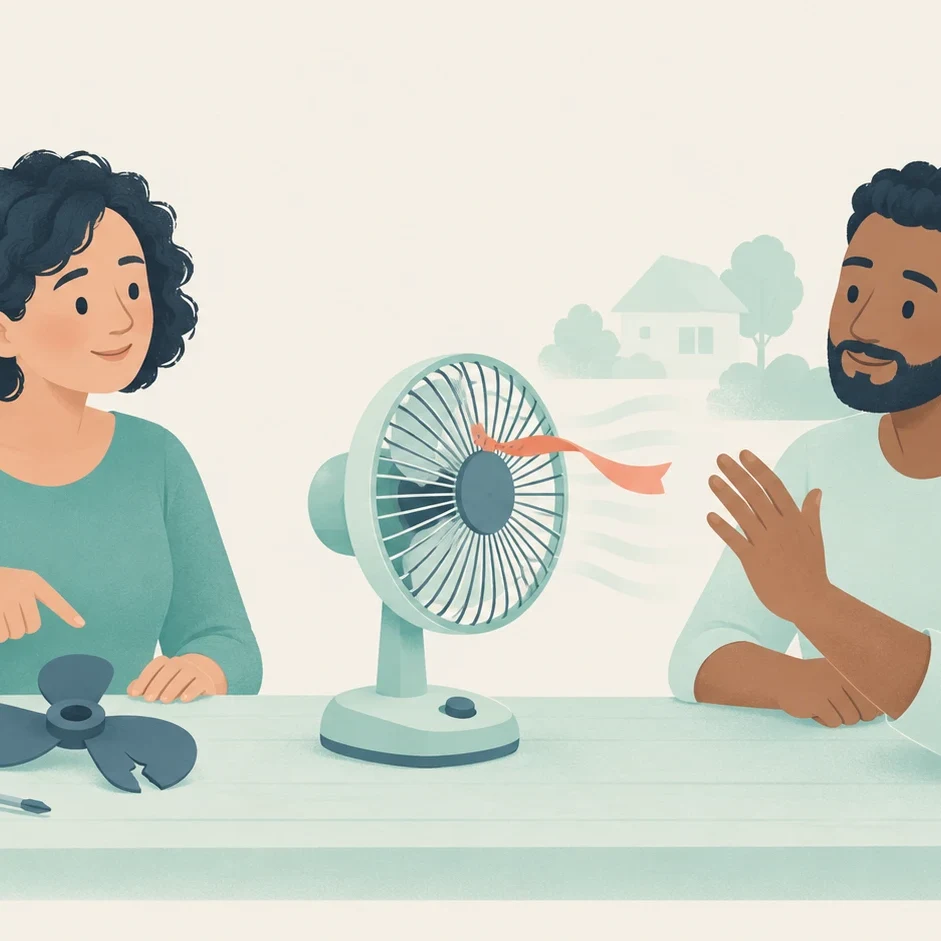
Took or have taken? Choose the form for your message
The past simple places an action in a finished past situation: I took the radio apart yesterday. The present perfect connects a past action with now: I have taken the radio apart, so we can check it.
-

Choose I, me, my, or mine when sharing plans
A pronoun can replace a name or a thing already understood. Subject forms such as she name who does an action. Object forms such as her name who receives it. Ownership forms show who something belongs to.
-

Parallel structure: make your lists easy to follow
Parallel structure means giving connected ideas a similar grammatical shape. In everyday terms, a list of things should sound like a list of things, and a list of actions should follow one action pattern.
-

Choose she and I or her and me
She and I names two people as the subject: the people doing an action or being described. Her and me names them as the object of a verb or after words such as to, with, and for. And joins the people; it does not decide which pronouns you need.
-

Present perfect progressive: how to use have been working
The present perfect progressive emphasizes the continuous nature, duration, or recent completion of an action that affects the present moment. Unlike simple forms that focus on finished products or counted quantities, this form focuses on the work itself and the time spent doing it.
Not ready for a trial? Get a free lesson every day
One short dictation in your inbox each day for 7 days. Practise where you are, no account needed.
Can’t find the phrase or situation you need?
Lesson requests come with membership.
See membership