イディオム
Take it out on someone
How is 'take it out on someone' different from 'take someone out'?
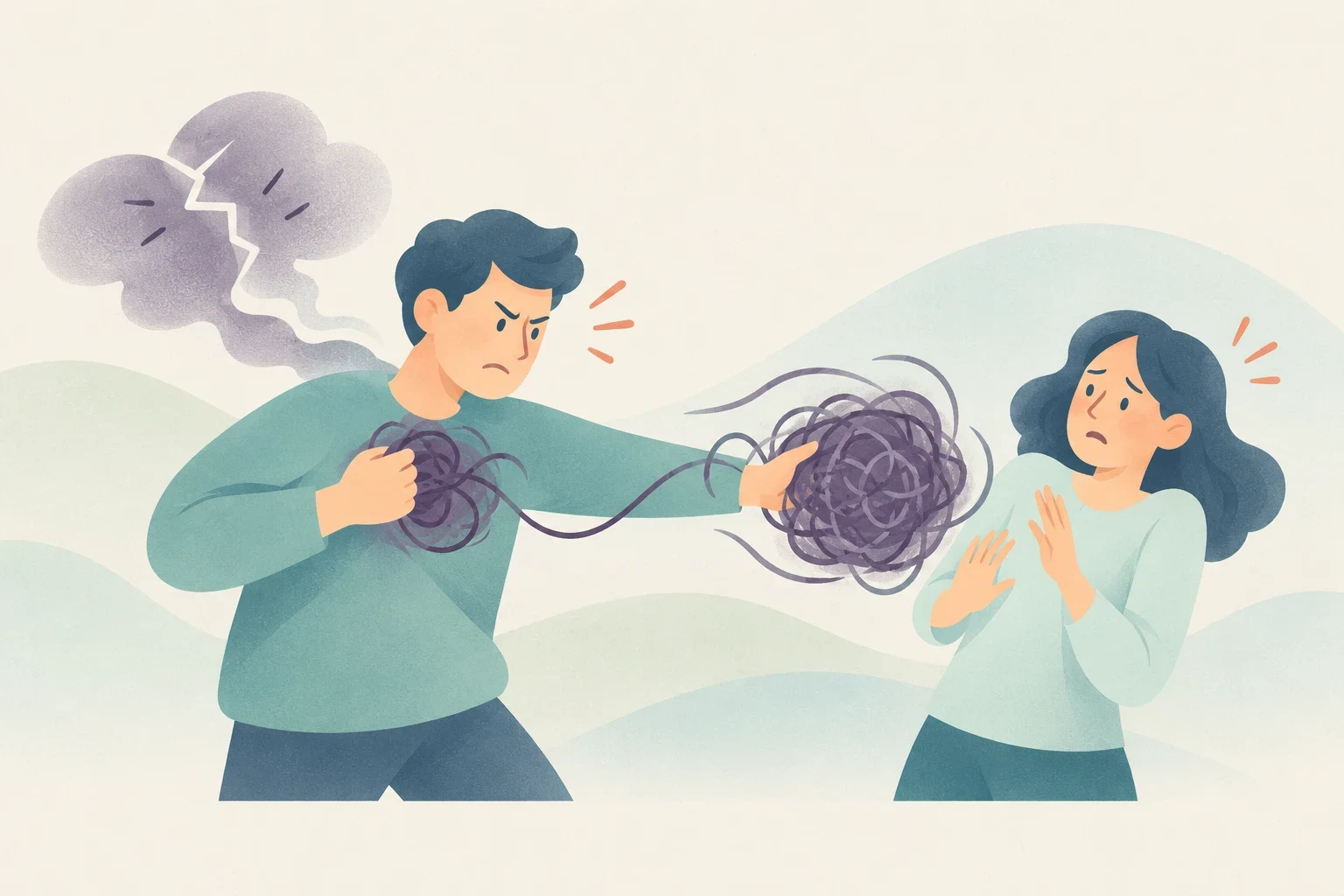
Take something out on someone means make that person suffer because of anger or upset caused by another situation, even though they are not responsible.
ポイント
- Use take it out on someone for unfairly redirected upset, put the target after on, use took for the past, and distinguish valid feelings from harmful behaviour.
- Use take it out on someone when the feeling is understood, or name it: take your anger out on someone.
- Keep the person after on and change take for tense.
このレッスンにはステージが5つあります。いつでも中断して、あとで続きから再開できます。

ステージ 1 / 5
理解
意味、使う場面、避けたい間違いを学びます。
例
Do not take your frustration out on the support team.
この表現を使う理由: The team should not become the target of frustration caused elsewhere.
ほかの例を2件見る
-
She took it out on her flatmate after receiving the bad news.
Her flatmate suffered from feelings caused by the news.
-
You can be upset, but it is unfair to take it out on someone else.
The feeling is accepted while harmful redirection is rejected.
基本から解説を読む
Deciding When Anger Is Misdirected
People often experience anger or pressure in one environment and discharge that tension onto an innocent person elsewhere. When you observe someone treating a friend, coworker, or family member poorly because of an unrelated problem, the idiom take it out on someone describes that exact behavior. Recognizing this shift helps you name the dynamic objectively without accepting unfair treatment.
-
Marcus had a terrible commute, but he should not take it out on his roommate.
この表現を使う理由: The commute caused the frustration, yet the roommate receives the unpleasant reaction.
-
When dinner arrived cold, the customer took it out on the server rather than speaking to the manager.
この表現を使う理由: The server did not cook the food, making the angry response misdirected.
自分で試す
Which situation correctly illustrates the phrase 'take it out on someone'?
答え: A driver stuck in traffic arrives home and yells at their partner over an unwashed mug.
答えを見る
答え: A driver stuck in traffic arrives home and yells at their partner over an unwashed mug.
The partner did not cause the traffic jam, so venting frustration onto them is an unfair redirection.
Arranging the Phrase Components in Correct Order
With it, use take it out on someone. When you name the emotion, you can place it before or after out: take your anger out on someone or take out your anger on someone. Keep on before the person who receives the unfair treatment.
-
Please do not take your bad mood out on the reception team.
この表現を使う理由: The noun phrase 'your bad mood' sits right between the verb 'take' and 'out on'.
-
I realize you are worried about the results, but you cannot take it out on me.
この表現を使う理由: The pronoun 'it' directly follows 'take' and precedes 'out on'.
これはTake for grantedとGet it out of your systemでも出てきます。
自分で試す
Which sentence places the emotion directly between took and out on?
答え: She took her morning frustration out on her assistant.
答えを見る
答え: She took her morning frustration out on her assistant.
The selected sentence puts her morning frustration between took and out on. Taking out an emotion on someone is also possible, but it uses a different order.
Selecting the Past and Continuous Verb Forms
The verb take is irregular, meaning you must alter the base word rather than adding an ending like ed. For completed past events, choose took; for ongoing actions, use taking with an auxiliary verb; for perfect tenses, combine taken with have or had. Misusing regular forms like taked interrupts listening comprehension and weakens your spoken message.
-
After losing the tennis match, he took his disappointment out on his coach.
この表現を使う理由: The simple past form 'took' marks an action completed immediately after the match.
-
She realized she was taking her office stress out on her children every evening.
この表現を使う理由: The past continuous form 'was taking' shows repeated behavior across an extended period.
自分で試す
Which sentence uses the correct past tense form of the idiom?
答え: He took his frustration out on the computer keyboard.
答えを見る
答え: He took his frustration out on the computer keyboard.
The standard simple past form of 'take' is 'took', never 'taked' or 'has took'.
Deciding Between General and Specific Emotion Words
While the pronoun it works when the cause is already obvious to everyone present, inserting a specific noun clarifies the exact feeling driving the reaction. Nouns like stress, anger, anxiety, or resentment fit smoothly into the object slot. Using a precise noun helps listeners understand the emotional root while keeping the focus on the inappropriate action.
-
Do not take your financial worries out on your family.
この表現を使う理由: Replacing 'it' with 'your financial worries' pinpoints the specific root of the pressure.
-
He took his personal insecurity out on new team members during reviews.
この表現を使う理由: The noun phrase 'his personal insecurity' defines the underlying motive clearly.
自分で試す
When is it preferable to replace 'it' with a specific noun like 'frustration'?
答え: Whenever you want to state clearly what emotion is causing the mistreatment.
答えを見る
答え: Whenever you want to state clearly what emotion is causing the mistreatment.
Naming the emotion explicitly gives clear context when the background cause has not been discussed.
Distinguishing Misdirection from Legitimate Feedback
Learners sometimes confuse taking anger out on someone with delivering deserved criticism or expressing honest disappointment. When a supervisor addresses an error caused directly by an employee, that exchange is direct feedback, not misdirection. The idiom applies exclusively when the recipient is blameless or when the severity of the reaction vastly exceeds any minor mistake because of external strain.
-
Giving constructive notes on a report is regular management, but shouting about unrelated delays takes it out on the writer.
この表現を使う理由: The contrast distinguishes legitimate performance feedback from unfair emotional venting.
-
If a friend forgets your birthday, expressing sadness is direct communication rather than taking it out on them.
この表現を使う理由: The emotional reaction matches the immediate event and addresses the person actually responsible.
自分で試す
In which situation is the idiom 'take it out on' NOT appropriate?
答え: A manager calmly corrects an accountant for an arithmetic error in today's balance sheet.
答えを見る
答え: A manager calmly corrects an accountant for an arithmetic error in today's balance sheet.
Direct, calm correction about an actual mistake is legitimate feedback, not misplaced anger.
Hearing Linked Consonants in Connected Speech
In conversational English, native speakers blend the words take, it, out, and on into a continuous stream of sound. The final consonant of take links into the vowel of it, while the voiceless stops in it and out often become soft taps before vowels. The sequence sounds roughly like tay-ki-dow-ton, which can make individual word boundaries difficult to isolate if you expect clear pauses.
-
Do not take it out on me.
この表現を使う理由: The consonant sounds link across word boundaries, creating a smooth, connected phrase.
-
She took it out on everyone nearby.
この表現を使う理由: The final consonant /k/ in 'took' connects smoothly into the vowel sound /ɪ/ in 'it'.
自分で試す
Why does the phrase 'take it out on' sound like a single word in fast conversation?
答え: Final consonants connect directly into the starting vowels of following words.
答えを見る
答え: Final consonants connect directly into the starting vowels of following words.
Linking consonants across word boundaries creates an unbroken chain of syllables in natural speech.
Responding Calmly When Someone Takes Frustration Out on You
When you become the target of another person's unrelated bad mood, responding with hostility usually escalates the confrontation. Using the phrase take it out on me within a neutral, firm boundary statement acknowledges their distress without accepting mistreatment. Phrasing your objection around the behavior rather than an attack on their character keeps professional and personal interactions productive.
-
I can see you are under immense pressure today, but please do not take it out on me.
この表現を使う理由: This statement validates the speaker's emotional state while establishing a clear behavioral limit.
-
Let us pause this conversation so you do not take your frustration with head office out on the crew.
この表現を使う理由: Suggesting a short break stops unfair redirection before work relationships suffer.
自分で試す
What is the primary benefit of saying 'I know you are stressed, but please do not take it out on me'?
答え: It validates their emotional reality while establishing a firm personal boundary.
答えを見る
答え: It validates their emotional reality while establishing a firm personal boundary.
The sentence recognizes real distress while clearly refusing to absorb unfair mistreatment.
Repairing Relationships After an Outburst
If you took your stress out on someone, name what you did when you apologize. Explain that the other person wasn't responsible for the problem, and take responsibility for how you treated them. The idiom can help you explain the mistake without using your stress as an excuse.
-
I am sorry for snapping earlier; I had a painful headache and took it out on you.
この表現を使う理由: The speaker takes accountability for the outburst and clarifies that the listener was not at fault.
-
I should have managed my workload better instead of taking my anxiety out on the team.
この表現を使う理由: This apology identifies personal responsibility and acknowledges the unfair impact on coworkers.
自分で試す
Which apology best repairs a working relationship after an emotional outburst?
答え: I apologize for my sharp tone earlier; I was anxious about deadlines and took it out on you.
答えを見る
答え: I apologize for my sharp tone earlier; I was anxious about deadlines and took it out on you.
This option accepts personal ownership and acknowledges the misdirected stress without blaming the coworker.
自然な使い方
「take it out on someone」の実際の使われ方
ニュートラル 職場でも友人との間でも、ほとんどの場面で使えます。
よく一緒に使われる言葉
- take your frustration out onPlease don't take your frustration out on the cashier.
- take your anger out onYou shouldn't take your anger out on the other players.
- take it out on someone elseWhen a plan fails, it is unfair to take it out on someone else.
他の言い方
- 「Do not direct your unrelated anger toward me.」の代わりに「Don't take it out on me.」 This is a direct, everyday way to set a boundary.
「Take it out on someone」に関する質問
How is 'take it out on someone' different from 'take someone out'?
The two expressions describe completely different situations. 'Take someone out' means to invite someone to a social activity like dinner or a movie, usually paying for them. In contrast, 'take it out on someone' means treating someone unkindly because of upset caused by another problem. The presence of the pronoun 'it' and the preposition 'on' completely transforms the meaning.
My uncle offered to take me out for lunch on my birthday.
Please do not take your frustration out on the restaurant server.
Can I use 'take it out on someone' in the passive voice?
An active sentence is often clearer: 'He hates it when people take their anger out on him'. The passive needs anger or frustration as its subject, as in 'Her anger was taken out on him'. Do not use 'He hates being taken it out on': it combines the object it with an incompatible passive pattern. You can also use 'targeted' or 'blamed unfairly' if that expresses the intended meaning.
She dislikes it when managers take their bad moods out on the team.
Nobody enjoys being the person on whom others vent their frustration.
Can I put the emotion word after 'out' instead of before it?
Yes. A noun phrase such as your anger can come before or after out. Both take your anger out on someone and take out your anger on someone are valid. With the pronoun it, keep it before out: take it out on someone.
He took his resentment out on his closest friends.
Try not to take your exhaustion out on the children tonight.
Is 'take it out on someone' always negative, or can it be positive?
The phrase is virtually always negative because it refers to unfair, misdirected mistreatment. However, you can use 'take it out on' with inanimate physical activities in a constructive way, such as exercising. For example, taking your stress out on a punching bag or running track is a healthy emotional outlet.
Whenever work becomes overwhelming, she takes her frustration out on the running track.
Going to the gym allows him to take his daily tension out on the weights.
最後に確認
これを覚えましょう
Use take it out on someone for unfairly redirected upset, put the target after on, use took for the past, and distinguish valid feelings from harmful behaviour.
ステージ 2 / 5
聞く
実際の文の中で聞いて、聞こえた通りに書き取ります。文は短いものから順に長くなります。
0 / 4完了
リスニング 1 / 4
聞いて、聞こえた通りに入力してください。必要なだけ再生できます。
0:00
- She took it out on her flatmate after receiving the bad news.
- You can be upset, but it is unfair to take it out on someone else.
リスニング 2 / 4
聞いて、聞こえた通りに入力してください。必要なだけ再生できます。
0:00
- She took it out on her flatmate after receiving the bad news.
- You can be upset, but it is unfair to take it out on someone else.
もう少し長いクリップに挑戦しましょう。一度聞いて、聞き逃した部分を再生してください。
リスニング 3 / 4
聞いて、聞こえた通りに入力してください。必要なだけ再生できます。
0:00
- She took it out on her flatmate after receiving the bad news.
- You can be upset, but it is unfair to take it out on someone else.
このクリップは長めです。解答欄の上の指示に従ってください。
リスニング 4 / 4
音声を聞いて、空欄に入る単語を入力してください。それ以外の部分は表示されています。
0:00
- She took it out on her flatmate after receiving the bad news.
- You can be upset, but it is unfair to take it out on someone else.
練習完了
練習が終わりました。
結果はこのブラウザに保存されました。
進捗を保存. 練習の進捗は、このデバイスにのみ保存されます。無料アカウントを作成すると、どこからでもアクセスできます。
無料アカウントを作成本日の無料レッスンは終了しました。明日、別のレッスンが無料で受けられます。 本日さらに利用したいですか?メンバーシップをご覧ください。
この進捗を複数のデバイスで保持するには、無料のSubLearnアカウントを作成してください。
進捗を保存するステージ 3 / 5
話す
音声に合わせて言ってから、自分の答えの中で使います。
シャドーイング
お手本に合わせて声に出す
音声をゆっくり再生し、お手本に合わせて声に出してみましょう。単語の発音とリズムをまねしてください。
あなたの番です
自分の言葉で話す
Speak for 30 to 60 seconds from memory. At a community basketball game, a player misses a shot and starts blaming a volunteer who keeps score. You are the team captain. Explain how you would step in and help the player repair the situation.
使う表現: take it out on take your frustration out on
まず10秒考えてから、レッスンを見ずに声に出して答えましょう。話す長さは上の課題を確認してください。フィードバックをリクエストするまで、録音は送信されません。
0:00
他の人がどう言うかを聞く
First, I would ask the player to step away from the court for a moment. I would say, "I know you're disappointed about that shot, but don't take it out on the volunteer. She's only keeping score. It's unfair to take your frustration out on someone who didn't cause the problem." Then I'd give him a minute to calm down. Before he returned to the game, I'd ask him to apologize to her. A simple apology would help, but he would also need to treat her respectfully for the rest of the game.
もう一度挑戦して、これに答えてください。 What would you say if the player kept blaming the volunteer?
ステージ 4 / 5
書く
自分の言葉で書いてみる
AIフィードバック・間違いがある場合があります · メンバーシップ限定 メンバーシップを見る
自分の文章を確認する
回答例を読む
下書きをこの端末に保存しました。
チェック項目に沿って、書いた文章を見直しましょう。文法や意味の自動採点は行いません。課題ごとの下書きは、このブラウザのタブに保存されます。

このレッスンの無料部分を完了しました
- 理解
- 聞く
- 話す
- 書く
- 確認メンバーシップ限定
見直すとよいところ
無料アカウントがあれば、完了したレッスンが復習の時期にもう一度表示されます。内容を覚えておくのに役立ちます。無料アカウントを作成
ほかにも試せること
ステージ 5 / 5 · メンバーシップ限定
確認
ヒントなしの新しいクリップがあります。
リスニングテストはメンバーシップに含まれています。まず無料のディクテーションを試してから、続けるかどうかを決めてください。
リスニング 1 / 2 メンバーシップ限定
リスニング 2 / 2 メンバーシップ限定
MicroEnglishをフォロー
レッスンや短い動画、クイズなどの情報を発信しています。お使いのアプリを選んでください。
質問とコメント
このレッスンについて質問したり、例を共有したり、他の学習者を助けたりできます。
例
覚え方のヒント
一緒に使う
関連する形
混同しないように
このレッスンでの例
この単語は、このサイトの辞書にはありません。スペルを確認するか、別の形で調べてみてください。
この単語を読み込めませんでした。もう一度お試しください。