Idiom
Lose your head
Does 'lose your head' mean panic or get angry?
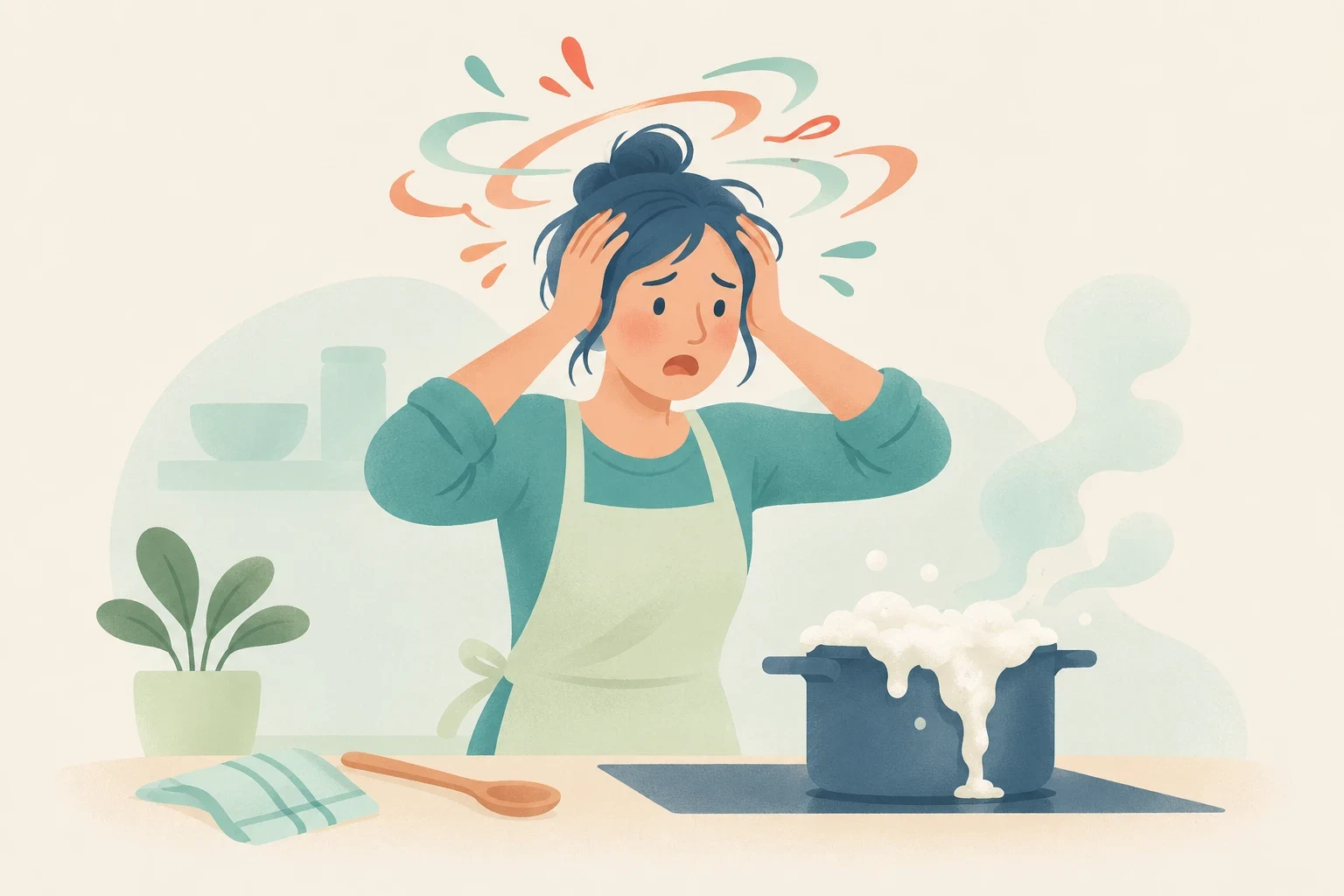
To lose your head means to lose emotional control and stop thinking or acting calmly due to intense panic, anger, or excitement.
Key points
- Use lose your head to describe an unthinking emotional reaction.
- Always pair the verb with the matching possessive word, select the proper verb form for your tense, and choose a gentler alternative when offering supportive advice.
- Match the possessive word to the person who experiences the feeling: my head, your head, her head, his head, or their heads.
This lesson has 5 stages. You can stop at any time and continue later.

Stage 1 of 5
Understand
What it means, when to use it, and mistakes to avoid.
Examples
When the restaurant basement flooded during the evening rush, Marcus lost his head and dropped a tray of glassware.
Why it works: Marcus panicked and acted without thinking calmly because of sudden stress.
2 more examples
-
Please take three deep breaths and try not to lose your head over this scheduling mix-up.
The base form lose is used after try not to as an encouraging piece of advice.
-
Both drivers apologized after realizing they had lost their heads over an accidental scratch.
The plural subject both drivers requires the plural possessive their and the plural noun heads.
Read the full guide
Use 'lose your head' when emotion stops clear thinking
Use the idiom lose your head when a sudden surge of strong emotion stops someone from thinking clearly and leads to uncontrolled behavior. The emotion may be intense fear, sudden anger, or overwhelming excitement. This phrase is figurative; nobody's physical head is actually detached. Ordinary worry or quiet irritation is not enough to justify this idiom. A person only loses their head when their emotional reaction takes over and causes them to say or do things they would avoid in a calm state.
-
When the kitchen pipe burst and flooded the hallway, Kevin lost his head and threw his phone against the wall.
Why it works: Kevin reacted out of panic instead of shutting off the main water valve.
-
She felt nervous before her driving test, but she never lost her head.
Why it works: Nervousness alone does not mean losing control; she kept thinking clearly.
Your turn
Which situation correctly illustrates losing your head?
Answer: Shouting wildly at a ticketing agent and slamming your phone because the gate changed.
Show the answer
Answer: Shouting wildly at a ticketing agent and slamming your phone because the gate changed.
Losing your head involves an outward loss of control and irrational behavior caused by intense emotion.
Recognise losing control in a missing-ticket conversation
Outside a concert arena, Maya and Liam are waiting in a packed queue as the opening band starts playing. When Liam tries to open his digital ticket, the mobile app crashes and the screen turns completely blank. Stressed by the crowd and the fear of missing the show, Liam immediately loses control and turns on his friend.
Liam: The ticket app is frozen! Did you delete the confirmation email when you borrowed my phone? Maya: No, I didn't touch your email. Take a breath and let's check your downloads. Liam: We are going to miss the entire concert because of you! Why can't you ever be careful? Maya: Stop shouting and look at your files. Here is the PDF you downloaded yesterday. Liam: Oh... it was right there. I am so sorry, Maya. I completely lost my head when the screen went dark.
-
Liam shouted, 'We are going to miss the entire concert because of you!' before checking his files.
Why it works: Liam let sudden panic overpower rational thinking and blamed his friend unfairly.
-
Liam admitted, 'I completely lost my head when the screen went dark.'
Why it works: Liam uses 'lost my head' to apologize for his unreasonable, emotional reaction.
This also comes up in A mean streak and Keep a low profile.
Your turn
In the dialogue, why does Liam say 'I completely lost my head'?
Answer: He panicked and shouted at Maya before checking his saved files.
Show the answer
Answer: He panicked and shouted at Maya before checking his saved files.
Liam acknowledges that panic made him lose composure and speak angrily without checking his documents first.
Match the person: my head, her head, our heads
The idiom always requires a possessive word between the verb and head. You must never say lose the head or lose a head in standard English. Instead, choose the possessive pronoun that matches the person losing control: I lose my head, you lose your head, he loses his head, and she loses her head. When speaking about two or more people, pluralize both the pronoun and the noun: we lose our heads and they lose their heads. When singular they refers to one person, use their head.
-
During the power cut, my sisters both lost their heads and dropped the flashlights.
Why it works: Because sisters is plural, both the possessive their and the noun heads are plural.
-
If a traveler feels overwhelmed, remind them not to lose their head.
Why it works: Singular they takes the singular noun head.
Your turn
Which sentence correctly matches the plural subject to the idiom?
Answer: Both players lost their heads after the referee blew the whistle.
Show the answer
Answer: Both players lost their heads after the referee blew the whistle.
Plural subjects require the plural possessive their and the plural noun heads.
Choose lose, lost or losing, and use lose after didn't
To use the phrase accurately across different time frames, adjust the verb lose while keeping head unchanged. The present simple uses lose or loses, the continuous uses losing, and the past simple uses lost. In past affirmative statements, use the model past form: 'I lost my head.' In negative statements and questions with did, English requires the base form lose: say 'I didn't lose my head' and 'Did you lose your head?' The base form lose is also required in negative imperatives such as 'Don't lose your head.' Because lost also serves as the past participle, never invent non-standard forms like losted. Pay careful attention to spelling: the verb is lose with one o, pronounced with a voiced /z/ sound. Loose with two o's means not tight and ends with an unvoiced /s/ sound. Similarly, the continuous participle is always spelled losing with a single o; writing loosing is an error.
-
I lost my head when the airline misplaced my luggage, but my brother stayed calm.
Why it works: The affirmative past statement uses the past simple form lost alongside the matching possessive my.
-
I didn't lose my head during the crisis, and my manager asked, 'Did you lose your head at any point?'
Why it works: Negative statements with didn't and questions with did both require the base form lose.
-
Don't lose your head if the software freezes during the client presentation.
Why it works: The negative imperative 'Don't lose your head' requires the base verb lose, not lost or loose.
Your turn
Which sentence correctly uses the base form of the verb?
Answer: Don't lose your head over an honest mistake.
Show the answer
Answer: Don't lose your head over an honest mistake.
The negative imperative 'Don't lose your head' requires the base form lose spelled with one o and pronounced with /z/.
Distinguish lose your head, keep your head and go to your head
Learners frequently confuse lose your head with other head expressions. The direct opposite is keep your head, which means remaining calm, collected, and practical during an emergency. Another distinct expression is go to your head. When praise, money, or unexpected victory goes to someone's head, they become arrogant or vain, believing they are superior to others. That idiom describes conceit, whereas losing your head describes a short-lived breakdown of emotional composure under stress. Neither expression refers to permanent intelligence or clinical mental health.
-
While the passengers panicked when the bus blew a tire, the driver kept his head and steered safely onto the shoulder.
Why it works: Kept his head is the direct opposite of lost his head; it means remaining calm and composed.
-
Winning the regional chess trophy went to his head, and he stopped practicing.
Why it works: Go to your head means becoming proud and boastful, not panicking.
Your turn
What does it mean if someone says the team captain kept her head?
Answer: She stayed calm and made sensible decisions during a crisis.
Show the answer
Answer: She stayed calm and made sensible decisions during a crisis.
Keep your head is the exact opposite of lose your head and means staying composed.
Choose a supportive tone when saying 'Don't lose your head'
The idiom lose your head belongs to conversational, informal English. Telling an upset person Don't lose your head can easily sound unsympathetic, dismissive, or irritated if your voice sounds sharp. In personal conversations, softer advice like Let's stay calm or Take it easy often provides better comfort without judging the other person's emotions. In formal workplace communications, academic writing, or incident reports, avoid idioms altogether; use neutral descriptions such as lost composure, became agitated, or acted impulsively instead.
-
During the negotiation, the representative lost composure and walked out of the room.
Why it works: Lost composure provides a professional, objective alternative for formal settings.
-
Let's take a deep breath; there is no reason to lose our heads over this minor error.
Why it works: Using inclusive our heads softens the warning and sounds collaborative.
Your turn
Which phrase is most appropriate for a formal incident report?
Answer: The technician lost composure and disconnected the primary power unit.
Show the answer
Answer: The technician lost composure and disconnected the primary power unit.
Lost composure provides the neutral, professional tone required in formal documentation.
Hear possessives and verb endings in connected speech
In natural connected speech, native speakers frequently reduce possessive pronouns and link adjacent consonants. The possessives your and her are unstressed; your reduces to /jər/, and her often drops the initial /h/ sound after consonants, sounding like /ər/. In past tense statements, the final /t/ in lost my head often blends into the following /m/, sounding like loss-my head. Also, do not confuse the voiced /z/ at the end of the verb lose with the unvoiced /s/ in loose. Listening for these subtle sound patterns helps you recognize the phrase instantly in rapid speech.
-
She lost her head when the dog ran away.
Why it works: In natural speech, lost her often sounds like 'loss-ter' because the /h/ disappears.
-
Do not lose your balance or lose your head.
Why it works: Notice the final /z/ sound in lose contrasting with the short reduced /jər/.
-
I lost my head when the power went out.
Why it works: The final /t/ of lost links into the /m/ of my, sounding like 'loss-my'.
Your turn
Why might the phrase 'lost her head' be difficult to catch in fast speech?
Answer: The /h/ in her is often dropped and the /t/ in lost connects to the vowel.
Show the answer
Answer: The /h/ in her is often dropped and the /t/ in lost connects to the vowel.
Unstressed pronouns frequently drop initial /h/, creating connected sounds like 'loss-ter'.
Recall the expression and describe a moment of panic
Consolidate your learning by completing this three-step recall sequence without looking back at earlier notes. First, fill in the missing words from memory in a complete sentence. Next, transform a statement to practice subject agreement and plural forms. Finally, write an original sentence describing an unexpected panic trigger and your emotional reaction. Review your answers using the key and model provided below.
1. Closed-book completion: When the projector stopped working right before the client pitch, David panicked and completely ______ ______ ______. 2. Person and tense change: Convert 'I lost my head' into a past tense statement about 'the passengers'. 3. Open response: Write a sentence describing a time someone panicked during a travel delay. Model: When our train was canceled thirty minutes before departure, I lost my head and argued with the station agent.
-
Task 1 Answer: When the projector stopped working right before the client pitch, David panicked and completely lost his head.
Why it works: Past simple lost paired with the third-person masculine possessive his head.
-
Task 2 Answer: When the turbulence started, the passengers lost their heads.
Why it works: Plural subject the passengers requires the plural possessive their and the plural noun heads.
Your turn
Which sentence correctly transforms 'She lost her head' into a plural past statement about 'the committee members'?
Answer: The committee members lost their heads.
Show the answer
Answer: The committee members lost their heads.
Because 'the committee members' is plural, both the possessive their and the noun heads must take the plural form.
Use it naturally
How people really use “lose your head”
Neutral Fine almost anywhere, at work or with friends.
Words it often goes with
- completely lost their headsThe bidders completely lost their heads and offered twice the expected price.
- lose your head overTry not to lose your head over a critical comment.
- almost lost my headI almost lost my head when I realized my name was on the winning ticket.
- started losing his headBen started losing his head when the crowd began shouting at him.
What people also say
- “I lost my head.” instead of “I stopped controlling my emotions.” Use this when strong emotion also affects your judgment or actions.
Questions about "Lose your head"
Does 'lose your head' mean panic or get angry?
It can mean either reaction, or even extreme excitement. The defining feature is not the specific emotion, but the loss of calm judgement. When anger or fear causes someone to stop thinking sensibly and do something irrational, they have lost their head. Feeling private worry or irritation without acting impulsively does not qualify.
He lost his head and threw his tennis racket across the court.
When the subway doors closed on her backpack, she lost her head and started screaming at the conductor.
Can I say 'I lost my head' about something that happened yesterday?
Yes, the past simple form 'lost my head' is very common when reflecting on past mistakes or offering an apology. You change the verb lose to lost, while keeping the possessive matching the person who experienced the emotional reaction.
I lost my head yesterday when the printer jammed right before the meeting.
She realized later that she had lost her head over an unimportant detail.
Do I say 'they lost their head' or 'they lost their heads'?
When talking about two or more people, standard English uses the plural noun: 'they lost their heads' or 'we lost our heads'. Each person has one head, so the noun matches the plural possessive. In modern informal English, singular 'they' referring to one person takes 'their head'.
Both drivers lost their heads and started shouting in the street.
If an employee calls in distress, remind them not to lose their head.
What is the difference between 'lose your head' and 'go to your head'?
'Lose your head' describes losing calm judgement. Success or praise can 'go to your head' and make you arrogant. The latter expression also has an alcohol sense: a drink can go to your head and make you feel intoxicated. The surrounding words show which meaning is intended.
Do not let that promotion go to your head.
He lost his head during the debate and insulted the moderator.
Is it rude to tell someone not to lose their head?
It can sound patronizing or critical if spoken sharply during a heated argument. Telling an upset person 'Don't lose your head' may feel like you are dismissing their feelings. In professional or delicate situations, gentler phrases such as 'Let's stay calm' or 'Let's take a breath' are much safer.
Telling my supervisor not to lose her head made the meeting even more tense.
A calm voice helped, but saying 'don't lose your head' sounded dismissive.
Before you go
Remember this
Use lose your head to describe an unthinking emotional reaction. Always pair the verb with the matching possessive word, select the proper verb form for your tense, and choose a gentler alternative when offering supportive advice.
Stage 2 of 5
Listen
Hear it in real sentences, from short to long, and write what you hear.
0 of 4 done
Listening 1 of 4
Listen, then type what you hear. Replay as often as you need.
0:00
- Please take three deep breaths and try not to lose your head over this scheduling mix-up.
- Both drivers apologized after realizing they had lost their heads over an accidental scratch.
Listening 2 of 4
Listen, then type what you hear. Replay as often as you need.
0:00
- Please take three deep breaths and try not to lose your head over this scheduling mix-up.
- Both drivers apologized after realizing they had lost their heads over an accidental scratch.
Try a longer clip. Listen once, then replay the part you missed.
Listening 3 of 4
Listen, then type what you hear. Replay as often as you need.
0:00
- Please take three deep breaths and try not to lose your head over this scheduling mix-up.
- Both drivers apologized after realizing they had lost their heads over an accidental scratch.
This clip is longer. Follow the instruction above the answer field.
Listening 4 of 4
Listen, then type the missing words. The rest of the text is already there.
0:00
- Please take three deep breaths and try not to lose your head over this scheduling mix-up.
- Both drivers apologized after realizing they had lost their heads over an accidental scratch.
Practice complete
You listened closely.
Your result is saved in this browser.
Keep your progress. Your practice is saved on this device only. Create a free account to keep it everywhere.
Create a free accountThat was today's free lesson. Tomorrow you get another one. Want more today? See membership.
Create a free SubLearn account to keep this progress across devices.
Save my progressStage 3 of 5
Speak
Say it with the speaker, then use it in your own answer.
Shadow
Say it along with the speaker
Play the line slowly, then speak at the same time as the speaker. Copy the rhythm, not just the words.
Your turn
Say it your way
Speak for 30 to 60 seconds from memory. Imagine you are advising a friend before their first art auction. Explain how excitement could lead to reckless bidding, set a spending limit, and describe a purchase you now regret.
Use: lose your head lost my head
Take ten seconds to think, then answer out loud without looking at the lesson. Speak for the time shown in the task above. Nothing is sent unless you ask for feedback.
0:00
Hear how someone else might say it
Before we go into the auction, I'd set a firm spending limit. It's easy to lose your head when everyone is competing and the painting you love is within reach. I lost my head at a record sale once and paid far more than I could afford for a signed album. I still enjoy it, but the excitement faded much faster than the regret. So choose your maximum bid now, including any fees. If the price goes above that, put your hand down. We can admire a painting without owning it.
Try once more and answer this: What would you do if someone kept bidding against you?
Stage 4 of 5
Write
Write your own response
AI feedback · it can make mistakes · Part of membership See membership
Check your own writing
Read one possible response
Draft saved on this device.
Use these checks to revise your message. Grammar and meaning are not automatically graded. Each task keeps its own draft in this browser tab.

You finished the free part of this lesson
- Understand
- Listen
- Speak
- Write
- CheckPart of membership
Worth another look
With a free account, the lessons you finish come back for review to help you remember them.Create a free account
Stage 5 of 5 · Part of membership
Check
New clips without hints.
Listening tests are included with membership. Try the free dictation first, then decide whether to continue.
Listening 1 of 2 Part of membership
Listening 2 of 2 Part of membership
Follow MicroEnglish
Find lesson updates, short videos and quick quizzes. Pick the app you already use.
Questions & comments
Ask about this lesson, share an example, or help another learner.
Example
Memory tip
Goes with
Related forms
Not to be confused with
In this lesson
This word isn't in our dictionary. Check the spelling, or try another form of the word.
We couldn't load this word. Try again.
