Modismo
A short fuse
Can I say someone has short fuse without the article a?
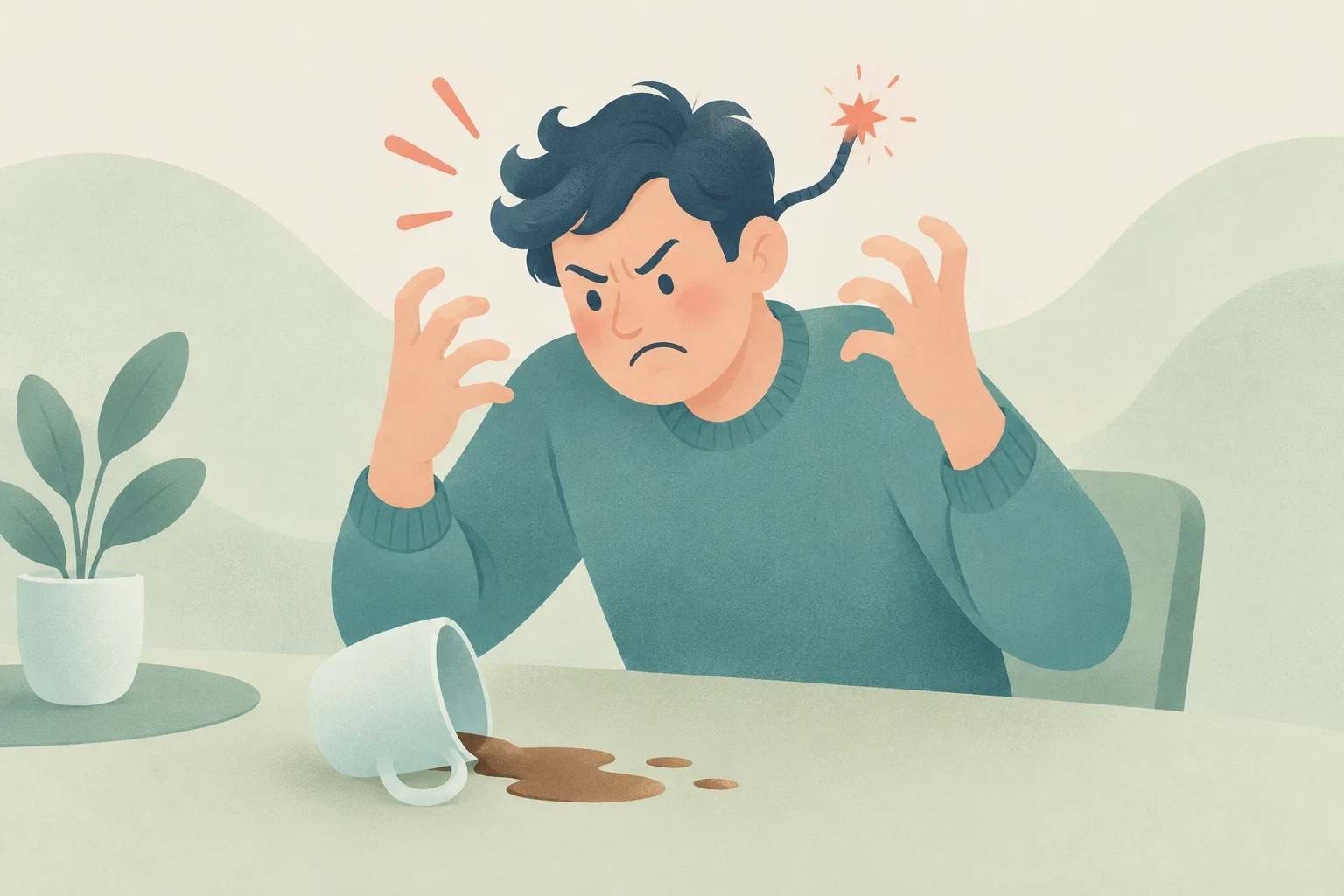
To have a short fuse means to become angry very easily and quickly after little or no provocation.
Puntos clave
- Have a short fuse means becoming angry quickly.
- Shorter compares levels of patience; context tells us the period and cause.
- Use have a short fuse for being quick to become angry.
Esta lección tiene 5 etapas. Puedes parar cuando quieras y continuar más tarde.

Etapa 1 de 5
Entender
Qué significa, cuándo usarlo y qué errores evitar.
Ejemplos
Our kitchen manager has a short fuse when food deliveries arrive late.
Por qué funciona: The manager gets irritated easily by ordinary supply delays.
2 ejemplos más
-
Lack of sleep gave several team members a shorter fuse than usual during the audit.
The comparative shorter fuse describes temporary irritability caused by exhaustion.
-
One firm disagreement does not prove that your coworker has a short fuse.
The context can describe a temporary period of irritability; a permanent personality trait is not required.
Leer la guía completa
Recognize quick anger in context
When you observe a colleague snapping at teammates after minor inconveniences, you must decide whether that anger is an isolated incident or a habit. The idiom have a short fuse describes an individual who reacts angrily with very little provocation. The metaphor comes from explosives, where a shorter cord burns down quickly and triggers an immediate blast. In everyday English, this phrase highlights how quickly irritation erupts rather than how loud the anger sounds.
-
Our shift supervisor has a short fuse whenever printers jam.
Por qué funciona: The supervisor becomes irritated rapidly over a minor technical malfunction.
-
He inherited a calm demeanor, but his brother has a short fuse.
Por qué funciona: The contrast shows an enduring personal tendency rather than a temporary mood.
Tu turno
Which situation best illustrates someone who has a short fuse?
Respuesta: A chef shouts furiously at an assistant who misplaced a single spoon.
Mostrar la respuesta
Respuesta: A chef shouts furiously at an assistant who misplaced a single spoon.
A short fuse describes an intense angry reaction triggered by very small problems or minor provocation.
Keep the indefinite article in the idiomatic frame
Learners often omit the article a because they treat anger as an uncountable concept. In this idiomatic structure, however, fuse remains a countable singular noun that requires the indefinite article a. You will usually place this phrase after verbs like have, possess, or develop. Dropping the article sounds ungrammatical to native speakers, while adding an inappropriate plural form distorts the intended expression entirely.
-
She has a short fuse in the morning before drinking coffee.
Por qué funciona: The sentence correctly retains the indefinite article a before short fuse.
-
New drivers often develop a short fuse when navigating heavy traffic.
Por qué funciona: The verb develop pairs naturally with a short fuse to show an emerging pattern.
Esto también aparece en A mean streak y Keep a low profile.
Tu turno
Which sentence uses the correct grammatical form of the idiom?
Respuesta: David has a short fuse whenever clients ask for minor changes.
Mostrar la respuesta
Respuesta: David has a short fuse whenever clients ask for minor changes.
The expression requires the indefinite article a before short fuse because fuse is a countable noun.
Use the comparative form to express temporary stress
A person may have a short fuse for a while rather than all the time. A shorter fuse than usual compares their current patience with their normal level. It does not by itself prove that fatigue, stress, or illness caused the change. Use the surrounding context to explain any known cause.
-
Working back-to-back shifts gave the nurse a shorter fuse than usual.
Por qué funciona: The comparative shorter indicates that exhaustion temporarily lowered her patience.
-
I notice a shorter fuse in myself when I skip breakfast.
Por qué funciona: The speaker observes temporary irritability caused by hunger rather than character.
Tu turno
What does saying someone has 'a shorter fuse today' imply?
Respuesta: The person is less patient today than usual.
Mostrar la respuesta
Respuesta: The person is less patient today than usual.
Shorter makes the comparison with usual patience. Today makes the description temporary; the phrase does not establish the cause.
Distinguish quick anger from a firm objection
A short fuse describes being quick to become angry. A firm objection or a safety intervention does not by itself show that someone has a short fuse. Look at how the person reacts and what the context establishes. You do not need to prove a lifelong pattern, and the idiom does not decide whether a concern is justified.
-
She objected sternly to the safety violation, but she does not have a short fuse.
Por qué funciona: One firm or angry response to danger does not indicate a quick temper.
-
He complains about noise, email tone, and room temperature because he has a short fuse.
Por qué funciona: Irritation across multiple unrelated daily events confirms a repeated pattern.
Tu turno
Why does stopping an unsafe machine not by itself show that an inspector has a short fuse?
Respuesta: Halting dangerous machinery is a justified safety action, not irrational anger.
Mostrar la respuesta
Respuesta: Halting dangerous machinery is a justified safety action, not irrational anger.
Stopping the machine tells us about a safety action, not how readily the inspector becomes angry.
Choose objective language in sensitive workplace contexts
Describing an employee as having a short fuse carries a negative personal judgment. In formal performance evaluations or delicate mediation talks, using the phrase directly can cause defensiveness and worsen professional relationships. Neutral descriptions of observable actions, such as noting that someone responds abruptly under pressure or struggles with sudden schedule changes, communicate the same practical reality while keeping conversations constructive.
-
In my feedback notes, I wrote that the vendor reacts abruptly to revisions.
Por qué funciona: Using descriptive behavioral language avoids subjective character insults.
-
Telling your manager that she has a short fuse will likely derail the meeting.
Por qué funciona: Directly applying the idiom to superiors in formal settings creates unnecessary conflict.
Tu turno
Which alternative is most suitable for a formal performance appraisal?
Respuesta: The employee occasionally reacts abruptly when handling urgent schedule revisions.
Mostrar la respuesta
Respuesta: The employee occasionally reacts abruptly when handling urgent schedule revisions.
Describing concrete actions objectively maintains professional credibility without resorting to colloquial criticism.
Catch the stressed noun and reduced vowel in rapid speech
In natural spoken English, content words receive primary emphasis while functional grammar words reduce. Within the phrase have a short fuse, the words short and fuse carry clear tonic stress, while the indefinite article a reduces to a weak schwa sound. Listeners who expect a distinct, separated vowel often miss the article entirely and mistakenly transcribe the expression as have short fuse.
-
You can hear the rhythm clearly in 'has a SHORT FUSE' during rapid speech.
Por qué funciona: Short and fuse stand out, while the article a before short is brief and unstressed.
-
Native speakers blend 'has a' into a connected unit before emphasizing 'short'.
Por qué funciona: Connected speech links the consonant to the unstressed schwa smoothly.
Tu turno
How does the article 'a' sound in the spoken phrase 'has a short fuse'?
Respuesta: It reduces to an unstressed, weak schwa sound linked to the preceding verb.
Mostrar la respuesta
Respuesta: It reduces to an unstressed, weak schwa sound linked to the preceding verb.
In fluent speech, the article 'a' is unstressed and pronounced as a weak schwa linked to 'has'.
Prevent errors with verbs, prepositions, and modifiers
Learners frequently introduce incorrect prepositions or verbs when attempting this idiom. Avoid saying make a short fuse or be in a short fuse. The standard collocation uses the verb have. When explaining what triggers the anger, connect the situation using when, whenever, or under pressure rather than forcing an unnatural preposition.
-
He has a short fuse when teammates ignore technical guidelines.
Por qué funciona: Using 'when' introduces the specific triggering condition naturally.
-
Under tight deadlines, several designers show a shorter fuse.
Por qué funciona: 'Under tight deadlines' sets the situational context without grammatical errors.
Tu turno
Which sentence contains a common grammatical error with this idiom?
Respuesta: The chef is in a short fuse whenever orders are returned.
Mostrar la respuesta
Respuesta: The chef is in a short fuse whenever orders are returned.
English speakers say 'have a short fuse' or 'show a short fuse'; 'be in a short fuse' is an incorrect collocation.
Incorporate balanced observations in written summaries
When writing summaries or case studies about interpersonal conflict, balance the idiom with context. Stating merely that an individual has a short fuse presents an incomplete picture. Strong writers provide the trigger, describe the resulting behavior, and explain how the team adjusted. This structure demonstrates advanced vocabulary while maintaining nuance and analytical depth.
-
Although the lead programmer has a short fuse during testing cycles, her code remains flawless.
Por qué funciona: The concession clause balances temper against technical competence.
-
To accommodate his short fuse in the morning, we schedule design critiques after lunch.
Por qué funciona: The sentence links the person's temperament to a practical team adjustment.
Tu turno
Which written sentence best balances the idiom with practical context?
Respuesta: Because our editor has a short fuse before deadlines, we submit draft copy early.
Mostrar la respuesta
Respuesta: Because our editor has a short fuse before deadlines, we submit draft copy early.
This sentence links the editor's temperament to a specific timeframe and explains the practical team solution.
Úsalo naturalmente
Cómo se usa "have a short fuse"
Informal Relajado; mejor con amigos y colegas que en la escritura formal.
Palabras con las que suele ir
- a short fuse under pressureMy brother has a short fuse under pressure, especially before a big performance.
- a shorter fuse than usualAfter a restless night, I had a shorter fuse than usual.
- a very short fuseThe coach has a very short fuse when players ignore instructions.
Lo que la gente también dice
- "She has a short fuse." en lugar de "She becomes angry with great ease." The idiom sounds natural in casual conversation about a recurring tendency.
Preguntas sobre "A short fuse"
Can I say someone has short fuse without the article a?
No. The idiom requires the indefinite article because 'fuse' functions here as a singular countable noun. Leaving out 'a' is a frequent learner error that sounds unnatural in spoken and written English. Always say 'has a short fuse' or 'had a short fuse'.
The project coordinator has a short fuse when meetings run late.
He noticed that she had a short fuse after traveling all night.
What is the difference between having a short fuse and being short-tempered?
Both expressions convey that someone becomes angry easily, but their grammatical role differs. 'Short-tempered' is a compound adjective used after a linking verb or directly before a noun, whereas 'have a short fuse' is an idiomatic verb phrase. In tone, 'short fuse' creates a more vivid visual image of an explosion.
She is short-tempered when deadlines approach.
She has a short fuse when deadlines approach.
How do I describe someone whose patience is temporarily worse than normal?
You can say someone has a short fuse today. A shorter fuse than usual makes an explicit comparison with their normal patience. Neither form on its own explains the cause; add the circumstances if they are known.
Exhaustion gave our supervisor a shorter fuse than normal yesterday.
Is it polite to tell someone directly that they have a short fuse?
Telling someone directly 'you have a short fuse' is usually considered blunt and accusatory. In professional settings, describe specific behaviors or temporary stress instead. You might say someone seems pressed for time or under strain rather than labeling their personality directly.
You seem under considerable pressure today, so let us revisit this topic later.
Antes de irte
Recuerda esto
Have a short fuse means becoming angry quickly. It can describe a temporary state or a usual tendency. Shorter compares levels of patience; context tells us the period and cause.
Etapa 2 de 5
Escuchar
Escúchalo en frases reales, de la más corta a la más larga, y escribe lo que oyes.
0 de 4 completado
Escucha 1 de 4
Escucha y luego escribe lo que oyes. Repite tantas veces como necesites.
0:00
- Lack of sleep gave several team members a shorter fuse than usual during the audit.
- One firm disagreement does not prove that your coworker has a short fuse.
Escucha 2 de 4
Escucha y luego escribe lo que oyes. Repite tantas veces como necesites.
0:00
- Lack of sleep gave several team members a shorter fuse than usual during the audit.
- One firm disagreement does not prove that your coworker has a short fuse.
Intenta un clip más largo. Escucha una vez y luego reproduce la parte que te perdiste.
Escucha 3 de 4
Escucha y luego escribe lo que oyes. Repite tantas veces como necesites.
0:00
- Lack of sleep gave several team members a shorter fuse than usual during the audit.
- One firm disagreement does not prove that your coworker has a short fuse.
Este clip es más largo. Sigue la instrucción encima del campo de respuesta.
Escucha 4 de 4
Escucha y luego escribe las palabras que faltan. El resto del texto ya está ahí.
0:00
- Lack of sleep gave several team members a shorter fuse than usual during the audit.
- One firm disagreement does not prove that your coworker has a short fuse.
Práctica completada
Escuchaste con atención.
Tu resultado está guardado en este navegador.
Mantén tu progreso. Tu práctica se guarda solo en este dispositivo. Crea una cuenta gratuita para conservarla también cuando uses otros dispositivos.
Crear una cuenta gratuitaEsa fue la lección gratuita de hoy. Mañana tendrás otra. ¿Quieres más hoy? Consulta la membresía.
Crea una cuenta gratuita de SubLearn para mantener este progreso en todos tus dispositivos.
Guardar mi progresoEtapa 3 de 5
Hablar
Dilo junto con el hablante y luego úsalo en tu propia respuesta.
Imita
Dilo junto con el hablante
Reproduce la frase a velocidad lenta y repítela al mismo tiempo que la grabación. Imita también el ritmo.
Tu turno
Dilo a tu manera
Speak from memory for 30 to 60 seconds about a family board game night. Describe a relative's reaction to a disputed rule, consider whether it reflects their usual behavior or temporary stress, and suggest how to keep the game enjoyable.
Usa: has a short fuse a shorter fuse than usual
Piensa durante diez segundos, luego responde en voz alta durante el tiempo que pida la tarea, sin mirar la lección. No se envía nada a menos que pidas retroalimentación.
0:00
Escucha cómo lo diría otra persona
At our last family game night, my cousin snapped when we questioned how he counted his points. My sister says he has a short fuse, but I think that's a bit unfair. He's usually happy to laugh at his own mistakes. He'd spent the whole day moving apartments, so he probably had a shorter fuse than usual. I'd suggest taking a snack break and checking the rules together before continuing. That would give everyone time to settle down without making him feel singled out. After all, the point is to enjoy each other's company.
Intenta una vez más y responde esto: How does your relative usually react when they lose?
Etapa 4 de 5
Escribir
Escribe tu propia respuesta
Retroalimentación de IA · puede cometer errores · Parte de la membresía Ver membresía
Revisa tu texto
Leer una posible respuesta
Borrador guardado en este dispositivo.
Usa estas comprobaciones para revisar tu mensaje. La gramática y el significado no se califican automáticamente. Cada tarea mantiene su propio borrador en esta pestaña del navegador.

Terminaste la parte gratuita de esta lección
- Entender
- Escuchar
- Hablar
- Escribir
- PruebaParte de la membresía
Vale la pena volver
Con una cuenta gratuita, las lecciones que terminas vuelven para que las repases, y eso te ayuda a recordarlas.Crear una cuenta gratuita
Etapa 5 de 5 · Parte de la membresía
Prueba
Grabaciones nuevas sin pistas.
Las pruebas de comprensión auditiva están incluidas con la membresía. Prueba primero el dictado gratuito y luego decide si quieres continuar.
Escucha 1 de 2 Parte de la membresía
Escucha 2 de 2 Parte de la membresía
Sigue a MicroEnglish
Encuentra lecciones, videos cortos y pruebas rápidas en la aplicación que ya usas.
Preguntas y comentarios
Pregunta sobre esta lección, comparte un ejemplo o ayuda a otro estudiante.
Ejemplo
Consejo para recordar
Combina con
Formas relacionadas
No confundir con
En esta lección
Esta palabra no está en nuestro diccionario. Revisa cómo se escribe o prueba otra forma de la palabra.
No pudimos cargar esta palabra. Inténtalo de nuevo.
