Encuentra tu próxima lección
Busca una frase o describe lo que necesitas decir. Cada día llegan lecciones nuevas.
Mostrando 1–18 de 25 lecciones
Borrar filtros-

How to Spell Exercise: Avoid Common Mistakes
Exercise functions both as a noun and as a verb. As an uncountable noun, it denotes bodily exertion intended to sustain physical fitness. As a countable noun, it refers to a structured learning task or problem in a textbook. As a verb, it describes performing physical movements or applying a right, authority, or caution.
-

Too long or to long: Choose the right word
Too long describes a duration or measurement that exceeds what is practical, acceptable, or desirable. The adverb too modifies the adjective long to show an unwanted surplus. In contrast, the word to is either a preposition indicating direction or an infinitive particle that precedes a base verb. The spelling to long does not function as a standard phrase for excess in modern English.
-

English grammar: choose your lesson
English grammar describes the predictable patterns words follow to show time, relationships, questions, and descriptions. Choosing the right topic begins by clarifying your communicative goal.
-

Regular and irregular verbs: How past forms change
Regular past verbs use the suffix -ed or -d to express completed actions in past time. Irregular past verbs express past time through specific vowel or consonant changes, or by keeping an identical base form, rather than taking the regular suffix.
-

Past continuous: talking about past actions
The past continuous describes an activity in progress at a specific past moment. It presents an action from the inside as ongoing, without stating when it began or whether it finished. It frequently provides the background scene for a shorter event or connects two activities occurring at the same time.
-

Bought or brought? Getting ready for a games night
Bought describes getting something by paying for it. It is the past form of buy. Brought describes bringing someone or something to a place. It is the past form of bring. The same object can appear with either verb: you bought a game yesterday and brought it here today.
-
Membresía
Accede a todas las lecciones gratis durante 7 días
- 448 lecciones con dictado y pruebas de escucha
- Tres acentos: británico, americano y australiano
- Nuevas lecciones cada día, y tu progreso se guarda
No se necesita tarjeta. Luego desde $7.50 al mes si quieres continuar.
Empezar prueba gratis -

I or me: Choose the Right Pronoun
I is the subject pronoun used when you perform an action or describe your state, while me is the object pronoun used when you receive an action or follow a preposition such as to, for, with, or between.
-
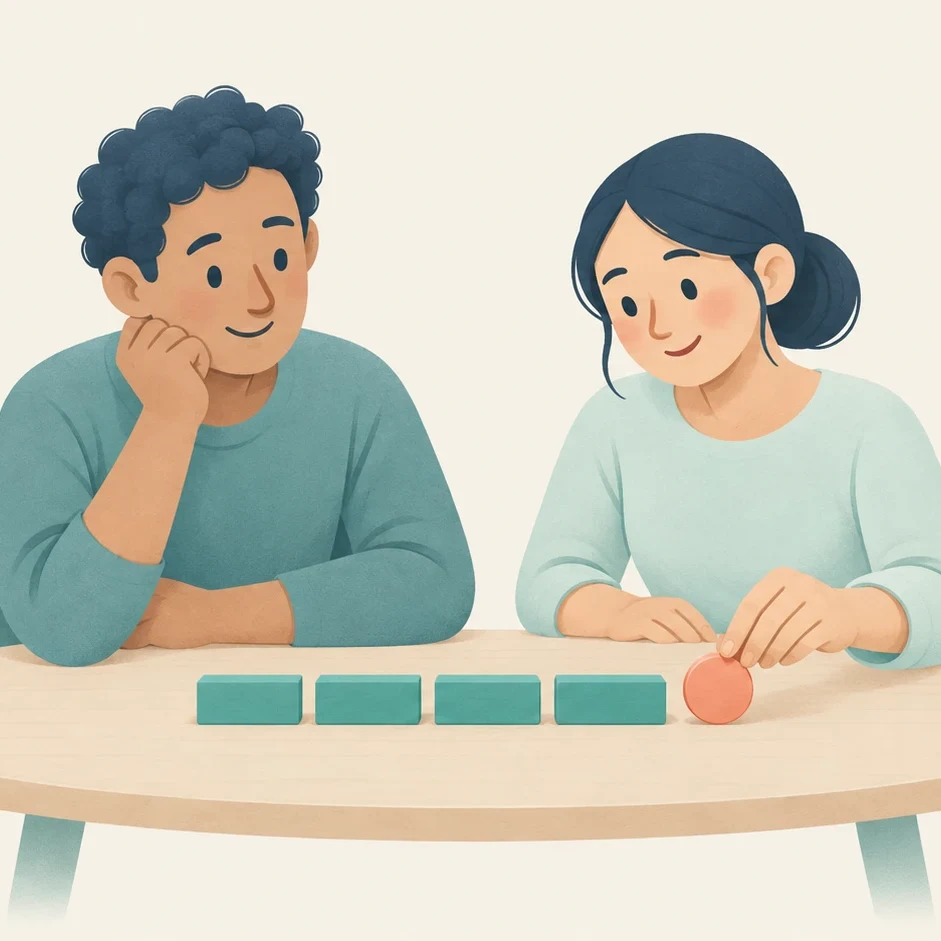
Full stops: when to use them
A full stop signals that an informative statement or a calm instruction is finished. It tells the reader to stop and process one complete idea before reading the next one.
-

Why English Class Matters: Practical Adult Skills
An English class is like a practical workshop. In class, you try out simple tools and see what works best. Reading exercises teach you to find facts quickly. Speaking tasks help you turn your thoughts into simple, clear sentences. Writing lessons show you how to name the person doing each action. Helpful feedback from your teacher shows you what to change next.
-

Practice speaking English: Ten simple steps
Speaking practice means producing audible English to express a thought, give instructions, or answer a question. Listening and reading build comprehension, but speaking demands that you organize words, control grammar, and produce sounds in real time.
-

Adverbs: Add Information to Actions
An adverb provides extra information about an action, a quality, another adverb, or a full statement. It answers questions like how, where, when, how often, or how much.
-

Simple Past Tense: Actions and Past States
The simple past places actions, events, and states entirely in finished time before now. You use it to describe a single completed event, a chronological sequence of steps, habitual routines during an earlier life period, or past conditions and feelings. The tense makes clear that the event occurred at a definite point or period in the past.
-

To, Too or Two: How to Choose
The word to points toward a destination or a receiver, and it connects a main verb to a base verb. The word too means also, or it shows that a quantity or quality exceeds what is suitable. The word two represents the count 2.
-

English exercises: choose what to practice
A targeted English exercise focuses on one linguistic decision, such as dropping a silent letter, choosing a singular or plural verb for a group, or distinguishing homophones by sentence function.
-

Dairy or Diary: How to Choose
Dairy names milk and food items made from milk, such as yogurt, butter, and cheese. It can also describe a business that bottles milk. A diary is a private book or digital record where you record daily events, personal thoughts, or schedule commitments.
-

A, an, and the: clear everyday rules
Articles show your listener whether you are referring to an unidentified single item, an identifiable specific item, or a whole category in general. Countable nouns can take a or an in the singular, while the definite article the works with singular, plural, and uncountable nouns whenever the listener can pinpoint the exact referent. Broad general statements using plural or uncountable nouns take no article at all.
-

John and I or John and me: Which Pronoun Fits?
The pronoun 'I' works as a subject. It names who carries out an action or who is described by the verb, whether alone or with someone else. The pronoun 'me' works as an object. It names who receives an action, who receives an item, or who follows a preposition such as 'for' or 'with'. When you link John to yourself with 'and', the pair functions as a single grammatical unit in the sentence.
-

John and I or John and me: Choose the Right Form
I functions as a subject pronoun, representing the speaker performing an action or expressing a state with be. Me functions as an object pronoun, representing the speaker receiving an action from a verb or following a preposition like to, for, with, or between. Adding John creates a compound unit, but the grammatical role of the pronoun remains unchanged.
¿No estás listo para una prueba? Recibe una lección gratis cada día
Un dictado corto en tu bandeja de entrada cada día durante 7 días. Practica donde estés, sin necesidad de cuenta.
¿No encuentras la frase o situación que necesitas?
Las solicitudes de lecciones requieren una membresía.
Ver membresía