
マイクロリスニング
Learn English through Gujarati: an English-first routine
How can I learn English through Gujarati?
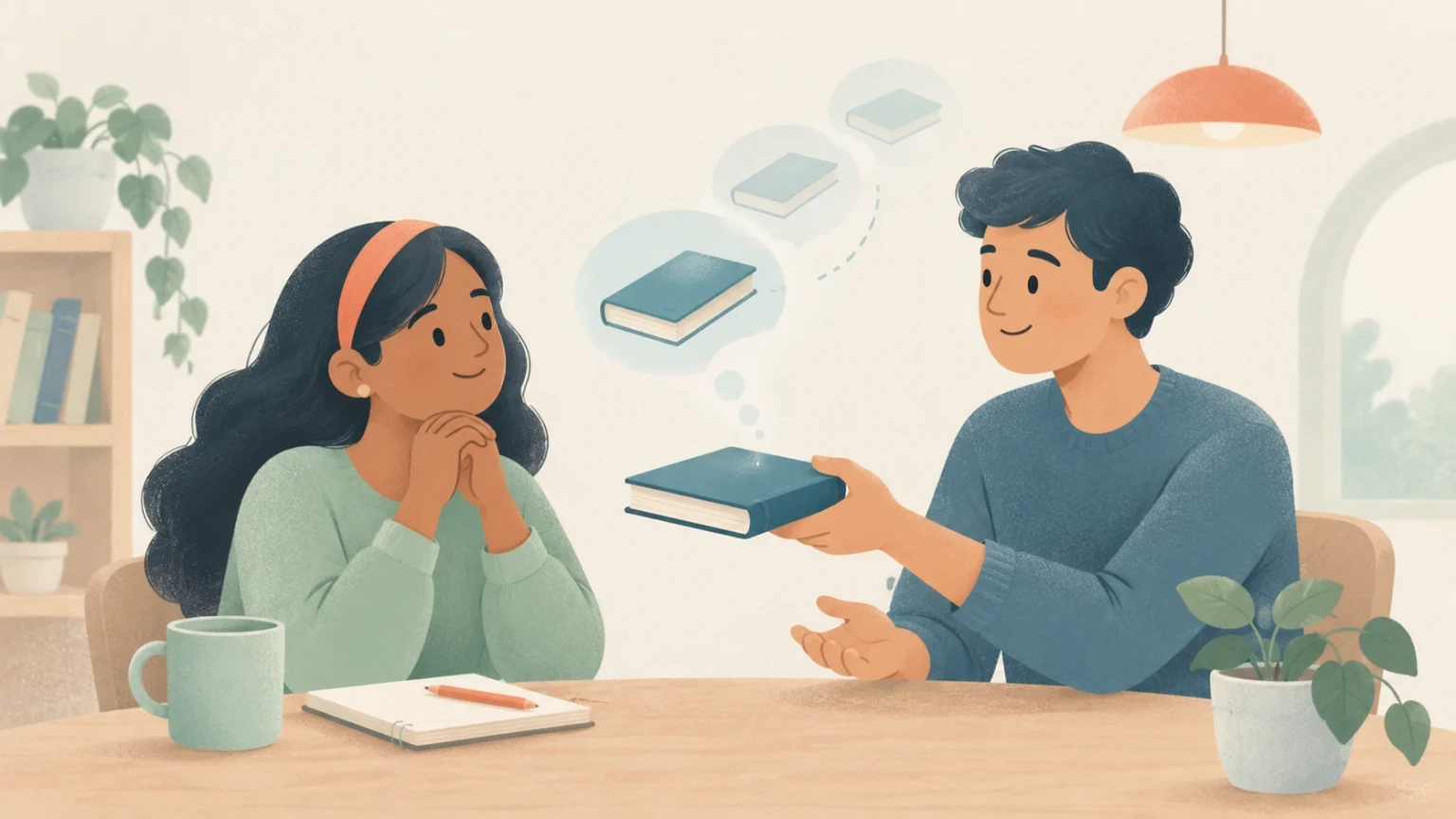
An English-first routine uses Gujarati briefly to check meaning, then returns to complete English phrases and real situations. For example, practise the phrase 'Could I borrow your notebook until lunch?' Listen to the English, say and write the whole phrase, change one detail, and try to recall it the next day instead of translating every word.
ポイント
- Choose one useful English task for each study session.
- Use Gujarati to check a phrase, then practise it in English.
- Save complete phrases to keep their word order and small words.
- Listen for the main idea before focusing on details.
このレッスンにはステージが5つあります。いつでも中断して、あとで続きから再開できます。
Your phone battery is low, and you need to borrow a charger at a shared study table. Use that small task to practice a request you can understand, say and recall later.

ステージ 1 / 5
理解
意味、使う場面、避けたい間違いを学びます。
詳しい説明
An English-first routine means anchoring your practice in authentic English sentences and real communicative situations. When you encounter a new request, you can use Gujarati to confirm its meaning and avoid confusion. Once that concept is clear, focus entirely on the English sentence structure, rhythm, and small words. This method prevents the hesitation caused by translating words one by one.
Can I borrow your phone charger for an hour?
この表現を使う理由: Use this standard polite request when you need to use someone else's charger temporarily.
ほかの例を2件見る
-
I will return your cable before three o'clock.
State a clear time boundary to show consideration when borrowing equipment.
-
Could I use your wall plug for twenty minutes?
Could offers a slightly more formal alternative when speaking to someone you do not know well.
基本から解説を読む
Choose one English task you need this week
This lesson sets out an English-language study routine for Gujarati-speaking learners, not a Gujarati translation course or a complete English course. When you begin your study routine, pick one realistic task you will meet in daily life. Do not try to prepare for every possible conversation at once. Focus on an immediate communication need, such as asking someone at a shared study desk to borrow a phone charger. When your practice connects to an actual event, your mind connects the English words directly to your real purpose.
-
Can I borrow your phone charger for an hour?
この表現を使う理由: This request fits a clear situation where you need power at a shared table.
-
I need to recharge my phone before my afternoon class.
この表現を使う理由: Stating the reason gives helpful context to the person next to you.
自分で試す
Why is it best to focus on one concrete English task during a study session?
答え: It connects the language directly to a situation you will actually encounter.
答えを見る
答え: It connects the language directly to a situation you will actually encounter.
Focusing on one specific situation gives the phrase an immediate communicative purpose, making it easier to remember and use.
Use Gujarati to check meaning, then return to English
Gujarati can help you clarify what a new phrase means when an idea feels unfamiliar. Look up the meaning or write a short note in Gujarati to confirm your understanding. Once the meaning is clear, return immediately to the English sentence. Do not spend your time translating every separate word back and forth, because English patterns and word order function independently.
-
Can I borrow your phone charger?
この表現を使う理由: Understand borrow as taking an item to use and return, without translating word by word.
-
Sure, you can use it for thirty minutes.
この表現を使う理由: Notice how English responds with permission rather than a literal translation.
Learn English Through Hindi: Daily Routine GuideとLearn English through Marathi: Daily Study Routineでこれをもう一度練習できます。
自分で試す
What is the most effective role for Gujarati in this study routine?
答え: Checking the meaning of an unfamiliar phrase before practicing it in English.
答えを見る
答え: Checking the meaning of an unfamiliar phrase before practicing it in English.
Using Gujarati as a quick meaning check helps you understand the concept, while returning to English builds natural speech habits.
Save a complete phrase with its situation
Writing down isolated vocabulary words like charger or borrow makes it difficult to construct a polite request later. Instead, write down the complete English phrase alongside the situation where you plan to use it. When you record the whole sentence, you preserve the exact word order and the essential small words that hold the request together.
-
Can I borrow your phone charger for an hour?
この表現を使う理由: Saving the complete frame keeps the modal verb, pronoun, and time phrase intact.
-
I will return your cable before three o'clock.
この表現を使う理由: Recording the full promise helps you state a return time smoothly.
自分で試す
Why should you record complete phrases instead of single vocabulary words?
答え: Full phrases preserve natural word order and necessary connecting words.
答えを見る
答え: Full phrases preserve natural word order and necessary connecting words.
A complete phrase includes the functional words and structure you need, preventing hesitant word-by-word assembly.
Follow a short conversation about borrowing a charger
Listen to how speakers interact during a brief exchange at a study table. In everyday English, to borrow means taking something to use and give back soon. The first speaker politely states a problem and asks to borrow a charger. The second speaker agrees and hands over the cable, and the first speaker names a specific return time. Listening to the complete exchange shows how a polite request leads naturally to an agreed arrangement.
-
Excuse me, my phone battery is low. Can I borrow your charger?
この表現を使う理由: The opening phrase establishes politeness before the main request.
-
Sure, go ahead. You can plug it in over here.
この表現を使う理由: This friendly response confirms permission and indicates the outlet.
-
Thank you so much. I will return it before three o'clock.
この表現を使う理由: The first speaker names a specific return time to complete the arrangement.
自分で試す
In a typical borrowing dialogue, what information usually follows the initial request?
答え: A clear statement of agreement and a specific return arrangement.
答えを見る
答え: A clear statement of agreement and a specific return arrangement.
Everyday borrowing exchanges typically conclude with permission and a practical plan for returning the borrowed item.
Replay with one more listening clue each time
When a spoken sentence feels too rapid, avoid looking at the written transcript immediately. Use the recorded audio as your listening model rather than relying on written text. Keep in mind that reading aloud and repeating the recording are speaking practice, not substitutes for hearing another speaker. Listen on the first run purely to identify what the speaker wants. On the second run, listen for the main action phrase. On the third run, focus on the small connecting words. Adding one clue on each replay trains your ear to separate sounds accurately.
-
Excuse me, can I borrow your phone charger for an hour?
この表現を使う理由: First listen for the item wanted, then focus on how the request begins.
-
I will return the charger before three o'clock.
この表現を使う理由: Listen first for the action return, then catch the specific time marker.
自分で試す
What should you focus on during your first pass of a listening recording?
答え: Understanding the general purpose and main desire of the speaker.
答えを見る
答え: Understanding the general purpose and main desire of the speaker.
Catching the speaker's main goal first provides context, making detailed words easier to recognize on subsequent replays.
Keep small words when you repeat a request
Learners often drop unstressed words such as can, I, your, or for when repeating a request quickly. In natural English, can I borrow sounds smooth because can is spoken in its weak form with an unstressed vowel. In connected speech, can and I link smoothly together. Omitting these grammatical words changes a polite request into a blunt command. Practice saying the entire group of words together so the small words and weak forms become second nature.
-
Can I borrow your charger?
この表現を使う理由: Keep both can and I to form a complete, polite request rather than saying borrow charger.
-
I need it for twenty minutes.
この表現を使う理由: Include the preposition for before the time duration.
自分で試す
Why is it important to keep small words like can and for in your spoken requests?
答え: They maintain correct English word order and ensure a polite tone.
答えを見る
答え: They maintain correct English word order and ensure a polite tone.
Leaving out function words makes speech sound abrupt or grammatically incomplete, even if the main noun is clear.
Read the dialogue and change one detail
After you understand the model dialogue, practice adapting it to fit your own life. Keep the stable phrase frame, such as Can I borrow your..., and change only one detail. You might replace the object with a pen, or alter the time from one hour to thirty minutes. This technique builds flexibility while protecting you from structural mistakes.
-
Can I borrow your black pen for a minute?
この表現を使う理由: The frame Can I borrow your remains unchanged while the object and time change.
-
Can I borrow your charging cable until lunch?
この表現を使う理由: Changing the time boundary lets you adapt the phrase to a workday schedule.
自分で試す
What is the benefit of changing only one detail in a learned phrase frame?
答え: It lets you adapt the sentence to your needs while keeping the correct structure.
答えを見る
答え: It lets you adapt the sentence to your needs while keeping the correct structure.
Substituting a single noun or time expression allows personalization while preserving the proven sentence pattern.
Write the recorded words in six short dictations
Writing down the exact words you hear is an active listening exercise. It forces you to notice articles, pronouns, and verb endings that your brain might skip when simply reading. Work through short audio clips without guessing. If you miss a word, replay the clip, identify the missing syllable, and write the sentence again until your transcript matches the recording.
-
Can I borrow your phone charger for an hour?
この表現を使う理由: Writing this sentence tests your ability to hear the weak pronunciation of can.
-
I will return your cable before three o'clock.
この表現を使う理由: Focus on catching the exact future modal will rather than dropping it.
自分で試す
What does writing out an audio recording help you notice?
答え: Small grammatical words and endings that are easily overlooked.
答えを見る
答え: Small grammatical words and endings that are easily overlooked.
Dictation bridges the gap between hearing general meaning and recognizing exact acoustic details like pronouns and prepositions.
Recall yesterday's phrase before checking your notes
When you sit down for your next study session, do not open your notebook immediately. Give yourself a situation cue, such as needing power for your phone, and attempt to say or write the phrase from memory. Active recall strengthens memory pathways much more effectively than passive rereading. If you get stuck, glance at the note, cover it, and produce the phrase once more.
-
Can I borrow your phone charger for an hour?
この表現を使う理由: Produce this sentence from memory when prompted by the low-battery situation.
-
I will return it before three o'clock.
この表現を使う理由: Test whether you can recall the return promise without looking at yesterday's page.
自分で試す
Why should you attempt recall before opening your study notes?
答え: It forces your brain to retrieve stored language, making memory stronger.
答えを見る
答え: It forces your brain to retrieve stored language, making memory stronger.
Active retrieval from memory cements language far better than simply looking over past notes.
Use a simple checklist for your next study session
A structured checklist keeps your daily practice consistent and manageable. Start by selecting one real situation and one useful phrase. Check the meaning, listen to the model three times, repeat it aloud, write it down, and substitute one detail. The next morning, test your recall before adding anything new. Following these straightforward steps ensures steady progress without overwhelming your schedule.
-
Choose one situation, check meaning, listen, speak, write, and recall.
この表現を使う理由: This sequence balances receptive understanding with active spoken and written production.
-
Practice one solid phrase each day rather than ten unreviewed words.
この表現を使う理由: Quality repetition builds usable communicative skill faster than rapid memorization.
自分で試す
What should you do before adding a new phrase to your daily routine?
答え: Successfully recall and speak yesterday's phrase from memory.
答えを見る
答え: Successfully recall and speak yesterday's phrase from memory.
Reviewing previous material before introducing new content ensures that learned phrases stay active in your memory.
よくある間違い
よくある間違いと、その直し方を理由と一緒に確認します。
-
これは違います:
Can borrow your notebook?こう言いましょう: Can I borrow your notebook?
Keep 'I' in the complete polite request.
-
これは違います:
I need it twenty minutes.こう言いましょう: I need it for twenty minutes.
Keep 'for' before a period of time.
-
これは違います:
I will returned the notebook later.こう言いましょう: I will return the notebook later.
Use the base form 'return' after 'will'.
自然な使い方
「Can I borrow your」の実際の使われ方
ニュートラル 職場でも友人との間でも、ほとんどの場面で使えます。
よく一緒に使われる言葉
- borrow your umbrellaCan I borrow your umbrella for my walk?
- borrow your penCan I borrow your pen to write my name?
- borrow your chargerCan I borrow your charger for an hour?
- borrow your bookCan I borrow your book until Friday?
他の言い方
- 「Can I take your charger for temporary use?」の代わりに「Can I borrow your charger?」 Borrow means you plan to give it back.
関連する形
- borrow verbI sometimes borrow a pen from my friend.
- borrowed verb, past tenseI borrowed an umbrella yesterday.
「Learn English through Gujarati: an English-first routine」に関する質問
Can I use Gujarati when I do not understand an English phrase?
Yes, Gujarati is a practical tool for confirming the meaning of an unfamiliar idea or checking a vocabulary difference. Once you understand what the phrase communicates, shift your focus entirely to the English wording. Practice the sentence pattern in English rather than dwelling on bilingual translation.
I checked the Gujarati meaning of borrow to confirm that it means taking something to return soon.
Should I translate every word before I speak?
No, translating word by word usually leads to unnatural grammar and hesitant speech. English and Gujarati organize prepositions, articles, and verbs differently. Learn and practice the complete phrase as a single unit so that you can recall it smoothly without mental translation.
Instead of translating each word, say Can I borrow your charger as one complete pattern.
What should I practice in a short study session?
Focus on one concrete situation and one useful phrase frame. Listen to the recording three times, repeat the sentence out loud, and write it once with a personalized detail. Keeping the session focused ensures you master the language without feeling overwhelmed.
Dedicate fifteen minutes to practicing one request frame until you can say it effortlessly.
What can I do if the recording sounds too fast?
Avoid reading the text immediately. Listen once for the speaker's main purpose, replay to notice the key action verb, and listen a third time for the connecting words. Gradual listening develops your ear for natural reductions like can I and lets you catch words at normal speed.
On the first replay, identify the main request before trying to catch every small word.
How can I practice when I do not have a speaking partner?
You can build spoken fluency independently by shadowing audio recordings and practicing situational prompts. Say the phrase aloud to match the audio rhythm, and then imagine a situation where you must speak the sentence from memory without looking at your notes.
Speak the phrase aloud to an empty chair as if you are asking someone at a study table.
What should I do if I forget yesterday's phrase?
Forgetting is a normal part of the learning cycle. If you cannot recall yesterday's phrase from memory, look at your notes for five seconds, cover them, and say the sentence aloud twice. Test yourself again later in the day before adding a new phrase.
Review the model note briefly, close the page, and write the phrase again from memory.
最後に確認
これを覚えましょう
Pick one communication goal, verify its meaning, and practice the complete English sentence. Listen carefully for small grammatical words, say the request aloud, and adapt one detail for your own life. Test your recall the following day before starting a new topic. Consistent practice with single phrases produces reliable spoken English.
ステージ 2 / 5
聞く
実際の文の中で聞いて、聞こえた通りに書き取ります。文は短いものから順に長くなります。
0 / 4完了
リスニング 1 / 4
リスニング 2 / 4
もう少し長いクリップに挑戦しましょう。一度聞いて、聞き逃した部分を再生してください。
リスニング 3 / 4
このクリップは長めです。解答欄の上の指示に従ってください。
リスニング 4 / 4
練習完了
練習が終わりました。
結果はこのブラウザに保存されました。
進捗を保存. 練習の進捗は、このデバイスにのみ保存されます。無料アカウントを作成すると、どこからでもアクセスできます。
無料アカウントを作成本日の無料レッスンは終了しました。明日、別のレッスンが無料で受けられます。 本日さらに利用したいですか?メンバーシップをご覧ください。
この進捗を複数のデバイスで保持するには、無料のSubLearnアカウントを作成してください。
進捗を保存するステージ 3 / 5
話す
音声に合わせて言ってから、自分の答えの中で使います。
シャドーイング
お手本に合わせて声に出す
音声をゆっくり再生し、お手本に合わせて声に出してみましょう。単語の発音とリズムをまねしてください。
あなたの番です
自分の言葉で話す
Imagine you are sitting at a shared workplace desk and your tablet battery is dying. Politely ask your colleague to borrow their charging cable for thirty minutes and state when you will return it.
次のように始めてみましょう “Excuse me, can I borrow your cable…”
まず10秒考えてから、レッスンを見ずに声に出して答えましょう。話す長さは上の課題を確認してください。フィードバックをリクエストするまで、録音は送信されません。
0:00
ステージ 4 / 5
書く
自分の言葉で書いてみる
AIフィードバック・間違いがある場合があります · メンバーシップ限定 メンバーシップを見る
自分の文章を確認する
回答例を読む
下書きをこの端末に保存しました。
チェック項目に沿って、書いた文章を見直しましょう。文法や意味の自動採点は行いません。課題ごとの下書きは、このブラウザのタブに保存されます。

このレッスンの無料部分を完了しました
- 理解
- 聞く
- 話す
- 書く
- 確認メンバーシップ限定
見直すとよいところ
無料アカウントがあれば、完了したレッスンが復習の時期にもう一度表示されます。内容を覚えておくのに役立ちます。無料アカウントを作成
ステージ 5 / 5 · メンバーシップ限定
確認
ヒントなしの新しいクリップがあります。
リスニングテストはメンバーシップに含まれています。まず無料のディクテーションを試してから、続けるかどうかを決めてください。
リスニング 1 / 2 メンバーシップ限定
リスニング 2 / 2 メンバーシップ限定
MicroEnglishをフォロー
レッスンや短い動画、クイズなどの情報を発信しています。お使いのアプリを選んでください。
質問とコメント
このレッスンについて質問したり、例を共有したり、他の学習者を助けたりできます。
例
覚え方のヒント
一緒に使う
関連する形
混同しないように
このレッスンでの例
この単語は、このサイトの辞書にはありません。スペルを確認するか、別の形で調べてみてください。
この単語を読み込めませんでした。もう一度お試しください。