找下一节课
搜索一个短语,或描述想表达什么,从当前可用课程中选择。
显示第343–358节,共358节课
清除筛选-

A good trajectory
A good trajectory indicates that your overall performance is improving steadily over time. It describes a positive trend rather than finished perfection, meaning that specific habits or details may still require adjustment.
-

Describing lost property
Describing lost property means providing a set of precise factual details that distinguishes your possession from other similar items in storage.
-
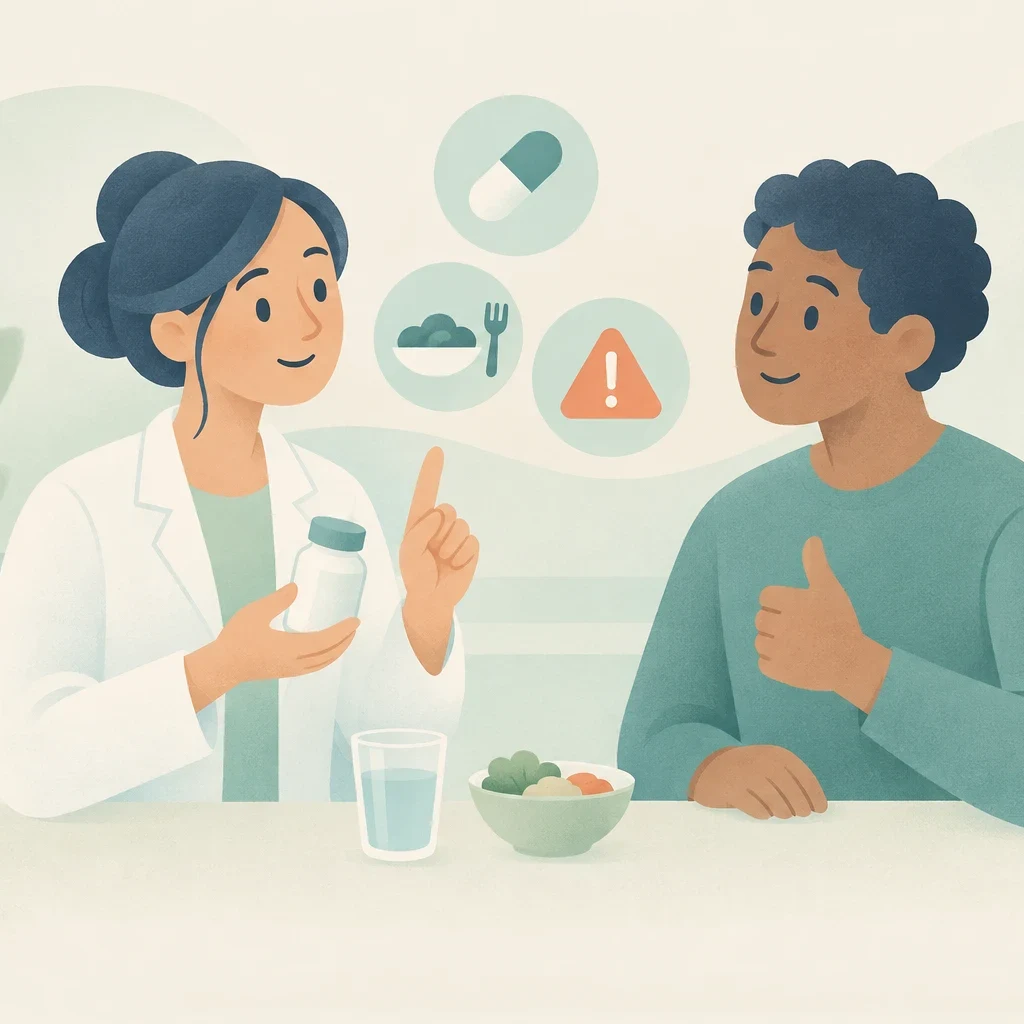
Medicine instructions
Medicine instructions tell you the amount to take each time and how often to take it. Words such as before, with, and after connect the instruction to food. A warning with if gives a condition and tells you what to do in that situation.
-

Project status update
In these updates, already helps report completed work, still shows that a situation continues, and once connects a next step to something that must happen first.
-

Confirming an appointment
Confirming an appointment means checking an arrangement that already exists rather than making a new booking. In this call, the bike repair shop updates the booking from Monday to Wednesday at 2:15 p.m., requests arrival at 2:10 p.m., and asks for the bike lock key.
-

Understanding an indirect refusal
An indirect refusal communicates that the speaker cannot or does not want to accept the current invitation without directly saying no. Appreciation can soften the message, while a reason explains why the proposed plan will not work.
-
会员
全部课程免费学7天
- 592节课程,包含听写和听力测试
- 三种口音:英式、美式和澳式
- 每天有新课,并保存学习进度
无需绑卡。之后如想继续使用,每月$7.50起。
开始免费试用 -

Train platform change
In this announcement, the train still goes to York, but its departure time and platform change. The sixteen ten train is delayed by fifteen minutes, so the revised departure is sixteen twenty-five from platform seven instead of platform two.
-

Checking a café order
In an order such as two soups, but one without cream, the customer wants two portions and changes only one. With introduces something included; without introduces something excluded. An allergy explains why an ingredient must be avoided.
-

Delivery voicemail corrections
A repair shop caller updates the delivery time for a repaired desk lamp from before lunch to the afternoon, changes the last digit of the order code, and gives a nearby collection desk as an alternative if the workplace reception is closed.
-

Changing a plan
In this conversation, the friends keep their bike ride but change the start time. One person explains the delay and suggests a new time. The other person then accepts it. Listen for that acceptance before deciding what the final plan is.
-
 视频 · 7分钟
 Take it easy
'Take it easy' means to rest and reduce effort, to calm down when feeling anxious or agitated, or to offer a warm, casual goodbye.
-

Third conditional: explanation and examples
The third conditional looks back at completed past events and imagines how changing one condition would have produced a different outcome. Both the condition and the result refer entirely to the past, describing an imaginary version of events that never actually took place.
-

Gerunds and infinitives with stop, try, remember and need
Some English verbs can be followed by either an -ing form or a to-infinitive, but the choice creates two completely different meanings. With stop, the -ing form ends an activity, while the to-infinitive states a purpose for pausing. With try, the -ing form tests a possible solution, while the to-infinitive focuses on making an effort at a difficult task. With remember, the -ing form recalls a past experience, while the to-infinitive focuses on completing a necessary chore. With need, the to-infinitive indicates that the subject performs an action, while the -ing form expresses a passive meaning showing what requires maintenance.
-

Future predictions
Predictions describe expected future events rather than certain facts. English uses will to share personal beliefs, expectations, and opinions without direct proof. It uses be going to when observable clues, trends, or current information show an outcome already in progress. When an outcome is merely possible, speakers choose might, may, or could.
-
 视频 · 8分钟
 Future plans
Future expressions in English do not simply state that an event happens later. They reveal how the speaker views the plan: as a spontaneous reaction at the moment of speech, a personal intention decided previously, or a confirmed arrangement coordinated with others.
-

Conditionals
A conditional sentence connects a condition with a result. English uses distinct verb combinations to show how the speaker views the relationship between these two clauses: as a universal constant, an actionable future possibility, an imagined present alternative, or a missed past opportunity.
还没想好是否试用?每天收一节免费课
连续7天,每天发一段短听写到邮箱。在哪里都能练,不用注册账户。
找不到想学的表达或场景?
定制课程是会员功能。
查看会员方案