Micro-listening
Sentence fragments: repair and practice guide
How can I tell whether something is a sentence fragment?
A complete sentence delivers an independent statement. In standard English writing, every sentence requires a subject and a working verb that together express a complete thought. A sentence fragment is a word group that begins with a capital letter and ends with a period, but fails to provide the grammatical elements required to stand by itself.
Key points
- Test every written statement by identifying who acts, what verb states the action or condition, and whether any connecting word leaves the reader waiting for an unstated main clause.
- When checking your writing, locate the subject and the working verb in each clause.
- If a statement begins with a connecting word like because, although, or if, make sure an independent clause follows.
This lesson has 5 stages. You can stop at any time and continue later.

Stage 1 of 5
Understand
What it means, when to use it, and mistakes to avoid.
Examples
If heavy rain begins, our team will move all tables inside.
Why it works: The introductory if-clause sets a condition, followed by an independent clause with a subject and finite verb.
2 more examples
-
The spare folding chairs in the storage room are clean.
A long noun phrase functions as the subject, completed by the working verb are and a predicate adjective.
-
We are packing extra paper supplies before the guests arrive.
The -ing verb packing has the helping verb are and subject We, forming an independent main clause.
Read the full guide
Turn community-event planning notes into complete messages
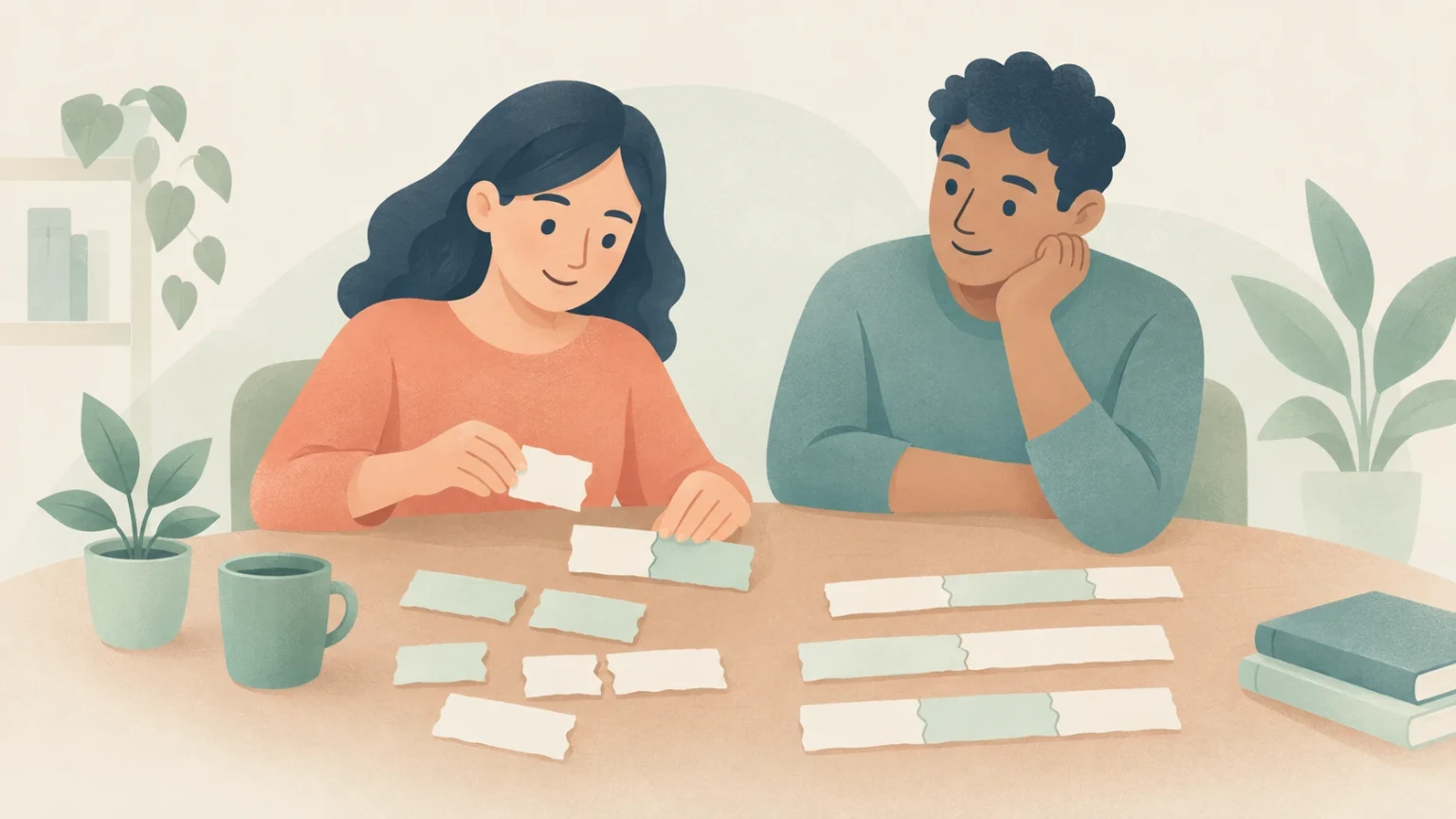
Elena and Marco are organizing a neighborhood gathering at the local community center. Elena reads a planning note from the whiteboard: 'If it rains.' Marco points out that while the note mentions a possible problem, the volunteers will not know what to do. Together, they turn the note into a useful sentence: 'If it rains, we can use the hall.' In daily communication, notes often leave out critical information. Readers need to know both the condition and the action so they can respond effectively.
-
If the weather turns cold, we will open the indoor cafe.
Why it works: This clear update tells volunteers both the condition and the resulting decision.
-
Our team prepares hot soup when the morning starts with frost.
Why it works: The main clause states the action clearly before the time clause explains the timing.
Your turn
Why does the planning note 'If it rains.' fail as a volunteer announcement?
Answer: It establishes a condition but omits the action volunteers must take.
Show the answer
Answer: It establishes a condition but omits the action volunteers must take.
A conditional clause beginning with if leaves readers waiting for an independent main clause that explains what happens.
Check for a subject, a working verb and an independent message
A sentence fragment is a group of words punctuated as a sentence that lacks the grammatical structure to stand alone in continuous writing. A capital letter at the start and a period at the end do not make a statement complete. To test a line, follow three steps: find who or what the statement is about, locate the working verb that asserts something, and confirm that the clause does not depend on missing words. Do not rely only on whether the sentence sounds finished to your ear.
-
The community hall opens at eight o'clock.
Why it works: The subject is The community hall, and opens is the working verb that completes the statement.
-
Neighbors share the tasks fairly.
Why it works: Neighbors functions as the subject, while share acts as the finite verb expressing the action.
You can practise this again in English Punctuation Rules: Clear Sentence Guide and Getting the Repair Café Ready: Group Words.
Your turn
Which element is missing from the fragment 'Before the doors open.'?
Answer: An independent main clause that states what happens.
Show the answer
Answer: An independent main clause that states what happens.
The word before introduces a dependent time clause, leaving the statement without an independent main clause.
Add a subject when a statement leaves out who acts
Quick notes frequently drop the subject because the writer knows who is doing the work. For example, 'Brings extra cups.' tells us about an action, but it does not tell readers who performs it. In standard writing, we repair this by naming the actor: 'Our neighbor brings extra cups.' Notice that this differs from a compound predicate like 'Our neighbor brings cups and makes tea,' where the single subject covers two coordinated verbs. It also differs from direct instructions, which have an understood you.
-
Our neighbor brings extra cups to the refreshment counter.
Why it works: Adding our neighbor supplies the necessary subject for the verb brings.
-
The caretaker cleans the kitchen and sets out the bins.
Why it works: A single subject successfully governs both verbs joined by and.
Your turn
How should you repair the note 'Cleans the front walkway before noon.'?
Answer: The caretaker cleans the front walkway before noon.
Show the answer
Answer: The caretaker cleans the front walkway before noon.
Adding the subject noun phrase The caretaker specifies who performs the action and creates a complete statement.
Give a noun phrase a verb that states something
A noun phrase can stretch across many words while still failing to be a sentence. Consider the phrase 'The spare chairs in the kitchen.' Although it clearly identifies specific physical objects, it asserts nothing about them. To convert the phrase into a complete sentence, supply a working verb that states an action or condition: 'The spare chairs in the kitchen are available.' Remember that forms of the verb be, such as is, are, was, and were, serve as complete working verbs just like action verbs.
-
The spare chairs in the kitchen are available for guests.
Why it works: The linking verb are provides the working verb needed to make the noun phrase a complete statement.
-
The sound equipment on the wooden table belongs to the church.
Why it works: The action verb belongs provides the predicate for the extended noun phrase.
Your turn
What does the group of words 'The large banner near the front entrance.' require to become a sentence?
Answer: A working verb explaining what the banner does or where it is.
Show the answer
Answer: A working verb explaining what the banner does or where it is.
The phrase contains only a subject noun and prepositional modifiers; it needs a working verb such as looks bright or is ready.
Complete -ing and to-verb phrases with a main clause or verb
Writers sometimes think adding a subject to an -ing phrase creates a full sentence, but writing 'We carrying extra bags.' remains an incomplete fragment. In continuous tenses, the -ing form cannot stand alone as a predicate verb without an auxiliary verb such as are, were, or have been. Write 'We are carrying extra bags.' instead. Note that an -ing word can also act as the subject itself: 'Helping is easy.' Similarly, purpose phrases starting with to-verbs, such as 'To keep everyone dry,' require an independent clause: 'To keep everyone dry, volunteers set up tents.'
-
We are carrying extra bags to the storage room.
Why it works: The auxiliary verb are pairs with the participle carrying to create a complete present continuous verb.
-
To protect the electronics, Marco covered the sound desk.
Why it works: The infinitive phrase of purpose introduces an independent clause with a subject and past simple verb.
Your turn
Which sentence correctly repairs the fragment 'Volunteers carrying heavy tables.'?
Answer: Volunteers are carrying heavy tables.
Show the answer
Answer: Volunteers are carrying heavy tables.
Adding the auxiliary verb are provides the finite helping verb necessary to complete the continuous verb form.
Finish clauses beginning with because, although, if or when
Subordinating conjunctions create dependent clauses that express specific relationships. Because introduces a reason, although introduces a contrast, if sets a condition, and when, while, or after mark time. Although these clauses contain both a subject and a verb, they cannot stand alone as sentences. You can repair them either by attaching a main clause or by connecting the fragment to an adjacent complete sentence. Put a comma after an introductory dependent clause: 'If it rains, we can use the hall.' A following essential time, condition, or reason clause usually needs no comma: 'We can use the hall if it rains.' For related condition rules, review /grammar/conditionals/.
-
Because the kitchen was crowded, we moved the coffee urn outside.
Why it works: A comma separates the introductory dependent reason clause from the main independent clause.
-
We moved the coffee urn outside because the kitchen was crowded.
Why it works: When the dependent clause follows the main clause, no comma is normally needed.
Your turn
Which sentence demonstrates the correct comma placement for an introductory dependent clause?
Answer: Although the wind was strong, we set up the tent.
Show the answer
Answer: Although the wind was strong, we set up the tent.
An introductory dependent clause starting with although must be followed by a comma before the main clause.
Join related ideas with the right sentence boundary
Do not confuse a sentence fragment with a comma splice. A fragment lacks a necessary grammatical component, such as a subject, a finite verb, or an independent clause. In contrast, a comma splice occurs when two complete, independent sentences are joined by only a comma without a coordinating conjunction. For example, 'The hall was warm, the tea was ready' is a comma splice, not a fragment. Correct a comma splice with a period, a semicolon, or a conjunction like and: 'The hall was warm, and the tea was ready.'
-
The hall was warm, and the tea was ready for our guests.
Why it works: The coordinating conjunction and joins two independent clauses after a comma.
-
The hall was warm. The tea was ready for our guests.
Why it works: A period separates two complete thoughts cleanly into distinct sentences.
Your turn
What structural problem appears in 'The doors unlocked, the lights were on'?
Answer: It is a comma splice because two independent clauses are joined only by a comma.
Show the answer
Answer: It is a comma splice because two independent clauses are joined only by a comma.
Both parts contain complete subjects and working verbs; joining them with only a comma creates a comma splice.
Keep short complete sentences and instructions
Sentence length does not determine grammatical completeness. A sentence can contain as few as two words and still express a complete thought. 'Everyone agrees.' is an entirely complete statement because everyone serves as the subject and agrees acts as the finite verb. Similarly, direct instructions such as 'Come inside.' or 'Please wait.' are grammatically complete because English imperative sentences carry an understood subject, you. Furthermore, starting a sentence with and or but does not make it a fragment as long as an independent clause follows.
-
Please sit near the window.
Why it works: This imperative sentence is complete with an understood subject you and the working verb sit.
-
Nobody complained.
Why it works: A two-word sentence with an indefinite pronoun subject and an intransitive past verb is fully grammatical.
Your turn
Why is the instruction 'Sign the volunteer list.' a complete sentence?
Answer: It has an understood subject, you, and a finite imperative verb, sign.
Show the answer
Answer: It has an understood subject, you, and a finite imperative verb, sign.
Imperative sentences in English omit the stated subject you while retaining full grammatical completeness.
Allow fragments in replies, headings and planning notes
In natural conversation, quick messages, and document headings, people frequently use fragments without causing confusion. If someone asks 'When will the truck arrive?' the short response 'After lunch' communicates the needed information immediately. The shared physical situation and previous question provide the missing context. However, when writing paragraphs in letters, formal reports, or public announcements, readers rely solely on your sentence structure. In those written contexts, fragments look unfinished and can create practical misunderstandings.
-
Question: Where is the spare key? Answer: On the kitchen counter.
Why it works: The prepositional phrase works smoothly as a spoken reply because the question provides context.
-
The spare key hangs on the kitchen counter.
Why it works: In a formal guide or written email, the full sentence avoids ambiguity.
Your turn
When is an isolated phrase like 'At six o'clock' fully acceptable?
Answer: In a conversational spoken reply to the question 'When do we start?'
Show the answer
Answer: In a conversational spoken reply to the question 'When do we start?'
Spoken dialogue naturally permits conversational ellipsis because the conversational turn supplies the missing structure.
Choose a repair using a fragment-type reference table
Use this reference guide to diagnose incomplete lines and choose the appropriate grammatical correction. Rather than adding random words, identify whether your fragment lacks an actor, an action, an auxiliary verb, or an independent clause. The table below outlines five common fragment patterns, shows what is missing in each case, and demonstrates a reliable repair.
-
Missing subject: 'Brings fresh fruit.' -> Repair: 'Our neighbor brings fresh fruit.'
Why it works: Adding the subject noun phrase our neighbor provides who performs the action.
-
Missing verb: 'The clean cups on the table.' -> Repair: 'The clean cups on the table are ready.'
Why it works: Adding the linking verb are completes the noun phrase predicate.
-
Incomplete -ing verb: 'Helpers carrying signs.' -> Repair: 'Helpers are carrying signs.'
Why it works: Adding the auxiliary verb are creates a complete continuous verb form.
-
Isolated phrase: 'Under the main awning.' -> Repair: 'Guests waited under the main awning.'
Why it works: Supplying an independent subject and verb grounds the prepositional phrase.
-
Dependent clause: 'Because the wind stopped.' -> Repair: 'Because the wind stopped, we opened the tent.'
Why it works: Supplying the independent main clause resolves the subordinating connector.
Your turn
Which fragment pattern best describes 'The tall ladder behind the stage.'?
Answer: Missing verb following an extended noun phrase.
Show the answer
Answer: Missing verb following an extended noun phrase.
The phrase contains a noun and a prepositional modifier but lacks any finite verb to make an assertion.
Listen for the words that complete six messages
When listening to spoken English, you cannot determine sentence boundaries by pauses alone. Speakers frequently pause in the middle of a clause to choose a word, or they speak continuously past a period into the next sentence. To decide if an utterance is complete, listen for grammatical markers: subjects, auxiliary verbs, and connecting words. In the dictation exercises below, you will use progressive hints to reconstruct six spoken messages accurately. You can practice related listening skills at /micro-listenings/5-2/ and /micro-listenings/20-3/.
-
Our neighbor brings extra cups.
Why it works: Listen for the clear subject noun followed immediately by the stressed verb.
-
The clean chairs remain inside.
Why it works: Notice that the predicate verb remain carries sentence stress directly after the noun phrase.
Your turn
Why is relying solely on speaker pauses unreliable for finding sentence boundaries?
Answer: Speakers often pause to think mid-sentence or speak across sentence boundaries without pausing.
Show the answer
Answer: Speakers often pause to think mid-sentence or speak across sentence boundaries without pausing.
Physical speech pauses reflect breathing and cognitive planning rather than dependable grammatical structure.
Printable worksheet: identify fragments, repair them and edit a paragraph
This printable practice activity tests your ability to identify and correct fragments in real writing. Copy the six items below onto paper or into your study notebook. Label each line as Complete (C) or Fragment (F). For every fragment, write out a full repair using the methods covered in this guide. Finally, edit the short coordination note at the bottom into three complete, polished sentences.
-
Item 1: Because the front gates opened early.
Why it works: Fragment. A dependent reason clause lacking an independent main clause.
-
Item 2: Our neighborhood coordinator greeted every volunteer warmly.
Why it works: Complete. Contains a distinct subject noun phrase and a past simple working verb.
-
Item 3: Cleaning the kitchen before the lunch rush.
Why it works: Fragment. An isolated -ing participle phrase missing both subject and auxiliary verb.
-
Item 4: The new recycling bins behind the garage are clean.
Why it works: Complete. The extended noun phrase subject is linked to an adjective by are.
-
Item 5: Although we ordered enough bread for everyone.
Why it works: Fragment. A dependent concession clause that leaves the reader waiting for the outcome.
-
Item 6: Please wipe the folding tables carefully.
Why it works: Complete. An imperative sentence with an understood subject you and a base verb.
Your turn
Which item from the practice set is already a complete sentence?
Answer: Item 6: Please wipe the folding tables carefully.
Show the answer
Answer: Item 6: Please wipe the folding tables carefully.
Item 6 is an imperative sentence with an understood subject you and the working verb wipe.
Check each worksheet answer and understand alternative repairs
Review your worksheet answers against this explanatory key. Remember that a fragment often permits more than one correct repair. For Item 1, you can add an independent clause ('Because the front gates opened early, visitors found seats easily') or remove the subordinator ('The front gates opened early'). For Item 3, you can add a subject and helper ('We are cleaning the kitchen before the lunch rush') or turn the phrase into an imperative ('Clean the kitchen before the lunch rush'). Both approaches create fully grammatical sentences.
-
Repair A for Item 5: Although we ordered enough bread for everyone, the delivery arrived late.
Why it works: Supplies an independent main clause to explain what happened despite the order.
-
Repair B for Item 5: We ordered enough bread for everyone.
Why it works: Removes the subordinating word although, leaving an independent simple sentence.
Your turn
Why are multiple repairs acceptable for a sentence fragment?
Answer: Because you can either supply the missing structure or attach the phrase to an adjacent clause.
Show the answer
Answer: Because you can either supply the missing structure or attach the phrase to an adjacent clause.
A writer can legitimately choose to complete the missing grammatical elements or connect the thought to an existing main clause.
Recall the checks and write a complete event update
Before you write your own event message, recall the three essential checks: does the sentence have a clear subject? Does it contain a complete, working verb? Does it express an independent idea that does not leave readers waiting? Practice by converting fragmented notes into a unified four-sentence announcement for neighborhood volunteers. Ensure that every single sentence can stand alone on the page without depending on unstated assumptions.
-
Our team finished decorating the garden pavilion this morning.
Why it works: A complete sentence with subject Our team and finite verb finished.
-
Because the sun is warm today, we will serve lunch on the lawn.
Why it works: Dependent reason clause correctly attached to an independent main clause.
Your turn
Which short passage is completely free of sentence fragments?
Answer: Our team opened the doors at ten. Because visitors were waiting outside, everyone received a schedule.
Show the answer
Answer: Our team opened the doors at ten. Because visitors were waiting outside, everyone received a schedule.
The second option joins the dependent reason clause directly to the independent clause, leaving no fragments.
Use it naturally
How people really use “sentence fragments”
Neutral Fine almost anywhere, at work or with friends.
Words it often goes with
- identify sentence fragmentsI can identify sentence fragments by checking for missing subjects or verbs.
- repair sentence fragmentsWe repair sentence fragments by adding the missing parts.
- avoid sentence fragmentsPlease avoid sentence fragments when you write your report.
Questions about "Sentence fragments: repair and practice guide"
How can I tell whether something is a sentence fragment?
Apply a three-step test to the group of words. First, check whether it has a subject that names who or what acts. Second, check whether it has a working verb that asserts an action or state. Third, verify that it does not begin with a subordinating connector like because or although that leaves the idea incomplete.
The volunteer finished the schedule.
Because the hall was warm, guests stayed late.
Can a fragment have both a subject and a verb?
Yes. A dependent clause contains both a subject and a verb, but it remains a fragment if it is punctuated as an independent sentence. When a clause begins with a connector like if, when, because, or while, it cannot stand alone without an independent main clause.
Although the room was small, we accommodated forty guests.
When the music started, everyone cheered.
How do I fix a fragment without changing its meaning?
The most effective way is to join the fragment directly to the adjacent complete sentence that it logically describes. If you prefer to keep two separate sentences, supply the missing subject or working verb while retaining your original vocabulary.
We stayed inside because the rain was heavy.
The chairs in the room are clean.
Is 'Come inside' a fragment because it has no subject?
No. 'Come inside' is a complete imperative sentence. In English commands and requests, the subject is the understood second-person pronoun you. Because the listener or reader understands who should act, imperative sentences are fully grammatical.
Come inside before the rain starts.
Please sign your name on the sheet.
Can I start a complete sentence with because?
Yes, you can begin a complete sentence with because, provided that you attach an independent main clause to it. When the dependent clause comes first, place a comma immediately after it before writing the main clause.
Because the weather was sunny, we ate lunch in the garden.
Because our helpers worked hard, the hall looked wonderful.
Can my worksheet answer be different from the answer key?
Yes. Fragments can be repaired in multiple valid ways. For example, you can supply a missing subject, add a working verb, remove a subordinating connector, or attach the fragment to an adjacent clause. As long as your final sentence contains a subject, a finite verb, and an independent thought, it is correct.
Because the room was cold, we closed the window.
The room was cold, so we closed the window.
Before you go
Remember this
Test every written statement by identifying who acts, what verb states the action or condition, and whether any connecting word leaves the reader waiting for an unstated main clause.
Stage 2 of 5
Listen
Hear it in real sentences, from short to long, and write what you hear.
0 of 4 done
Listening 1 of 4
Listening 2 of 4
Try a longer clip. Listen once, then replay the part you missed.
Listening 3 of 4
This clip is longer. Follow the instruction above the answer field.
Listening 4 of 4
Listen, then type the missing words. The rest of the text is already there.
0:00
Practice complete
You listened closely.
Your result is saved in this browser.
Keep your progress. Your practice is saved on this device only. Create a free account to keep it everywhere.
Create a free accountThat was today's free lesson. Tomorrow you get another one. Want more today? See membership.
Create a free SubLearn account to keep this progress across devices.
Save my progressStage 3 of 5
Speak
Say it with the speaker, then use it in your own answer.
Shadow
Say it along with the speaker
Play the line slowly, then speak at the same time as the speaker. Copy the rhythm, not just the words.
Your turn
Say it your way
Speak for 30 to 60 seconds from memory. You and your sister are at the library, and your notebook is missing. Tell a librarian what you are doing, where you last saw it, and what you will do if you cannot find it. Use complete sentences.
Use: We are If
Take ten seconds to think, then answer out loud without looking at the lesson. Speak for the time shown in the task above. Nothing is sent unless you ask for feedback.
0:00
Hear how someone else might say it
My sister and I need some help. We are looking for my blue notebook. I used it at a table near the window about an hour ago. Then we went upstairs to find a book for my homework. I think I left the notebook beside the computer, but it is not there now. Does anyone have it at the front desk? If we cannot find it, I will ask my teacher for another copy of the homework questions. My sister can help me write my notes again tonight.
Try once more and answer this: What does your notebook look like?
Stage 4 of 5
Write
Use what you've learned to write about your day or week, then write a message.
Write
Put it in your own words
- I used “sentence fragments”.
- It is about my life, not the lesson’s example.
- I read it once aloud to check it sounds right.
Write your own response
Choose a situation and write 30–50 words of your own. In this activity, you decide what to say rather than copy the words in a recording.
Check your own writing
Read one possible response
Use these checks to revise your message. Grammar and meaning are not automatically graded. Each task keeps its own draft in this browser tab.

You finished the free part of this lesson
- Understand
- Listen
- Speak
- Write
- CheckPart of membership
Worth another look
With a free account, the lessons you finish come back for review to help you remember them.Create a free account
Stage 5 of 5 · Part of membership
Check
New clips without hints.
Listening tests are included with membership. Try the free dictation first, then decide whether to continue.
Listening 1 of 2 Part of membership
Listening 2 of 2 Part of membership
Follow MicroEnglish
Find lesson updates, short videos and quick quizzes. Pick the app you already use.
Questions & comments
Ask about this lesson, share an example, or help another learner.
Example
Memory tip
Goes with
Related forms
Not to be confused with
In this lesson
This word isn't in our dictionary. Check the spelling, or try another form of the word.
We couldn't load this word. Try again.
