Micro-listening
Material nouns: rules and simple examples
Why do some menus say 'two coffees' if coffee is a material or substance?
A material noun names a tangible substance, raw material, or matter that exists as an undivided mass rather than an individual countable object. In standard usage, these words do not take indefinite articles or plural endings unless their meaning shifts to a container, a specific document, a single serving, or a category.
Key points
- Material nouns name the physical matter of the world and normally take noncount grammar: some sand, much iron, or a piece of leather.
- To count an amount, count the unit or container instead.
- Shift to count grammar only when your sentence refers to a specific manufactured object, an official document, a drink serving, or a distinct variety.
This lesson has 5 stages. You can stop at any time and continue later.
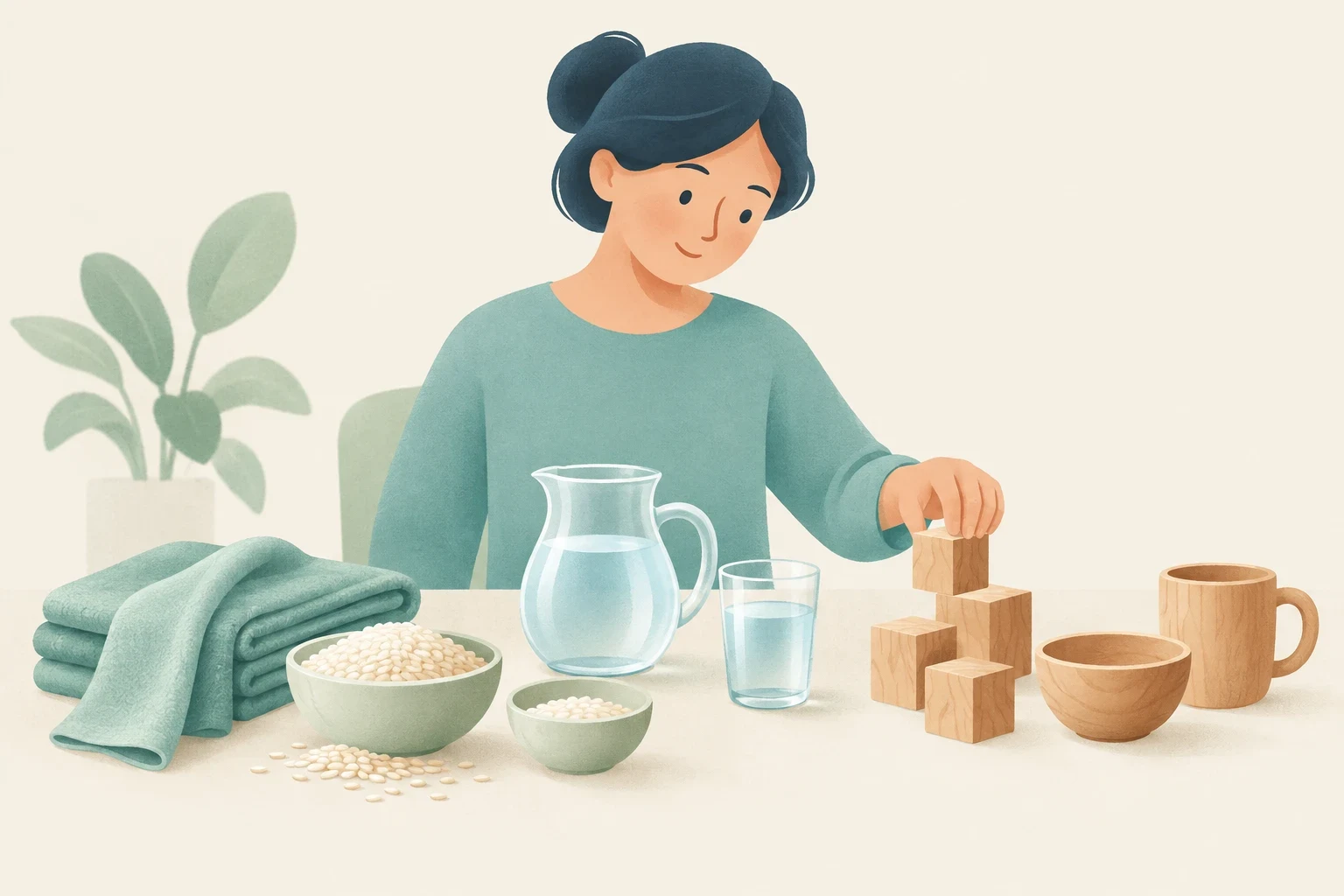

Stage 1 of 5
Understand
What it means, when to use it, and mistakes to avoid.
Examples
The counter is made of smooth marble that resists heat.
Why it works: Marble names the stone substance, so it functions as a noncount noun without an article.
3 more examples
-
We packed four bottles of water for the afternoon hike.
Bottles provides the countable unit while water remains in the singular noncount form.
-
Please recycle that empty glass bottle after finishing your drink.
Glass acts as a noun adjunct describing the material of the countable bottle.
-
The lawyer filed the incorporation papers with the city registry.
Papers means official legal documents, which makes the plural count form necessary.
Read the full guide
Decide whether the noun names a material or an object
Before you write or speak, ask yourself what the noun represents in your sentence. When a word refers to the physical substance something consists of rather than an individual counted item, it functions as a material noun. Common substances include wood, iron, clay, wool, and cotton. These words do not take the indefinite articles a or an when they describe general substances. Recognizing that you are naming raw matter rather than a single manufactured item keeps your sentence grammatically accurate from the start.
-
The old cottage door is crafted from solid oak.
Why it works: Oak names the natural wood used to build the door, not an individual countable object.
-
We use clay to shape traditional cooking pots.
Why it works: Clay refers to the raw substance, so no article or plural ending appears here.
Your turn
Which sentence treats the noun as a raw material rather than a counted object?
Answer: The heavy gate is forged from iron to prevent rust.
Show the answer
Answer: The heavy gate is forged from iron to prevent rust.
In this sentence, iron refers to the metal substance itself, so it acts as a noncount material noun without an article.
Choose quantity words instead of counting directly
Because material nouns describe an undivided mass, you cannot place numbers directly before them in standard descriptions. Saying three woods or four cements sounds unnatural when you simply mean an amount of the substance. Instead, rely on quantity determiners such as some, much, little, enough, or plenty of. These words allow you to describe volume or availability smoothly without forcing a noncount substance into an incorrect plural form. Selecting the right determiner clarifies your meaning immediately.
-
The builder added enough sand to stabilize the cement mixture.
Why it works: Enough sand expresses sufficient quantity without counting individual grains.
-
There is little gold remaining in that abandoned river valley.
Why it works: Little indicates a small amount of the precious metal in a noncount pattern.
You can practise this again in Concrete nouns: simple rules and examples and abstract nouns: everyday rules and examples.
Your turn
Which phrase correctly expresses a quantity of the material noun leather?
Answer: some leather for the upholstery
Show the answer
Answer: some leather for the upholstery
Some works naturally with noncount material nouns to show indefinite quantity without forcing a count form.
Add a countable unit to name an exact amount
When your message requires an exact count or commercial measurement, do not attach numbers directly to the material noun. Instead, insert a countable measurement or container noun before the substance name. Words like sheet, bar, bottle, meter, and kilogram provide the necessary boundary. In this structure, the first noun carries the number and the plural ending, while the material noun remains in its singular base form. This pattern lets you measure raw materials with complete grammatical precision.
-
The print shop ordered ten boxes of recycled paper.
Why it works: Boxes carries the number and plural ending, while paper stays singular as the substance.
-
Please pass me two bars of unscented soap from the cabinet.
Why it works: Bars provides the countable unit for the substance soap.
Your turn
Which option correctly states an exact quantity of water for the team?
Answer: five water bottles for the athletes
Show the answer
Answer: five water bottles for the athletes
Bottles is the countable noun that accepts the number five, while water remains the material name.
Distinguish a raw material from a shaped item
Several English words refer both to a raw substance and to a specific finished item made from that substance. Glass is a prime example of this split. In a window pane, glass is noncount because it names the clear material. At a dinner table, a glass is a countable container used for drinking liquids. Confusing these two patterns causes awkward errors in writing and listening. Always check whether your sentence focuses on the physical substance or on the shaped object before choosing your grammar.
-
Tempered glass withstands sudden temperature changes.
Why it works: Glass refers to the manufactured material, so it takes singular noncount grammar.
-
Could you place three clean glasses on the dining table?
Why it works: Glasses here means individual drinking vessels, making the plural form correct.
Your turn
In which sentence does glass refer to an individual object rather than the material?
Answer: He poured orange juice into a tall glass.
Show the answer
Answer: He poured orange juice into a tall glass.
A tall glass refers to a specific drinking vessel, which takes the article a and countable form.
Separate a writing material from printed documents
The word paper follows a dual pattern similar to glass, but learners often mistake its plural form in professional situations. When you speak about the raw substance used for writing or wrapping, paper is strictly noncount. We say two sheets of paper or a roll of paper. However, in legal, academic, and business contexts, papers refers to official documents, identification records, or scholarly articles. Deciding whether you mean the blank physical pulp or completed documents tells you whether to use the plural.
-
This printer needs more paper before we run the report.
Why it works: Paper refers to the raw sheets of printing material as an undivided supply.
-
The immigration officer examined our travel papers carefully.
Why it works: Papers means formal legal documents, which requires the countable plural.
Your turn
Which sentence uses paper as a noncount material noun?
Answer: The artist sketched the portrait on handmade paper.
Show the answer
Answer: The artist sketched the portrait on handmade paper.
Handmade paper describes the physical sheet material, functioning as a noncount material noun.
Recognize when a drink or food stands for a serving
Coffee, tea, soup, and juice can be noncount substances or countable servings. In a cafe, two coffees usually means two cups of coffee, and a soup means one serving or bowl of soup. These are standard count uses, not broken grammar rules. Use a unit noun when you need to specify the container or amount.
-
The table ordered three coffees and two orange juices.
Why it works: Coffees and juices serve as casual spoken shorthand for cups and glasses of those drinks.
-
Green tea contains antioxidants that support general wellness.
Why it works: Tea here names the general beverage substance, requiring noncount phrasing.
Your turn
What does the plural noun mean in 'We ordered four teas for our group'?
Answer: Four individual cups or mugs of tea.
Show the answer
Answer: Four individual cups or mugs of tea.
In restaurant ordering, teas is informal shorthand for individual servings or cups of tea.
Use plurals to discuss varieties
A material noun can be plural when it means different kinds. Several woods may mean pine, teak, and mahogany; different soils may mean several soil types. This usage occurs in specialist writing and everyday discussion. It contrasts varieties, not simply larger amounts of the same substance. Use noncount grammar when discussing the substance generally.
-
The cabinetmaker works with various hard woods from northern forests.
Why it works: Woods refers to different timber species, such as cherry and maple.
-
Chefs evaluate regional olive oils to balance delicate flavors.
Why it works: Oils refers to distinct varieties produced by different groves or processing styles.
Your turn
Why would an author write 'The research lab tested five European clays'?
Answer: To refer to five distinct types or mineral varieties of clay.
Show the answer
Answer: To refer to five distinct types or mineral varieties of clay.
The plural forms of material nouns in technical contexts indicate distinct varieties or classifications.
Check the meaning before finalizing your sentence
Before completing an email, report, or essay, run a fast verification on every noun that names a substance. Ask three quick questions. First, does the word name the raw matter itself? If so, drop any indefinite article and plural ending. Second, are you counting individual containers or measurements? If yes, place the plural ending on the container noun, not the substance. Third, are you describing specific documents, objects, or varieties? If the answer is yes, ensure your context makes that shift unmistakable.
-
We poured three buckets of water into the garden barrel.
Why it works: Buckets is counted while water stays singular as the substance.
-
Polished brass gives the entrance lanterns an elegant finish.
Why it works: Brass is the metal substance, so it remains noncount with no article.
Your turn
Which sentence demonstrates correct noncount usage for a material noun?
Answer: The new deck is built entirely from cedar wood.
Show the answer
Answer: The new deck is built entirely from cedar wood.
Cedar wood names the material without an incorrect indefinite article or plural ending.
Use it naturally
How people really use “Material nouns”
Neutral Fine almost anywhere, at work or with friends.
Words it often goes with
- smooth marbleThe table is made of smooth marble.
- bottles of waterWe need six bottles of water for the picnic.
- thick paperUse thick paper to make the cards.
- solid woodThis bench is made of solid wood.
What people also say
- “two sheets of paper” instead of “two papers” Use sheets when you mean pieces of paper for writing or drawing.
- “some water” instead of “a water” Use some for an amount of water. A water can mean one serving when ordering.
Questions about "Material nouns: rules and simple examples"
Why do some menus say 'two coffees' if coffee is a material or substance?
In conversational English, names of drinks often stand for individual cups or servings. While coffee as a raw substance or bean is noncount, ordering two coffees is short for two cups of coffee. The same pattern applies to teas, sodas, and juices in restaurants.
She ordered two coffees and a bottle of mineral water.
Coffee grows well in high mountain regions.
What is the difference between 'made of' and 'made from'?
Use 'made of' when the original substance is still recognizable in the finished object, such as a table made of wood. Use 'made from' when the material undergoes a chemical transformation or process, such as paper made from wood pulp or cheese made from milk.
This warm blanket is made of pure sheep wool.
Plastic bottles are made from petroleum compounds.
How can words like glass and paper be both countable and noncountable?
The grammar shifts because the meaning changes. When glass refers to the hard transparent material, it is noncount. When it refers to a drinking vessel, it is countable. Similarly, paper refers to the writing material, while papers refers to documents or academic essays.
The window was replaced with shatterproof glass.
Please hand me a clean glass for some water.
The clerk organized the tax papers into neat folders.
Can I say 'three waters' or should I say 'three glasses of water'?
In formal writing or precise descriptions, always use a unit or container word such as glasses, bottles, or liters. Saying 'three waters' is common when ordering quickly in casual dining, but using container words prevents confusion and is standard across all contexts.
We packed five bottles of water for the hike.
The server brought three glasses of water to our table.
Before you go
Remember this
Material nouns name the physical matter of the world and normally take noncount grammar: some sand, much iron, or a piece of leather. To count an amount, count the unit or container instead. Shift to count grammar only when your sentence refers to a specific manufactured object, an official document, a drink serving, or a distinct variety.
Stage 2 of 5
Listen
Hear it in real sentences, from short to long, and write what you hear.
0 of 4 done
Listening 1 of 4
Listening 2 of 4
Try a longer clip. Listen once, then replay the part you missed.
Listening 3 of 4
This clip is longer. Follow the instruction above the answer field.
Listening 4 of 4
Listen, then type the missing words. The rest of the text is already there.
0:00
Practice complete
You listened closely.
Your result is saved in this browser.
Keep your progress. Your practice is saved on this device only. Create a free account to keep it everywhere.
Create a free accountThat was today's free lesson. Tomorrow you get another one. Want more today? See membership.
Create a free SubLearn account to keep this progress across devices.
Save my progressStage 3 of 5
Speak
Say it with the speaker, then use it in your own answer.
Shadow
Say it along with the speaker
Play the line slowly, then speak at the same time as the speaker. Copy the rhythm, not just the words.
Your turn
Say it your way
Speak from memory for 30 to 60 seconds. You are organizing an art activity for children at a park festival. Explain what supplies and drinks you will bring, how much you need, and what everyone will do with them.
Use: paper bottles of water glass bottle
Take ten seconds to think, then answer out loud without looking at the lesson. Speak for the time shown in the task above. Nothing is sent unless you ask for feedback.
0:00
Hear how someone else might say it
I'm planning an art activity for ten children at the park festival. I'll bring some paper and a box of colored pencils. Each child will get three sheets to draw animals or flowers. We also need ten bottles of water because we will be outside all afternoon. I'll bring a glass bottle to hold a few flowers for the children to draw. I'll keep it on my table so it doesn't fall. At the end, we'll collect the extra paper and put all the empty bottles in the recycling bin.
Try once more and answer this: What will the children make?
Stage 4 of 5
Write
Use what you've learned to write about your day or week, then write a message.
Write
Put it in your own words
- I used “Material nouns”.
- It is about my life, not the lesson’s example.
- I read it once aloud to check it sounds right.
Write your own response
Choose a situation and write 30–50 words of your own. In this activity, you decide what to say rather than copy the words in a recording.
Check your own writing
Read one possible response
Use these checks to revise your message. Grammar and meaning are not automatically graded. Each task keeps its own draft in this browser tab.

You finished the free part of this lesson
- Understand
- Listen
- Speak
- Write
- CheckPart of membership
Worth another look
With a free account, the lessons you finish come back for review to help you remember them.Create a free account
Stage 5 of 5 · Part of membership
Check
New clips without hints.
Listening tests are included with membership. Try the free dictation first, then decide whether to continue.
Listening 1 of 2 Part of membership
Listening 2 of 2 Part of membership
Follow MicroEnglish
Find lesson updates, short videos and quick quizzes. Pick the app you already use.
Questions & comments
Ask about this lesson, share an example, or help another learner.
Example
Memory tip
Goes with
Related forms
Not to be confused with
In this lesson
This word isn't in our dictionary. Check the spelling, or try another form of the word.
We couldn't load this word. Try again.