Micro-listening
Interjections in Daily English: Choosing, Punctuating, and Hearing Everyday Reactions
The short answer
An interjection is a sound, single word, or brief phrase that expresses an immediate reaction or emotion. It does not connect grammatically to subject-verb structures, and its spelling remains identical regardless of tense, person, or quantity.
Key points
- Interjections communicate fast feelings without complicated grammar.
- Pitch and context clarify intended meaning, while commas and end punctuation determine written emphasis.
- In spoken English, use interjections to react spontaneously to physical events, social moments, and new information.
This lesson has 5 stages. You can stop at any time and continue later.

Stage 1 of 5
Understand
What it means, when to use it, and mistakes to avoid.
Examples
Ouch, this wooden splinter got caught in my thumb.
Why it works: Ouch signals immediate physical discomfort caused by the wood splinter.
3 more examples
-
Oops, I printed the inventory list on single-sided paper by mistake.
Oops marks a minor clerical slip that creates no major harm.
-
Phew, the paint dried before our guests walked into the hallway.
Phew shows relief that an inconvenient mess was avoided.
-
Wow, this restored bicycle rides so smoothly across the gravel.
Wow expresses genuine admiration for the quality of the restored bicycle.
Read the full guide
Express an Immediate Reaction with an Interjection
When an unexpected event happens, English speakers often produce a brief vocal reaction before formulating a complete grammatical sentence. These short sounds and words are called interjections. They do not depend on a subject or verb, and their forms never change for past tense or plural numbers. You can speak one by itself to communicate how you feel right away.
-
Ouch! That metal latch pinched my palm.
Why it works: Ouch functions as an independent reaction communicating physical hurt.
-
Wow, this fresh bread tastes delicious.
Why it works: Wow introduces a full sentence to express genuine admiration.
Your turn
Which sentence uses an interjection to communicate an immediate reaction to physical pain?
Answer: Ouch, a sharp rose thorn poked right through my gardening glove.
Show the answer
Answer: Ouch, a sharp rose thorn poked right through my gardening glove.
Ouch directly signals the sudden physical pain of being poked by a thorn.
Select the Right Reaction from Everyday Choices
This compact reference table helps you select common everyday reaction words based on the feeling and social situation you experience. These eleven interjections represent everyday conversational choices rather than an exhaustive list. Notice that tone of voice shapes meaning significantly: for instance, hey can sound warmly friendly or abruptly sharp depending on your pitch and volume.
| Reaction | Common Meaning | Situation | Original Example |
|---|---|---|---|
| oh | Realization, surprise, or mild disappointment | Noticing new facts or remembering an errand | Oh, the library is closed on Monday mornings. |
| ah | Understanding, discovery, or sudden clarity | Finally figuring out a puzzle or explanation | Ah, now I see how these two pieces lock together. |
| wow | Strong surprise, wonder, or shock | Seeing an impressive achievement or massive damage | Wow, that handmade wooden table is stunning. |
| ouch | Sudden physical pain or sharp hurt | Getting pinched, scratched, or bumped | Ouch, that rose thorn poked through my glove. |
| oops | Harmless mistake or minor clumsiness | Dropping a small item or making a typo | Oops, I printed the schedule on the wrong paper. |
| uh-oh | Developing problem or impending trouble | Seeing something begin to tip over or leak | Uh-oh, dark water is pooling under the sink. |
| phew | Relief, cooling down, or escaping danger | Narrowly avoiding a stressful mishap | Phew, our bus arrived right before it began raining. |
| ew | Physical disgust or repulsion | Encountering spoiled food or sticky dirt | Ew, someone left sour milk inside the locker. |
| yay | Celebration, joy, or shared victory | Finishing a difficult project or hearing good news | Yay, we completed the assembly ahead of schedule! |
| hmm | Thinking, hesitation, or uncertainty | Pausing to weigh options or ponder a choice | Hmm, I am not sure which bus stop is closer. |
| hey | Attracting attention or greeting | Calling to someone (warning: delivery can sound friendly or sharp) | Hey, you left your transit pass on the counter. |
-
Hmm, I am not sure which bus stop is closer to the library.
Why it works: Hmm reflects a moment of pause and thoughtful uncertainty.
-
Hey, you dropped your transit pass near the ticket counter.
Why it works: Hey catches someone's attention, sounding friendly or sharp depending on tone.
You can practise this again in Optative sentences: choosing hope or wish and Speak English Online: Simple Daily Practice.
Your turn
Which reaction word best fits a moment of thoughtful pause while deciding between two dinner recipes?
Answer: Hmm
Show the answer
Answer: Hmm
Hmm represents hesitation, quiet thinking, or uncertainty between options.
Distinguish Between Noticing and Strong Surprise
Deciding between oh and wow depends on whether you are simply noticing new information or feeling genuinely amazed. Use oh when a fact becomes clear, when someone reminds you of an errand, or when you feel mild disappointment. Use wow when an achievement or sight impresses you deeply. While oh fits quiet everyday realizations, wow marks stronger surprise, which may include shock rather than praise.
-
Oh, the grocery store closes an hour earlier on Sundays.
Why it works: Oh marks the quiet realization of new factual information.
-
Wow, the storm knocked down that hundred-year-old oak tree.
Why it works: Wow expresses shock at the severe impact of the storm.
Your turn
Which sentence indicates deep admiration and amazement rather than casual acknowledgment?
Answer: Wow, that handmade wooden table shows astonishing detail and balance.
Show the answer
Answer: Wow, that handmade wooden table shows astonishing detail and balance.
Wow conveys strong surprise, admiration, and wonder toward skilled craftsmanship.
Tell Pain, Mistakes, and Impending Trouble Apart
Choosing among ouch, oops, and uh-oh depends on what you want the listener to notice first. Say ouch when your body hurts or when someone makes a stinging remark. Say oops when you make a clumsy mistake without causing injury. Say uh-oh when you detect warning signs of bigger trouble ahead. The same incident can trigger different reactions depending on your personal focus.
Listen to the endings of ouch and oops. Ouch ends with a 'ch' sound. In oops, your lips close for /p/, then open to let air pass for /s/. Uh-oh has two parts, often separated by a brief catch in the throat. Phew begins with a breathy sound. Compare the reactions as you listen.
-
Oops, I typed the wrong apartment number on the package label.
Why it works: Oops identifies a harmless clerical error that can be rewritten.
-
Uh-oh, dark water is seeping from under the kitchen dishwasher.
Why it works: Uh-oh warns of an escalating plumbing problem requiring fast intervention.
Your turn
A painter notices a tall ladder beginning to tilt away from the wall. Which reaction fits best?
Answer: Uh-oh
Show the answer
Answer: Uh-oh
Uh-oh signals immediate awareness of approaching danger or a developing accident.
Express Relief, Disgust, and Celebration Accurately
Three common reactions help you express physical sensations and emotional releases. Phew indicates that an uncomfortable tension or danger has passed, though speakers also use it when reacting to extreme heat or an unpleasant odor. Deliver phew with an audible, breathy sigh through the lips rather than a harsh consonant sound. Ew signals instant physical disgust toward something dirty or spoiled. Yay celebrates personal success or shared good news. Selecting among them clarifies your exact emotional state.
-
Phew, the mechanic repaired our car brakes before our road trip.
Why it works: Phew signals relief that a potential safety hazard was resolved.
-
Ew, someone left sticky syrup all over the kitchen counter.
Why it works: Ew shows disgust at touching an unclean kitchen surface.
Your turn
Which sentence clearly expresses relief that a stressful safety inspection is over?
Answer: Phew, the fire inspector approved all of our emergency exits.
Show the answer
Answer: Phew, the fire inspector approved all of our emergency exits.
Phew conveys relief after the tension of an official inspection concludes safely.
Place Reactions Alone or Before a Complete Sentence
Interjections are grammatically independent, which allows them to stand alone as complete utterances or sit directly in front of full sentences. You can also place a reaction at the end of a statement when speaking naturally, as in 'You finished that report already, wow.' When you want to explain why you reacted, place the reaction at the start of your sentence. Each position helps you adapt your natural rhythm in conversation.
-
Ouch! That metal edge scratched my wrist.
Why it works: The interjection introduces an explanatory sentence describing the injury.
-
Did you finish the whole five-mile run already? Wow.
Why it works: Wow stands as a standalone conversational response following a question.
Your turn
Which dialogue snippet shows an interjection functioning as a standalone conversational response?
Answer: Colleague: 'The audit passed without penalties.' Auditor: 'Phew.'
Show the answer
Answer: Colleague: 'The audit passed without penalties.' Auditor: 'Phew.'
Phew stands completely by itself as an autonomous response without an attached clause.
Choose Commas and End Marks to Guide Delivery
In written English, punctuation marks indicate the rhythm and emotional volume of your spoken voice. A comma connects an opening reaction softly to the following clause when the feeling is calm. An exclamation point gives the reaction separate emphasis, creating a dramatic pause before the sentence begins. Use a question mark for an inquiring tone like Oh? and a period for quiet, flat standalone remarks.
-
Oh, the delivery van just pulled into our gravel driveway.
Why it works: The comma smoothly attaches Oh to the sentence with a gentle pause.
-
Oh! The delivery van just backed into our wooden fence.
Why it works: The exclamation mark provides strong dramatic separation for an urgent event.
Your turn
Which written sentence links an opening reaction smoothly to the sentence with a comma?
Answer: Oh, the delivery van just pulled into the driveway.
Show the answer
Answer: Oh, the delivery van just pulled into the driveway.
A comma connects the interjection directly to the main clause with a mild pause.
Hear How Intonation Changes the Message of Oh
The two-letter reaction oh changes its communicative meaning through vocal intonation rather than spelling. A rising pitch turns oh into a questioning reaction that asks for confirmation or shows mild disbelief. A falling pitch signals steady understanding, quiet acceptance, or mild disappointment. Paying attention to pitch movement alongside the physical setting prevents misunderstandings in fast conversational exchanges.
-
Oh? I thought the museum opened at nine rather than ten.
Why it works: A rising pitch presents Oh as a polite check regarding the opening schedule.
-
Oh, I see where the spare printer paper is stored now.
Why it works: A falling pitch expresses clear realization and comprehension.
Your turn
What does a rising pitch on the word Oh typically signal in conversational English?
Answer: Inquiry, surprise, or seeking confirmation
Show the answer
Answer: Inquiry, surprise, or seeking confirmation
A rising pitch indicates that the speaker is questioning or verifying new facts.
Follow Changing Reactions During a Practical Task
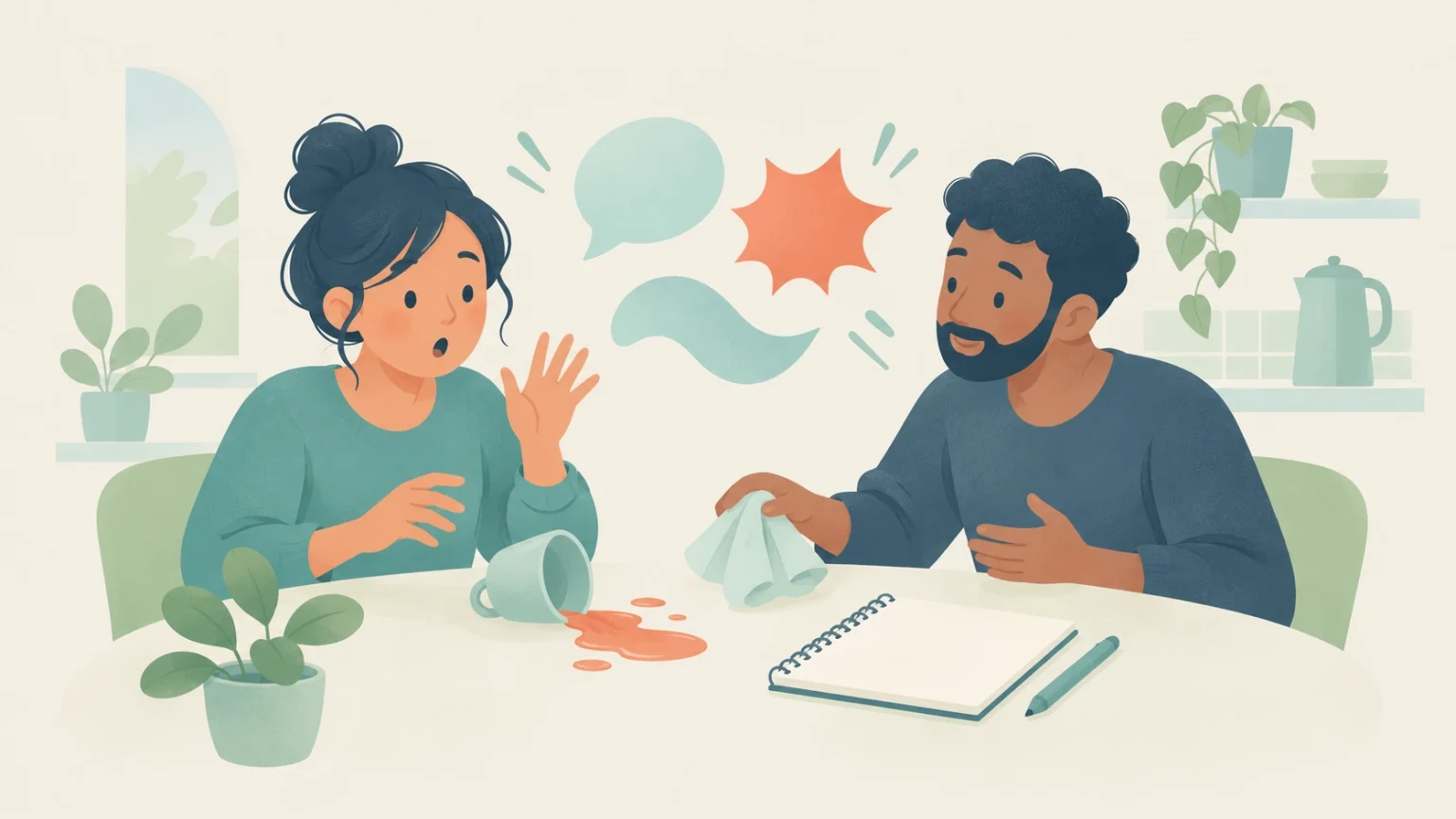
Working through a practical project with a partner demonstrates how different reaction words arise naturally as events unfold. While assembling furniture, two people often navigate small missteps, physical hazards, and shared milestones together. Real conversations shift between these words fluidly based on immediate actions, moving from quick slips to relief and final celebration without adhering to an artificial script.
-
Elena: 'Oops, I slid the shelf bracket upside down on this side.'
Why it works: Elena realizes she made a harmless assembly mistake.
-
Marco: 'Uh-oh, hold that panel steady before the wooden pegs twist.'
Why it works: Marco spots impending damage to the wooden frame.
-
Elena: 'Ouch! The metal clamp pinched my index finger.'
Why it works: Elena reacts to sudden physical pain from the metal clamp.
-
Marco: 'Phew, the support brace locked into place and nothing broke.'
Why it works: Marco expresses relief once the frame is safely secured.
-
Elena: 'Yay, the top shelf snapped into the side brackets perfectly!'
Why it works: Elena celebrates successfully finishing the shelf.
Your turn
During furniture assembly, which reaction best fits the moment someone drops a wooden dowel under the couch?
Answer: Oops
Show the answer
Answer: Oops
Oops fits an accidental, harmless drop of an assembly part.
Adjust Reaction Words for Politeness and Workplace Tone
Reaction words appear frequently in casual conversations and friendly workplace chat channels, but they require careful judgment in professional correspondence. When an important project deadline slips or a customer order goes missing, writing oops can sound dismissive or irresponsible. In formal or serious situations, state the issue directly, apologize respectfully, and explain the concrete correction you plan to take.
-
Oops, I attached the rough draft instead of the approved presentation slides.
Why it works: Acceptable in a casual team chat channel among close colleagues.
-
We apologize for the delayed shipment and have arranged morning courier delivery.
Why it works: Professional phrasing appropriate for addressing an affected client.
Your turn
Which message is most suitable for an email to an important corporate client regarding a delayed shipment?
Answer: We apologize for the delivery delay and have arranged expedited morning shipping.
Show the answer
Answer: We apologize for the delivery delay and have arranged expedited morning shipping.
Formal client communication requires a clear apology and an actionable solution.
Avoid Misleading Reactions Without Rejecting Natural Choices
Several reaction words can fit the same event. A burnt cookie might prompt oh when you notice it, oops when you realize you forgot it, or uh-oh when you see smoke. Choose the word that fits your reaction. Ouch can express physical pain or an emotional sting, such as a hurtful remark.
-
Uh-oh, the oven timer rang five minutes ago and the crust looks dark.
Why it works: Focuses on the threat of the baked food burning.
-
Oops, I forgot to check the kitchen timer while cleaning the sink.
Why it works: Focuses on the personal oversight rather than the food itself.
Your turn
Why is it inaccurate to claim that wow always expresses enthusiastic approval?
Answer: Because wow can also express stunned disbelief or shock at negative destruction.
Show the answer
Answer: Because wow can also express stunned disbelief or shock at negative destruction.
Wow indicates strong amazement or shock, which can be negative as well as positive.
Recall and Write Reactions in Fresh Contexts
Building confidence with reaction words requires practicing both auditory recognition and spontaneous recall. Start by listening for the physical context and speaker attitude before you worry about exact letters. Focus on clear pronunciation: contrast the distinct final sounds of ouch and oops, practice the two distinct parts of uh-oh separated by a brief pause, and produce the soft, breathy delivery of phew. Once you understand the speaker's emotional state, you can write the correct reaction and recall it quickly in daily conversations.
-
Phew, the mechanic said the strange engine rattling was only a loose bolt.
Why it works: Recalls the relief reaction after an automotive concern turns out harmless.
-
Ouch! A hot spark leaped out of the campfire onto my woolen sock.
Why it works: Recalls the pain reaction following sudden heat contact.
Your turn
When listening to rapid conversational speech, what is the best first step for identifying an unfamiliar reaction word?
Answer: Listen for the speaker's physical situation and emotional state before guessing the spelling.
Show the answer
Answer: Listen for the speaker's physical situation and emotional state before guessing the spelling.
Identifying context and emotional intention provides the clearest clue to the target reaction word.
Use it naturally
How people really use “Phew”
Informal Relaxed; better with friends and colleagues than in formal writing.
Words it often goes with
- Phew, that's overPhew, that's over for today!
- Phew, what a reliefPhew, what a relief to be indoors after that long walk!
- Phew, we made itPhew, we made it to the station before the train left.
What people also say
- “Phew, I can relax now!” instead of “I am experiencing relief now.” Use this when something stressful has ended.
Questions about "Interjections in Daily English: Choosing, Punctuating, and Hearing Everyday Reactions"
What is an interjection?
An interjection is a short spoken word or sound used to convey an immediate feeling, evaluation, or reaction. It functions independently without requiring grammatical connections to subjects or verbs.
Ouch! That metal corner is sharp.
Wow, you finished painting the shed quickly.
What are the most common interjections in English?
Everyday English relies heavily on oh, ah, wow, ouch, oops, uh-oh, phew, ew, yay, hmm, and hey. Each word corresponds to familiar communicative needs like noticing, realizing, feeling pain, or signaling surprise.
Phew, the final bus arrived on schedule.
Yay, our community garden project won first prize.
What is the difference between oh and wow?
Use oh for moments of noticing, cognitive realization, or mild acknowledgment. Use wow when an experience causes deep surprise, amazement, or profound shock.
Oh, I see where you left your keys.
Wow, this hand-carved clock is magnificent.
When should I say ouch, oops or uh-oh?
Say ouch when experiencing physical discomfort or emotional hurt. Say oops when acknowledging an accidental minor slip. Say uh-oh when detecting early signs of danger or an unfolding problem.
Ouch, that thorn punctured my skin.
Oops, I dropped my pencil.
Uh-oh, the ceiling has started to leak.
Do interjections always need an exclamation mark?
No. An exclamation point indicates strong volume or intense emotion. A comma attaches an interjection softly to an ongoing sentence, a period marks flat delivery, and a question mark reflects an inquiring tone.
Oh, I forgot my notebook today.
Oh? Did the manager change the policy?
Can I use interjections in work emails?
In informal team chats and quick notes to close coworkers, mild reactions like oops or phew are common. In formal client communication or serious apologies, omit interjections in favor of clear factual explanations and professional remedies.
Team chat: Oops, sent the old slide link!
Client email: We apologize for the delay and will deliver the shipment by noon.
Before you go
Remember this
Interjections communicate fast feelings without complicated grammar. Choose oh to show realization, wow for strong admiration or surprise, ouch for pain, oops for harmless mistakes, uh-oh for looming problems, phew for relief, ew for disgust, and yay for celebration. Pitch and context clarify intended meaning, while commas and end punctuation determine written emphasis.
Stage 2 of 5
Listen
Hear it in real sentences, from short to long, and write what you hear.
0 of 4 done
Listening 1 of 4
Listening 2 of 4
Try a longer clip. Listen once, then replay the part you missed.
Listening 3 of 4
This clip is longer. Follow the instruction above the answer field.
Listening 4 of 4
Listen, then type the missing words. The rest of the text is already there.
0:00
Practice complete
You listened closely.
Your result is saved in this browser.
Keep your progress. Your practice is saved on this device only. Create a free account to keep it everywhere.
Create a free accountThat was today's free lesson. Tomorrow you get another one. Want more today? See membership.
Create a free SubLearn account to keep this progress across devices.
Save my progressStage 3 of 5
Speak
Say it with the speaker, then use it in your own answer.
Shadow
Say it along with the speaker
Play the line slowly, then speak at the same time as the speaker. Copy the rhythm, not just the words.
Your turn
Say it your way
Speak for 30 to 60 seconds from memory. Imagine you have just finished your first full exercise class at a gym. Tell a friend how you felt before, during, and after it. Express relief and explain whether you would go again.
Use: Phew
Take ten seconds to think, then answer out loud without looking at the lesson. Speak for the time shown in the task above. Nothing is sent unless you ask for feedback.
0:00
Hear how someone else might say it
Phew, that class was hard! Before it started, I felt nervous because everyone else seemed to know the exercises. I wanted to finish the whole class without stopping. The first ten minutes were fine, but then my legs began to feel tired. I slowed down and followed the teacher carefully. At the end, I sat down and took a long drink of water. I felt relieved that I could rest. I would go again, but next time I would choose a shorter class.
Try once more and answer this: Which exercise was the hardest?
Stage 4 of 5
Write
Use what you've learned to write about your day or week, then write a message.
Write
Put it in your own words
- I used “Phew”.
- It is about my life, not the lesson’s example.
- I read it once aloud to check it sounds right.
Write your own response
Choose a situation and write 30–50 words of your own. In this activity, you decide what to say rather than copy the words in a recording.
Check your own writing
Read one possible response
Use these checks to revise your message. Grammar and meaning are not automatically graded. Each task keeps its own draft in this browser tab.

You finished the free part of this lesson
- Understand
- Listen
- Speak
- Write
- CheckPart of membership
Worth another look
With a free account, the lessons you finish come back for review to help you remember them.Create a free account
Stage 5 of 5 · Part of membership
Check
New clips without hints.
Listening tests are included with membership. Try the free dictation first, then decide whether to continue.
Listening 1 of 2 Part of membership
Listening 2 of 2 Part of membership
Follow MicroEnglish
Find lesson updates, short videos and quick quizzes. Pick the app you already use.
Questions & comments
Ask about this lesson, share an example, or help another learner.
Example
Memory tip
Goes with
Related forms
Not to be confused with
In this lesson
This word isn't in our dictionary. Check the spelling, or try another form of the word.
We couldn't load this word. Try again.
