
Micro-listening
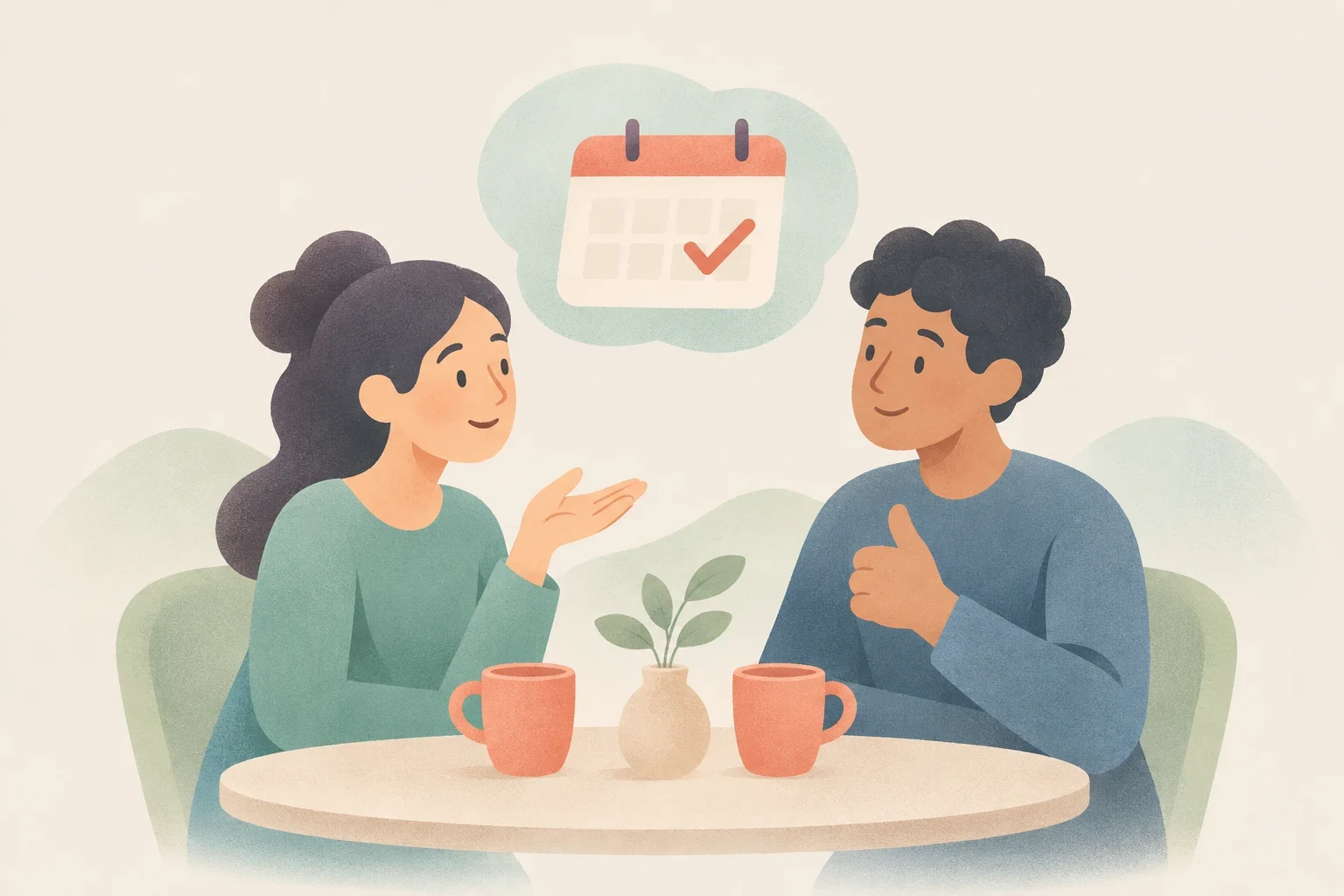
Are we still meeting tomorrow: confirming plans
Is it 'if we still meeting tomorrow' or 'if we are still meeting tomorrow'?
The word 'still' shows that the arrangement existed before now, and 'are meeting' talks about a fixed future plan. If you start your message with 'I wanted to ask if...', keep the word 'are' or the contraction 'we're': 'I wanted to ask if we're still meeting tomorrow.'
Key points
- You can also ask 'Are we still on for Friday?' or 'Is tomorrow still good for you?' when checking a shared schedule.
- Start a direct check-in with 'Are we still meeting...?' or 'Are we still on for...?'.
- In an indirect question after 'if' or 'whether', switch to statement word order and keep the helping verb: 'if we are still meeting' or 'if we're still meeting'.
This lesson has 5 stages. You can stop at any time and continue later.

Stage 1 of 5
Understand
What it means, when to use it, and mistakes to avoid.
Examples
Are we still meeting tomorrow morning at the coffee shop?
Why it works: A natural direct question using 'are we still meeting' to check an existing plan.
3 more examples
-
I just wanted to check if we're still meeting tomorrow afternoon.
A polite indirect check-in that keeps the contraction 'we're' after 'if'.
-
Are we still on for Friday lunch, or do you need to reschedule?
'Still on for' works well before a day, meal, or shared event.
-
Yes, we're still on, and I will see you at two o'clock.
A short, friendly reply that confirms both the plan and the meeting time.
Read the full guide
Ask if a planned meeting is still happening
Use 'Are we still meeting tomorrow?' when you already made a plan with someone and want to check that it has not changed. The word 'still' shows that the arrangement existed before now, and 'are meeting' talks about a fixed future plan. If you start your message with 'I wanted to ask if...', keep the word 'are' or the contraction 'we're': 'I wanted to ask if we're still meeting tomorrow.'
Without the word 'still', the question 'Are we meeting tomorrow?' can sound as if you forgot the schedule completely. Including 'still' tells your coworker or friend that you remember the agreement. It gives the other person an easy way to confirm the time or mention a schedule conflict.
-
Are we still meeting tomorrow to review the project budget?
Why it works: 'Still' confirms a plan that both people agreed on earlier.
-
Hi Maya, are we still meeting at the café at ten?
Why it works: Works well in a quick morning text message before you leave home.
-
Are we meeting tomorrow, or did we pick Thursday instead?
Why it works: Without 'still', the speaker is unsure which day was chosen.
Your turn
Why do speakers add the word 'still' in 'Are we still meeting tomorrow?'
Answer: To show that the meeting was arranged earlier and check that nothing changed
Show the answer
Answer: To show that the meeting was arranged earlier and check that nothing changed
'Still' connects the question to an existing plan and checks that the arrangement holds.
Build the question with are we still and an -ing verb
Start a direct question with 'Are we still', then add an '-ing' verb such as 'meeting', 'having', or 'going'. English uses this form, called the present continuous, for a single future arrangement that two people have already agreed on. You can review more examples of fixed arrangements in /grammar/future-plans/.
Do not use 'Do we still meet tomorrow?' for one appointment. The present simple ('do we meet') asks about a repeated routine or timetable, such as a weekly class. When you mean one specific coffee chat or office meeting tomorrow, use 'Are we still meeting tomorrow?'
Compare how the helping verb changes the meaning between a single tomorrow plan and a regular weekly schedule. A negative question such as 'Aren't we still meeting?' sounds surprised and is used only when you think the other person forgot.
-
Are we still meeting tomorrow afternoon?
Why it works: Present continuous ('are we still meeting') for one fixed future arrangement.
-
Do we still meet every Tuesday morning?
Why it works: Present simple ('do we still meet') for a repeated weekly schedule.
-
Aren't we still having lunch with the design team today?
Why it works: Negative question used when something suggests the plan might have been forgotten.
-
Are we still having lunch together after the training session?
Why it works: 'Are we still having' checks a shared meal plan.
-
Are we still going to the workshop on Friday morning?
Why it works: 'Are we still going' checks a plan to attend an event together.
You can practise this again in Weather-dependent plans and Already, still, yet: choose the right word.
Your turn
You have one coffee meeting planned with a coworker tomorrow. Which question is natural?
Answer: Are we still meeting for coffee tomorrow?
Show the answer
Answer: Are we still meeting for coffee tomorrow?
Use 'Are we still meeting' (present continuous) for one planned future meeting, not 'Do we still meet'.
Choose between still meeting, still on, and still good for you
You do not have to repeat the verb 'meeting' in every message. In everyday conversation, people often say 'Are we still on for [day or event]?' Here, 'on' is an adjective meaning planned and active. If a meeting is canceled, people say 'The meeting is off.'
When you want to focus on the other person's convenience, make the day or time the subject of your question. Ask 'Is tomorrow still good for you?' or 'Does two o'clock still work for you?' Both questions make it comfortable for the other person to ask for a new time.
| Question pattern | What follows | Best situation |
|---|---|---|
| Are we still meeting...? | Time or place (tomorrow, at noon) | Neutral check-in with a coworker, classmate, or client |
| Are we still on for...? | Noun, meal, or day (Friday, lunch, coffee) | Friendly, natural check-in with a colleague or friend |
| Is [time] still good for you? | No extra object needed | Checking whether the other person's schedule is still free |
| Does [time] still work for you? | No extra object needed | Polite workplace email or message confirming a clock time |
-
Are we still on for Friday, or would next Monday be easier?
Why it works: 'Still on for' is followed by a day, time, or activity noun.
-
Is tomorrow morning still good for you?
Why it works: Puts the focus on whether the time suits the listener.
-
Does two o'clock still work for you, or should we meet later?
Why it works: 'Does [time] still work for you?' is polite and common at work.
Your turn
Which word completes 'Are we still ___ for lunch tomorrow?'
Answer: on
Show the answer
Answer: on
The fixed expression is 'be still on for [a day or event]', meaning the plan is still active.
Keep the helping verb are in indirect questions
When you soften a message with 'I just wanted to check if...' or 'I'm writing to see whether...', the second part of the sentence is called an indirect question. In an indirect question, the subject 'we' comes before 'are': 'I just wanted to check if we are still meeting tomorrow.'
A very common mistake is dropping 'are' and writing 'check if we still meeting tomorrow.' Learners make this mistake because spoken 'we're' sounds almost identical to 'we' before 'still'. In grammar, an '-ing' verb like 'meeting' cannot stand alone after 'we' without 'are' or the contraction 'we're'.
Check two things whenever you use 'if' or 'whether' to confirm a plan. First, keep 'are' or '-re' with 'we'. Second, put 'we are' in statement order rather than question order ('if we are', never 'if are we').
-
I just wanted to check if we're still meeting tomorrow.
Why it works: Correct: keeps the contraction 'we're' instead of dropping the verb in 'if we still meeting'.
-
Could you let me know whether we are still meeting at ten?
Why it works: Correct: uses statement order ('we are') after 'whether', not 'whether are we'.
-
I'm texting to see if tomorrow is still good for you.
Why it works: Correct: keeps 'is' after 'tomorrow' in an indirect check-in.
-
I wanted to ask if we are still meeting in the main office tomorrow.
Why it works: Full form 'we are' looks clean and professional in a workplace email.
-
Just checking if we're still on for coffee before the presentation.
Why it works: Short, natural text message that keeps the contraction 'we're'.
Your turn
Which indirect check-in is grammatically correct?
Answer: I just wanted to check if we're still meeting tomorrow.
Show the answer
Answer: I just wanted to check if we're still meeting tomorrow.
After 'if', use statement word order ('we are' or 'we're') and never drop the helping verb before 'meeting'.
Match your question to a coworker, client, or friend
The way you confirm a plan depends on who you are messaging. With a close friend or peer, a short question such as 'Are we still on for tonight?' or 'Still good for lunch?' feels warm and relaxed. You do not need a long introduction in a chat app.
With a client or senior manager, a complete sentence with a polite opener works better. Write 'I wanted to confirm that two o'clock tomorrow still works for you.' If you need to confirm a formal clinic or service appointment instead of a shared peer plan, compare /micro-listenings/2-2/.
Choose your phrasing by how well you know the other person and how easy it should be for them to reschedule. Adding 'still work for you' shows respect for a busy client's calendar.
-
Hey, are we still on for dinner at seven?
Why it works: Casual and friendly for a text message to a friend.
-
Hi Alex, are we still meeting at eleven to review the slides?
Why it works: Direct and polite for a coworker on a team chat.
-
Hello Ms. Patel, I'm writing to confirm whether ten o'clock tomorrow still works for you.
Why it works: Polite and professional for an email to a client.
-
Looking forward to our call tomorrow, and please let me know if two o'clock still works for you.
Why it works: Combines a warm note with an easy way for a client to adjust the time.
-
Are we still on for our study session after class?
Why it works: Natural phrasing for a classmate or peer.
Your turn
You are sending an email to a new client the day before a meeting. Which sentence fits best?
Answer: I'm writing to check whether two o'clock tomorrow still works for you.
Show the answer
Answer: I'm writing to check whether two o'clock tomorrow still works for you.
A complete indirect sentence checking whether the time still works is polite and appropriate for a client.
Place still and time expressions in the right order
The word 'still' changes position depending on the verb in your sentence. When you use 'am', 'is', or 'are', place 'still' after the subject in a question ('Are we still meeting?') and after 'be' in a statement ('We're still meeting'). Place it before an ordinary verb like 'work' ('Does Friday still work?').
Time words such as 'tomorrow', 'at two o'clock', or 'for Friday' usually go at the end of the question. You can also place the day or time at the front as the subject when you use 'be good' or 'work'. For plans that depend on outside conditions, see /micro-listenings/5-2/.
Keep 'still' right before the main '-ing' verb, before 'on' or 'good', or before 'work'. Never put 'still' at the very end of the question when confirming a schedule.
-
Are we still meeting at ten o'clock tomorrow?
Why it works: 'Still' goes between 'are we' and 'meeting'; the clock time and day go at the end.
-
Is Thursday afternoon still good for you?
Why it works: The time phrase is the subject, and 'still' comes after 'is Thursday afternoon'.
-
Does three thirty still work for your team?
Why it works: With the main verb 'work', 'still' comes directly before 'work'.
-
We're still meeting in Room 4B right after lunch.
Why it works: In a statement, 'still' comes after 'we're' and before 'meeting'.
-
Are we still on for coffee at nine tomorrow morning?
Why it works: A shorter time unit ('at nine') usually comes before the broader day ('tomorrow morning').
Your turn
Which sentence puts 'still' in the natural position?
Answer: Does ten o'clock still work for you tomorrow?
Show the answer
Answer: Does ten o'clock still work for you tomorrow?
With a main verb like 'work', place 'still' after the subject ('ten o'clock') and right before the verb ('work').
Hear weak forms and contractions when people confirm plans
In natural spoken English, helping verbs such as 'are', 'do', and 'does' are usually unstressed when they start a question. Speakers pronounce 'Are we' quickly with a weak vowel sound, so 'Are we still meeting?' focuses stress on the words 'still', 'meet-', and the time expression.
Inside a sentence, 'we are' contracts to 'we're', which often sounds like a short 'wer' before 'still'. Because the '/r/' sound blends smoothly into the next word, learners often hear 'if we still meeting' even when the speaker actually said 'if we're still meeting'. Listen for the rhythm and supply the verb in writing.
Content words that carry the decision ('still', 'meeting', 'on', 'good', 'tomorrow') get clear stress. Grammar glue words ('are', 'we're', 'for', 'at') are spoken quickly and linked to neighboring words.
-
Are we STILL MEETing toMORrow?
Why it works: 'Are we' is quick and light, while 'still', 'meet-', and '-mor-' carry the main beats.
-
I wanted to check if we're STILL ON for FRIday.
Why it works: 'We're' is compressed before 'still', and 'for' links smoothly into 'Friday'.
-
Does TWO o'clock STILL WORK for you?
Why it works: 'Does' and 'for you' are unstressed, highlighting the time and 'still work'.
-
We're still meeting in the lobby before the talk begins.
Why it works: Even when 'we're' sounds brief in audio, always include the apostrophe and 're' in writing.
-
Are we still on for breakfast tomorrow morning?
Why it works: Listen for 'still on' as the stressed core of the question.
Your turn
Why do learners sometimes think speakers say 'if we still meeting' without a helping verb?
Answer: Because the contraction 'we're' is unstressed and blends quickly before 'still'
Show the answer
Answer: Because the contraction 'we're' is unstressed and blends quickly before 'still'
In fast speech, 'we're' is reduced and unstressed, making it sound very close to 'we', even though the verb is still there.
Reply clearly to confirm or reschedule the plan
When someone asks 'Are we still meeting tomorrow?', give a clear answer in your first few words. To confirm, say 'Yes, we're still on,' 'Yes, see you at two,' or 'Yes, tomorrow still works for me.' Repeating the time or place reassures the other person that you agree on the details.
If your schedule has changed, apologize briefly and suggest a specific new time. To move a meeting later on the same day, ask 'Could we push it back by half an hour?' For more practice with changing plans and rescheduled calls, see /micro-listenings/1-2/ and /micro-listenings/7-2/.
-
Yes, see you at two in the second-floor meeting room.
Why it works: Confirms the plan and reminds the other person of the time and location.
-
Yes, we're still on, and I'll bring the updated samples.
Why it works: Friendly confirmation that echoes 'still on'.
-
Sorry, my morning call ran late, so could we push it back by half an hour?
Why it works: 'Push it back by [time]' means move the meeting to a later time.
Your turn
You are scheduled to meet at 2:00 p.m., and you ask 'Could we push it back by half an hour?' What time are you suggesting?
Answer: 2:30 p.m.
Show the answer
Answer: 2:30 p.m.
'Push it back' means move an arrangement to a later time, so half an hour later than 2:00 p.m. is 2:30 p.m.
Write and check your own plan-confirmation messages
Before you hit send on a confirmation text or email, run a quick three-step check. First, make sure your question includes a helping verb ('Are we still meeting...?', 'if we're still meeting', or 'Does ten o'clock still work...?'). Second, name the exact day or time so there is no confusion.
Third, add one helpful detail or alternative time. Mentioning the meeting place ('at the café on Main Street') or offering a backup slot ('or we can move it to Thursday') saves back-and-forth messages. Use the writing tasks below to practice confirming and adjusting plans in different situations.
-
Hi Jordan, I just wanted to check if we're still meeting at three o'clock tomorrow to review the client report.
Why it works: Includes the helping verb ('we're'), 'still meeting', the exact time, and the purpose.
-
Are we still on for lunch today at noon, or would twelve thirty be better for you?
Why it works: Checks the current plan and offers an easy thirty-minute adjustment.
Your turn
Which message is clear, complete, and grammatically accurate?
Answer: Hi Sam, are we still meeting at ten tomorrow morning for the budget review?
Show the answer
Answer: Hi Sam, are we still meeting at ten tomorrow morning for the budget review?
'Are we still meeting' uses the present continuous with its helping verb and gives the exact time and purpose.
Questions about "Are we still meeting tomorrow: confirming plans"
Is it 'if we still meeting tomorrow' or 'if we are still meeting tomorrow'?
Always include 'are' or the contraction 'we're': write 'if we are still meeting tomorrow' or 'if we're still meeting tomorrow.' In English grammar, an '-ing' verb like 'meeting' needs a form of 'be' ('am', 'is', 'are') to form a tense. People sometimes leave out 'are' because spoken 'we're' sounds very short before 'still', but 'if we still meeting' is grammatically incomplete.
I just wanted to check if we're still meeting tomorrow morning.
Please let me know if we are still meeting in the conference room.
Can I say 'Do we still meet tomorrow?' instead of 'Are we still meeting tomorrow?'
For one planned appointment tomorrow, use 'Are we still meeting tomorrow?' The present continuous ('are we meeting') describes a single future arrangement that you already agreed on. 'Do we still meet...?' uses the present simple, which refers to a repeated schedule or routine, such as asking whether a weekly club still meets on Tuesdays.
Are we still meeting tomorrow afternoon to go over the contract?
Do we still meet every Friday morning under the new team schedule?
What does 'Are we still on for tomorrow?' mean?
'Are we still on for tomorrow?' means 'Is our plan for tomorrow still happening?' In this expression, 'on' means scheduled and going ahead as planned, while 'off' means canceled. You can put a day, time, or activity after 'for', such as 'for tomorrow', 'for lunch', or 'for five o'clock'. It is natural and friendly with coworkers and friends.
Are we still on for tomorrow, or do you need to move our call?
Are we still on for lunch at noon today?
How do I politely confirm a meeting with a client by email or text?
With a client, use an indirect check-in or ask whether the scheduled time still works for them. Good options include 'I wanted to confirm whether ten o'clock tomorrow still works for you' or 'I am writing to check that we are still meeting tomorrow at two.' Mentioning the meeting topic and offering flexibility makes the message polite and helpful.
I am writing to confirm whether three o'clock tomorrow still works for you.
I just wanted to check that tomorrow afternoon is still a good time for our call.
Where does the word 'still' go when I ask about a plan?
In a direct question with 'am', 'is', or 'are', place 'still' right after the subject: 'Are we still meeting?' or 'Is tomorrow still good for you?' In an indirect question or statement, place 'still' after 'be': 'if we are still meeting' or 'We're still on.' With other verbs like 'work', place 'still' right before the main verb: 'Does Friday still work for you?'
Are we still meeting at the coffee shop before work?
Does eleven o'clock tomorrow still work for you?
Before you go
Remember this
Start a direct check-in with 'Are we still meeting...?' or 'Are we still on for...?'. In an indirect question after 'if' or 'whether', switch to statement word order and keep the helping verb: 'if we are still meeting' or 'if we're still meeting'. To confirm, reply 'Yes, we're still on' or 'Yes, see you at two.' To adjust the time, ask 'Could we push it back by half an hour?'
Stage 2 of 5
Listen
Hear it in real sentences, from short to long, and write what you hear.
0 of 4 done
Listening 1 of 4
Listening 2 of 4
Try a longer clip. Listen once, then replay the part you missed.
Listening 3 of 4
This clip is longer. Follow the instruction above the answer field.
Listening 4 of 4
Listen, then type the missing words. The rest of the text is already there.
0:00
Practice complete
You listened closely.
Your result is saved in this browser.
Keep your progress. Your practice is saved on this device only. Create a free account to keep it everywhere.
Create a free accountThat was today's free lesson. Tomorrow you get another one. Want more today? See membership.
Create a free SubLearn account to keep this progress across devices.
Save my progressStage 3 of 5
Speak
Say it with the speaker, then use it in your own answer.
Shadow
Say it along with the speaker
Play the line slowly, then speak at the same time as the speaker. Copy the rhythm, not just the words.
Your turn
Say it your way
Leave a 20-30 second voice message for a coworker named Sam. Check whether you are still meeting tomorrow at 11:00 a.m. in the third-floor lounge to review the survey results, and offer 3:00 p.m. as a backup time.
You could start with “Hi Sam, I just wanted to check if we're still meeting tomorrow…”
Take ten seconds to think, then answer out loud without looking at the lesson. Speak for the time shown in the task above. Nothing is sent unless you ask for feedback.
0:00
Stage 4 of 5
Write
Write your own response
AI feedback · it can make mistakes · Part of membership See membership
Check your own writing
Read one possible response
Draft saved on this device.
Use these checks to revise your message. Grammar and meaning are not automatically graded. Each task keeps its own draft in this browser tab.

You finished the free part of this lesson
- Understand
- Listen
- Speak
- Write
- CheckPart of membership
Worth another look
With a free account, the lessons you finish come back for review to help you remember them.Create a free account
Stage 5 of 5 · Part of membership
Check
New clips without hints.
Listening tests are included with membership. Try the free dictation first, then decide whether to continue.
Listening 1 of 2 Part of membership
Listening 2 of 2 Part of membership
Follow MicroEnglish
Find lesson updates, short videos and quick quizzes. Pick the app you already use.
Questions & comments
Ask about this lesson, share an example, or help another learner.
Example
Memory tip
Goes with
Related forms
Not to be confused with
In this lesson
This word isn't in our dictionary. Check the spelling, or try another form of the word.
We couldn't load this word. Try again.
