Idiom
From scratch
What does 'from scratch' mean?
'From scratch' means starting an activity at the earliest stage without using an existing version, pre-assembled kit, or prepared base. It identifies the origin of your materials or knowledge rather than the physical act of scratching.
Key points
- Choose 'from scratch' whenever you want to highlight the lack of a prepared starting base.
- Keep the phrase unchanged after the verb or object, remember that both first attempts and restarts can be from scratch, and leave out articles entirely.
- Place 'from scratch' directly after 'start', 'begin', or an action verb with its direct object, such as 'make dough from scratch' or 'build a table from scratch'.
This lesson has 5 stages. You can stop at any time and continue later.

Stage 1 of 5
Understand
What it means, when to use it, and mistakes to avoid.
Watch & learn
From scratch
Use 'from scratch' to describe creating, learning, or restarting something from the very beginning without a prepared base or existing foundation.
Line 1 of 8 · Theo
Theo: No . I'll the from .
Say this line out loud, then continue.
The video could not continue. Try again or use the transcript below.
Your session
Learn with the video 15 min
Watch a short part, answer a question and practice what you heard. Then talk it through with the tutor.
The first part is free. Members continue to part 2 and can ask for more.
Key words in this video
Example
Memory tip
Goes with
Related forms
Not to be confused with
From this video
We couldn't load this word. Try again.
Examples
Rather than buying frozen pastry sheets, they made the crust from scratch.
Why it works: The cooks used basic pantry ingredients instead of a pre-formed store product.
2 more examples
-
Because the old venue map had inaccurate measurements, we drew the floor plan from scratch.
The team created a completely new drawing instead of modifying an inaccurate draft.
-
She had never held a violin before, so she learned the instrument from scratch.
The learner started without previous experience of playing the violin.
Read the full guide
Decide when an activity begins without a prepared base
When you want to clarify where work begins, determine whether a prepared base exists. English speakers use 'from scratch' when someone starts with raw materials, basic knowledge, or an empty workspace instead of an existing draft. The idiom has nothing to do with scratching a surface with fingernails. It also does not mean you have zero tools, no instructions, or no human support. A cook uses bowls and measuring spoons, and a woodworker uses saws and blueprints. What matters is the starting condition: you begin at the very first step without relying on pre-made parts.
-
Elena decided to design the community flyer from scratch on a blank screen.
Why it works: Elena did not use an existing marketing template or an earlier document.
-
He assembled the garden bench from scratch using rough cedar planks.
Why it works: He built the furniture with raw wood rather than buying a flat-pack furniture kit.
Your turn
Which situation is the best example of doing something from scratch?
Answer: Baking bread by measuring your own flour, yeast, salt, and water
Show the answer
Answer: Baking bread by measuring your own flour, yeast, salt, and water
Baking with raw pantry ingredients starts at the first stage without a pre-made base, which fits the idiom exactly.
Choose between ready-made bases and raw ingredients
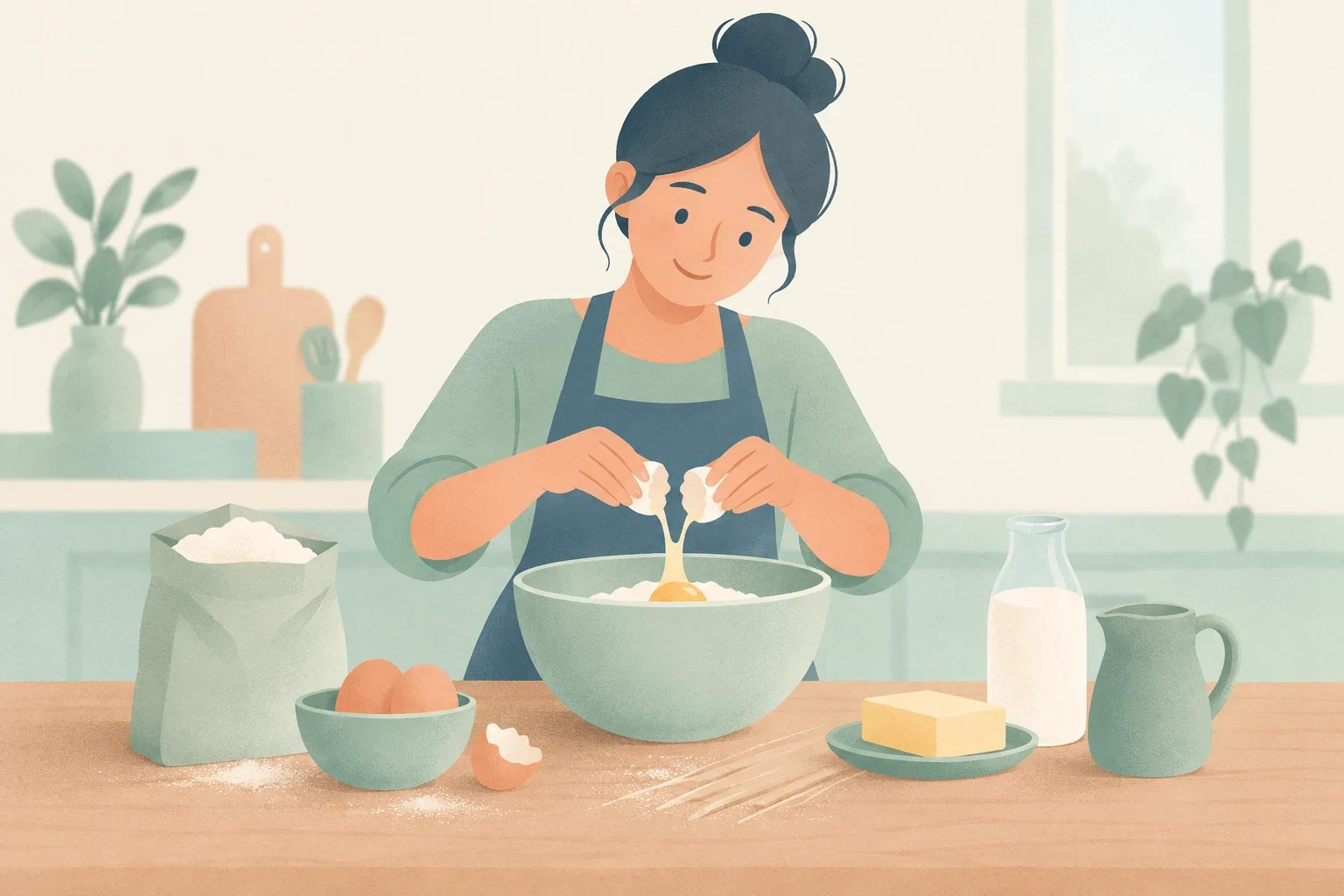
Consider an everyday dinner choice to see how the phrase functions in real conversation. You and a friend walk through a grocery store planning a Friday pizza evening. One option is placing plastic-wrapped dough rounds into your cart, which gives you a prepared shortcut. The other option is picking up yeast, olive oil, and flour so you can mix the dough at home. Selecting the basic ingredients means you intend to make the crust from scratch. The phrase identifies which stage of production you take responsibility for, distinguishing raw preparation from convenience products.
-
'Shall we buy pizza bases?' 'Let's make them from scratch.' 'Have we got enough flour?'
Why it works: The speakers choose to mix raw flour and yeast instead of purchasing prepared pizza crusts.
-
We could buy jarred pasta sauce, or we can make a rich sauce from scratch with ripe tomatoes.
Why it works: The speaker contrasts convenience groceries with cooking from raw ingredients.
This also comes up in For the time being and Word of mouth.
Your turn
In the dialogue between the two friends, what have the speakers decided to make themselves?
Answer: The pizza dough bases
Show the answer
Answer: The pizza dough bases
The speaker suggests making the pizza bases from scratch instead of buying ready-made ones from the store.
Place the phrase after action verbs or direct objects
Notice where the phrase sits within a standard English sentence. You can connect it directly to intransitive verbs like 'start' or 'begin', giving the structure 'start from scratch'. When using transitive action verbs such as 'make', 'build', 'create', or 'design', place the direct object before the idiom. For instance, say 'build a website from scratch' or 'create a syllabus from scratch'. The verb shifts to show tense, but 'from scratch' never changes its shape. In learning contexts, the phrase shows that a student began with zero prior knowledge of that specific subject.
-
Our local running club built their registration portal from scratch last winter.
Why it works: The club coded an entirely new web portal instead of installing pre-built software.
-
Omar learned Spanish guitar from scratch when he turned forty.
Why it works: Omar began learning Spanish guitar without previous training in it.
Your turn
Which sentence shows the correct word order when using an action verb with a direct object?
Answer: She created a lovely pottery vase from scratch.
Show the answer
Answer: She created a lovely pottery vase from scratch.
Put the direct object 'a lovely pottery vase' directly after the verb 'created', followed by 'from scratch'.
Distinguish a fresh restart from resuming old work
Pay close attention when someone talks about beginning again, because 'start again' and 'start from scratch' convey different conditions. Starting again can mean returning to a project while keeping earlier research, outline notes, or partial drafts. Starting again from scratch means discarding all earlier material and beginning with a completely blank slate. You can also explore related expressions like /idioms/from-the-ground-up/, which emphasizes constructing an entire system from its foundations, or /idioms/up-to-scratch/, which describes whether quality meets an acceptable standard. An early advantage is known as a /idioms/head-start/.
-
The architect revised two rooms, so she did not have to start from scratch.
Why it works: She adapted existing blueprints rather than throwing away the entire house plan.
-
Because the old fabric tore beyond repair, the tailor cut a new jacket from scratch.
Why it works: The tailor abandoned the ruined garment and cut fresh cloth from the beginning.
Your turn
What is the difference between starting again and starting again from scratch?
Answer: Starting again can reuse earlier parts, while starting from scratch discards all previous work.
Show the answer
Answer: Starting again can reuse earlier parts, while starting from scratch discards all previous work.
Starting again allows you to keep useful work, whereas starting from scratch means returning to zero without an existing base.
Use the idiom neutrally in daily talk and workplace notes
Observe how native speakers use this expression across informal chats, team meetings, and professional correspondence. 'From scratch' carries a neutral, descriptive tone rather than dramatic emotion. It does not automatically signal that a project was extremely painful, nor does it deliver exaggerated self-praise. In an office email, stating that your department produced a training manual from scratch simply reports that no earlier document served as the source. It describes the workflow accurately and plainly, making it suitable for both casual weekend conversations and standard business reports.
-
In yesterday's staff meeting, Clara explained that the onboarding handbook was developed from scratch.
Why it works: The statement reports a practical fact about document preparation without boasting.
-
We made dinner from scratch because we had two hours of free time before the movie.
Why it works: The phrase fits comfortably into relaxed personal conversation.
Your turn
How does 'from scratch' function in ordinary workplace communication?
Answer: As a neutral, factual description of how a project or document was produced
Show the answer
Answer: As a neutral, factual description of how a project or document was produced
The idiom is standard and neutral, simply describing whether earlier materials were used.
Avoid articles and keep the fixed preposition
Look out for three frequent grammatical errors that adult learners make when writing this phrase. First, never insert the definite article 'the' before 'scratch'; 'from the scratch' is incorrect. Second, never add the indefinite article 'a'; 'from a scratch' suggests physical skin damage rather than a starting point. Third, preserve the preposition 'from'. Replacing it with 'by', 'of', or 'with' breaks the fixed pattern. Treat 'from scratch' as two inseparable words that never permit intervening words or substitutions, whether in writing or fast speech.
-
The team drafted the safety protocol from scratch.
Why it works: Correct: 'from scratch' has no article between the preposition and noun.
-
Avoid writing: 'The team drafted the safety protocol from the scratch.'
Why it works: Incorrect: adding 'the' is an ungrammatical modification of the idiom.
Your turn
Which of the following sentences uses the idiom correctly?
Answer: We assembled the bicycle from scratch on Saturday.
Show the answer
Answer: We assembled the bicycle from scratch on Saturday.
The fixed expression uses 'from' with no article before 'scratch'.
Recognize weak vowels and consonant clusters in speech
Train your ear to catch how native speakers pronounce /frəm skrætʃ/ in natural, connected sentences. In ordinary conversation, 'from' rarely carries a full vowel; speakers use the weak schwa sound /frəm/. In contrast, 'scratch' receives primary phrase stress with a clear /æ/ vowel and a crisp final /tʃ/ sound. Pay close attention to the three-consonant onset /skr/. Do not insert an extra vowel before or between these consonants. Whether you listen to British, North American, or Australian speakers, focus on the rhythm: a rapid unstressed preposition linked to a prominent stressed syllable.
-
They built the garden gate from scratch in April.
Why it works: Notice how 'from' reduces to /frəm/ while 'scratch' stands out with stronger volume and pitch.
-
We made bread from scratch every Saturday.
Why it works: The final /tʃ/ of 'scratch' links smoothly to the opening vowel /ɛ/ of 'every'.
Your turn
Which pronunciation pattern is typical when native speakers say 'from scratch' in connected speech?
Answer: 'From' usually has a weak unstressed vowel, while 'scratch' carries primary stress.
Show the answer
Answer: 'From' usually has a weak unstressed vowel, while 'scratch' carries primary stress.
In connected speech, 'from' reduces to /frəm/ while 'scratch' takes the prominent stress.
Verify the missing foundation in your own sentences
Consolidate your mastery by testing whether an activity truly begins without an existing base. Before using the phrase, ask yourself one specific question: what pre-made version or shortcut is being bypassed? If a baker avoids ready dough, they make bread from scratch. If a programmer writes fresh code without borrowing existing libraries, they code from scratch. To practice recall, write an original sentence about a personal hobby or workplace duty. Identify the prepared starting point you avoided, verify that no article appears before 'scratch', and check that your verb matches your intended tense.
-
I crafted a leather wallet from scratch instead of buying a factory-made replacement.
Why it works: The avoided starting point is a pre-manufactured retail wallet.
-
She wrote her university lecture notes from scratch rather than downloading an online summary.
Why it works: The avoided shortcut is a pre-existing digital study guide.
Your turn
In which sentence is 'from scratch' used accurately to show that an existing shortcut was avoided?
Answer: He created the garden layout from scratch on empty soil instead of copying a published landscaping plan.
Show the answer
Answer: He created the garden layout from scratch on empty soil instead of copying a published landscaping plan.
Creating a layout on raw ground without copying an existing plan represents starting from the beginning with no prepared base.
Use it naturally
How people really use “from scratch”
Neutral Fine almost anywhere, at work or with friends.
Words it often goes with
- make it from scratchThis soup takes longer when you make it from scratch.
- build from scratchA simple bench is something we can build from scratch.
- learn from scratchPortuguese is a language I would love to learn from scratch.
- start from scratchWe lost the original design, so we have to start from scratch.
What people also say
- “I made the sauce from scratch.” instead of “I made the sauce from the starting point.” Use this when you used basic ingredients instead of a prepared sauce.
Questions about "From scratch"
What does 'from scratch' mean?
The idiom 'from scratch' means starting completely from the beginning, without using a prepared base, a pre-assembled kit, or an existing draft. When you make food from scratch, you combine basic raw ingredients like flour and eggs instead of heating a frozen meal or using a boxed mix. In workplace or creative projects, it means producing original work rather than editing an earlier template.
We made the pasta sauce from scratch using fresh garden tomatoes.
He wrote the entire training manual from scratch.
Can I use 'from scratch' when I am doing something for the first time?
Yes, you can use the phrase for an initial attempt. When someone learns a brand-new skill with zero prior knowledge, they start from scratch. It emphasizes that they have no previous foundation or background in that subject. It is equally common for a first attempt as it is for restarting after an earlier attempt fails.
She joined the pottery class with no art experience, so she began from scratch.
I learned web development from scratch during the summer.
Does 'from scratch' mean I cannot use instructions or get help?
No, 'from scratch' does not mean working completely alone or without guidance. You can follow a cookbook recipe, look at woodworking blueprints, use power tools, or ask an experienced instructor for advice. The expression only describes the materials and starting state: you start with raw elements rather than a ready-made product or pre-built base.
I followed a simple recipe book to bake the cake from scratch.
With help from his teacher, David built an electric guitar from scratch.
What is the difference between 'start again' and 'start from scratch'?
When you 'start again', you simply resume an activity, and you may keep useful parts of your previous work. For example, if you edit a report after lunch, you start again from page five. When you 'start from scratch', however, you discard all previous versions and return to a blank page with no pre-existing foundation.
The printer jammed, so we paused and started again from page ten.
The file became corrupted, forcing us to write the report from scratch.
Do I say 'from scratch' or 'from the scratch'?
Always say 'from scratch'. In English, this idiom is a fixed two-word phrase that never takes an article. Adding 'the' or 'a' before 'scratch' is a common learner error. Similarly, the preposition is always 'from', never 'by', 'with', or 'of'.
They rebuilt the garden shed from scratch after the storm.
Incorrect: They rebuilt the shed from the scratch.
Is 'from scratch' the same as 'up to scratch'?
No, they have completely different meanings. 'From scratch' describes the starting point of a process with no prepared base. In contrast, 'up to scratch' is an idiom meaning good enough or meeting a required standard of quality. If work is not up to scratch, you might decide to throw it away and start from scratch.
The new employee's drafting work was not up to scratch.
Because the draft was not up to scratch, we wrote a new version from scratch.
Before you go
Remember this
Choose 'from scratch' whenever you want to highlight the lack of a prepared starting base. Keep the phrase unchanged after the verb or object, remember that both first attempts and restarts can be from scratch, and leave out articles entirely.
Stage 2 of 5
Listen
Hear it in real sentences, from short to long, and write what you hear.
Continue with the four activities from the video: listening, reading, speaking and writing. Back to the video
0 of 4 done
Listening 1 of 4
Listen, then type what you hear. Replay as often as you need.
0:00
- Because the old venue map had inaccurate measurements, we drew the floor plan from scratch.
- She had never held a violin before, so she learned the instrument from scratch.
Listening 2 of 4
Listen, then type what you hear. Replay as often as you need.
0:00
- Because the old venue map had inaccurate measurements, we drew the floor plan from scratch.
- She had never held a violin before, so she learned the instrument from scratch.
Try a longer clip. Listen once, then replay the part you missed.
Listening 3 of 4
Listen, then type what you hear. Replay as often as you need.
0:00
- Because the old venue map had inaccurate measurements, we drew the floor plan from scratch.
- She had never held a violin before, so she learned the instrument from scratch.
This clip is longer. Follow the instruction above the answer field.
Listening 4 of 4
Listen, then type the missing words. The rest of the text is already there.
0:00
- Because the old venue map had inaccurate measurements, we drew the floor plan from scratch.
- She had never held a violin before, so she learned the instrument from scratch.
Practice complete
You listened closely.
Your result is saved in this browser.
Keep your progress. Your practice is saved on this device only. Create a free account to keep it everywhere.
Create a free accountThat was today's free lesson. Tomorrow you get another one. Want more today? See membership.
Create a free SubLearn account to keep this progress across devices.
Save my progressStage 3 of 5
Speak
Say it with the speaker, then use it in your own answer.
Shadow
Say it along with the speaker
Play the line slowly, then speak at the same time as the speaker. Copy the rhythm, not just the words.
Your turn
Say it your way
Imagine you move to a country where you do not speak the local language. Speak for 30 to 60 seconds from memory about learning it from scratch so you can get to know your neighbors. Explain your first steps and one goal for your first month.
Use: from scratch
Take ten seconds to think, then answer out loud without looking at the lesson. Speak for the time shown in the task above. Nothing is sent unless you ask for feedback.
0:00
Hear how someone else might say it
If I moved to Brazil, I would have to learn Portuguese from scratch because I don't know any yet. First, I'd learn how to introduce myself and ask simple questions. I'd practice a little every morning, then try using those phrases with my neighbors. I would probably feel embarrassed at first, but I'd explain that I was learning and ask them to speak slowly. By the end of the first month, I'd like to have a short conversation with someone in my building without switching to English.
Try once more and answer this: What would you say to a neighbor on your first day?
Stage 4 of 5
Write
Write your own response
AI feedback · it can make mistakes · Part of membership See membership
Check your own writing
Read one possible response
Draft saved on this device.
Use these checks to revise your message. Grammar and meaning are not automatically graded. Each task keeps its own draft in this browser tab.

You finished the free part of this lesson
- Understand
- Listen
- Speak
- Write
- CheckPart of membership
Worth another look
With a free account, the lessons you finish come back for review to help you remember them.Create a free account
Stage 5 of 5 · Part of membership
Check
New clips without hints.
Listening tests are included with membership. Try the free dictation first, then decide whether to continue.
Listening 1 of 2 Part of membership
Listening 2 of 2 Part of membership
Follow MicroEnglish
Find lesson updates, short videos and quick quizzes. Pick the app you already use.
Questions & comments
Ask about this lesson, share an example, or help another learner.
Example
Memory tip
Goes with
Related forms
Not to be confused with
In this lesson
This word isn't in our dictionary. Check the spelling, or try another form of the word.
We couldn't load this word. Try again.