Idiom
At first glance
What does 'at first glance' mean?
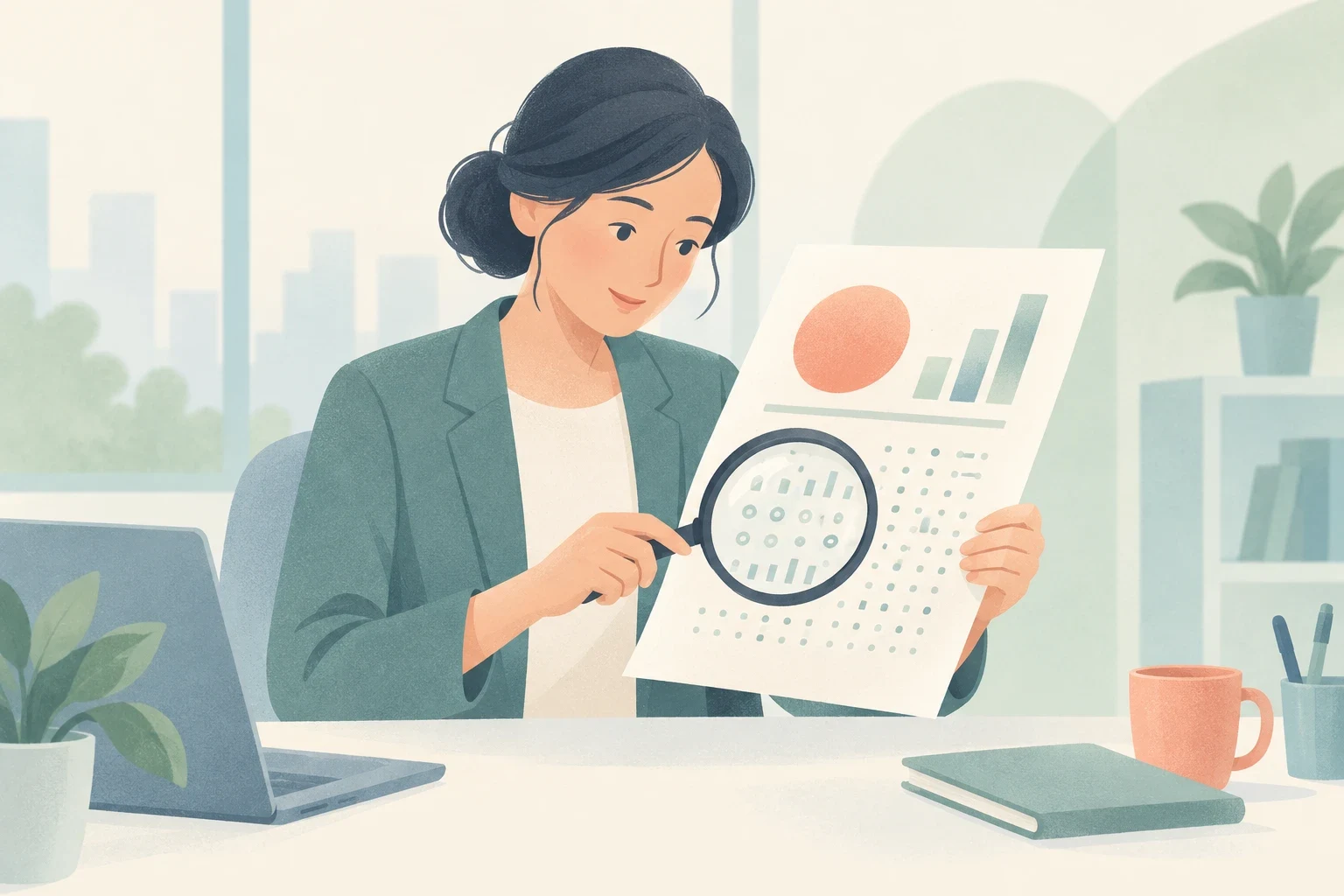
'At first glance' means when first looking at or considering something, before having the opportunity to examine it carefully. It signals that an opinion is preliminary and subject to change.
Key points
- Remember that 'at first glance' is a fixed three-word unit with no article.
- Use it whenever you want to separate an early impression from a verified conclusion.
- Use 'at first glance' at the beginning of a clause with a comma or at the end of a clause without a comma.
This lesson has 5 stages. You can stop at any time and continue later.

Stage 1 of 5
Understand
What it means, when to use it, and mistakes to avoid.
Watch & learn
At first glance: meaning and listening practice
Learn At first glance with Bella, then practise with British and American conversations, speaking time and common questions. B2 English.
Line 1 of 7 · Bella (tutor)
to MicroEnglish. B2 a
Say this line out loud, then continue.
The video could not continue. Try again or use the transcript below.
Your session
Learn with the video 15 min
Watch a short part, answer a question and practice what you heard. Then talk it through with the tutor.
The first part is free. Members continue to part 2 and can ask for more.
Key words in this video
Example
Memory tip
Goes with
Related forms
Not to be confused with
From this video
We couldn't load this word. Try again.
Examples
At first glance, the contract looked standard, but two clauses required revision.
Why it works: The phrase introduces an early positive impression that changes after careful reading.
2 more examples
-
The apartment seems quiet at first glance.
Placing the phrase at the end shows a preliminary view without requiring a comma.
-
At first glance, our new coworker appeared reserved, yet she turned out to be very outgoing.
The phrase applies naturally to people and their initial demeanor, not just physical objects.
Read the full guide
Use the Phrase for an Initial Impression
You are about to choose a café table because it looks free. Your friend notices a reserved sign: 'At first glance, it looks available, but there's a sign by the menu.' A glance is a quick look. 'At first glance' means when you first look at or think about something, before checking it carefully. What you think then may be right, or you may change your mind. The expression does not promise that your early view is mistaken. Instead, it informs your listener that you formed your judgment quickly, before examining every detail.
- Sam
That window table looks great. At first glance, nobody is sitting there.
- Elena
Look closer near the napkins. Someone placed a reserved sign beside the cup.
- Sam
You are right. Let us check the patio instead.
-
At first glance, the problem seemed minor, but solving it took all morning.
Why it works: The speaker shares an initial visual assessment before discovering deeper complexity.
-
The hotel lobby looked impressive at first glance.
Why it works: The phrase frames an early perception based on a quick visual sweep.
Your turn
Why does a speaker begin a statement with 'at first glance'?
Answer: To share an early judgment formed before examining details carefully.
Show the answer
Answer: To share an early judgment formed before examining details carefully.
The idiom communicates that the speaker is offering a preliminary view based on an initial look rather than a thorough investigation.
Keep the Phrase as Three Words Without an Article
English treats 'at first glance' as a fixed three-word unit. You must use the preposition 'at', the ordinal word 'first', and the singular noun 'glance'. Never insert an article like 'a' or 'the' inside this phrase. Saying 'at the first glance' or 'in first glance' sounds unnatural to native speakers. While the noun 'glance' can appear with articles in other expressions, such as 'take a quick glance', this specific idiom never takes an article.
Learners often try to translate prepositions directly from their native languages, resulting in incorrect variations like 'in first glance' or 'on first glance'. Another frequent slip is adding the definite article to produce 'at the first glance'. Always keep the phrase strictly to its three standard words: at, first, glance.
-
At first glance, the invoice seemed accurate.
Why it works: The correct form uses 'at' and omits any article before 'glance'.
-
At first glance, the two paint samples look identical.
Why it works: The phrase remains three separate words regardless of the subject.
This also comes up in First-day onboarding tasks and Expressions with get.
Your turn
Which sentence uses the correct fixed form of the idiom?
Answer: At first glance, the apartment appeared vacant.
Show the answer
Answer: At first glance, the apartment appeared vacant.
The fixed idiom requires the preposition 'at', singular 'glance', and no definite or indefinite article.
Put the Phrase Before the Sentence or After the Impression
You can place 'at first glance' in two natural sentence positions. When you place it at the beginning of a clause, follow the pattern 'At first glance, + subject + verb'. In this opening position, always place a comma after 'glance'. Alternatively, you can place it at the end of the clause following the pattern 'subject + looks/seems + adjective + at first glance'. When placed at the end, no comma is required before the phrase. Notice also that while the surrounding verbs change tense to express the past or present, the phrase 'at first glance' never changes form.
-
At first glance, the instructions look clear.
Why it works: When opening a clause, the phrase takes a comma before the main subject.
-
The instructions looked clear at first glance.
Why it works: At the end of the clause, no comma separates the phrase from the adjective.
Your turn
Which sentence shows the correct comma usage when 'at first glance' appears at the beginning?
Answer: At first glance, the instructions look clear.
Show the answer
Answer: At first glance, the instructions look clear.
When 'at first glance' introduces a clause, the comma belongs immediately after 'glance', before the subject.
Add a Contrast When Your Impression Changes
Because 'at first glance' marks a preliminary impression, speakers often pair it with a contrast when subsequent facts prove that impression incomplete or mistaken. The most common connector is 'but', which links the initial view directly to the new reality. Alternatively, you can divide the thought into two sentences and begin the second sentence with 'On closer inspection' or 'However'. Even so, remember that a contrast clause is optional. You can use 'at first glance' on its own when describing a tentative opinion that has not yet been investigated, or when a deeper check confirms your first thought.
-
At first glance, the house looked tiny, but the interior was surprisingly roomy.
Why it works: The conjunction 'but' introduces the contrasting discovery made inside.
-
At first glance, the spreadsheet seemed fine. On closer inspection, three totals were wrong.
Why it works: A second sentence beginning with 'On closer inspection' provides a formal contrast.
-
The machinery appears safe at first glance, though we still need a full safety audit.
Why it works: The phrase expresses preliminary status without declaring an outright error.
Your turn
Is a contrasting clause beginning with 'but' required every time you say 'at first glance'?
Answer: No, 'but' is optional; you can state a preliminary impression without changing your mind.
Show the answer
Answer: No, 'but' is optional; you can state a preliminary impression without changing your mind.
While a contrast is common when impressions change, 'at first glance' can stand on its own to express a preliminary observation.
Distinguish Four Related Expressions
Learners frequently confuse 'at first glance' with three related expressions: 'at a glance', 'at first', and 'at first sight'. Understanding the specific purpose of each phrase prevents awkward misunderstandings. 'At first glance' introduces an impression before thorough examination. In comparison, 'at a glance' means with one brief look that successfully reveals needed information, such as checking a clock or reading a fuel gauge. Meanwhile, 'at first' refers to time and sequential stages, meaning 'initially', without requiring any visual action. Finally, 'at first sight' refers to initial appearances and can describe objects, places, or sudden romantic attraction in the idiom 'love at first sight'.
-
She knew at a glance that the store was closed.
Why it works: The phrase 'at a glance' indicates immediate comprehension from a single look.
-
At first, the software was difficult to use, but we mastered it after a week.
Why it works: 'At first' describes a time stage, not visual inspection.
Your turn
Which expression fits best: 'The technician glanced at the dashboard and could see ___ that the battery was disconnected'?
Answer: at a glance
Show the answer
Answer: at a glance
'At a glance' means with a single quick look that reveals the necessary information immediately.
Use an Initial Impression in Conversation or Work
'At first glance' has a neutral register, making it equally effective in relaxed conversation and professional correspondence. You can use it in team meetings, email updates, and technical reviews to share a preliminary finding without overpromising certainty. It helps you manage expectations by signaling that your assessment is based on limited examination. Furthermore, you can apply 'at first glance' to people, objects, and abstract situations. You might describe a colleague who seemed shy on their first day, a mobile application that looked complicated, or a company policy that appeared strict.
When you make an assumption too quickly without waiting for facts, English speakers might say you [jump the gun](/idioms/jump-the-gun/). Similarly, if you offer a rough numerical estimate based on early figures, you give [a ballpark guess](/idioms/a-ballpark-guess/). By comparison, 'at first glance' simply frames your preliminary visual or mental impression.
-
At first glance, our new project manager seemed intimidating, but he is remarkably kind.
Why it works: The expression applies to a person's initial demeanor, not just inanimate objects.
-
At first glance, the proposed schedule works, but we should review shipping deadlines tomorrow.
Why it works: In a workplace email, the phrase sets a professional, measured tone.
Your turn
Why is 'at first glance' particularly useful in workplace emails?
Answer: It signals a preliminary assessment without committing to premature certainty.
Show the answer
Answer: It signals a preliminary assessment without committing to premature certainty.
The phrase communicates a sensible professional reserve, showing that an initial review took place while leaving room for subsequent findings.
Hear the Phrase as Connected Speech
In conversational speech, the words in 'at first glance' often run together. The vowel in 'at' can reduce to /ə/. The /t/ at the end of 'first' may be less audible or omitted before the /ɡ/ in 'glance'. A careful pronunciation can retain it, as in /ət fɜːst ɡlæns/ or /ət fɜːrst ɡlæns/. Stress often falls on 'glance', but the speaker can change it for emphasis.
Pronunciation varies by accent. Some speakers pronounce the r in 'first'; others do not. The vowel in 'glance' also varies, including /æ/ and /ɑː/. These differences occur within countries as well as between them. Use the recording to hear the particular speaker's pronunciation.
-
At first glance, everything looked ready for the launch.
Why it works: Notice how 'at first glance' flows smoothly into the vowel sound of 'everything'.
-
The apartment seemed peaceful at first glance.
Why it works: At the end of a sentence, 'glance' receives a clean release before the silence.
Your turn
Which word often carries the main stress in a neutral pronunciation of 'at first glance'?
Answer: On the noun 'glance'.
Show the answer
Answer: On the noun 'glance'.
The main stress often falls on 'glance' in a neutral pronunciation. A speaker can move the stress to make a contrast.
Recall the Phrase and Describe Your Own Impression
To make 'at first glance' an active part of your English vocabulary, practice recalling and constructing the expression without looking at notes. Start by confirming the three components: preposition 'at', modifier 'first', and singular noun 'glance'. Next, decide whether your sentence requires a contrast with 'but' or simply presents an unverified initial view. Finally, check that your surrounding verb tense aligns with the time of your observation. Practicing this self-review sequence ensures that you can produce the phrase fluently in real conversations.
-
At first glance, the error message looked serious, but a simple restart resolved it.
Why it works: The sentence contrasts a quick initial impression with an easy practical solution.
-
The recipe seemed complicated at first glance.
Why it works: An uncontrasted statement sharing a preliminary opinion.
Your turn
Which sentence successfully reconstructs the phrase from memory to describe a newly purchased bicycle?
Answer: At first glance, the bicycle looked brand new, but the chain was rusty.
Show the answer
Answer: At first glance, the bicycle looked brand new, but the chain was rusty.
The correct reconstruction retains 'at', excludes articles, and pairs the initial view naturally with a contrasting clause.
Use it naturally
How people really use “at first glance”
Neutral Fine almost anywhere, at work or with friends.
Words it often goes with
- looks ordinary at first glanceThe painting looks ordinary at first glance, but its tiny details are impressive.
- seems clear at first glanceThe message seems clear at first glance, but the final sentence has two possible meanings.
- appears simple at first glanceThe recipe appears simple at first glance, yet it requires careful timing.
What people also say
- “At first glance, they look alike.” instead of “Upon an initial visual examination, they look alike.” Use this for a quick visual impression in everyday conversation.
Questions about "At first glance"
What does 'at first glance' mean?
'At first glance' describes what you think or see when you first consider something, before examining it closely. It introduces an initial impression. That impression might turn out to be accurate, or deeper investigation might prove it wrong.
At first glance, the recipe looks easy, but preparing the pastry takes two hours.
Do I have to use 'but' after 'at first glance'?
No, 'but' is not grammatically required. Speakers frequently use 'but' because early impressions often change, but you can also use 'at first glance' when your initial reaction is confirmed or when you simply want to state a preliminary observation without an immediate contrast.
At first glance, the proposal seems balanced.
At first glance, the engine sounded healthy, and thorough testing confirmed it was running well.
Can I put 'at first glance' at the end of a sentence?
Yes, you can place 'at first glance' either at the start of a clause or at the end. When it sits at the beginning, you typically put a comma after it. When it sits at the end of a clause, no comma is needed.
At first glance, the schedule looks manageable.
The schedule looks manageable at first glance.
What is the difference between 'at first glance' and 'at a glance'?
'At first glance' focuses on an initial impression that may change after closer study. In contrast, 'at a glance' means with a single quick look, often giving you enough clear information to recognize or understand something immediately.
She could tell at a glance that the printer was out of ink.
At first glance, the report seemed complete, but three pages were missing.
Does 'at first sight' only mean falling in love?
No. While 'love at first sight' is a well-known set phrase for sudden romance, 'at first sight' can also describe the initial appearance of an object or situation. In many descriptive contexts, 'at first sight' and 'at first glance' are interchangeable, though 'at first glance' is much more common for workplace reviews and analytical inspections.
The old cottage looked charming at first sight.
They fell in love at first sight during their summer holiday.
Can I use 'at first glance' when talking about a person?
Yes, you can use 'at first glance' to describe your initial impression of someone's personality, mood, or appearance. It indicates how the person appeared before you talked to them or got to know them better.
At first glance, our new team leader seemed distant, but she quickly proved to be warm and supportive.
Before you go
Remember this
Remember that 'at first glance' is a fixed three-word unit with no article. Use it whenever you want to separate an early impression from a verified conclusion.
Stage 2 of 5
Listen
Hear it in real sentences, from short to long, and write what you hear.
Continue with the four activities from the video: listening, reading, speaking and writing. Back to the video
0 of 4 done
Listening 1 of 4
Listen, then type what you hear. Replay as often as you need.
0:00
- The apartment seems quiet at first glance.
- At first glance, our new coworker appeared reserved, yet she turned out to be very outgoing.
Listening 2 of 4
Listen, then type what you hear. Replay as often as you need.
0:00
- The apartment seems quiet at first glance.
- At first glance, our new coworker appeared reserved, yet she turned out to be very outgoing.
Try a longer clip. Listen once, then replay the part you missed.
Listening 3 of 4
Listen, then type what you hear. Replay as often as you need.
0:00
- The apartment seems quiet at first glance.
- At first glance, our new coworker appeared reserved, yet she turned out to be very outgoing.
This clip is longer. Follow the instruction above the answer field.
Listening 4 of 4
Listen, then type the missing words. The rest of the text is already there.
0:00
- The apartment seems quiet at first glance.
- At first glance, our new coworker appeared reserved, yet she turned out to be very outgoing.
Practice complete
You listened closely.
Your result is saved in this browser.
Keep your progress. Your practice is saved on this device only. Create a free account to keep it everywhere.
Create a free accountThat was today's free lesson. Tomorrow you get another one. Want more today? See membership.
Create a free SubLearn account to keep this progress across devices.
Save my progressStage 3 of 5
Speak
Say it with the speaker, then use it in your own answer.
Shadow
Say it along with the speaker
Play the line slowly, then speak at the same time as the speaker. Copy the rhythm, not just the words.
Your turn
Say it your way
Imagine finding an old family photo of your grandfather at a party. Speak for 30 to 60 seconds from memory. Explain your first impression of his mood, which small details changed your mind, and what you would ask him about that day.
Use: at first glance
Take ten seconds to think, then answer out loud without looking at the lesson. Speak for the time shown in the task above. Nothing is sent unless you ask for feedback.
0:00
Hear how someone else might say it
I found an old photo of my grandfather at a family party. He looked quite serious at first glance, so I wondered if he was having a bad day. Then I noticed that he was holding a silly birthday card. Everyone around him was laughing, and there was a small smile on his face. I think he was pretending to be upset about getting older. That sounds like his sense of humor. I would ask him who gave him the card and whether he remembers what it said.
Try once more and answer this: Which detail in the photo surprised you most?
Stage 4 of 5
Write
Write your own response
AI feedback · it can make mistakes · Part of membership See membership
Check your own writing
Read one possible response
Draft saved on this device.
Use these checks to revise your message. Grammar and meaning are not automatically graded. Each task keeps its own draft in this browser tab.

You finished the free part of this lesson
- Understand
- Listen
- Speak
- Write
- CheckPart of membership
Worth another look
With a free account, the lessons you finish come back for review to help you remember them.Create a free account
Stage 5 of 5 · Part of membership
Check
New clips without hints.
Listening tests are included with membership. Try the free dictation first, then decide whether to continue.
Listening 1 of 2 Part of membership
Listening 2 of 2 Part of membership
Follow MicroEnglish
Find lesson updates, short videos and quick quizzes. Pick the app you already use.
Questions & comments
Ask about this lesson, share an example, or help another learner.
Example
Memory tip
Goes with
Related forms
Not to be confused with
In this lesson
This word isn't in our dictionary. Check the spelling, or try another form of the word.
We couldn't load this word. Try again.
