Idiom
Jump the gun
What does 'jump the gun' mean?
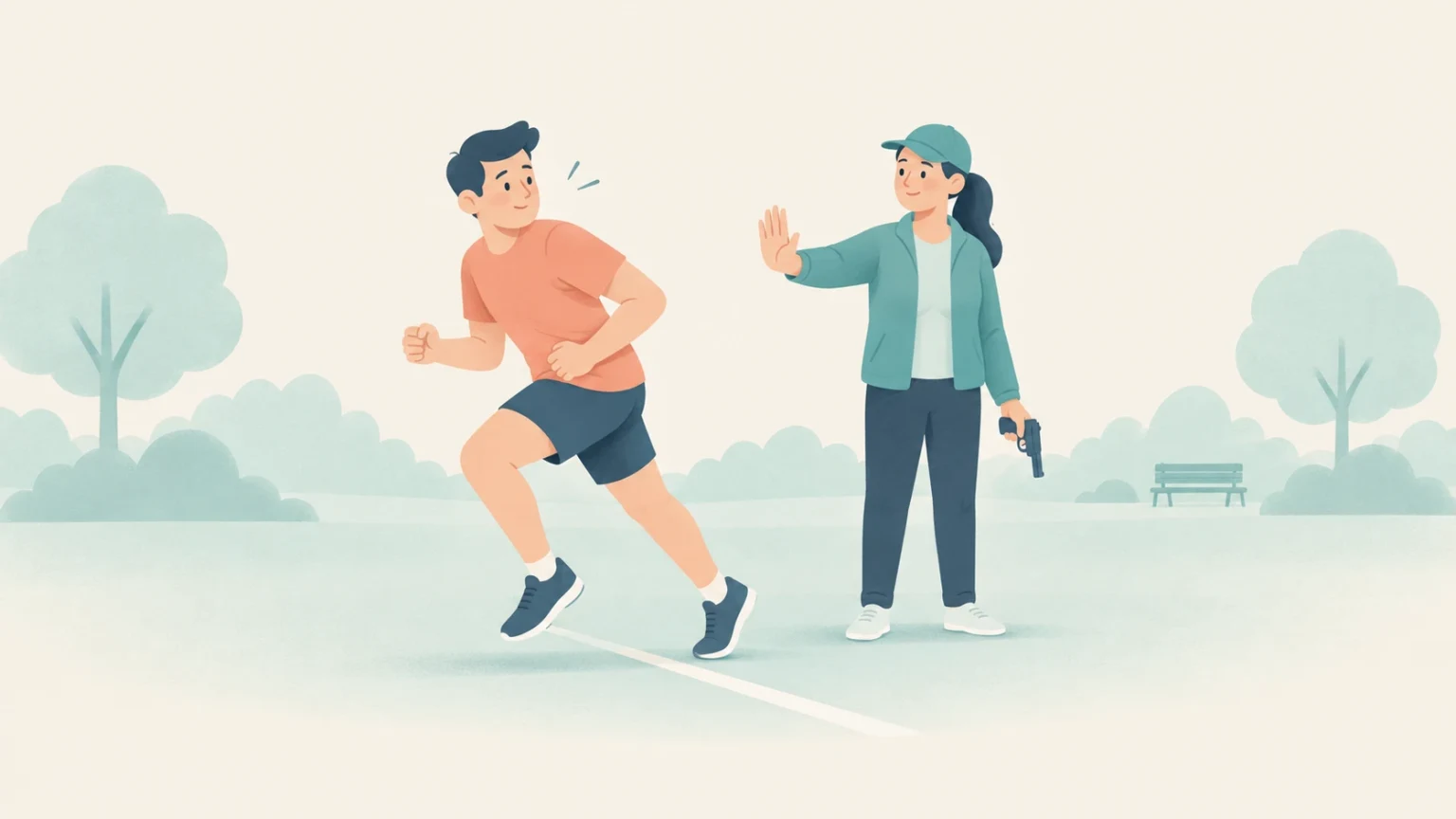
To jump the gun means to do something too soon, before the proper moment or before essential information and permission are available.
Key points
- Use jump the gun when someone acts prematurely before a necessary condition is met.
- Adapt the verb for time while keeping the noun phrase fixed, and use 'let's not jump the gun' to suggest patience politely.
- Change 'jump' to fit the tense of your sentence, including jumps, jumped, and jumping.
This lesson has 5 stages. You can stop at any time and continue later.

Stage 1 of 5
Understand
What it means, when to use it, and mistakes to avoid.
Examples
We jumped the gun by printing the event flyers before the city granted our permit.
Why it works: The printing happened prematurely because municipal approval was missing.
2 more examples
-
Let's not jump the gun and celebrate until the official contract is signed.
The speaker advises patience because celebrations should wait for a signed agreement.
-
I may be jumping the gun, but the client seemed very pleased with our initial presentation.
The speaker politely admits that forming a definitive conclusion at this stage is early.
Read the full guide
Decide if an action happened before the right moment
Sometimes we do something before we know we are ready. We can call this jumping the gun. It means we should have waited or checked something first. In English, these words work together as a set phrase. Everyday conversations that use it have nothing to do with real weapons or sports races. Instead, the expression describes someone acting before permission arrives, before an official announcement, or before enough facts are clear.
-
We jump the gun if we share our news before the manager approves it.
Why it works: The speaker points out that sharing news requires approval first.
-
Do not jump the gun and celebrate before every score is verified.
Why it works: Celebrating is premature while the scores remain unverified.
Your turn
When does a speaker use the idiom 'jump the gun'?
Answer: When someone acts before waiting for a necessary check or permission.
Show the answer
Answer: When someone acts before waiting for a necessary check or permission.
The expression describes an action taken before the proper moment or confirmation.
Identify the missing step before calling an action premature
Before using this idiom, identify what specific event or piece of information should happen first. If there is no missing step, an early action is simply efficient rather than premature. Consider this situation: you are about to order a large sofa, but your housemate has not measured the doorway. Ordering right away risks serious trouble because the sofa might not fit through the door. A natural exchange illustrates the necessary pause: 'Shall I order the sofa now?' 'Let's not jump the gun. We need to measure the doorway.' The missing measurement is the reason to wait.
-
He jumped the gun by signing the lease before reviewing the heating costs.
Why it works: Signing was premature because heating costs needed a review first.
-
Let us not jump the gun until the building inspector signs the document.
Why it works: The speaker identifies an official inspection document as the necessary condition.
This also comes up in Play safe and Last-ditch effort.
Your turn
Why is ordering a sofa without measuring the door an example of jumping the gun?
Answer: A required measurement should happen before placing the final order.
Show the answer
Answer: A required measurement should happen before placing the final order.
The idiom fits because an essential check must take place before the purchase.
Adjust the verb while keeping the noun phrase unchanged
The verb 'jump' changes form to match your subject and tense, but 'the gun' remains completely fixed. We use jump, jumps, jumped, and jumping in natural sentences. In questions and negative statements with did, didn't, do, or don't, always keep the base form 'jump' rather than writing errors like 'did you jumped the gun?'. When using modal verbs, say 'may be jumping the gun' instead of the incorrect phrase 'may be jump the gun'. Avoid altering the noun phrase: never say 'jump a gun' or 'jumped the guns'. You can also use 'by' followed by an -ing verb to name the specific action done too early.
-
He often jumps the gun when exciting projects are announced.
Why it works: The third-person singular form 'jumps' matches the subject 'he'.
-
Marcus jumped the gun when he printed five hundred programs yesterday.
Why it works: The past tense form 'jumped' shows a completed early action.
-
She did not jump the gun by reserving seats early because tickets were already on sale.
Why it works: The base form 'jump' follows 'did not', and 'by' introduces the specific early action.
Your turn
Which sentence uses the correct grammatical form?
Answer: Did you jump the gun when you sent that email?
Show the answer
Answer: Did you jump the gun when you sent that email?
The helping verb 'did' requires the base verb 'jump', and the noun phrase is always 'the gun'.
Choose your tone when warning someone or admitting haste
Telling another person 'You jumped the gun' sounds direct and critical. In a workplace or polite conversation, that phrasing can sound like an accusation of poor judgment. To soften your tone, use 'Let's not jump the gun.' This suggestion includes both speakers and directs attention to patience rather than blame. If you prefer completely neutral language without an idiom, say 'act too soon' or 'decide too early.' When speaking about your own thoughts, you can say 'I may be jumping the gun, but...' to introduce an early conclusion politely.
-
Let's not jump the gun until our supervisor confirms the project budget.
Why it works: The inclusive phrase 'let's not' softens the reminder to wait.
-
I might be jumping the gun, but these sales numbers look very encouraging.
Why it works: The speaker cautiously shares an early positive opinion.
Your turn
How does 'Let's not jump the gun' sound compared to 'You jumped the gun'?
Answer: It sounds less accusatory because it frames waiting as a shared decision.
Show the answer
Answer: It sounds less accusatory because it frames waiting as a shared decision.
Using 'let's not' includes the speaker and avoids pointing direct blame at the listener.
Distinguish premature action from a head start
Learners sometimes confuse jumping the gun with being fast or gaining an advantage. Moving quickly is helpful when all required conditions are met. If you finish your research early, you have a head start, not a timing mistake. Jumping the gun always carries criticism of timing: an action took place before it was justified. Note that an action can jump the gun even if nothing goes wrong in the end. The phrase judges the lack of caution at the moment of action, not merely the final result.
-
Packing your luggage two days early gives you a helpful head start.
Why it works: Early preparation is useful because no missing permission or check is required.
-
Announcing our expansion before funding was secure jumped the gun, even though the money arrived later.
Why it works: The decision was still premature when made, regardless of the lucky outcome.
Your turn
What makes an early action a case of jumping the gun rather than a head start?
Answer: It happens before a necessary condition or confirmation is satisfied.
Show the answer
Answer: It happens before a necessary condition or confirmation is satisfied.
Jumping the gun specifically means acting before essential information or approval exists.
Notice weak words and past consonants in fast speech
In natural spoken English, words inside an idiom do not receive equal volume. In 'jump the gun', the word 'the' is reduced to a weak sound /ðə/. The noun 'gun' receives natural sentence stress and sounds louder and clearer than the article. In the past tense 'jumped', the -ed ending represents /t/, though its release may be hard to hear in connected speech. Listeners sometimes miss this /t/ because it sits directly before the /ð/ sound in 'the'. You do not need to add an extra syllable; 'jumped' has only one syllable, with no extra vowel before its /t/ ending.
-
I realized I jumped the gun when the teacher collected blank tests.
Why it works: The word 'jumped' ends in /t/ before the weak article /ðə/.
-
We are jumping the gun if we assume the repair is finished.
Why it works: The continuous form adds the unstressed ending -ing to 'jump'.
Your turn
How many syllables are in the past tense verb 'jumped'?
Answer: One syllable.
Show the answer
Answer: One syllable.
The past form 'jumped' is pronounced with one syllable ending in a /t/ sound.
Listen for clues before writing spoken sentences
When listening to natural dictation, rely on sentence structure and context clues before writing. First, ask yourself what role the phrase plays: is the speaker offering a gentle warning, admitting a personal mistake, or forming a cautious guess? Next, identify whether the event is happening now, planned for later, or finished in the past. If you hear did, didn't, or let's, you will always write the base verb 'jump'. Paying attention to surrounding time words will help you choose between 'jump', 'jumped', and 'jumping' with certainty.
-
Let's not jump the gun until our test results come back on Monday.
Why it works: The structure 'let's not' signals a base verb and a warning.
-
I definitely jumped the gun when I paid the invoice on Friday.
Why it works: The past time word 'Friday' and past verb 'paid' confirm 'jumped'.
Your turn
If you hear the words 'Let's not' before the idiom, which form of the verb should you write?
Answer: jump
Show the answer
Answer: jump
Phrases starting with 'let's not' take the base verb form 'jump'.
Use the idiom accurately in your own messages
Now you can apply the phrase in your own writing. When drafting an email or message, first decide whether you need to warn a colleague or acknowledge your own early step. If you are warning someone, write 'Let's not jump the gun' and state what check is missing. If you are admitting a personal oversight, write 'I jumped the gun by' followed by the action. Never write 'jumped a gun' or 'jump the guns'. Selecting the right tone and keeping the words exact ensures clear, professional communication.
-
I jumped the gun by emailing the client before our supervisor checked the draft.
Why it works: A clear admission of acting before an essential supervisor review.
-
Let's not jump the gun; we should wait for the legal team's feedback.
Why it works: A constructive warning that identifies the needed legal feedback.
Your turn
Which sentence correctly admits an early action in a professional email?
Answer: I jumped the gun by sending the contract before the lawyer reviewed it.
Show the answer
Answer: I jumped the gun by sending the contract before the lawyer reviewed it.
The sentence uses 'jumped the gun by' with the base idiom and correct past tense.
Use it naturally
How people really use “jump the gun”
Informal Relaxed; better with friends and colleagues than in formal writing.
Words it often goes with
- jump the gun byDon't jump the gun by buying tickets before we agree on a date.
- jumped the gun onWe jumped the gun on the announcement and had to correct it later.
- may be jumping the gunI may be jumping the gun, but I've already picked a name for our new dog.
- let's not jump the gunI like the idea, but let's not jump the gun until we know the cost.
What people also say
- “Let's wait for confirmation.” instead of “Let us delay our action until confirmation is received.” This is a simple, direct way to suggest waiting.
Questions about "Jump the gun"
What does 'jump the gun' mean?
To jump the gun means to do something before the appropriate moment, before receiving confirmation, or before having enough information. It describes actions taken in haste without waiting for an essential prior step.
We jumped the gun by ordering catering before our guests confirmed their attendance.
Can I use it if I act too soon but nothing goes wrong?
Yes, you can. The idiom criticizes the lack of caution and premature timing when the action occurred, not whether an accident or failure actually followed. Even if everything turned out fine, acting before confirmation was still jumping the gun.
He jumped the gun by paying early, but fortunately the invoice amount was correct.
How do I say 'jump the gun' in the past?
Change 'jump' to its regular past form 'jumped' and keep 'the gun' exactly as it is. In negative statements or questions with did or didn't, use the base verb 'jump'.
She jumped the gun yesterday.
I did not jump the gun on that project.
Is 'Don't jump the gun' rude?
It can sound blunt or impatient if spoken sharply to a colleague. To make your request friendlier and less critical, say 'Let's not jump the gun,' which includes you both, or use plain wording such as 'Let's wait a moment first.'
Let's not jump the gun until we hear from our manager.
Can I use it when I make a guess too early?
Yes. Speakers often say 'I may be jumping the gun, but...' when sharing an early opinion or preliminary conclusion before all the evidence is collected.
I might be jumping the gun, but the client seems very happy with our work.
How is it different from getting a head start?
A head start means beginning useful work early to gain an advantage when you are permitted to do so. Jumping the gun means acting prematurely when you should have waited for a specific check, approval, or event.
Arriving early gave us a head start on preparing the meeting room.
Before you go
Remember this
Use jump the gun when someone acts prematurely before a necessary condition is met. Adapt the verb for time while keeping the noun phrase fixed, and use 'let's not jump the gun' to suggest patience politely.
Stage 2 of 5
Listen
Hear it in real sentences, from short to long, and write what you hear.
0 of 4 done
Listening 1 of 4
Listen, then type what you hear. Replay as often as you need.
0:00
- Let's not jump the gun and celebrate until the official contract is signed.
- I may be jumping the gun, but the client seemed very pleased with our initial presentation.
Listening 2 of 4
Listen, then type what you hear. Replay as often as you need.
0:00
- Let's not jump the gun and celebrate until the official contract is signed.
- I may be jumping the gun, but the client seemed very pleased with our initial presentation.
Try a longer clip. Listen once, then replay the part you missed.
Listening 3 of 4
Listen, then type what you hear. Replay as often as you need.
0:00
- Let's not jump the gun and celebrate until the official contract is signed.
- I may be jumping the gun, but the client seemed very pleased with our initial presentation.
This clip is longer. Follow the instruction above the answer field.
Listening 4 of 4
Listen, then type the missing words. The rest of the text is already there.
0:00
- Let's not jump the gun and celebrate until the official contract is signed.
- I may be jumping the gun, but the client seemed very pleased with our initial presentation.
Practice complete
You listened closely.
Your result is saved in this browser.
Keep your progress. Your practice is saved on this device only. Create a free account to keep it everywhere.
Create a free accountThat was today's free lesson. Tomorrow you get another one. Want more today? See membership.
Create a free SubLearn account to keep this progress across devices.
Save my progressStage 3 of 5
Speak
Say it with the speaker, then use it in your own answer.
Shadow
Say it along with the speaker
Play the line slowly, then speak at the same time as the speaker. Copy the rhythm, not just the words.
Your turn
Say it your way
Speak for 30 to 60 seconds from memory. Your sister wants to book a mountain cabin for a family vacation before anyone has confirmed their days off. Explain why she should wait and suggest what to check first.
Use: jump the gun
Take ten seconds to think, then answer out loud without looking at the lesson. Speak for the time shown in the task above. Nothing is sent unless you ask for feedback.
0:00
Hear how someone else might say it
I know you love that mountain cabin, and the price looks good. Still, I think we might jump the gun if we book it tonight. We haven't asked everyone whether they can take those days off, and Dad might have other plans that week. If we pay now, we could lose our deposit or leave someone out. Why don't we send a message to the family and ask them to reply by Thursday? Meanwhile, we can check the cancellation rules and find another cabin as a backup. Then we can book once we know who can come.
Try once more and answer this: What would you do if the cabin sold out while you waited?
Stage 4 of 5
Write
Write your own response
AI feedback · it can make mistakes · Part of membership See membership
Check your own writing
Read one possible response
Draft saved on this device.
Use these checks to revise your message. Grammar and meaning are not automatically graded. Each task keeps its own draft in this browser tab.

You finished the free part of this lesson
- Understand
- Listen
- Speak
- Write
- CheckPart of membership
Worth another look
With a free account, the lessons you finish come back for review to help you remember them.Create a free account
Stage 5 of 5 · Part of membership
Check
New clips without hints.
Listening tests are included with membership. Try the free dictation first, then decide whether to continue.
Listening 1 of 2 Part of membership
Listening 2 of 2 Part of membership
Follow MicroEnglish
Find lesson updates, short videos and quick quizzes. Pick the app you already use.
Questions & comments
Ask about this lesson, share an example, or help another learner.
Example
Memory tip
Goes with
Related forms
Not to be confused with
In this lesson
This word isn't in our dictionary. Check the spelling, or try another form of the word.
We couldn't load this word. Try again.
