Phrasal verb
Cut down
What does cut down mean in everyday English?
Cut down describes reducing the amount, size, or frequency of something. With on, it refers to consuming less or doing an activity less often. Without on, it can mean making a text, speech, or list shorter. It also refers to cutting through the trunk of a tree so that it falls to the ground.
Key points
- Choose cut down on followed by a noun or -ing action to talk about reducing consumption.
- Choose cut something down or cut it down to describe making an item shorter.
- Use cut down without on when removing a tree at its base.
This lesson has 5 stages. You can stop at any time and continue later.

Stage 1 of 5
Understand
What it means, when to use it, and mistakes to avoid.
Examples
Our office decided to cut down on paper cups by giving everyone a reusable mug.
Why it works: The speaker uses cut down on before a plural noun to describe consuming fewer disposable items.
2 more examples
-
The editor asked me to cut the draft down to five hundred words.
Cut the draft down describes making a written text shorter, and to introduces the target length.
-
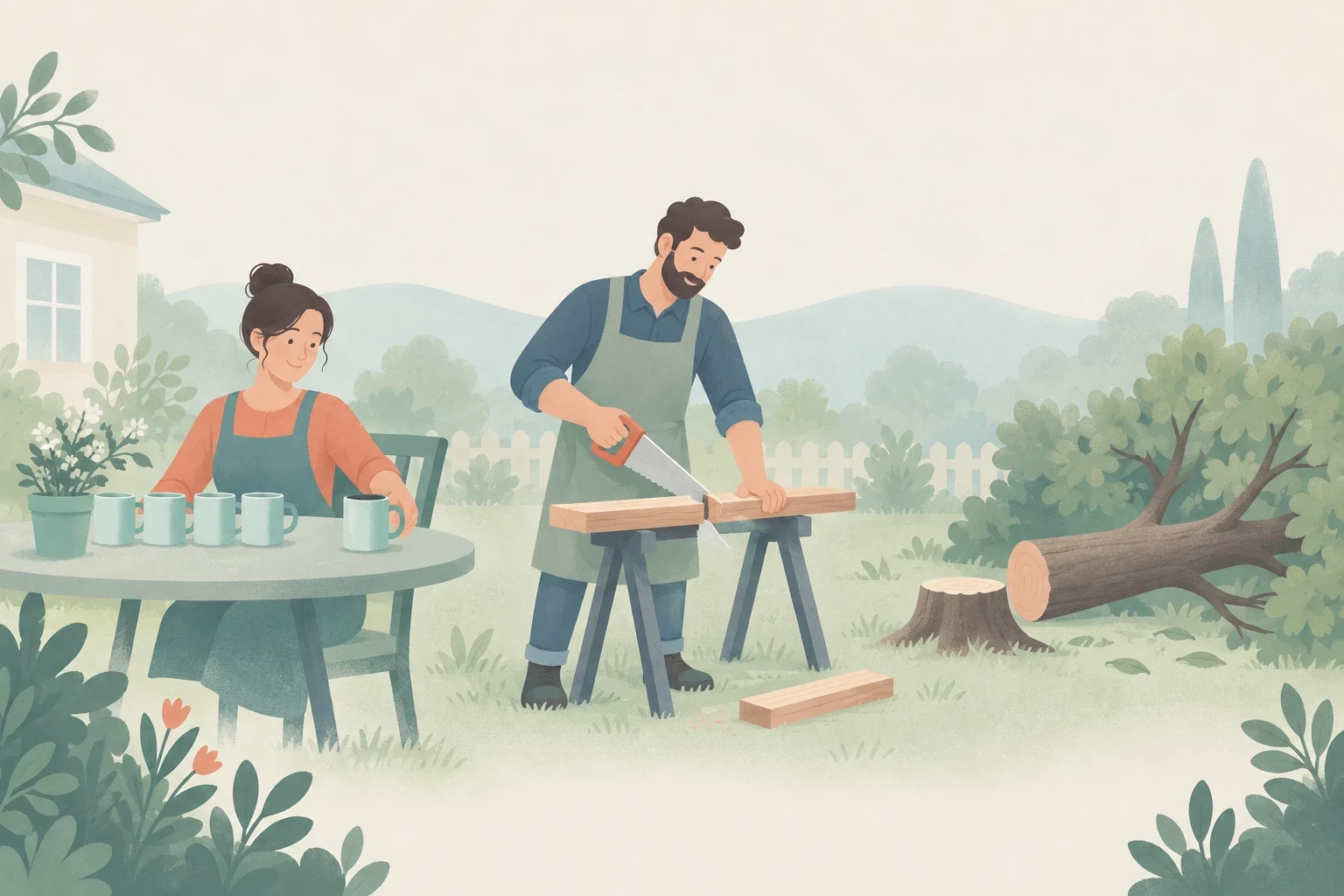
Gardeners had to cut the dead oak tree down before the winter storms arrived.
Cutting the tree down means felling it completely by cutting through the trunk.
Read the full guide
Choose cut down for using less, making something smaller, or cutting a tree
English speakers use cut down in three distinct everyday situations. First, it describes reducing consumption or an ongoing habit, such as drinking coffee or spending money on clothes. Second, it describes making an object smaller, such as shortening a long presentation or shrinking an itemized list. Third, it has a physical meaning: cutting through the trunk of a tree so that it falls to the ground. In every situation, something becomes smaller, shorter, or brought down completely.
-
We want to cut down on energy use this winter.
Why it works: Here cut down on refers to reducing the consumption of electricity or gas.
-
You should cut that email down before sending it to the director.
Why it works: Here cut down means making a piece of writing shorter and more concise.
-
The city workers cut the rotten pine down yesterday.
Why it works: Here cut down means felling a tree near its base.
Your turn
Which sentence describes making a written message shorter?
Answer: I need to cut my project report down to two pages.
Show the answer
Answer: I need to cut my project report down to two pages.
Cutting a report down means reducing its length, whereas cutting down on ordering takeout refers to reducing a habit.
Use cut down on before a habit, a noun, or an -ing activity
When you talk about reducing consumption or an ongoing habit, you commonly place on after cut down. The phrase cut down on connects directly to a noun or a verb ending in -ing. For example, you can cut down on sugar, cut down on disposable cups, or cut down on driving to work. In addition, you can use the separable pattern when discussing financial resources or budgets. Expressions like cut down on spending and cut spending down can both describe a reduction. Presenting the separable and prepositional patterns as overlapping choices gives you natural flexibility, whether you talk about cutting down our spending or cutting costs down by ten percent. If the habit is already clear from context, you can simply stop at cut down without any object. To study verb forms after prepositions in detail, refer to /grammar/gerunds-and-infinitives-1-stop-try-remember-need/.
-
I am trying to cut down on buying snacks at the train station.
Why it works: The -ing verb buying follows cut down on to name the specific habit.
-
We can cut down on spending this month, or we can cut our spending down by cooking at home.
Why it works: Both cut down on spending and cut spending down describe reducing financial expenses.
-
You drink five coffees every afternoon; you really should cut down.
Why it works: No object is needed after cut down because the coffee habit is already known to both speakers.
This also comes up in Turn down and Delivery voicemail corrections.
Your turn
Which sentence correctly places the words to describe reducing an activity?
Answer: He decided to cut down on driving into the city center.
Show the answer
Answer: He decided to cut down on driving into the city center.
The words cut down on must stay together as a unit before the -ing activity driving.
Put it before down when reducing something or removing a tree
When cut down means shortening an item or felling a tree, the phrasal verb is separable. With a full noun, you have two natural choices: you can say cut down the list or cut the list down. You can also say cut down the tree or cut the tree down. However, when you replace the noun with a pronoun such as it or them, English grammar allows only one order. The pronoun must go between cut and down: cut it down or cut them down. Saying cut down it is an error.
-
This article has six thousand words, so the publisher told me to cut it down.
Why it works: The pronoun it must sit between cut and down.
-
That dead apple tree might collapse, so my neighbor will cut it down tomorrow.
Why it works: The pronoun it refers to the tree and goes directly before down.
Your turn
Which sentence uses the correct pronoun position?
Answer: The speech was too long, so I cut it down before the meeting.
Show the answer
Answer: The speech was too long, so I cut it down before the meeting.
Pronouns like it must always go between cut and down in this separable pattern.
Use to for the final amount and keep cut unchanged in the past
To name a new limit or final target length, use the preposition to after down. For instance, you cut an article down to three pages. If you want to state the amount removed instead of the final result, use by: we cut the budget down by ten percent. For verb tenses, remember that cut is irregular and never takes an -ed ending. The five principal verb forms are cut, cuts, cutting, cut, cut. Notice that the base form, the past simple, and the past participle are all cut. The form cutted does not exist in standard English. In past simple questions and negatives, use did and did not cut.
| Pattern | Focus | Object Placement | Example |
|---|---|---|---|
| cut down on [noun / -ing] | Consumption or habits | Keep together: cut down on it | We cut down on buying snacks. |
| cut [something] down to | Shortening to a target limit | Separable: cut the report down or cut it down to two pages | She cut the report down to five pages. |
| cut [something] down by | Amount removed | Separable: cut costs down by ten percent | They cut the budget down by ten percent. |
| cut [tree] down | Felling a tree | Separable: cut the tree down or cut it down (never use on) | The storm damaged the tree, so they cut it down. |
-
The committee cut the meeting schedule down to forty minutes.
Why it works: The past simple form cut remains unchanged without any -ed ending.
-
Did you cut down on printing costs during the last project?
Why it works: Past questions use the auxiliary did followed by the base form cut.
-
She did not cut down on coffee last month, but she cut down this week.
Why it works: Past negative sentences use did not cut, and the past simple cut stays unchanged.
Your turn
Which past simple sentence is grammatically correct?
Answer: Did you cut down on printing costs during the last project?
Show the answer
Answer: Did you cut down on printing costs during the last project?
Cut never takes -ed; the past forms use cut and auxiliary did.
Follow two neighbours planning to use fewer disposable cups
Context helps distinguish between reducing supplies and shortening materials. In this original dialogue, two neighbours, Elena and Marcus, organize a street lunch. Notice how they choose cut down on for supplies they want to reduce, cut down alone when the topic is clear, and cut down without on when discussing a physical garden tree in a separate thought. For more practice discussing upcoming intentions, see /grammar/future-plans/.
-
Marcus: We need three packages of plastic cups for the lunch. Elena: Let us cut down on single-use plastic and ask everyone to bring a mug.
Why it works: Elena uses cut down on before single-use plastic to suggest reducing that consumption.
-
Marcus: That makes sense. We threw away dozens of cups last summer, so we should definitely cut down.
Why it works: Marcus uses cut down without an object because the plastic cup habit was just stated.
-
Elena: By the way, the gardener will cut down the old walnut tree behind the hall next Tuesday.
Why it works: Elena switches to the physical meaning of cutting a tree through its trunk without adding on.
Your turn
In the dialogue, why does Marcus say 'we should definitely cut down' without naming plastic cups?
Answer: The habit of throwing away disposable cups was already clear from the previous sentence.
Show the answer
Answer: The habit of throwing away disposable cups was already clear from the previous sentence.
When the context or habit has just been mentioned, native speakers often drop the object and use cut down alone.
Hear cut down on and cut it down in six short dictations
Listening to spoken English requires noticing where sounds link together or change. When people say cut down, the final t in cut often links smoothly into the d of down without a clear release, making the words sound joined. In cut down on, the word on is usually unstressed and links closely to down. In cut it down, speakers from North America and Australia often pronounce the t in it as a quick tap. Paying attention to these natural speech patterns will help you write the exact words you hear.
-
I cut down on salt by cooking fresh vegetables at home.
Why it works: Notice how down on connects quickly in fluent speech.
-
Can you cut it down to ten minutes before the presentation starts?
Why it works: Notice how cut it down flows together as a continuous sequence of sounds.
Your turn
What listening feature often occurs when a speaker says cut down on quickly?
Answer: The word on is unstressed and links smoothly to down.
Show the answer
Answer: The word on is unstressed and links smoothly to down.
In connected speech, the preposition on is unstressed and joins directly with down.
Correct misplaced on and distinguish reducing from stopping
Two common mistakes occur with cut down. The first mistake is adding on when shortening a text or removing a tree. You cut down a tree or cut an essay down; adding on in those contexts sounds unnatural. The second mistake is confusing cut down with related phrasal expressions. Cut down means reduce an amount or frequency, while cut out means eliminate something completely. If you drink two cups of tea instead of five, you cut down, but if you stop drinking tea entirely, you cut it out. In addition, English speakers frequently use cut back on as a very close alternative to cut down on when reducing an ongoing habit or expense, such as cutting back on travel costs or luxury groceries.
-
Incorrect: The council will cut down on that dying oak tree. Correct: The council will cut down that dying oak tree.
Why it works: Do not put on before a tree because you are felling it, not reducing consumption.
-
I cut down on sweets during the week, but my brother cut them out completely.
Why it works: Cut down means reduce, while cut out means eliminate entirely.
-
We decided to cut back on restaurant meals to keep our monthly budget balanced.
Why it works: Cut back on serves as a close alternative to cut down on for reducing a habit or expense.
Your turn
If you change your routine from four sodas a day to one soda a day, which verb phrase fits best?
Answer: I cut down on soda.
Show the answer
Answer: I cut down on soda.
You reduced the quantity rather than eliminating soda completely, so cut down on is correct.
Recall the patterns and write three original messages with cut down
Consolidate what you have learned by testing your recall of the three core structures. Structure one uses cut down on plus a noun or -ing verb to show reduced consumption. Structure two uses cut something down or cut it down to with a target size to show shortening. Structure three uses cut down without on to describe felling a tree. In professional writing, you can also use reduce as a formal alternative, but cut down remains the most natural phrase in everyday spoken messages and emails.
-
Everyday: We need to cut down on utility expenses this month. Formal: We need to reduce utility expenses this month.
Why it works: Reduce works well in formal reports, while cut down is standard in daily discussions.
-
Please review this announcement and cut it down to two paragraphs before noon.
Why it works: This practical request uses cut it down to specify a smaller size.
Your turn
Which sentence matches formal written English while expressing the same meaning as cut down on expenses?
Answer: We need to reduce our expenses this month.
Show the answer
Answer: We need to reduce our expenses this month.
Reduce is the formal single-word equivalent of cut down on.
Use it naturally
How people really use “cut down”
Neutral Fine almost anywhere, at work or with friends.
Words it often goes with
- cut down on sugarI'm trying to cut down on sugar in my tea.
- cut down on spendingWe need to cut down on spending before our trip.
- cut the list downWe can cut the list down to five names.
- cut down a treeThey had to cut down a tree that was leaning over the house.
What people also say
- “I need to cut down on coffee.” instead of “I need to reduce my consumption of coffee.” This sounds more natural in everyday conversation.
Questions about "Cut down"
What does cut down mean in everyday English?
Cut down primarily means reducing the amount, size, or frequency of something. It also has a physical meaning of cutting through the base of a tree so that it falls to the ground.
We must cut down our spending this month.
The workers cut down the dry tree.
When do I need to use on after cut down?
Use cut down on before an activity ending in -ing and with habits or consumption, such as drinking less coffee. Some nouns also work in the separable pattern: cut spending down. For example, use cut down on before items like sugar, coffee, or driving. Do not use on when shortening a text or felling a tree.
She is trying to cut down on sweet drinks.
He cut down on driving by cycling to work.
Can I say cut down without saying what I am reducing?
Yes, you can use cut down without an object when the topic or habit is already obvious to your listener. Native speakers frequently say this as a short response or self-reminder.
I spend too much money on clothes; I really need to cut down.
If you feel tired after eating heavy lunches, you should cut down.
Is it correct to say cut it down or cut down it?
It is always cut it down. When using a pronoun like it or them with the separable meaning of cut down, the pronoun must go between cut and down. Placing the pronoun at the end is a grammatical error.
The speech is too long, so please cut it down.
The branch is rotten, so the gardener will cut it down.
Does cut down mean to stop an activity completely?
No, cut down means to reduce the quantity or frequency of an activity, not eliminate it entirely. If you want to express stopping completely, use the phrasal verb cut out.
I cut down on coffee by drinking one cup instead of four.
The doctor advised him to cut out tobacco entirely.
Is the past tense of cut down written as cut or cutted?
The past tense is always cut. The verb cut is irregular and never changes its form in the past simple or past participle. The form cutted does not exist in standard English.
They cut down energy usage last winter.
Yesterday, the crew cut down two dying pine trees.
Before you go
Remember this
Choose cut down on followed by a noun or -ing action to talk about reducing consumption. Choose cut something down or cut it down to describe making an item shorter. Use cut down without on when removing a tree at its base.
Stage 2 of 5
Listen
Hear it in real sentences, from short to long, and write what you hear.
0 of 4 done
Listening 1 of 4
Listen, then type what you hear. Replay as often as you need.
0:00
- The editor asked me to cut the draft down to five hundred words.
- Gardeners had to cut the dead oak tree down before the winter storms arrived.
Listening 2 of 4
Listen, then type what you hear. Replay as often as you need.
0:00
- The editor asked me to cut the draft down to five hundred words.
- Gardeners had to cut the dead oak tree down before the winter storms arrived.
Try a longer clip. Listen once, then replay the part you missed.
Listening 3 of 4
Listen, then type what you hear. Replay as often as you need.
0:00
- The editor asked me to cut the draft down to five hundred words.
- Gardeners had to cut the dead oak tree down before the winter storms arrived.
This clip is longer. Follow the instruction above the answer field.
Listening 4 of 4
Listen, then type the missing words. The rest of the text is already there.
0:00
- The editor asked me to cut the draft down to five hundred words.
- Gardeners had to cut the dead oak tree down before the winter storms arrived.
Practice complete
You listened closely.
Your result is saved in this browser.
Keep your progress. Your practice is saved on this device only. Create a free account to keep it everywhere.
Create a free accountThat was today's free lesson. Tomorrow you get another one. Want more today? See membership.
Create a free SubLearn account to keep this progress across devices.
Save my progressStage 3 of 5
Speak
Say it with the speaker, then use it in your own answer.
Shadow
Say it along with the speaker
Play the line slowly, then speak at the same time as the speaker. Copy the rhythm, not just the words.
Your turn
Say it your way
Speak for 30 to 60 seconds from memory. Imagine you are recording an audio guide for a local museum. Your first recording is too long. Explain how you will shorten it and what visitors still need to hear.
Use: cut down on cut it down
Take ten seconds to think, then answer out loud without looking at the lesson. Speak for the time shown in the task above. Nothing is sent unless you ask for feedback.
0:00
Hear how someone else might say it
I'm making an audio guide for our local museum. My first recording is eight minutes long, and visitors only have about three minutes at each stop. I need to cut it down to three minutes. I'll keep the story about who made each object and why people used it. I'll cut down on dates and long descriptions because visitors can read those on the signs. Then I'll ask a friend to listen. If she can follow the story without looking at my notes, I'll record the new version.
Try once more and answer this: Which part of the recording would you keep?
Stage 4 of 5
Write
Write your own response
AI feedback · it can make mistakes · Part of membership See membership
Check your own writing
Read one possible response
Draft saved on this device.
Use these checks to revise your message. Grammar and meaning are not automatically graded. Each task keeps its own draft in this browser tab.

You finished the free part of this lesson
- Understand
- Listen
- Speak
- Write
- CheckPart of membership
Worth another look
With a free account, the lessons you finish come back for review to help you remember them.Create a free account
Stage 5 of 5 · Part of membership
Check
New clips without hints.
Listening tests are included with membership. Try the free dictation first, then decide whether to continue.
Listening 1 of 2 Part of membership
Listening 2 of 2 Part of membership
Follow MicroEnglish
Find lesson updates, short videos and quick quizzes. Pick the app you already use.
Questions & comments
Ask about this lesson, share an example, or help another learner.
Example
Memory tip
Goes with
Related forms
Not to be confused with
In this lesson
This word isn't in our dictionary. Check the spelling, or try another form of the word.
We couldn't load this word. Try again.
