Micro-listening
Joining a library
The short answer
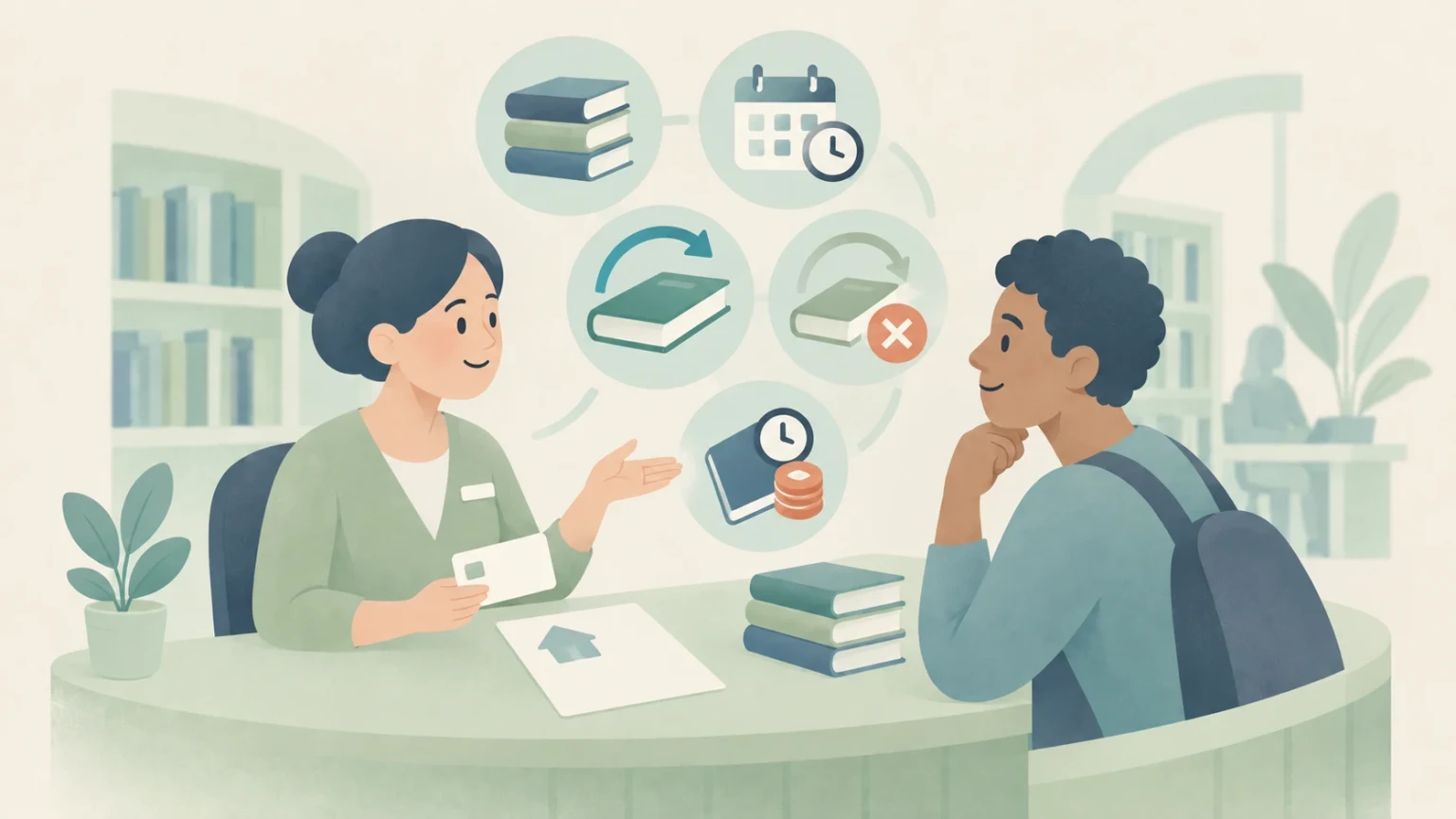
Joining a library means becoming a registered member who can borrow books temporarily and use resources. Registration involves showing acceptable evidence such as photo ID and proof of address before receiving your membership card. Under this fictional practice policy, members can take out up to six books for three weeks.
Key points
- Borrowers may renew their loans online unless another patron has reserved the title, while unreturned items incur a recurring overdue charge of twenty pence per day.
- To join a library means to become an official member.
- After presenting photo ID and proof of address, you receive your library card.
This lesson has 5 stages. You can stop at any time and continue later.

Stage 1 of 5
Understand
What it means, when to use it, and mistakes to avoid.
Watch & learn
How to use the phrasal verb check out
Elena and Marcus show you how to use check out to borrow library books, get media lab gear, and pay for school supplies.
Line 1 of 6 · Elena
I to out for our the library .
Say this line out loud, then continue.
The video could not continue. Try again or use the transcript below.
Your session
Learn with the video 15 min
Watch a short part, answer a question and practice what you heard. Then talk it through with the tutor.
The first part is free. Members continue to part 2 and can ask for more.
Key words in this video
Example
Memory tip
Goes with
Related forms
Not to be confused with
From this video
We couldn't load this word. Try again.
Examples
To join the library, please show photo ID and proof of address before receiving your card.
Why it works: Joining means becoming a member, and receiving the card occurs after presenting evidence.
2 more examples
-
Registered members can borrow up to six paperbacks for three weeks.
The phrase up to six sets the maximum allowance, while for three weeks denotes the loan duration.
-
You can renew your books online, unless another member has reserved them.
The conjunction unless marks the reservation as the sole condition that blocks a renewal.
Read the full guide
Joining a library means becoming a member
To join a library means to register as an official member so that you can use its services. When you join, you receive a library card, which is a membership pass that tracks what you check out. Receiving your card is the final step of registration, which happens after you present acceptable evidence at the counter. As a member, you borrow books by taking them home temporarily and returning them later. In contrast, the library lends books to members under established rules. Keeping the perspectives of borrower and lender clear helps you speak confidently with the staff.
-
I would like to join the library today so I can borrow books for my class.
Why it works: Joining means becoming a member who borrows materials temporarily.
-
The desk clerk issues your library card after checking your registration details.
Why it works: Receiving a card happens after presenting evidence, not before.
Your turn
What does joining a library mean for a new visitor?
Answer: Becoming an official member with borrowing privileges
Show the answer
Answer: Becoming an official member with borrowing privileges
Joining a library means registering as an official member who can borrow books temporarily and use services.
First listen: identify what the new member wants to do
During your first listen to a service desk conversation, focus on the speaker's main purpose before you try to track specific numbers or policies. A visitor who has recently moved usually begins by stating their overall goal, such as asking to join the library or finding out how to take books home. In this dialogue, the patron also asks practical clarification questions like 'How long can I keep them?' to find out if loans can run longer. Listening for this general intention gives you a clear framework for sorting out registration requirements and borrowing rules on later listens.
-
Hello, I moved here recently and would like to join the library today.
Why it works: The opening sentence establishes the visitor's primary purpose right away.
-
How long can I keep them if I need extra study time?
Why it works: A spoken clarification question asks directly about the length of the loan.
You can practise this again in Renewing library items and Delayed train announcement.
Your turn
What does the visitor primarily want to do at the counter?
Answer: Join the library and find out how to borrow books
Show the answer
Answer: Join the library and find out how to borrow books
The visitor's primary purpose is to register as a new member and learn how borrowing works.
Check which evidence the librarian asks for
To issue a library card, the librarian asks to see valid personal evidence. Photo ID serves as evidence of your personal identity, while proof of address confirms where you live. In our fictional practice policy, the clerk asks for both photo ID and proof of address, with an audible 'and' connecting them. However, do not assume two separate documents are always mandatory everywhere, because some official IDs already include residential details. Remember that a library card is the membership pass you receive only after registration is complete, whereas your identification documents are the evidence you bring to register.
-
Please show photo ID and proof of address before we process your card.
Why it works: The spoken word 'and' shows that both pieces of evidence are requested here.
-
You will receive your library card once we verify your address document.
Why it works: Receiving the card is the final outcome of presenting acceptable evidence.
Your turn
Why should you avoid assuming that two separate documents are always required to join a library?
Answer: Some official photo IDs also include verified residential details
Show the answer
Answer: Some official photo IDs also include verified residential details
Different libraries have varying policies, and some single credentials can show both identity and address.
Match each number to books, weeks or a daily charge
Spoken library rules link numbers to specific prepositions that clarify their function. The phrase 'up to six' establishes a borrowing limit, meaning six is the maximum number of books you can check out, not a required total. The phrase 'for three weeks' signals the loan duration before items must be returned. The phrase 'per day' marks a recurring late charge of twenty pence for each day an overdue book is late. If a figure sounds unclear in conversation, use confirmation questions such as 'Is that for each day?' to confirm how the fee accumulates.
-
You can borrow up to six paperbacks for three weeks.
Why it works: Up to sets the upper limit, while for indicates the loan duration.
-
Is that for each day, or is it a one-time late fee?
Why it works: A confirmation question clarifies whether a charge recurs daily.
Your turn
In the rule 'borrow up to six books for three weeks', what does 'up to six' mean?
Answer: Six is the maximum number of books permitted at one time
Show the answer
Answer: Six is the maximum number of books permitted at one time
The phrase 'up to' specifies the upper numerical ceiling, not a compulsory quota.
Use unless to identify when renewal is blocked
The word 'unless' means 'except if' and introduces the exact circumstance that stops an action from taking place. In library borrowing policies, extensions are normally permitted, but an active reservation by another reader changes that situation. If nobody else has reserved the book, you can renew your loan online and keep the title longer. In contrast, if another member has placed a reservation on that title, renewal is blocked immediately and you must return it on schedule. Listening carefully for 'unless' ensures you do not assume renewals are guaranteed under every condition.
-
You can renew your books online, unless another member has reserved them.
Why it works: Renewal is permitted unless a reservation by another borrower blocks it.
-
A hold was placed on my novel, so the portal blocked my loan extension.
Why it works: When someone else reserves the copy, the exception applies and you must return it.
Your turn
What happens if another member reserves a book you want to extend?
Answer: The system blocks your renewal and you must return the book on time
Show the answer
Answer: The system blocks your renewal and you must return the book on time
Because 'unless' introduces the blocking exception, an active reservation stops renewal.
Replay with hints before checking the library dialogue
Developing confident listening requires staged progressive support before you check the full transcript. Start by listening to the whole exchange once for general meaning. Next, use category prompts like joining requirements, borrowing limits, loan duration, renewal restrictions, and late charges to guide your focus. If a detail remains elusive, replay smaller spoken chunks and complete selected word gaps, such as 'borrow [___] to six books' or 'twenty pence [___] day'. Only after these guided attempts should you reveal the transcript and review the evidence in the compact listening table: Requirements: photo ID and proof of address; Maximum books: up to six; Loan duration: three weeks; Renewal restriction: permitted unless reserved; Late charge: twenty pence per day.
-
Replaying the chunk 'twenty pence per day' helps you catch the exact recurrence rate.
Why it works: Replaying short segments clarifies connected speech before reading the text.
-
Completing a word gap like 'up [___] six' directs your ear to weak function words.
Why it works: Targeted gap exercises highlight prepositions that carry important rule limits.
Your turn
What is the recommended staged listening order before looking at the full transcript?
Answer: Listen for gist, use category prompts, replay chunks with word gaps, then inspect the text
Show the answer
Answer: Listen for gist, use category prompts, replay chunks with word gaps, then inspect the text
Progressive support moves from overall gist to category prompts, targeted replays, and final transcript review.
Avoid confusing borrowing, renewing and reserving
Language learners frequently mix up the verbs borrow, renew, and reserve when speaking with library staff. Remember that you borrow an available book from the shelves to take home today, while the library lends that book to you. You renew a book that is already checked out to your account when you need extra time to finish reading it. You reserve a book when another patron currently has it checked out and you want the library to hold it for you when it is returned. Choosing the exact verb ensures the librarian understands whether you want to check out, extend, or hold an item.
-
May I renew these two history books for another three weeks?
Why it works: Renew applies to extending time on items currently checked out on your account.
-
Could you reserve that grammar guide for me as soon as it comes back?
Why it works: Reserve asks the counter staff to hold a currently unavailable title for you.
Your turn
Which verb should you use when an item is currently checked out by someone else and you want it next?
Answer: Reserve
Show the answer
Answer: Reserve
Reserving asks the library to set aside an item for you as soon as the current borrower returns it.
Write six short sentences and recall the borrowing rules
To consolidate what you have learned, write six short practice sentences covering requirements, borrowing limits, loan duration, renewal exceptions, late fees, and spoken clarification questions. After completing your dictations, test yourself with a short recall task while keeping the transcript hidden. Summarize the policy rules from memory: state which evidence registers a new patron, how many volumes a member may check out, how long loans last, when an online renewal is blocked, and how much overdue charges cost each day. Recalling these patterns without looking turns listening recognition into active communicative skill.
-
Please present your photo ID and proof of address to register.
Why it works: Covers the essential registration evidence required at the counter.
-
New members may check out up to six books at one time.
Why it works: States the maximum borrowing allowance using the limit phrase up to.
-
Standard book loans last for three weeks from today.
Why it works: Specifies the standard loan duration using for plus a time period.
-
You can renew your loan online unless someone has reserved the title.
Why it works: Illustrates how the conjunction unless introduces the renewal block.
-
Overdue books cost twenty pence per day until they are returned.
Why it works: Explains the recurring daily penalty rate for late returns.
-
How long can I keep them if I need extra time?
Why it works: Models a spoken clarification question about extending loan time.
Your turn
Why should you perform a policy recall task with the transcript hidden?
Answer: It transforms passive listening comprehension into active spoken and written recall
Show the answer
Answer: It transforms passive listening comprehension into active spoken and written recall
Active recall practice without reading the text strengthens memory and fluent spoken retrieval.
Use it naturally
How people really use “borrow”
Neutral Fine almost anywhere, at work or with friends.
Words it often goes with
- borrow booksI borrow books from the library every month.
- borrow paperbacksWe can borrow paperbacks for our book club.
- borrow up to sixMembers can borrow up to six books at a time.
What people also say
- “How long can I keep them?” instead of “What is the permitted borrowing duration?” This is a simple, natural way to ask about the return date.
Related forms
- borrower nounEach borrower needs a library card.
- borrowing nounThe borrowing period is three weeks.
Questions about "Joining a library"
What does 'proof of address' mean?
Proof of address means an official document that confirms your current home residence. Common examples include a recent utility bill, bank statement, or tenancy agreement showing your name and residential address within the library area.
The clerk accepted my council tax statement as proof of address.
I brought a recent electricity bill to verify my home address.
Does 'up to six books' mean I must borrow six?
No, the phrase 'up to' specifies the maximum allowance rather than a compulsory number. You can choose any number from one book up to six books. If you only need two books today, you are free to borrow just two.
New cardholders may borrow up to six paperbacks.
I only needed two books, even though the limit was six.
What is the difference between borrowing, renewing and reserving?
You borrow a book when you take it out from the library. You renew it when the library extends the time you can keep it. You reserve it when you ask the library to hold it for you, often because another reader has it. The available options depend on the library.
I asked to borrow three travel guides from the display shelf.
She renewed her novel online, but I had to reserve the missing volume.
What does 'unless someone has reserved it' mean?
The word 'unless' introduces the single condition that blocks your renewal. In this policy, you can extend your loan if nobody else needs the book. However, if another borrower places a reservation on that title, your extension is denied and you must return it.
The portal renews your loan automatically unless another member reserves the title.
I could not extend my checkout because a classmate had reserved the textbook.
Does 'per day' mean I pay the charge every day the book is late?
Yes, 'per day' means the overdue fee recurs for every single calendar day an item remains late past its due date. For instance, an overdue fine of twenty pence per day amounts to sixty pence if an item is kept three days past the deadline.
Late items accumulate twenty pence per day until returned.
Bringing the book back two days late resulted in a forty pence fee.
How can I ask the librarian to explain a rule again?
You can ask polite clarification and confirmation questions such as 'How long can I keep them?', 'Could you explain that condition again?', or 'Is that fee for each day?' These spoken questions help you confirm policy details before borrowing.
Excuse me, could you clarify how many weeks I can keep these books?
Is that charge for each day that the book is overdue?
Before you go
Remember this
To join a library means to become an official member. After presenting photo ID and proof of address, you receive your library card. Standard membership allows you to borrow up to six books for three weeks. You can renew items online unless another reader reserves the copy. If items become overdue, a charge of twenty pence per day accumulates until they are returned.
Stage 2 of 5
Listen
Hear it in real sentences, from short to long, and write what you hear.
Continue with the four activities from the video: listening, reading, speaking and writing. Back to the video
0 of 4 done
Listening 1 of 4
Listening 2 of 4
Try a longer clip. Listen once, then replay the part you missed.
Listening 3 of 4
This clip is longer. Follow the instruction above the answer field.
Listening 4 of 4
Listen, then type the missing words. The rest of the text is already there.
0:00
Practice complete
You listened closely.
Your result is saved in this browser.
Keep your progress. Your practice is saved on this device only. Create a free account to keep it everywhere.
Create a free accountThat was today's free lesson. Tomorrow you get another one. Want more today? See membership.
Create a free SubLearn account to keep this progress across devices.
Save my progressStage 3 of 5
Speak
Say it with the speaker, then use it in your own answer.
Shadow
Say it along with the speaker
Play the line slowly, then speak at the same time as the speaker. Copy the rhythm, not just the words.
Your turn
Say it your way
You recently moved to a new neighborhood and want to register at the local library counter. Speak for 20 to 30 seconds asking the librarian what identification you need to show and how many items you may borrow.
You could start with “Hello, I recently moved here and would like to register for a library card…”
Take ten seconds to think, then answer out loud without looking at the lesson. Speak for the time shown in the task above. Nothing is sent unless you ask for feedback.
0:00
Stage 4 of 5
Write
Write your own response
AI feedback · it can make mistakes · Part of membership See membership
Check your own writing
Read one possible response
Draft saved on this device.
Use these checks to revise your message. Grammar and meaning are not automatically graded. Each task keeps its own draft in this browser tab.

You finished the free part of this lesson
- Understand
- Listen
- Speak
- Write
- CheckPart of membership
Worth another look
With a free account, the lessons you finish come back for review to help you remember them.Create a free account
Stage 5 of 5 · Part of membership
Check
New clips without hints.
Listening tests are included with membership. Try the free dictation first, then decide whether to continue.
Listening 1 of 2 Part of membership
Listening 2 of 2 Part of membership
Follow MicroEnglish
Find lesson updates, short videos and quick quizzes. Pick the app you already use.
Questions & comments
Ask about this lesson, share an example, or help another learner.
Example
Memory tip
Goes with
Related forms
Not to be confused with
In this lesson
This word isn't in our dictionary. Check the spelling, or try another form of the word.
We couldn't load this word. Try again.
