Repérer les nombres et les heures
Écoutez d’abord le nombre, puis les mots qui l’entourent. La personne parle-t-elle d’une heure, d’une quantité ou d’un ordre ?
Leçons 37 à 48 sur 48
-

Renewing library items
Renewing an item grants permission to keep it past its original return date. If an item cannot be renewed, its original deadline remains active. In our conversation, the cookbook and audiobook receive new deadlines, while the reserved gardening book must still be returned on Saturday.
-

Changing a restaurant booking
A restaurant booking reserves a table for a specific number of people at an agreed time. Changing a booking means asking the restaurant to update those details. The final arrangement depends on what the restaurant has available, so only details accepted by both sides become the new booking.
-

Eight hours of sleep
The phrase eight hours of sleep refers to duration, but speakers rarely mean a rigid target of exactly 480 minutes. In everyday conversations about health, speakers use words like most and around to describe a typical adult span of seven to nine hours. Individual sleep needs differ according to routine, age, and activity level. Listening carefully to qualifying words prevents you from mistaking a broad population guideline for a personal medical mandate.
-

Weather-dependent plans
Conditional plans establish two possible paths based on an uncertain event. In this conversation, the friends prefer cycling outdoors, but rain makes that choice uncertain. The word if introduces the weather condition required for cycling. The word otherwise introduces the indoor alternative if that condition fails. The word instead highlights that cooking lunch replaces cycling rather than adding another event to their afternoon.
-

Medicine instructions
Pharmacy instructions separate the dose taken at one time from the daily frequency. Food prepositions define whether medicine requires an empty or full stomach, while conditional warnings explain what actions to avoid if drowsiness or worsening symptoms occur.
-
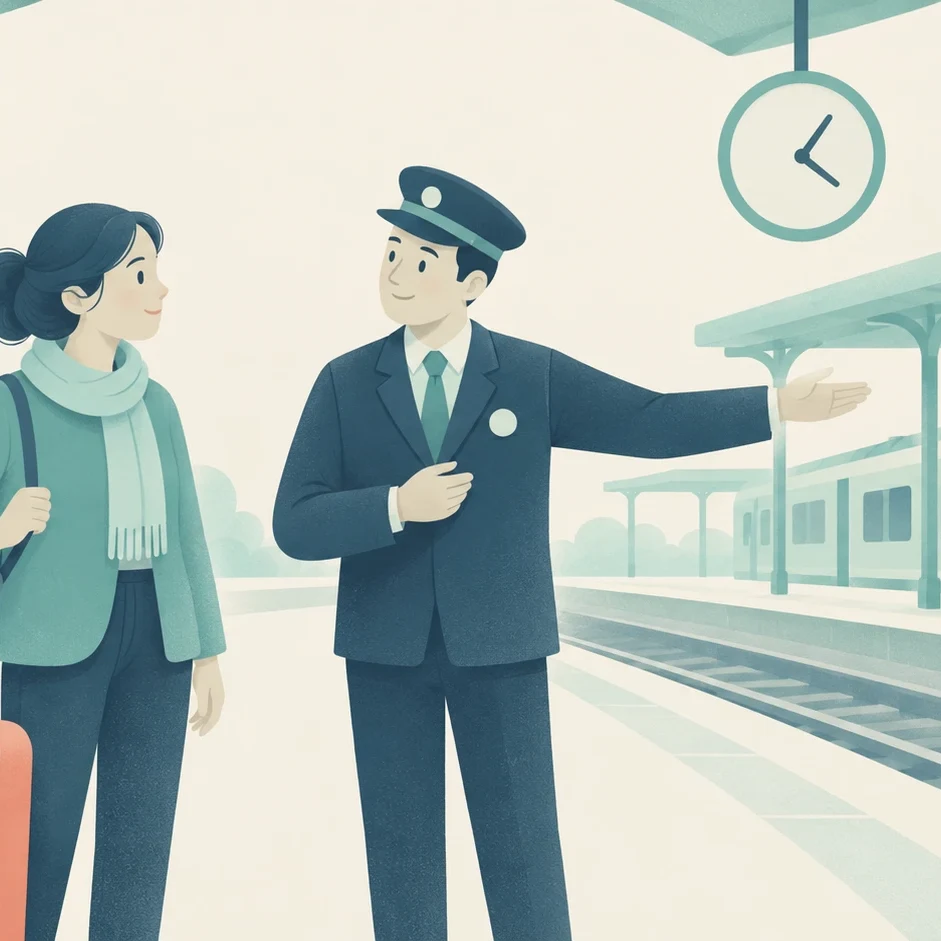
Train platform change
When an announcement updates a train journey, the destination remains the same while the platform and time change. In our scenario, the sixteen ten train to York is delayed by fifteen minutes, meaning it departs at sixteen twenty-five from platform seven instead of platform two.
-
Abonnement
Accédez à toutes les leçons gratuitement pendant 7 jours
- 571 leçons avec dictées et tests d’écoute
- Trois accents : britannique, américain et australien
- De nouvelles leçons chaque jour et votre progression enregistrée
Aucune carte requise. Ensuite, à partir de $7.50 par mois si vous souhaitez continuer.
Commencer l’essai gratuit -

Checking a café order
In an order such as two soups, but one without cream, the customer wants two portions and changes only one. With introduces something included; without introduces something excluded. An allergy explains why an ingredient must be avoided.
-

Delivery voicemail corrections
A repair shop caller updates the delivery time for a repaired desk lamp from before lunch to the afternoon, changes the last digit of the order code, and gives a nearby collection desk as an alternative if the workplace reception is closed.
-

To jump ship
To jump ship means to leave an organization, employer, or difficult project, especially suddenly because you anticipate failure, mismanagement, or severe instability.
-

Put into perspective
To put something into perspective means to compare a problem, number, or event with relevant facts or a wider background so you can judge its true seriousness, importance, or scale more fairly. The expression describes the mental shift that happens when a useful comparison gives you a balanced view, showing whether an issue is truly severe or simply a normal part of a bigger process.
-

One-off
One-off means that an action, event, charge, or object occurs or exists only once. When you call an event a one-off, you state that it does not establish a routine or repeated series.
-

In one go
'In one go' means completing an entire task or action in a single continuous attempt or period of effort, rather than dividing it into separate steps, trips, or sessions. In this phrase, 'go' functions as a noun meaning an attempt or round of activity.
Vous hésitez à commencer l’essai ? Recevez une leçon gratuite chaque jour
Une courte dictée par e-mail chaque jour pendant 7 jours. Entraînez-vous où vous êtes, sans compte.
Vous ne trouvez pas l’expression ou la situation à travailler ?
Les demandes de leçon sont comprises dans l’abonnement.
Voir les abonnements