
Several meanings of a broader economy
Oman's nonhydrocarbon economy grew by 3.3 percent in 2024, according to the IMF's January 2026 Article IV report. Total real GDP grew by 1.6 percent. The difference is useful evidence that activity outside oil and gas was expanding, but it leaves several questions about economic structure unresolved. Production, government revenue, employment, and export earnings measure different forms of dependence. Improvement in one does not establish improvement in all of them.
Oman Vision 2040 provides the national planning reference for 2021 to 2040. Its economic direction combines diversification with fiscal sustainability, private sector leadership, and a productive workforce. Those aims belong together because a sector can expand while depending on spending ultimately financed by oil. The analytical distinction is between producing something other than hydrocarbons and becoming less vulnerable to hydrocarbon income. Neither measure makes the other irrelevant. Output records what an economy produces, while the source and stability of demand help explain how that production can continue. For an assessment of the vision, the first task is therefore to identify which kind of diversification a particular indicator actually measures. The reported growth rates establish expansion during a stated year; they do not settle the broader argument.

A timetable with several kinds of numbers
The Eleventh Five-Year Development Plan, announced in January 2026, covers 2026 to 2030. It is the vision's second implementation roadmap. The government targets real growth of about 4 percent and gives manufacturing, digital activity, and tourism central roles. The announced sector growth targets are 5.9 percent for manufacturing, 10.8 percent for the digital economy, and 5.7 percent for tourism. Supporting sectors include logistics, renewable energy, and food security.
These targets express policy ambition. By comparison, the IMF report projected real GDP growth of 2.8 percent and nonhydrocarbon growth of 3.5 percent for 2025. Those projections concern a different period and use the IMF's assessment framework. Placing all the percentages in a single list would conceal the distinction between a government's objective and an institution's forecast. It would also obscure the size of the sectors behind the rates.
The development plan schedules work programs for 2026 to 2027 and 2028 to 2029, with evaluation in 2030. This offers a sequence for reviewing delivery. A useful comparison at each stage would preserve the original definition of an indicator, identify revisions to the data, and distinguish price changes from changes in output. Without that consistency, apparent progress may reflect a changed measure as much as changed activity.
Investment becomes productive through other firms
The vision calls for an economy led by private businesses and for links between smaller enterprises and large corporations. This places supplier relationships inside the diversification agenda. A large investment can create opportunities for nearby firms, but the extent of those connections depends on purchasing decisions, quality requirements, and the ability to deliver. A supplier network is an operating relationship, rather than an automatic consequence of geographical proximity.
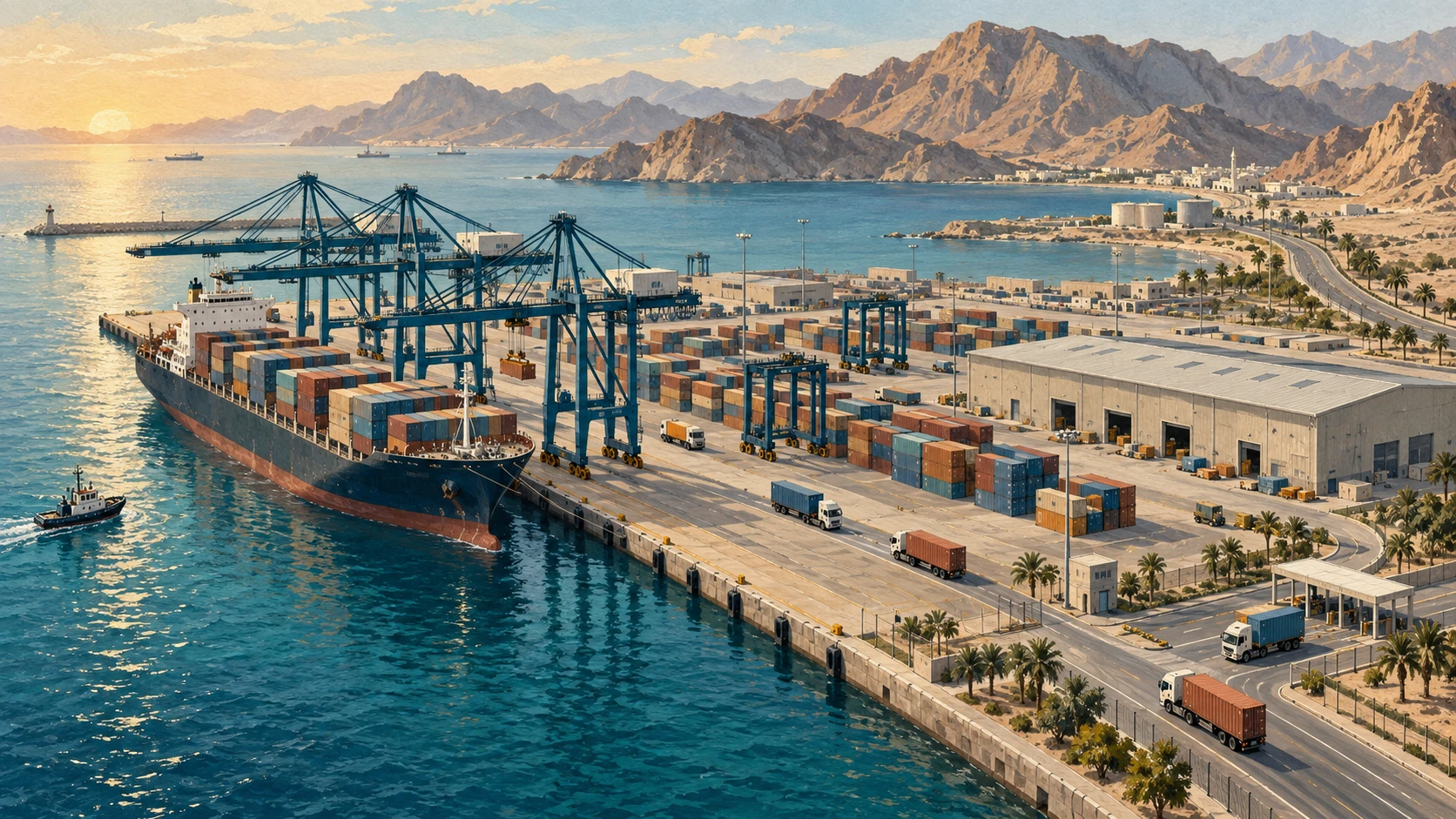
The World Bank's October 2025 account of its Oman program describes investment climate reforms, support for smaller enterprises, and cooperation in logistics and green manufacturing. It also identifies financing support connected with Duqm's port and industrial infrastructure. These are documented areas of engagement. An agreement, a financial guarantee, and an operating project are distinct stages with different evidence behind them.
The economic implication is that access to capital and access to a customer have to meet. Financing can help a company acquire equipment, but revenue depends on selling goods or services. Transport capacity matters when there is cargo to move. Public policy can improve the conditions around these decisions, while commercial demand determines whether firms can sustain the resulting activity. Measuring expenditure alone captures the resources committed and leaves their productive use unresolved.
The labor market connects ambitions with households
The vision's workforce aims link skills, productivity, and rewards for performance. The IMF recommended further measures to narrow public and private sector wage differences and increase women's labor force participation. It also called for better vocational outcomes. These recommendations identify economic constraints; their inclusion in the report does not establish that the constraints have been removed.
Employment and productivity have different relationships with investment. A firm may produce more with the same workforce after changing its equipment or organization. It may also hire more people because demand grows. Both developments can matter, but output growth alone cannot reveal which occurred. A national account of diversification therefore needs information about who gains access to work and whether firms can sustain the wage bill.
Pay differences influence the choices available to workers, while firms face the cost of employing people with the required abilities. These incentives can complicate an otherwise persuasive sector strategy. The inference is that industrial priorities and labor policy need to be examined together. Announced positions, filled positions, and lasting employment are separate measures. Evidence about job quality would add another dimension, including stability and remuneration, without assuming that every new position delivers the same benefit to a household.
Public money remains part of the adjustment
The IMF warned that lower oil prices and heightened global uncertainty could weaken Oman's fiscal and external balances. Its report recorded central government debt at 36.1 percent of GDP at the end of September 2025. That figure concerns a specific date and institutional boundary. It cannot be substituted for a measure of every public entity's liabilities or treated as a permanent level of debt.
Fiscal sustainability concerns the government's ability to sustain its financial commitments. Diversification can support that aim if a broader economy develops reliable sources of public revenue. Yet investment itself requires resources, and a government can face pressure before the expected benefits arrive. This creates a sequencing issue: the spending needed to support transformation may occur while oil still shapes the capacity to finance it.
The IMF's recommendations include stronger public investment management and fiscal frameworks. In analytical terms, these would help connect project selection with the budget and the government's ability to absorb shocks. A favorable growth projection cannot remove uncertainty about future oil income. The relevant evidence includes the cost and timing of commitments, the revenue available to meet them, and the risks left with public bodies.
Progress needs consistent evidence at several scales
Vision 2040 includes development across governorates, sustainable land use, and accessible transport. These priorities prevent national growth from being the only relevant scale of assessment. An increase in total output does not identify which places gained work or whether the public services around them kept pace. Cooperation described by the World Bank on renewable energy and water efficiency adds the use of resources to this picture.
Oman's official implementation reports, including the 2024 to 2025 edition, provide an account of activity under the vision. They can be read alongside institutional assessments, while preserving the distinction between official reporting and independent evaluation. The analytical standard proposed here is consistent evidence connecting investment to operating firms, household opportunities, and sustainable public commitments.
That standard avoids demanding that one percentage carry the entire case for transformation. The documented expansion outside oil and gas is meaningful evidence within its scope. Lasting diversification would become more convincing when that expansion is accompanied by resilient sources of demand and revenue, productive firms, and employment that survives beyond the initial investment period.