Phrasal verb
Get back to
What is the difference between 'get back to' and 'reply to'?
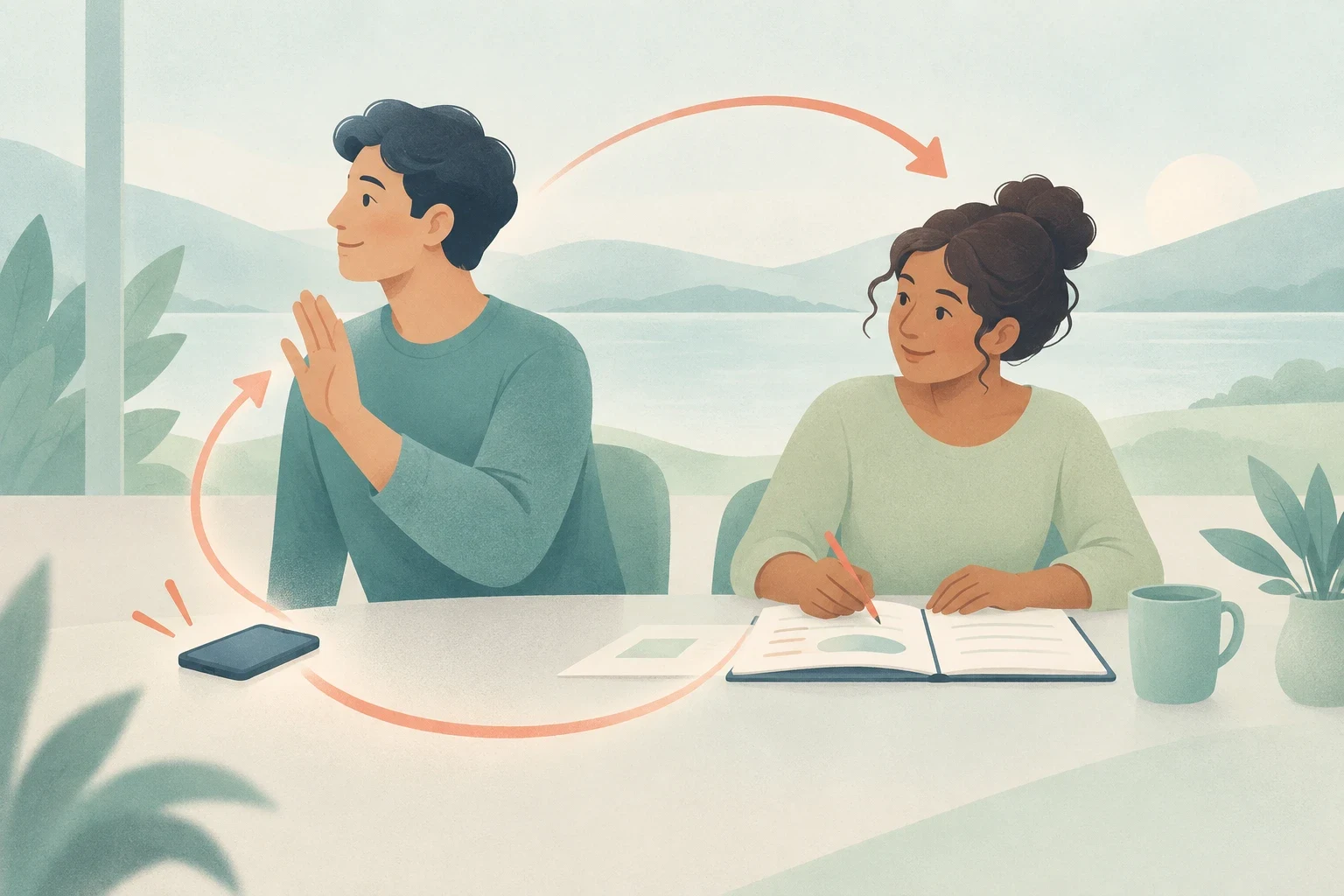
Get back to means either to reply to someone at a later time with information, or to return to an activity, discussion, or task after an interruption.
Key points
- Place a person after get back to when promising a later reply, and place a task or an -ing verb after it when resuming paused work.
- Always keep the three words together.
- Keep get back to together as a unit.
This lesson has 5 stages. You can stop at any time and continue later.

Stage 1 of 5
Understand
What it means, when to use it, and mistakes to avoid.
Watch & learn
Get back to
Distinguish contacting someone later from resuming a paused activity, and choose the correct noun or verb pattern after the preposition.
Line 1 of 8 · Nadia
Nadia: me? a ?
Say this line out loud, then continue.
The video could not continue. Try again or use the transcript below.
Your session
Learn with the video 15 min
Watch a short part, answer a question and practice what you heard. Then talk it through with the tutor.
The first part is free. Members continue to part 2 and can ask for more.
Key words in this video
Example
Memory tip
Goes with
Related forms
Not to be confused with
From this video
We couldn't load this word. Try again.
Examples
I will review your proposal and get back to you before noon.
Why it works: The speaker names the person who will receive the later reply and specifies a clear deadline.
2 more examples
-
After our short coffee break, we should get back to testing the software.
An -ing form follows the preposition to because the team is resuming an activity.
-
The technician will get back to us with a cost estimate later today.
The phrase adds with to name the exact information that will be delivered.
Read the full guide
Decide between contacting a person and resuming a task
Your first decision is whether your sentence focuses on communication or activity. When you place a person or pronoun after get back to, you promise a future answer or message. When you place a task, topic, or routine after the phrase, you describe returning to an activity that was interrupted. Mixing these two patterns confuses listeners because it suggests either that an inanimate task will speak or that a person is an activity.
-
I must get back to David before he leaves the office.
Why it works: A person follows to, so the sentence promises communication.
-
I must get back to my spreadsheets before the meeting.
Why it works: A work task follows to, so the sentence describes resuming paused work.
Your turn
Which sentence promises a future message to a colleague?
Answer: I will get back to Sarah after lunch.
Show the answer
Answer: I will get back to Sarah after lunch.
Placing Sarah after the preposition indicates that the speaker will contact her later, whereas the project or the desk indicates returning to an activity or location.
Promise a later reply without sounding dismissive
When someone asks for an immediate decision during a busy workday, you can protect your schedule without sounding rude. Using get back to someone signals that you acknowledge their request but need time to find accurate facts. Native speakers often pair this phrase with a clear condition, such as after checking the schedule or as soon as the client calls. A definite timeframe reassures the listener that you will not forget their question.
-
Let me check our inventory and get back to you this afternoon.
Why it works: This gives a specific action and a definite time for the response.
-
We will get back to all applicants by Friday afternoon.
Why it works: A group of people receives the promise with an explicit deadline.
This also comes up in Get round to and Look into.
Your turn
Which sentence provides both a clear reason and a polite delay?
Answer: Let me ask our manager and get back to you by five.
Show the answer
Answer: Let me ask our manager and get back to you by five.
This option politely explains the step required before answering and sets a clear deadline.
Return to an activity after a conversation ends
Interruptions happen constantly in offices and study spaces. When a conversation finishes or a visitor leaves, you need a natural way to transition back to your work. Native speakers use get back to work or get back to business to mark the end of small talk and the restart of serious effort. In this structure, the noun phrase represents the paused task rather than a listener.
-
Thanks for the coffee, but now I should get back to work.
Why it works: The speaker politely signals the end of a break.
-
Once the fire alarm stopped, everyone got back to their desks.
Why it works: The group resumed work after an unexpected physical interruption.
Your turn
What does a manager mean when saying, 'Let us get back to the agenda'?
Answer: The team should resume discussing the planned list of topics.
Show the answer
Answer: The team should resume discussing the planned list of topics.
Placing a topic such as the agenda after get back to means resuming discussion on that paused item.
Choose an -ing form when describing an action
In get back to, to is a preposition. It can be followed by a noun, a pronoun, or an -ing verb form. Get back to studying uses studying as a verb form. Get back to study can also be grammatical when study is a noun meaning the activity. Identify the role of the word rather than rejecting the same spelling in every context.
-
After answering your email, I will get back to writing the summary.
Why it works: The verb write takes -ing because to functions as a preposition.
-
She wants to get back to exercising three mornings every week.
Why it works: Exercising serves as the gerund object of the preposition to.
Your turn
Which sentence uses the correct verb form after get back to?
Answer: He took a sip of water and got back to painting the fence.
Show the answer
Answer: He took a sip of water and got back to painting the fence.
The preposition to must remain in the phrasal verb and be followed by the gerund painting.
Specify the message using the preposition with
When promising an answer, you frequently want to mention the specific document, data, or detail that you plan to provide. To add this information cleanly, follow the pattern get back to someone with something. The person remains directly after to, while with introduces the payload of facts or files. Placing the information before the person creates unnatural, confusing word order.
-
I will get back to you with the updated price sheet by tomorrow morning.
Why it works: The person you follows to, and with introduces the specific document.
-
The technician got back to us with a simple solution to our connection issue.
Why it works: The solution is introduced by with after the pronoun us.
Your turn
Which sentence correctly shows who will receive what information?
Answer: Our team will get back to you with the final results on Tuesday.
Show the answer
Answer: Our team will get back to you with the final results on Tuesday.
The correct structure places the recipient immediately after to and the content after with.
Identify connected speech and irregular past forms
In fast everyday speech, native speakers do not pronounce each word in get back to with equal volume. Stress depends on the sentence and the point being emphasized. The word to often has the weak form /tə/. When the pronoun you follows, the /t/ sound often links smoothly into /j/, producing /gɛt bæk tə jə/. In past narratives, remember that get changes irregularly to got, while to keeps its weak pronunciation.
-
I got back to him as soon as our flight landed.
Why it works: Got indicates past completion, and to links rapidly to the pronoun him.
-
Did anyone get back to you about that broken printer?
Why it works: The question retains the base form get after the auxiliary did.
Your turn
Why is 'I getted back to her yesterday' incorrect in English?
Answer: The verb get is irregular and changes to got in the simple past.
Show the answer
Answer: The verb get is irregular and changes to got in the simple past.
Get is an irregular verb whose past simple form is got, not getted.
Avoid false friends and separated word order
Learners whose native languages use verbs like retornar or retourner often say return you or reply you. In English, return you means carrying a human being back to a place, and reply requires to before a person. Additionally, never separate get back to by placing the object in the middle; get someone back to can mean helping someone return to a place or activity. The separate pattern get someone back can mean take revenge; it does not use to in that sense.
-
I will get back to Maria after checking the records.
Why it works: Get back to stays intact as a fixed three-word unit.
-
The supervisor promised to get back to our department by Friday.
Why it works: Our department functions as the collective recipient directly after to.
Your turn
What is wrong with the sentence: 'I will return you tomorrow with an answer'?
Answer: Return you sounds like physically returning a person rather than replying to them.
Show the answer
Answer: Return you sounds like physically returning a person rather than replying to them.
Return cannot be used directly with a person to mean send a reply; English uses get back to someone instead.
Write clear follow-up messages across channels
In workplace emails and chat messages, get back to is both common and polite when used with precision. If you must leave a customer inquiry waiting, provide an immediate holding message that states when you will provide an update. In written communication, pairing the phrase with a specific time demonstrates competence and accountability, preventing misunderstandings or unnecessary repeat messages from anxious clients.
-
Thanks for reaching out; I will get back to you with the schedule by 3 PM.
Why it works: A polite opening is paired with a clear deadline for the follow-up.
-
We will get back to your inquiry as soon as our office reopens on Monday.
Why it works: Your inquiry functions as the topic object receiving attention.
Your turn
Which written message best maintains professional trust when you need time to investigate?
Answer: I received your request and will get back to you by three with our findings.
Show the answer
Answer: I received your request and will get back to you by three with our findings.
Stating receipt of the request along with an exact time and what will be shared maintains trust and clarity.
Use it naturally
How people really use “get back to”
Neutral Fine almost anywhere, at work or with friends.
Words it often goes with
- get back to you with an answerI'll get back to you with an answer tomorrow.
- get back to workWe should get back to work after lunch.
- get back to the discussionLet's get back to the discussion before everyone leaves.
- get back to readingI want to get back to reading my book.
What people also say
- “I'll get back to you tomorrow.” instead of “I will give you my response on the following day.” This sounds natural when promising a later reply.
- “Let's get back to cooking.” instead of “Let's return to the activity of cooking.” Use an -ing form for the activity you are resuming.
Questions about "Get back to"
What is the difference between 'get back to' and 'reply to'?
Reply to refers to any formal or neutral response to a message, question, or letter. Get back to is more common in spoken and informal business English, and it carries the specific idea of returning to someone after taking time to find an answer or check facts. It also allows you to talk about resuming tasks, which reply to cannot do.
Please reply to this email to confirm your attendance.
I do not have the numbers right now, but I will get back to you soon.
Can I say 'I will get back with you' instead of 'get back to you'?
In standard English, the established phrase is get back to someone. In some informal American dialects, speakers say get back with you, but in professional and international settings, get back to you is the preferred, universally accepted choice. Use with only when naming the information you are bringing, such as get back to you with an answer.
She will get back to you with the missing details tomorrow.
Can I say 'get back to work on the report'?
Yes. Work can be a noun, so get back to work on the report is grammatical. If the word after to is a verb in the return-to-an-activity pattern, use its -ing form: get back to working on the report or get back to writing. The noun and verb patterns are both useful.
Let us take a quick break and then get back to writing our notes.
He got back to inspecting the machines after lunch.
What happens if I put the person between get and back?
Separating the phrase completely alters its meaning. Saying get someone back means taking revenge on someone who harmed you, or helping someone return to a physical place or relationship. To mean reply or contact later, keep the words together: get back to someone.
I need to get back to Marcus regarding our proposal.
He hid my keys as a joke, but I will get him back tomorrow.
Before you go
Remember this
Place a person after get back to when promising a later reply, and place a task or an -ing verb after it when resuming paused work. Always keep the three words together.
Stage 2 of 5
Listen
Hear it in real sentences, from short to long, and write what you hear.
Continue with the four activities from the video: listening, reading, speaking and writing. Back to the video
0 of 4 done
Listening 1 of 4
Listen, then type what you hear. Replay as often as you need.
0:00
- After our short coffee break, we should get back to testing the software.
- The technician will get back to us with a cost estimate later today.
Listening 2 of 4
Listen, then type what you hear. Replay as often as you need.
0:00
- After our short coffee break, we should get back to testing the software.
- The technician will get back to us with a cost estimate later today.
Try a longer clip. Listen once, then replay the part you missed.
Listening 3 of 4
Listen, then type what you hear. Replay as often as you need.
0:00
- After our short coffee break, we should get back to testing the software.
- The technician will get back to us with a cost estimate later today.
This clip is longer. Follow the instruction above the answer field.
Listening 4 of 4
Listen, then type the missing words. The rest of the text is already there.
0:00
- After our short coffee break, we should get back to testing the software.
- The technician will get back to us with a cost estimate later today.
Practice complete
You listened closely.
Your result is saved in this browser.
Keep your progress. Your practice is saved on this device only. Create a free account to keep it everywhere.
Create a free accountThat was today's free lesson. Tomorrow you get another one. Want more today? See membership.
Create a free SubLearn account to keep this progress across devices.
Save my progressStage 3 of 5
Speak
Say it with the speaker, then use it in your own answer.
Shadow
Say it along with the speaker
Play the line slowly, then speak at the same time as the speaker. Copy the rhythm, not just the words.
Your turn
Say it your way
Speak for 30 to 60 seconds from memory. You are baking a birthday cake at home when your sister calls to ask how many guests can come. Explain what you need to check, promise her a reply, and describe returning to the cake.
Use: get back to you
Take ten seconds to think, then answer out loud without looking at the lesson. Speak for the time shown in the task above. Nothing is sent unless you ask for feedback.
0:00
Hear how someone else might say it
I'm making a chocolate cake for my dad's birthday. My sister just called because she wants to invite some friends. I told her, "I'll get back to you with a number after I check how many chairs we have." We have a small kitchen, so we can't invite too many people. Now I need to get back to baking before it gets too late. The cake is already in the oven, but I still need to make the chocolate topping. I'll call my sister while the cake cools.
Try once more and answer this: How will you check how many people can come?
Stage 4 of 5
Write
Write your own response
AI feedback · it can make mistakes · Part of membership See membership
Check your own writing
Read one possible response
Draft saved on this device.
Use these checks to revise your message. Grammar and meaning are not automatically graded. Each task keeps its own draft in this browser tab.

You finished the free part of this lesson
- Understand
- Listen
- Speak
- Write
- CheckPart of membership
Worth another look
With a free account, the lessons you finish come back for review to help you remember them.Create a free account
Stage 5 of 5 · Part of membership
Check
New clips without hints.
Listening tests are included with membership. Try the free dictation first, then decide whether to continue.
Listening 1 of 2 Part of membership
Listening 2 of 2 Part of membership
Follow MicroEnglish
Find lesson updates, short videos and quick quizzes. Pick the app you already use.
Questions & comments
Ask about this lesson, share an example, or help another learner.
Example
Memory tip
Goes with
Related forms
Not to be confused with
In this lesson
This word isn't in our dictionary. Check the spelling, or try another form of the word.
We couldn't load this word. Try again.
