Micro-listening
Nerd Meaning: Enthusiast or Social Slang
What does 'nerd' mean in English?
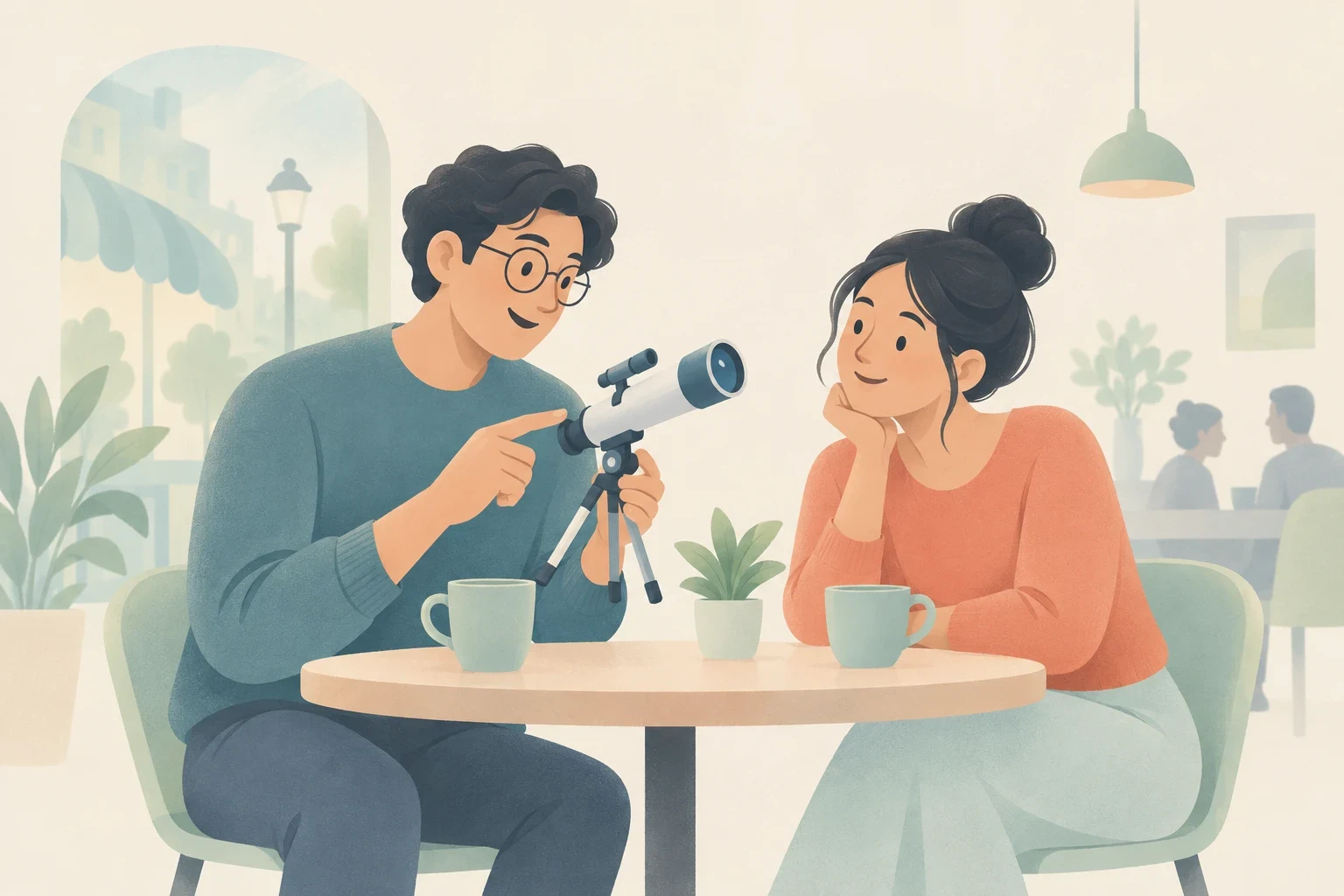
'Nerd' means a person with an intense, detailed interest in a particular subject, usually in informal conversation. For example, 'I'm a garden nerd' shows warm pride in your hobby. Use 'nerdy' for related activities or things, and choose 'specialist', 'enthusiast', or 'expert' in formal professional situations.
Key points
- 'Nerd' describes deep enthusiasm and detailed knowledge.
- Put a subject before 'nerd' for clarity.
- 'Nerdy' describes related activities, items, or conversations.
- Self-description usually sounds warm and modest.
This lesson has 5 stages. You can stop at any time and continue later.

At a glance
| Form | Use it for | Example |
|---|---|---|
| nerd | An informal noun for a deeply enthusiastic person | She's a plant nerd. |
| nerdy | An adjective for related activities or things | We had a nerdy discussion. |
| specialist or expert | Formal alternatives for professional settings | He's a database specialist. |
Stage 1 of 5
Understand
What it means, when to use it, and mistakes to avoid.
The full explanation
A nerd is a person who has an intense, absorbing interest in a specific subject, hobby, or technical area and spends substantial time mastering its details. In modern English, it highlights deep curiosity and specialized knowledge rather than social awkwardness, though it remains distinctly informal.
I am an audio nerd, so I spent the entire weekend adjusting my speaker cables.
Why it works: The speaker uses audio nerd playfully on themselves to show pride in a detailed personal hobby.
3 more examples
-
Marcus is a history nerd who memorized every train timetable in the city.
History nerd identifies the specific area of passionate study in a warm, informal way.
-
We had a nerdy discussion about keyboard switches during our lunch break.
The adjective nerdy describes an enjoyable conversation focused on small mechanical details.
-
Because our client needed an objective review, our manager introduced Elena as an industry specialist rather than a tech nerd.
Industry specialist provides an appropriate, respectful tone for a professional business meeting.
Read the full guide
Decide if deep enthusiasm fits the word
Use the noun nerd when a person shows intense, sustained fascination with a subject rather than casual interest. A casual reader enjoys a novel on a quiet Sunday afternoon, but a book nerd tracks publishing houses, compares different translations, and collects early editions. The word focuses on detailed knowledge and time spent studying small points that other people ignore. Listen for genuine passion in relaxed conversation before you choose this informal noun.
-
Elena is a coffee nerd who measures water temperature to the exact degree every morning.
Why it works: Elena's precise morning routine demonstrates the intense attention to detail that fits the word nerd.
-
My neighbor is a weather nerd who monitors local rainfall with three separate digital gauges.
Why it works: Weather nerd describes an active hobby involving dedicated data collection.
Your turn
Which situation best justifies calling someone a film nerd?
Answer: A person who studies camera lenses, directors' cuts, and audio design in old movies.
Show the answer
Answer: A person who studies camera lenses, directors' cuts, and audio design in old movies.
Nerd describes someone with deep, specialized knowledge and active enthusiasm for small technical details.
Add a subject word before nerd
You make your statement clearer and friendlier by placing a specific noun directly before nerd. Calling someone a nerd by itself can sound vague or slightly sharp, but saying plant nerd, board game nerd, or spreadsheet nerd defines their unique interest immediately. This compound pattern shows that you admire their detailed skill in that exact hobby. Native speakers rely on this structure constantly in modern workplace chats and weekend clubs.
-
David is a spreadsheet nerd, so he created an automated budget table for our kitchen renovation.
Why it works: Placing spreadsheet before nerd clarifies David's specific technical skill and enthusiasm.
-
Our walking group has two plant nerds who identify every wildflower along the mountain path.
Why it works: Plant nerds names the specific botanical interest shared by the two group members.
You can practise this again in Present perfect progressive: how to use have been working and Nowhere to Put It: Explain a Space Problem.
Your turn
How can you make the word nerd sound specific and positive when describing a friend who loves history?
Answer: Place the subject first and describe your friend as a history nerd.
Show the answer
Answer: Place the subject first and describe your friend as a history nerd.
Placing the specific subject before nerd highlights knowledge and enthusiasm while preventing the word from sounding like a broad insult.
Judge your relationship before speaking
The tone of nerd changes depending on who speaks and the shared history between the speakers. Close friends use the word warmly to celebrate a shared obsession or tease each other gently during an activity. However, an unfamiliar acquaintance or an older relative might still hear the word as an unkind remark about social awkwardness. Always listen to how the other person speaks before you introduce this label into the room.
-
My childhood friend smiled when I called him a comic book nerd after seeing his collection.
Why it works: Long friendship and shared humor make the informal term feel affectionate.
-
The new client looked confused when Liam jokingly called him a software nerd during their first meeting.
Why it works: Using the word with a new business contact creates social discomfort because familiarity is missing.
Your turn
Why should you avoid calling a new manager a finance nerd during your first team lunch?
Answer: Without an established friendly relationship, the informal label can sound disrespectful or dismissive.
Show the answer
Answer: Without an established friendly relationship, the informal label can sound disrespectful or dismissive.
Nerd carries social risks when speakers do not share an established bond of friendly familiarity.
Use the word for yourself first
The safest way to use nerd is as a self-description to explain your own unusual habits or intense hobbies. When you say I am a grammar nerd or I am a complete coffee nerd, you show modesty and good humor about your specialized interests. People appreciate the honesty, and it invites others to share their own passions. Using the word on yourself carries zero social risk and demonstrates natural conversational fluency.
-
I am a total map nerd, so I studied the subway layout before our flight landed.
Why it works: The speaker claims the label voluntarily to explain why they know the route so well.
-
Forgive me for checking the battery specs; I am an electronics nerd about portable devices.
Why it works: Self-labeling softens the speaker's detailed question and sounds polite to the listener.
Your turn
What is the primary conversational benefit of describing yourself as a garden nerd?
Answer: It explains your deep enthusiasm with warm modesty and invites relaxed conversation.
Show the answer
Answer: It explains your deep enthusiasm with warm modesty and invites relaxed conversation.
Calling yourself a nerd shows self-awareness and relaxed pride in your hobby without judging anyone else.
Pick professional words at work
In workplace documents, formal presentations, performance appraisals, and official introductions, avoid nerd entirely. Instead, select professional terms like specialist, enthusiast, expert, or analyst that directly describe competence and formal capability. An enthusiast highlights passion and broad interest, while an expert or specialist implies recognized training, deep experience, and professional authority. Matching the vocabulary to the workplace standard protects everyone's professional reputation.
-
Our engineering director introduced Maya as our database specialist during the vendor presentation.
Why it works: Database specialist establishes formal professional credentials suitable for external clients.
-
The newsletter profiled Arthur as an active astronomy enthusiast who organizes community stargazing nights.
Why it works: Enthusiast reflects Arthur's personal passion while maintaining a respectful editorial tone.
Your turn
Which phrasing is best for a formal resume summary?
Answer: Logistics specialist with seven years of supply chain management experience.
Show the answer
Answer: Logistics specialist with seven years of supply chain management experience.
Logistics specialist sounds formal, credible, and appropriate for career documentation.
Describe habits and items with nerdy
Transform nerd into the adjective nerdy when you want to describe an activity, joke, conversation, or personal style. A nerdy board game involves complex rules, detailed miniature figures, and hours of tactical planning. A nerdy joke relies on specific math or scientific principles that outsiders might not catch immediately. Just like the noun, nerdy sounds playful among friends but can feel critical if used to mock someone's appearance or serious interests.
-
We spent a nerdy evening debating the historical accuracy of medieval armor in fantasy films.
Why it works: Nerdy modifies evening to describe a recreational activity centered on obscure facts.
-
Rachel wore nerdy socks printed with algebraic formulas to her calculus exam.
Why it works: Nerdy describes a humorous fashion choice showing affection for mathematics.
Your turn
Which sentence correctly uses the adjective form nerdy?
Answer: He explained the puzzle using a very nerdy calculation that solved the problem.
Show the answer
Answer: He explained the puzzle using a very nerdy calculation that solved the problem.
Nerdy functions as an adjective modifying the noun calculation; it cannot replace the noun nerd or a collective noun.
Catch the stressed vowel in conversation
In fast conversational speech, nerd carries the central stressed vowel sound /ɜːr/, identical to the vowel sound in bird, word, and heard. Because the word ends with the voiced consonant /d/, American speakers lengthen the vowel slightly before releasing the final stop. When followed by a vowel sound, such as nerd is or nerd about, the final /d/ links smoothly to the next word. Practice hearing this single stressed syllable in noisy cafe conversations.
-
That audio nerd is always testing different microphone cables in the sound studio.
Why it works: The final /d/ in nerd links directly to the initial vowel sound of is.
-
A true word nerd enjoys discovering where odd English idioms originated.
Why it works: Word and nerd share the exact same vowel sound /ɜːr/, creating a rhyming rhythm.
Your turn
Which group of words shares the same central vowel sound as nerd?
Answer: Bird, shirt, learn
Show the answer
Answer: Bird, shirt, learn
Nerd, bird, shirt, and learn all feature the standard stressed /ɜːr/ vowel sound.
Write about personal hobbies without awkwardness
When you write informal personal profiles, blog comments, or casual chat messages, using nerd communicates authenticity and approachable charm. State your interest directly, connect it to a concrete habit, and keep your tone lighthearted. For example, writing that you are a font nerd who notices typography on restaurant menus tells a memorable personal story in few words. This balance keeps your writing engaging without sounding arrogant or overly academic.
-
As a self-described transit nerd, I always take the commuter train instead of a taxi.
Why it works: Self-described transit nerd introduces a personal preference clearly and charmingly.
-
My weekend was wonderfully quiet; I stayed home like a true book nerd and finished two novels.
Why it works: Like a true book nerd humorously justifies a relaxing weekend spent reading.
Your turn
Which opening sentence works best for an informal personal blog post about coffee?
Answer: I am a total coffee nerd, which explains why I weigh every batch of beans on digital scales.
Show the answer
Answer: I am a total coffee nerd, which explains why I weigh every batch of beans on digital scales.
The sentence uses coffee nerd to introduce a personal habit with warmth, humor, and concrete detail.
Common mistakes
What learners often say, what to say instead, and why.
-
Not this:
She is an astronomy nerdy.Say: She is an astronomy nerd.
'Nerd' is the noun for a person; 'nerdy' is an adjective.
-
Not this:
He is astronomy nerd who collects maps.Say: He is an astronomy nerd who collects maps.
A singular countable noun needs the article 'an'.
-
Not this:
They enjoyed a nerdy about old cameras.Say: They enjoyed a nerdy discussion about old cameras.
'Nerdy' must modify a noun; it cannot stand alone here.
Questions about "Nerd Meaning: Enthusiast or Social Slang"
What is the difference between nerd and geek in everyday English?
In modern conversational English, both words describe enthusiastic hobbyists, but nerd often suggests a deep focus on technical details, academic theory, or analytical study. Geek frequently points to pop culture enthusiasms, such as video games, comic books, or movies, or a lifestyle built around collecting. However, many native speakers treat them as interchangeable in informal speech. Neither word is an insult when friends use it affectionately.
He is a computer science nerd who designs encryption algorithms.
She is a board game geek who hosts weekly tournament nights.
Can calling someone a nerd still be considered an insult?
Yes, the word can still offend if the listener values traditional social formality or does not know you well. In the past, nerd described an unpopular, socially awkward outsider. While modern culture has turned the word into a badge of pride for passionate experts, tone and context dictate the result. Using it about an acquaintance who is sensitive about social acceptance can still cause offense.
Calling a stranger a nerd across the room can sound hostile or mocking.
My sister gladly calls herself a science nerd because she loves laboratory research.
Can you use nerd as a verb in English?
Yes, English speakers frequently combine the word with out to form the phrasal verb nerd out. To nerd out means to speak enthusiastically or examine something with great passion for its technical minutiae. It is an informal, colorful expression that usually shows excitement rather than criticism.
We nerded out for two hours over vintage bicycle gears.
Whenever someone mentions astronomy, Carlos starts to nerd out immediately.
What words should I use instead of nerd in a formal job interview?
During an interview or in a resume, replace nerd with specialist, enthusiast, analyst, or expert. If you want to convey personal passion without informal slang, state that you have a keen interest in the subject or an eye for technical detail. These phrases highlight enthusiasm while preserving professional dignity.
I am a cloud architecture specialist with extensive network management experience.
She has a keen interest in historical archives and manuscript preservation.
Before you go
Remember this
Use nerd in casual conversation when celebrating someone's deep fascination with a topic, especially your own. Pair it with a specific subject like coffee nerd or design nerd, and turn to nerdy for activities. Reserve professional terms like expert, specialist, or analyst whenever you write resumes, work emails, or formal introductions.
Stage 2 of 5
Listen
Hear it in real sentences, from short to long, and write what you hear.
0 of 4 done
Listening 1 of 4
Listen, then type what you hear. Replay as often as you need.
0:00
Read the transcript
My brother is an audio nerd who builds custom speakers.
The speaker combines audio with nerd to describe a focused hobby in an informal, positive manner.
Listen for
At natural speed these words change shape. Tap one to hear it again.
- The last sound of the first word runs straight into the next word.
- The last sound of the first word runs straight into the next word.
Listen for
At natural speed these words change shape. Tap one to hear it again.
- The last sound of the first word runs straight into the next word.
- The last sound of the first word runs straight into the next word.
Listen for
At natural speed these words change shape. Tap one to hear it again.
- The last sound of the first word runs straight into the next word.
- The last sound of the first word runs straight into the next word.
- The last sound of the first word runs straight into the next word.
Listening 2 of 4
Listen, then type what you hear. Replay as often as you need.
0:00
Read the transcript
A history nerd led our walking tour inside an ancient library.
History nerd names the guide's specific passion, explaining why the ancient library was chosen.
Listen for
At natural speed these words change shape. Tap one to hear it again.
- The last sound of the first word runs straight into the next word.
- The last sound of the first word runs straight into the next word.
- The last sound of the first word runs straight into the next word.
Listen for
At natural speed these words change shape. Tap one to hear it again.
- The last sound of the first word runs straight into the next word.
- The last sound of the first word runs straight into the next word.
- The last sound of the first word runs straight into the next word.
Listen for
At natural speed these words change shape. Tap one to hear it again.
- The last sound of the first word runs straight into the next word.
- The last sound of the first word runs straight into the next word.
- The final t or d is barely said before the next consonant.
Try a longer clip. Listen once, then replay the part you missed.
Listening 3 of 4
Listen, then type what you hear. Replay as often as you need.
0:00
Read the transcript
Sarah is a real coffee nerd and always weighs every single bean before grinding it. She spent twenty minutes explaining water temperature and brewing techniques to everyone around our breakfast table.
Coffee nerd portrays Sarah's careful morning routine with warm admiration for her detailed knowledge.
Listen for
At natural speed these words change shape. Tap one to hear it again.
- The last sound of the first word runs straight into the next word.
- The last sound of the first word runs straight into the next word.
- The last sound of the first word runs straight into the next word.
Listen for
At natural speed these words change shape. Tap one to hear it again.
- The last sound of the first word runs straight into the next word.
- The last sound of the first word runs straight into the next word.
- The last sound of the first word runs straight into the next word.
Listen for
At natural speed these words change shape. Tap one to hear it again.
- The last sound of the first word runs straight into the next word.
- The last sound of the first word runs straight into the next word.
- The last sound of the first word runs straight into the next word.
This clip is longer. Follow the instruction above the answer field.
Listening 4 of 4
Listen, then type the missing words. The rest of the text is already there.
0:00
Read the transcript
Whenever our team encounters a difficult database bug, we ask Marcus for guidance. Marcus is a genuine coding nerd who loves exploring unusual software errors and testing novel scripts. Yesterday he spent several quiet hours rewriting our slow search algorithm. He did not quit until our web application was running twice as fast as before. Having such an enthusiastic colleague on our project makes resolving technical issues much easier.
Coding nerd highlights Marcus's deep enjoyment of complex technical challenges in a supportive workplace setting.
Listen for
At natural speed these words change shape. Tap one to hear it again.
- The last sound of the first word runs straight into the next word.
- The last sound of the first word runs straight into the next word.
- The last sound of the first word runs straight into the next word.
Listen for
At natural speed these words change shape. Tap one to hear it again.
- The last sound of the first word runs straight into the next word.
- The last sound of the first word runs straight into the next word.
- The last sound of the first word runs straight into the next word.
Practice complete
You listened closely.
Your result is saved in this browser.
Keep your progress. Your practice is saved on this device only. Create a free account to keep it everywhere.
Create a free accountThat was today's free lesson. Tomorrow you get another one. Want more today? See membership.
Create a free SubLearn account to keep this progress across devices.
Save my progressStage 3 of 5
Speak
Say it with the speaker, then use it in your own answer.
Shadow
Say it along with the speaker
My brother is an audio nerd who builds custom speakers.
Play the line slowly, then speak at the same time as the speaker. Copy the rhythm, not just the words.
Your turn
Say it your way
Describe a personal hobby or interest that you enjoy. Use the phrase nerd about myself or a subject nerd to explain what you collect or study in your free time.
Use: nerd Meaning: Enthusiast or Social Slang
You could start with “When it comes to my free time, I am a bit of a…”
Think for ten seconds, then answer out loud for as long as the task above asks, without looking at the lesson. Nothing is sent unless you ask for feedback.
0:00
Stage 4 of 5
Write
Write about your own day or week using it, then write a message.
Write
Put it in your own words
- I used “nerd Meaning: Enthusiast or Social Slang”.
- It is about my life, not the lesson’s example.
- I read it once aloud to check it sounds right.
Write your own response
Choose a situation and write 30–50 words in your own wording. This is separate from typing the exact words in a recording.
Check your own writing
Read one possible response
Use these checks to revise your message. Grammar and meaning are not automatically graded. Each task keeps its own draft in this browser tab.

You finished the free part of this lesson
- Understand
- Listen
- Speak
- Write
- CheckPart of membership
Worth another look
With a free account, the lessons you finish come back for review to help you remember them.Create a free account
Stage 5 of 5 · Part of membership
Check
New clips without hints.
Listening tests are included with membership. Try the free dictation first, then decide whether to continue.
Listening 1 of 2 Part of membership
Listening 2 of 2 Part of membership
Follow MicroEnglish
New lessons, short videos and quick quizzes every day. Pick the app you already use.
Questions & comments
Ask about this lesson, share an example, or help another learner.
Example
Memory tip
Goes with
Related forms
Not to be confused with
In this lesson
This word isn't in our dictionary. Check the spelling, or try another form of the word.
We couldn't load this word. Try again.
