Micro-listening
Changed museum tour
The short answer
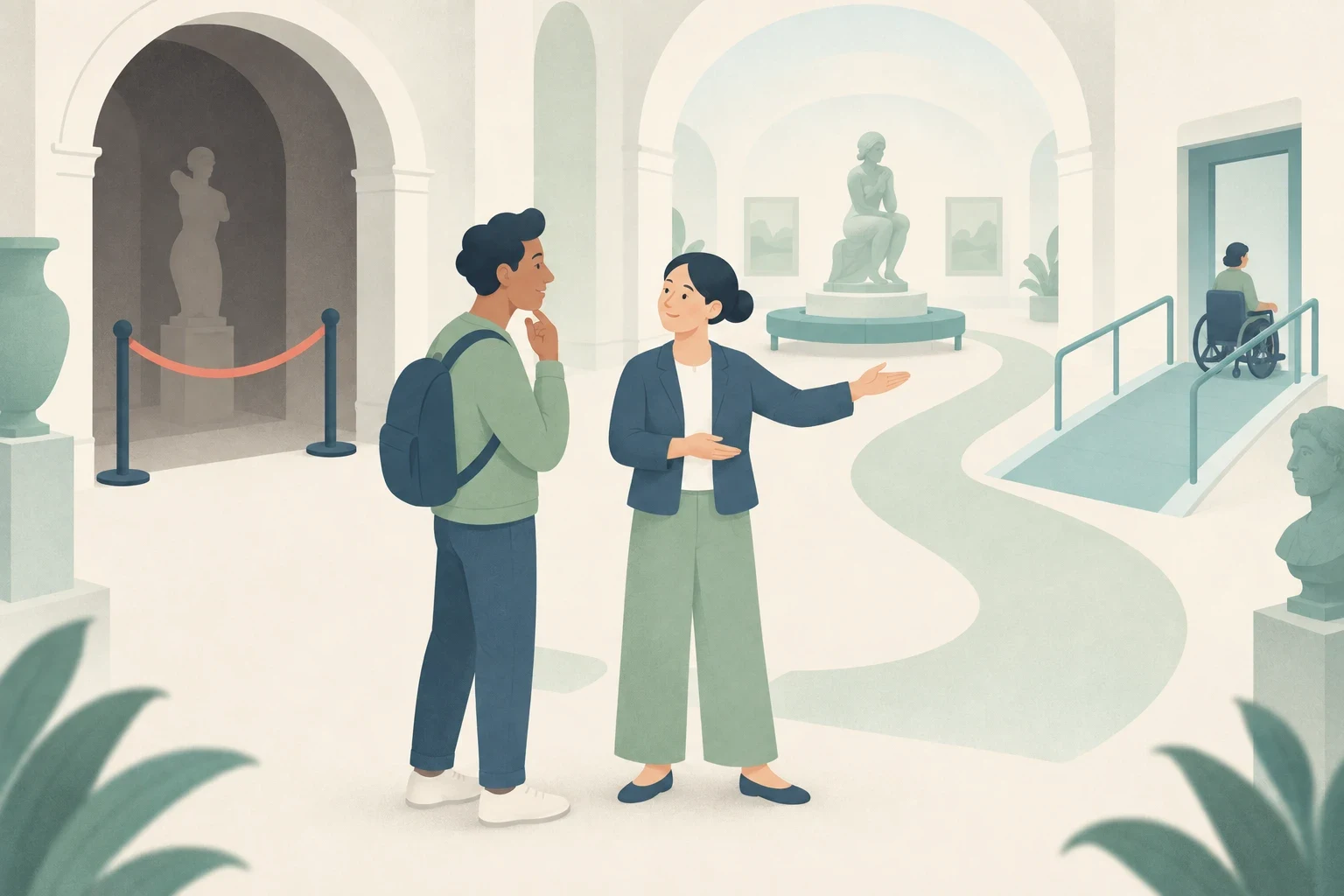
When a planned exhibition is closed, guides announce an alternative starting point using words like instead, describe subsequent stops with phrases like move on to, and indicate the ending location with finish by. Visitors who prefer step-free access are directed to an elevator using polite preference markers like would rather.
Key points
- The phrase would rather offers step-free alternatives politely.
- Use instead to name a replacement gallery.
- Use move on to when transitioning between stops on the route.
This lesson has 5 stages. You can stop at any time and continue later.

Stage 1 of 5
Understand
What it means, when to use it, and mistakes to avoid.
Examples
We will begin our tour in the photography gallery instead.
Why it works: The word instead confirms that the photography gallery replaces the original planned opening stop.
2 more examples
-
After seeing the prints, our group will move on to the design collection.
The phrase move on to introduces the subsequent exhibition on the schedule.
-
Visitors who would rather avoid stairs should take our elevator near reception.
Would rather expresses a polite personal choice for step-free access without asking for reasons.
Read the full guide
Deciding Which Gallery to Cross Off First
Tour guides often mention original stops before announcing that unexpected maintenance or repairs prevent access. When you hear a room name paired with words such as closed, unavailable, or because of repairs, that location is cancelled. Do not write down the first room you hear as your destination. When a guide pairs a location name with a negative status or a reason like maintenance, that room must be removed from your route list immediately.
-
The ancient sculpture room is closed for renovations today.
Why it works: The mention of closed for renovations means this room is completely removed from the route.
-
Because water leaked into gallery two, nobody can enter this morning.
Why it works: Because introduces the problem that cancels the visit to gallery two.
Your turn
When a guide mentions a gallery name followed by a reason for closure, what should you do on your schedule?
Answer: Cross out that gallery immediately because visitors cannot enter it.
Show the answer
Answer: Cross out that gallery immediately because visitors cannot enter it.
Hearing that a space is closed or under repair means it is dropped from the itinerary, not postponed.
Identifying the Replacement Starting Point
After explaining which room is unavailable, guides introduce the actual starting point using substitute words such as instead or in place of. In spoken English, instead often lands at the end of the clause or directly before the new venue name. Focus your attention on the prepositional phrase that follows begin or start, because that names where your group will actually assemble first.
-
We will begin our tour in the photography gallery instead.
Why it works: Instead signals that the photography gallery replaces the original first stop.
-
Rather than gathering near the fountain, we will meet upstairs in hall four.
Why it works: Rather than marks the fountain as cancelled and hall four as the actual meeting point.
You can practise this again in A year-long cruise and Rescheduled interview voicemail.
Your turn
Which word in an announcement most clearly shows that a room replaces the original starting location?
Answer: Instead
Show the answer
Answer: Instead
The word instead indicates a direct substitute for a cancelled plan.
Following Movement Between Connected Galleries
Museum educators connect different parts of a tour using transitional phrases like move on to, head over to, and continue toward. Because the words move, on, and to flow together in natural speech, learners sometimes miss the boundary between them. Move on to names the next stop. That stop may also be the final destination, so listen to the rest of the route.
-
After seeing the portraits, we will move on to the design collection.
Why it works: Move on to indicates that the design collection is the second stop on the path.
-
Our group will continue to the modern prints before lunch.
Why it works: Continue to identifies the sequential gallery following the current room.
Your turn
What does the phrase 'move on to' tell the listener during a tour?
Answer: It introduces the next scheduled room on the route.
Show the answer
Answer: It introduces the next scheduled room on the route.
The phrase move on to marks progression from one stop to the following stop.
Separating the Tour Route from the Final Meeting Place
A common listening error is mistaking the final exhibition room for the spot where the tour disperses. Guides employ distinct verbs such as finish by, conclude at, or assemble near to name the exit point. If an announcement states that the group will finish by the café, the café is the dismissal location rather than a gallery stop. Keep your list of exhibits separate from the final rendezvous point.
-
Our formal tour will finish by the café on the lobby level.
Why it works: Finish by identifies the café as the gathering spot at the conclusion of the visit.
-
We will view the textiles and then assemble near the gift shop.
Why it works: The textiles are an exhibition stop, while the gift shop is the final assembly area.
Your turn
Why must you distinguish between 'move on to' and 'finish by'?
Answer: Move on to introduces another exhibit, while finish by names where the tour ends.
Show the answer
Answer: Move on to introduces another exhibit, while finish by names where the tour ends.
Move on to indicates route continuation, whereas finish by identifies the final stopping point.
Choosing Accessible Routes Without Making Assumptions
Public announcements frequently provide step-free alternatives using the polite modal expression would rather. This wording communicates personal preference without implying physical limitation or illness. It accommodates visitors with heavy bags, strollers, or tired legs without demanding explanations. Listen carefully for landmark directions, such as the lift near reception, so you can locate the elevator quickly.
-
Visitors who would rather avoid stairs should take the lift near reception.
Why it works: Would rather expresses personal preference, and the sentence gives clear elevator directions.
-
Anyone who would rather take the elevator can meet us upstairs in hall three.
Why it works: The guide offers the lift as an option without asking why someone chooses it.
Your turn
What does 'would rather avoid stairs' express in a museum announcement?
Answer: A polite preference for an alternative way to reach the upper level.
Show the answer
Answer: A polite preference for an alternative way to reach the upper level.
Would rather indicates preference and choice, not a mandatory ban or total inability.
Listening for Stressed Words in Spoken Direction Changes
In natural speech, English speakers apply vocal emphasis to words that provide corrections or unexpected news. When an itinerary changes, words like instead, closed, and new location names receive longer duration and higher pitch. Function words like to, in, and the become reduced and quiet. Training your ear to latch onto stressed syllables helps you extract key route facts even in noisy museum spaces with high ceilings.
-
We will NOT enter gallery one; we will go upstairs INSTEAD.
Why it works: The stressed words NOT and INSTEAD make the correction unmistakable.
-
Please take the LIFT near reception, not the main stairs.
Why it works: Heavy stress falls on LIFT and reception to emphasize the alternative path.
Your turn
Which words typically receive the strongest vocal emphasis during a route update?
Answer: Corrective words and new room names such as instead and photography.
Show the answer
Answer: Corrective words and new room names such as instead and photography.
Speakers naturally emphasize content words and corrective markers that change existing plans.
Distinguishing Between Causes and Actual Solutions
Listeners sometimes confuse the reason for an adjustment with the adjusted plan itself. If an announcement mentions that restoration work is underway in gallery five, gallery five represents the cause of the problem, not your destination. Connectors like because and due to signal the issue, while so, therefore, and will begin introduce the actual remedy. Keeping cause and action separate prevents you from walking into a closed work area.
-
Because painting is underway in room six, we will view the drawings in room eight.
Why it works: Room six is the source of disruption; room eight is the actual destination.
-
Due to a broken window on level one, our talk will take place on level two.
Why it works: Level one explains the problem, while level two names the revised location.
Your turn
If you hear 'Because the glass wing is closed, we will assemble in the garden', where should you go?
Answer: To the garden, because it is the replacement meeting location.
Show the answer
Answer: To the garden, because it is the replacement meeting location.
The garden is the replacement assembly spot; the glass wing is merely the reason for the change.
Recording Spoken Route Adjustments in Quick Notes
When jotting down rapid route changes, do not attempt to write full sentences. Write short location keywords and connect them with arrows to represent sequence. Mark a clear cross over cancelled rooms and underline the final assembly spot. This note-taking method preserves your concentration so you can absorb elevator directions and timing without missing critical details. Visual markers clarify order without requiring full written sentences.
-
Jotting down short abbreviations helps you track fast route announcements.
Why it works: Abbreviating room names prevents you from falling behind while listening.
-
Drawing an arrow between stops shows the order of movement clearly.
Why it works: Arrows show the chronological progression between rooms so you can track the itinerary order at a glance.
Your turn
What is an effective strategy for noting down sudden tour changes while listening?
Answer: Note key room names in sequence and cross out cancelled stops.
Show the answer
Answer: Note key room names in sequence and cross out cancelled stops.
Writing keywords and crossing out closed rooms captures the itinerary without overloading your memory.
Use it naturally
How people really use “move on to”
Neutral Fine almost anywhere, at work or with friends.
Words it often goes with
- move on to the next taskWhen we finish cutting the vegetables, we can move on to the next task.
- move on to another topicAfter discussing dinner, we can move on to another topic.
- move on to dessertAfter the main course, we will move on to dessert.
- move on to the next roomAfter cleaning the kitchen, we will move on to the next room.
What people also say
- “Let's move on to the next task.” instead of “Let us proceed to the next task.” This sounds more relaxed in everyday conversation.
Questions about "Changed museum tour"
Where does 'instead' go in a sentence about a schedule change?
In spoken English, 'instead' most frequently appears at the very end of the sentence following the replacement action. It can also appear at the start of a sentence followed by a comma, or as the prepositional phrase 'instead of' followed by the cancelled noun.
We will meet in gallery four instead.
Instead of entering the courtyard, the group will assemble in the main foyer.
Why do guides say 'would rather avoid' instead of 'cannot climb'?
The phrase 'would rather' expresses preference rather than physical ability. In public settings, guides use it to make accessibility options welcoming to anyone, including tired visitors or families with strollers, without making medical judgments about individuals.
Visitors who would rather avoid stairs should take our elevator near reception.
I would rather wait here while the others climb up to the tower.
Does 'move on to' mean the tour is ending or continuing?
'Move on to' means continue to the next room or activity. That next stop could also be the last one. Listen for the rest of the announcement to learn where the tour ends; phrases such as 'finish by the café' name an ending location.
After ten minutes here, we will move on to the ceramics display.
Our group will finish by the café near the front doors.
Why is the word 'closed' sometimes difficult to hear in noisy rooms?
The final /d/ sound in 'closed' often blends into the following word or becomes unreleased before consonants. Listen for the surrounding context words, such as 'repairs', 'renovation', or 'because', which signal that an area is unavailable.
The sculpture hall is closed while painting continues.
Because room two is closed today, we are gathering outside.
Before you go
Remember this
Listen for cause words like because to identify closed spaces, spot instead to identify the replacement start, track move on to for subsequent rooms, and look for finish by to find the final meeting area. The phrase would rather offers step-free alternatives politely.
Stage 2 of 5
Listen
Hear it in real sentences, from short to long, and write what you hear.
0 of 4 done
Listening 1 of 4
Listening 2 of 4
Try a longer clip. Listen once, then replay the part you missed.
Listening 3 of 4
This clip is longer. Follow the instruction above the answer field.
Listening 4 of 4
Listen, then type the missing words. The rest of the text is already there.
0:00
Practice complete
You listened closely.
Your result is saved in this browser.
Keep your progress. Your practice is saved on this device only. Create a free account to keep it everywhere.
Create a free accountThat was today's free lesson. Tomorrow you get another one. Want more today? See membership.
Create a free SubLearn account to keep this progress across devices.
Save my progressStage 3 of 5
Speak
Say it with the speaker, then use it in your own answer.
Shadow
Say it along with the speaker
Play the line slowly, then speak at the same time as the speaker. Copy the rhythm, not just the words.
Your turn
Say it your way
Explain a route change to a group of visitors at an art gallery. Name the closed gallery, state the alternative starting room, and explain how to find the lift.
You could start with “Because our main gallery is closed today, we will begin…”
Take ten seconds to think, then answer out loud without looking at the lesson. Speak for the time shown in the task above. Nothing is sent unless you ask for feedback.
0:00
Stage 4 of 5
Write
Write your own response
AI feedback · it can make mistakes · Part of membership See membership
Check your own writing
Read one possible response
Draft saved on this device.
Use these checks to revise your message. Grammar and meaning are not automatically graded. Each task keeps its own draft in this browser tab.

You finished the free part of this lesson
- Understand
- Listen
- Speak
- Write
- CheckPart of membership
Worth another look
With a free account, the lessons you finish come back for review to help you remember them.Create a free account
Stage 5 of 5 · Part of membership
Check
New clips without hints.
Listening tests are included with membership. Try the free dictation first, then decide whether to continue.
Listening 1 of 2 Part of membership
Listening 2 of 2 Part of membership
Follow MicroEnglish
Find lesson updates, short videos and quick quizzes. Pick the app you already use.
Questions & comments
Ask about this lesson, share an example, or help another learner.
Example
Memory tip
Goes with
Related forms
Not to be confused with
In this lesson
This word isn't in our dictionary. Check the spelling, or try another form of the word.
We couldn't load this word. Try again.
