Micro-listening
A year-long cruise
What does a year-long cruise mean?
The fictional cruise lasts one year and includes private cabin lodging and daily meals in the headline price. Travel insurance and shore excursions cost extra, and the traveler must obtain managerial permission to work remotely before completing a booking.
Key points
- The cruise lasts twelve months, covering cabin lodging and meals, while insurance and shore trips require additional payment.
- Interest in an offer does not equal a completed booking when remote-work permission remains unresolved.
- Use 'year-long' with a hyphen before a noun to describe a twelve-month duration.
This lesson has 5 stages. You can stop at any time and continue later.

Stage 1 of 5
Understand
What it means, when to use it, and mistakes to avoid.
Examples
A year-long cruise allows travelers to explore multiple continents without constantly packing suitcases.
Why it works: Year-long functions as a hyphenated compound adjective modifying cruise before the noun.
2 more examples
-
The quoted fare covers cabin lodging and food, but insurance requires an additional fee.
The conjunction but introduces an expense outside the advertised base price.
-
Elena hopes to book the journey, although she must secure manager approval first.
The subordinate clause highlights an unresolved condition that delays the final booking.
Read the full guide
Distinguish Ship Travel from Everyday Hotel Holidays
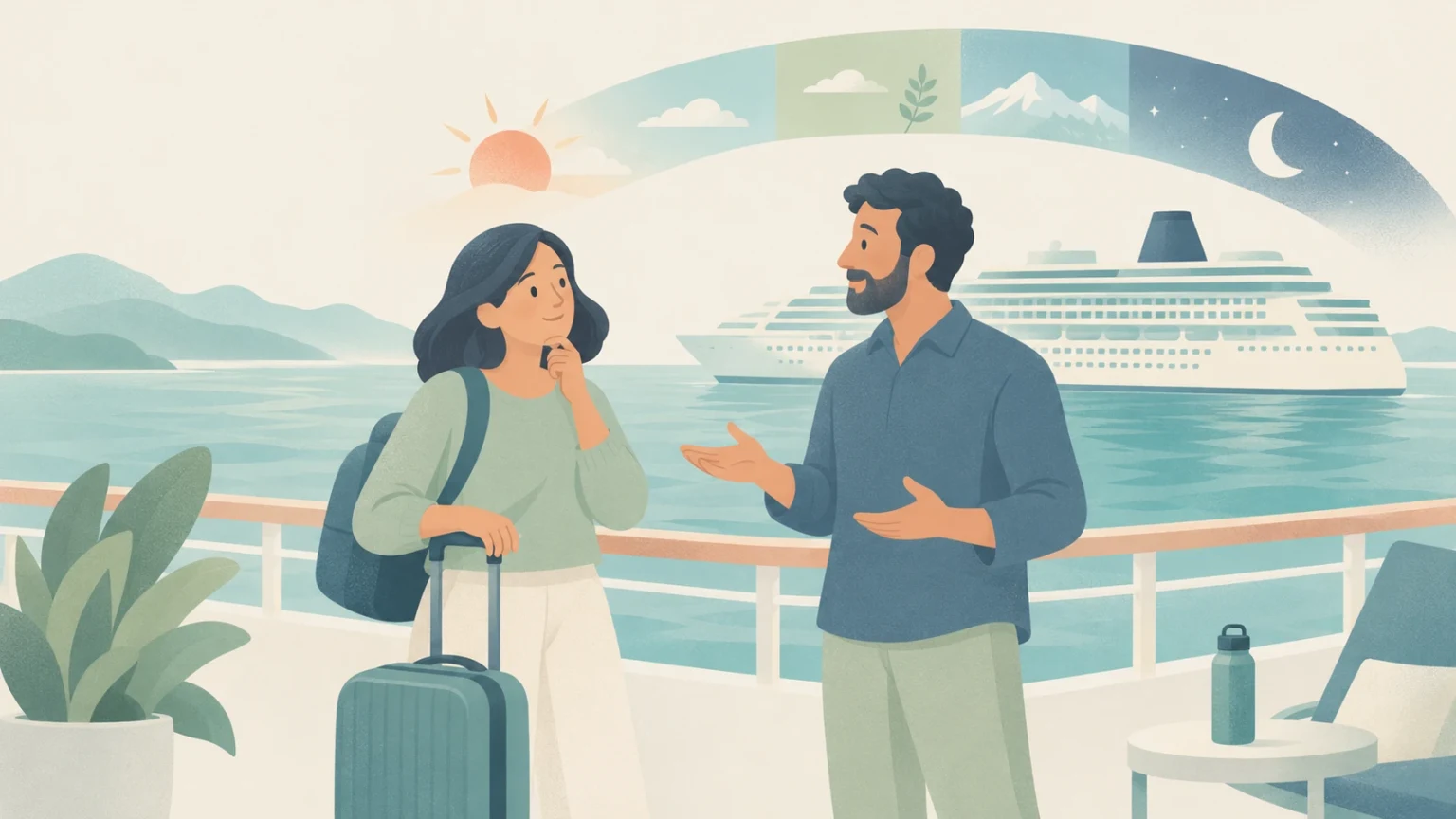
A cruise is a holiday spent traveling from port to port on a large passenger ship. When a voyage is described as year-long, it lasts for twelve consecutive months. In this fictional practice situation, two colleagues named Elena and Marcus discuss an online travel offer during their lunch break. Elena is attracted to the idea because living on a ship lets travelers explore many foreign cities without packing their bags repeatedly. Before listening, remember that a cabin is a bedroom on a ship, and working remotely means performing your regular employment duties away from the office.
-
A cruise allows passengers to sleep in the same cabin while waking up in different ports.
Why it works: Cabin describes a private room on a ship.
-
Elena plans to work remotely on her laptop during the voyage.
Why it works: Remotely indicates working away from the company office.
-
This year-long cruise itinerary is a fictional scenario created for listening practice.
Why it works: The term fictional clarifies that this specific travel package is not a real commercial product.
Your turn
What does the word cabin mean in the context of ship travel?
Answer: A private bedroom or sleeping area on a ship.
Show the answer
Answer: A private bedroom or sleeping area on a ship.
A cabin refers to a passenger bedroom on a ship, providing private living space during the voyage.
Catch the Main Attraction on Your First Listen
During your first listen, do not try to write down every specific dollar figure or vocabulary item. Instead, listen for the main reason Elena finds the trip appealing. Pay attention to how she describes the daily routine of sea travel compared to ordinary road or flight vacations. Progressive listening hints can help your ear catch this idea: first identify the topic of packing luggage, then listen for her contrast between staying in one room and changing hotels.
-
Elena likes the voyage because she can see the world without packing her luggage every week.
Why it works: The primary appeal is visiting multiple locations while keeping the same living space.
-
Progressive hint: listen for the word packing after Marcus mentions that a year sounds exhausting.
Why it works: Focusing on contrast words reveals the speaker's true feeling.
You can practise this again in Put behind and A wardrobe clear-out.
Your turn
Why does Elena want to take a year-long cruise instead of taking several shorter land trips?
Answer: She can see many foreign destinations without repeatedly packing bags and changing hotels.
Show the answer
Answer: She can see many foreign destinations without repeatedly packing bags and changing hotels.
Elena explains that she can explore dozens of countries while staying in the same cabin rather than moving hotels constantly.
Separate Included Costs from Uncovered Extras
On your second listen, sort the travel details into three separate categories: included items, extra expenses, and items that remain unchecked. Listen carefully for transition markers like 'however' and 'costs extra'. Elena states that her cabin and all daily meals are included in the base fare. In contrast, medical insurance and shore tours require extra payment. Avoid guessing about unmentioned services such as laundry or internet access, because the conversation provides no evidence about them.
-
The basic fare includes your private cabin and all daily meals.
Why it works: Includes indicates services covered by the headline ticket price.
-
However, travel insurance costs extra, and guided shore excursions require additional payments.
Why it works: However introduces expenses that require separate payment.
Your turn
Which item is covered by the basic ticket price in the conversation?
Answer: A private cabin and all daily meals.
Show the answer
Answer: A private cabin and all daily meals.
Elena confirms that the base price covers passenger accommodation and meals, while insurance and tours cost extra.
Detect Unfinished Steps Before Assuming a Booking
Enthusiasm for a trip does not mean that a reservation exists. When listening to travel plans, distinguish between positive feelings and completed actions. Phrases such as 'need permission' or 'before I pay' signal an unfinished requirement. Elena clearly wants to embark on the cruise, but she has not paid a deposit or reserved a cabin because her manager has not yet approved her remote work request. For more practice on talking about upcoming intentions, see /grammar/future-plans/.
-
I really want to go, but I need permission from my manager to work remotely before I pay any deposit.
Why it works: The conjunction but introduces an essential condition that blocks immediate booking.
-
An interested traveler is not a confirmed passenger until contracts are signed.
Why it works: Desire expresses preference, whereas booking requires formal financial and administrative commitment.
Your turn
What prevents Elena from booking the year-long cruise immediately?
Answer: She must obtain official permission from her manager to work remotely.
Show the answer
Answer: She must obtain official permission from her manager to work remotely.
Elena states she cannot book or pay a deposit until her manager formally approves her remote working arrangement.
Match an answer to the words that support it
After you listen, check which words support your answer. Distinguish the advertised price, extra charges, and any condition that must be met first. The examples below describe a different trip, so you can practice this decision before trying the recordings.
-
The weekend rail pass covers every local journey.
Why it works: Covers tells you which journeys the pass pays for.
-
Breakfast comes with the room, but dinner is charged separately.
Why it works: The word but introduces a cost that is not included.
-
The museum ticket costs another twelve pounds.
Why it works: Another marks an additional cost beyond the price already discussed.
-
We can confirm the reservation once Maya gets permission to take Friday off.
Why it works: Once introduces the condition that must be met before the reservation can be confirmed.
Your turn
In the last worked example, what must happen before the reservation can be confirmed?
Answer: Maya must get permission to take Friday off.
Show the answer
Answer: Maya must get permission to take Friday off.
Once introduces the condition. Permission to take Friday off is needed before the reservation can be confirmed.
Position Compound Time Modifiers Before Nouns and Verbs
When describing duration before a noun, combine the singular time word and 'long' with a hyphen, as in 'a year-long cruise' or 'a day-long conference'. Use year-long for one year. Years-long is also possible, but means lasting several years. In speech, this hyphen is inaudible, but speakers place stress on both parts of the compound modifier. In contrast, after a verb, use a prepositional or predicate phrase without hyphens: 'the cruise lasts a year' or 'the voyage is a year long'. Notice also that /micro-listenings/6-2/ covers related hotel vocabulary.
-
She booked a year-long cruise to study ocean wildlife.
Why it works: Year-long is a hyphenated compound modifier positioned directly before the noun cruise.
-
The holiday lasts a year and includes multiple ocean crossings.
Why it works: After the verb lasts, use the phrase a year without hyphens.
-
Their sea voyage is one year long.
Why it works: When placed after the verb is, do not hyphenate year long.
Your turn
Which sentence correctly describes a cruise lasting one year?
Answer: They signed up for a year-long cruise around the continent.
Show the answer
Answer: They signed up for a year-long cruise around the continent.
Year-long means lasting one year. Years-long can also be grammatical, but means lasting several years.
Notice spelling and word endings
Use these separate written examples to notice spelling and grammar before listening. Cruise and crews sound the same, so the situation helps you choose the spelling. Notice compound adjectives before nouns and endings such as -s and -ed. In the recordings, write the words you actually hear.
-
Their week-long cruise starts on Monday.
Why it works: Cruise names the trip. The compound adjective week-long comes before that noun.
-
Our island trip lasts a week.
Why it works: A week follows the verb here, so it is not written as a compound adjective.
-
Breakfast and a shared room are included.
Why it works: Included describes what comes with the price. Notice the final -ed.
-
Travel insurance costs an extra twenty pounds.
Why it works: Extra tells you that this cost is added to the main price.
-
The guided tour visits three small villages.
Why it works: Guided describes the tour; it is not the base verb guide.
-
They will book the tickets after the manager agrees.
Why it works: After shows the order: agreement comes first, and booking follows.
Your turn
How should a listener decide between writing 'cruise' and 'crews' in a travel dictation?
Answer: Use sentence context, because cruise refers to a ship voyage while crews refers to teams of workers.
Show the answer
Answer: Use sentence context, because cruise refers to a ship voyage while crews refers to teams of workers.
Because cruise and crews are homophones, only the surrounding meaning clarifies whether the speaker means a voyage or workers.
Summarize Booking Conditions and Frame Practical Inquiries
To confirm that you have mastered the lesson material, practice recalling the four key elements without looking back at the transcript: the primary attraction, the two included items, the two excluded costs, and the unresolved workplace condition. Once you can summarize these points, formulate a direct question to resolve an unmentioned detail, such as onboard internet reliability or refund policies. Practicing this active recall prepares you to evaluate real travel offers. To practice adapting travel plans when circumstances shift, explore /micro-listenings/1-2/.
-
The offer covers lodging and food, but insurance is extra and manager approval remains necessary.
Why it works: This concise summary captures the key factual components of the listening passage.
-
Does the private cabin include reliable satellite internet for remote working?
Why it works: This inquiry addresses a vital unmentioned practical requirement before booking.
Your turn
Which question would most effectively clarify a practical condition not mentioned in the dialogue?
Answer: Does the cabin include high-speed satellite internet suitable for daily remote work?
Show the answer
Answer: Does the cabin include high-speed satellite internet suitable for daily remote work?
Internet access is a critical unmentioned factor for anyone planning to work remotely during a long cruise.
Use it naturally
How people really use “year-long”
Neutral Fine almost anywhere, at work or with friends.
Words it often goes with
- year-long cruiseMy aunt returned from a year-long cruise last week.
- year-long courseThe college offers a year-long course in photography.
- year-long projectOur year-long project will finish in December.
- year-long studyThe scientists completed a year-long study of local birds.
What people also say
- “The cruise lasts a year.” instead of “The cruise has a duration of one year.” Use this simple sentence when talking about how long the cruise lasts.
Questions about "A year-long cruise"
What does a year-long cruise mean?
A year-long cruise is a holiday journey on a passenger ship that lasts for twelve months. The hyphen connects 'year' and 'long' into a single modifying word placed right before the noun 'cruise'.
She saved money for a year-long cruise.
A year-long cruise visits ports around the globe.
How can I hear what the price includes?
Listen for verbs like 'includes', 'covers', or passive phrases like 'are included'. When an expense is extra, speakers typically use contrast words like 'but', 'however', or phrases such as 'costs extra' and 'additional fee'.
Dinner is included in your room rate.
Guided tours cost extra, but breakfast is free.
Does the traveller want to go, or have they already booked?
The traveller wants to go, but has not booked yet. Expressing excitement or interest describes a desire, while words like 'need permission' or 'before I sign' show that unresolved conditions remain.
He wants to join the tour, but he needs manager approval first.
She likes the itinerary, yet she has not paid any deposit.
Why is it year-long and not years-long?
Use 'year-long' for one year. 'Years-long' means lasting several years, so it changes the duration. With a number before a noun, use a singular unit, as in 'a three-week trip' or 'a two-hour flight'.
They booked a year-long trip across South America.
We attended a two-hour lecture on maritime safety.
What should I do if I cannot catch every word?
Focus on stressed content words such as nouns, main verbs, and contrast markers. You do not need every grammatical connector to understand whether costs are covered or whether someone has completed a booking.
Focus on key words like cabin, included, and extra.
Notice transition words such as but and however.
Before you go
Remember this
The cruise lasts twelve months, covering cabin lodging and meals, while insurance and shore trips require additional payment. Interest in an offer does not equal a completed booking when remote-work permission remains unresolved.
Stage 2 of 5
Listen
Hear it in real sentences, from short to long, and write what you hear.
0 of 4 done
Listening 1 of 4
Listening 2 of 4
Try a longer clip. Listen once, then replay the part you missed.
Listening 3 of 4
This clip is longer. Follow the instruction above the answer field.
Listening 4 of 4
Listen, then type the missing words. The rest of the text is already there.
0:00
Practice complete
You listened closely.
Your result is saved in this browser.
Keep your progress. Your practice is saved on this device only. Create a free account to keep it everywhere.
Create a free accountThat was today's free lesson. Tomorrow you get another one. Want more today? See membership.
Create a free SubLearn account to keep this progress across devices.
Save my progressStage 3 of 5
Speak
Say it with the speaker, then use it in your own answer.
Shadow
Say it along with the speaker
Play the line slowly, then speak at the same time as the speaker. Copy the rhythm, not just the words.
Your turn
Say it your way
Describe an extended travel plan you would like to take, state two items included in the basic cost, and mention one condition you must check before reserving your place.
You could start with “I am looking into a trip that lasts several months, which includes…”
Take ten seconds to think, then answer out loud without looking at the lesson. Speak for the time shown in the task above. Nothing is sent unless you ask for feedback.
0:00
Stage 4 of 5
Write
Write your own response
AI feedback · it can make mistakes · Part of membership See membership
Check your own writing
Read one possible response
Draft saved on this device.
Use these checks to revise your message. Grammar and meaning are not automatically graded. Each task keeps its own draft in this browser tab.

You finished the free part of this lesson
- Understand
- Listen
- Speak
- Write
- CheckPart of membership
Worth another look
With a free account, the lessons you finish come back for review to help you remember them.Create a free account
Stage 5 of 5 · Part of membership
Check
New clips without hints.
Listening tests are included with membership. Try the free dictation first, then decide whether to continue.
Listening 1 of 2 Part of membership
Listening 2 of 2 Part of membership
Follow MicroEnglish
Find lesson updates, short videos and quick quizzes. Pick the app you already use.
Questions & comments
Ask about this lesson, share an example, or help another learner.
Example
Memory tip
Goes with
Related forms
Not to be confused with
In this lesson
This word isn't in our dictionary. Check the spelling, or try another form of the word.
We couldn't load this word. Try again.
