Micro-listening
A wardrobe clear-out
Does clearing out my wardrobe mean throwing everything away?
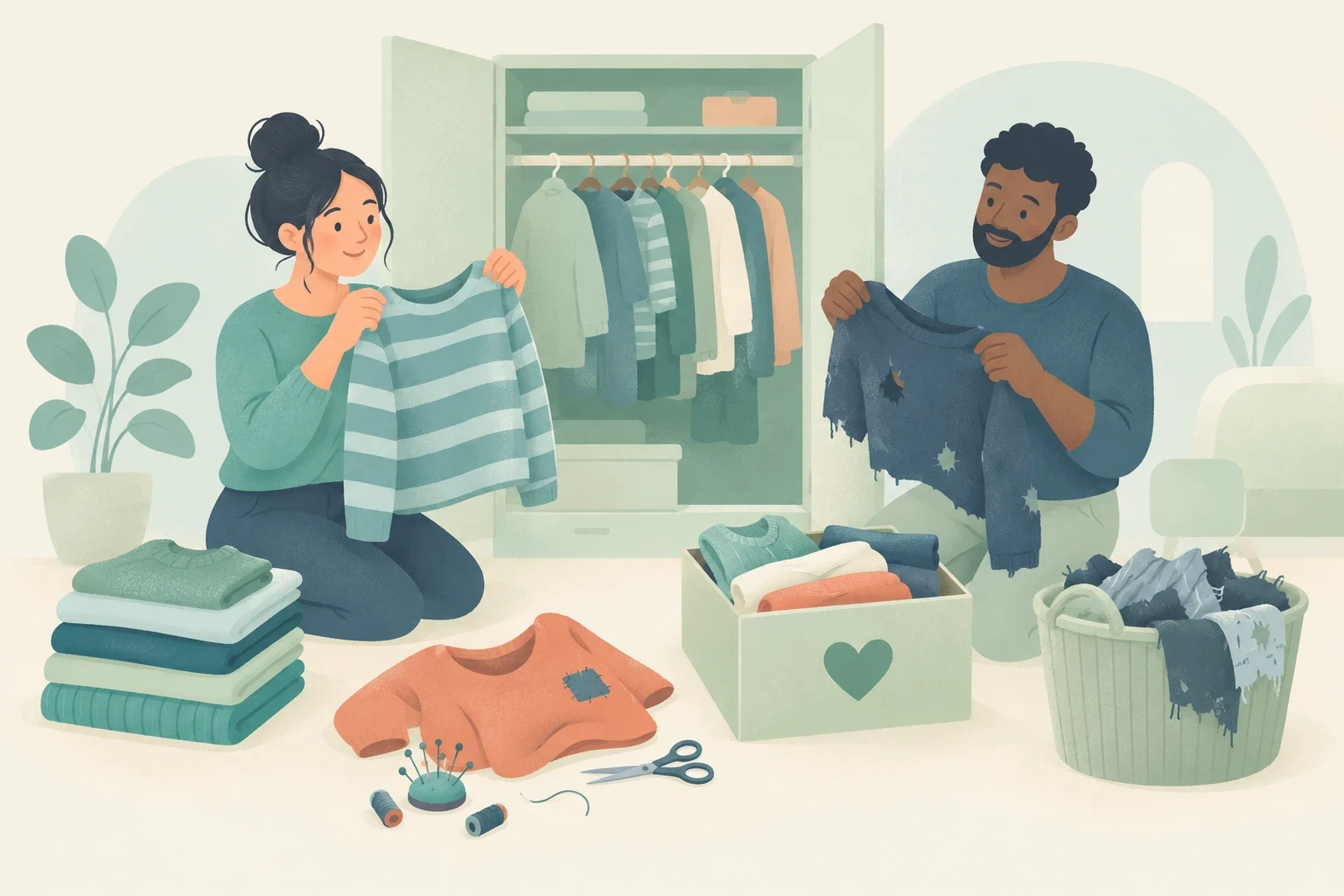
In this clear-out, the speakers sort clothes into things to keep, repair, donate, or recycle. Listen for the condition of each item and the decision made about it. A local collection service may have its own rules about what it accepts.
Key points
- Sort clothes by matching condition to destination: keep items worn regularly, repair minor damage like loose seams, donate wearable garments that do not fit, and send shredded textiles to recycling.
- Use 'hang on to' as a casual synonym for keep, and 'give away' or 'donate' when passing wearable items to others without receiving money.
- Reserve 'throw away' or 'discard' for trash rather than recycling.
This lesson has 5 stages. You can stop at any time and continue later.

Stage 1 of 5
Understand
What it means, when to use it, and mistakes to avoid.
Examples
I will hang on to this wool sweater because I wear it every week during the winter.
Why it works: 'Hang on to' expresses the decision to keep an item that is still in active use.
3 more examples
-
This striped shirt has a loose seam, but I can stitch it tonight, so put it with repairs.
'But' introduces a contrast that reverses the decision, and 'so' leads to the final action.
-
These blue jeans do not fit me anymore, so let us donate them to the charity shop.
Wearable clothes that do not fit are donated to an organization without payment.
-
The bedsheet is completely shredded, so we should drop it in the textile recycling bin.
Severely damaged fabric that cannot be worn is recycled rather than donated.
Read the full guide
Decide what stays and what goes during a clear-out
A wardrobe is a place where you keep clothes. When you have a clear-out, you choose what to keep and what to remove. A clear-out does not mean throwing away all your clothes or emptying every shelf into the trash. Instead, you review your belongings and select specific destinations: keeping items you still use, repairing items with minor flaws, donating wearable pieces that no longer fit, and recycling ruined fabric. Notice that the noun 'clothes' always takes a plural verb, and 'fit' refers specifically to size and comfort on your body.
-
My clothes take up too much space, so I need to clear out the wardrobe.
Why it works: 'Clothes' takes the plural verb 'take', and 'clear out' means removing unwanted items.
-
These trousers do not fit me anymore, but they are in great condition to donate.
Why it works: 'Fit' describes body size, not whether the garment is broken or dirty.
Your turn
What does having a wardrobe clear-out mean in everyday English?
Answer: Sorting through your clothes to decide what to keep, mend, donate, or recycle.
Show the answer
Answer: Sorting through your clothes to decide what to keep, mend, donate, or recycle.
A clear-out means organizing and removing unwanted or damaged items, not discarding everything.
Identify why speakers sort their clothes on first listen
When you listen to a conversation for the first time, do not try to catch every single clothing item or color. Your primary goal is to identify the overall purpose of the conversation and why the speakers are clearing space. In this conversation, two housemates need to share a wardrobe because new storage boxes are arriving. Listen for the broader practical problem before you track individual garments. If you focus too early on minor details like buttons or seams, you may miss the main context that drives their sorting choices.
-
We need room in this wardrobe before your boxes arrive tomorrow.
Why it works: This opening sentence sets the practical problem: clearing space for a housemate.
-
Let us sort these piles before unpacking the rest of your luggage.
Why it works: The speakers establish the activity before discussing individual items.
You can practise this again in Drop out and A year-long cruise.
Your turn
Why are the two housemates sorting their clothes in this conversation?
Answer: They need to make room in the wardrobe before boxes arrive.
Show the answer
Answer: They need to make room in the wardrobe before boxes arrive.
The speaker establishes immediately that they need to create space in the wardrobe before boxes arrive.
Connect each item with its reason and destination
On your second listen, connect each specific garment to both its final destination and the speaker's stated reason. Listen closely for changes of mind. A speaker may begin by suggesting donation, but quickly correct themselves when they notice a repairable problem. In this dialogue, the sweater stays because Elena wears it weekly, the striped shirt goes to repairs because its seam is loose, the jeans are donated because they no longer fit, and the torn sheet goes to fabric recycling because it is shredded.
-
I wear this wool sweater every week, so I will keep it.
Why it works: Regular frequency of use justifies keeping the garment on the hanger.
-
They do not fit me now, so let us donate them.
Why it works: Size change explains why clean, wearable pants are given to charity.
Your turn
Where does the striped shirt end up after Elena corrects Sam?
Answer: In the repair pile so Elena can stitch the loose sleeve seam.
Show the answer
Answer: In the repair pile so Elena can stitch the loose sleeve seam.
Although Sam asks if she is donating it, Elena corrects him and sends the shirt to repairs because she can stitch the loose seam.
Use progressive hints to catch changed decisions
Spoken decisions often turn on small linking words. The word 'because' introduces the underlying reason, 'so' introduces the practical result, and 'but' signals a contrast that can reverse an expected outcome. When Elena says, 'The sleeve seam is loose, but I can stitch it, so put it with repairs,' the word 'but' prevents the shirt from going into the donation bag. When training your ear, listen first for the item, second for the contrast word, and third for the resulting action verb.
-
The seam is loose, but I can stitch it.
Why it works: 'But' contrasts the defect with the speaker's ability to fix it.
-
It is shredded, so take it to the textile recycling bin.
Why it works: 'So' links the unwearable condition directly to the recycling decision.
Your turn
Which word alerts the listener that an expected decision is about to change?
Answer: The contrast word 'but'.
Show the answer
Answer: The contrast word 'but'.
'But' introduces a contrast that frequently reverses an initial proposal or assumption.
Verify clothing outcomes against the transcript
Read the spoken dialogue once to check your listening comprehension against the written text: 'Sam: We need room in this wardrobe before your boxes arrive. Elena: I wear this wool sweater every week, so I will keep it. Sam: Are you donating this striped shirt? Elena: No, wait. The sleeve seam is loose, but I can stitch it, so put it with repairs. Sam: These blue jeans look new. Elena: They do not fit me now, so let us donate them. Sam: What about this torn sheet? Elena: It is shredded, so take it to the textile recycling bin.' Notice how each item pairs with a distinct reason: the sweater is kept for regular wear, the shirt is repaired for a loose seam, the jeans are donated because of fit, and the sheet is recycled due to shredding. Keep in mind that local textile recycling arrangements vary by city, so treat these outcomes as specific to this household rather than universal rules.
-
Sweater: worn every week -> Keep (stays on hanger).
Why it works: Evidence phrase: 'I wear this wool sweater every week, so I will keep it.'
-
Torn sheet: shredded and unwearable -> Fabric recycling bin.
Why it works: Evidence phrase: 'It is shredded, so take it to the textile recycling bin.'
Your turn
According to the transcript, why does the cotton sheet go to textile recycling rather than the charity shop?
Answer: The sheet is shredded and unwearable, making it unfit for donation.
Show the answer
Answer: The sheet is shredded and unwearable, making it unfit for donation.
Elena notes that the sheet is shredded, which makes it unsuitable for donation and only fit for textile recycling.
Separate keeping, giving away, and throwing away
Learners often confuse three everyday phrasal verbs used during a clear-out. 'Hang on to' is an informal way to say keep. 'Give away' means transferring an item to another person or a charity organization without payment. 'Throw away' means discarding an item as trash. Do not use 'throw away' when you mean donate or recycle. Watch out for speech sounds that can mislead your ear: 'clothes' and 'close' sound very similar in rapid speech, but grammar confirms the clothing noun. Similarly, 'wear' sounds identical to 'where', so use the surrounding sentence to verify the spelling. Pay attention to weak negative forms like 'doesn't fit' or 'do not fit', because that single negative word determines whether a garment is kept or donated.
-
I will hang on to these boots because they still protect my feet in the rain.
Why it works: 'Hang on to' means keep; it does not mean discard.
-
We should give away these coats to the shelter instead of throwing them away.
Why it works: 'Give away' transfers ownership for free, while 'throw away' discards into the trash.
Your turn
Which sentence correctly uses informal English to mean keep an item?
Answer: I will hang on to this jumper because I wear it often.
Show the answer
Answer: I will hang on to this jumper because I wear it often.
'Hang on to' means keep. You would not throw away or give away an item that you intend to wear.
Write spoken sorting decisions with accuracy
Practise writing complete short sentences from audio to test your listening accuracy. Focus on recognizing word boundaries in linked phrases like 'give it away' and 'hang on to it'. Below are six key sentences that represent the core decisions in a sorting conversation: 1. 'I will hang on to this jacket because I wear it often.' 2. 'The shirt has a loose seam, so I will repair it.' 3. 'These trousers do not fit, so let us donate them.' 4. 'The towel is shredded, so take it to fabric recycling.' 5. 'Wait, do not give that away because I can mend it.' 6. 'We need to clear out the wardrobe before unpacking boxes.' Notice how each sentence relies on accurate spelling for homophones such as 'wear' rather than 'where', and plural agreement for 'trousers do not fit'.
-
Wait, do not give that away because I can mend it.
Why it works: A corrected decision using the linked spoken chunk 'give that away'.
-
The shirt has a loose seam, so I will repair it.
Why it works: A concise cause-and-result structure explaining garment repair.
Your turn
Which sentence accurately reports a repair decision from the audio practice?
Answer: The shirt has a loose seam, so I will repair it.
Show the answer
Answer: The shirt has a loose seam, so I will repair it.
This sentence accurately reflects the spoken structure, spelling 'wear/seam' correctly and matching reason to action.
Recall sorting decisions and state your plan
Test your memory without looking back at the transcript. Can you recall why the jeans were donated and why the striped shirt went into the repair basket? Elena donated the jeans because they did not fit her waist, and she kept the shirt for repair because the seam was loose. Now apply this pattern to your own clothes by constructing sentences with 'because' and 'so'. For further listening practice with changed decisions and future arrangements, explore our related micro-listening lessons at /micro-listenings/1-2/, /micro-listenings/8-2/, and the grammar guide at /grammar/future-plans/.
-
I am donating this jacket because it does not fit my shoulders.
Why it works: Recalls the fit-based donation structure with a personal clothing item.
-
This pocket is torn, so I will mend it before wearing the coat again.
Why it works: Applies the repair structure using 'so' to state the practical consequence.
Your turn
Without checking the text, why did Elena decide to donate the blue jeans?
Answer: They were clean and wearable, but they did not fit her anymore.
Show the answer
Answer: They were clean and wearable, but they did not fit her anymore.
Elena donated the jeans because they were in good condition but no longer fit her waist.
Use it naturally
How people really use “hang on to”
Informal Relaxed; better with friends and colleagues than in formal writing.
Words it often goes with
- hang on to this sweaterI will hang on to this sweater because it keeps me warm.
- hang on to old clothesI hang on to old clothes when I can still use them.
- hang on to itIf that jacket still fits, hang on to it.
What people also say
- “I'll hang on to this coat.” instead of “I will retain this coat.” Use hang on to for a casual decision to keep something.
Questions about "A wardrobe clear-out"
Does clearing out my wardrobe mean throwing everything away?
Not necessarily. A clear-out can remove some or all of the contents. Here, the speakers keep useful clothes and decide what to repair, donate, or recycle. Check the destination rather than assuming everything is thrown away.
We cleared out the bedroom wardrobe and kept all our winter sweaters.
A clear-out helps you organize your space rather than empty it completely.
What does 'hang on to it' mean here?
'Hang on to' is a common informal phrasal verb that means to keep or retain something rather than giving it away, selling it, or throwing it in the trash.
I will hang on to this rain jacket because it still works well.
Do not throw those boots away; hang on to them for outdoor work.
What is the difference between giving clothes away and throwing them away?
Giving clothes away means passing wearable items to another person, a friend, or a charitable organization without asking for payment. Throwing clothes away means discarding them into the garbage to be taken to a landfill.
We gave away three bags of wearable clothing to the local shelter.
You should give away clothes that still fit someone else instead of throwing them away.
How can I hear the reason for each decision?
Listen for linking words that signal causes and consequences. The word 'because' introduces the underlying reason, such as daily wear or poor fit. The word 'so' introduces the practical result or action that follows that reason.
I wear this coat daily, so I am keeping it.
We are donating these boots because they do not fit my feet.
How do I know when the speaker changes their mind?
Speakers signal changes of mind with conversational hesitation markers such as 'wait', 'actually', or 'no', followed immediately by the contrast conjunction 'but'. This combination alerts you that their initial proposal is being cancelled.
No, wait, do not donate that shirt because I can mend the seam.
I was going to throw this away, but I can repair the zipper.
Before you go
Remember this
Sort clothes by matching condition to destination: keep items worn regularly, repair minor damage like loose seams, donate wearable garments that do not fit, and send shredded textiles to recycling.
Stage 2 of 5
Listen
Hear it in real sentences, from short to long, and write what you hear.
0 of 4 done
Listening 1 of 4
Listening 2 of 4
Try a longer clip. Listen once, then replay the part you missed.
Listening 3 of 4
This clip is longer. Follow the instruction above the answer field.
Listening 4 of 4
Listen, then type the missing words. The rest of the text is already there.
0:00
Practice complete
You listened closely.
Your result is saved in this browser.
Keep your progress. Your practice is saved on this device only. Create a free account to keep it everywhere.
Create a free accountThat was today's free lesson. Tomorrow you get another one. Want more today? See membership.
Create a free SubLearn account to keep this progress across devices.
Save my progressStage 3 of 5
Speak
Say it with the speaker, then use it in your own answer.
Shadow
Say it along with the speaker
Play the line slowly, then speak at the same time as the speaker. Copy the rhythm, not just the words.
Your turn
Say it your way
Speak for 30 to 60 seconds from memory. You help a school drama club after its last show. Explain which costumes the club should save for another show, which need repairs, and which it can give away. Give reasons for your choices.
Use: hang on to donate loose seam
Take ten seconds to think, then answer out loud without looking at the lesson. Speak for the time shown in the task above. Nothing is sent unless you ask for feedback.
0:00
Hear how someone else might say it
We need to sort the costumes after our last show. I think we should hang on to the long green coat because we can use it in another play. The brown hat is useful too, so I will put it with the coat. This white shirt has a loose seam near the shoulder. My friend can fix it before our next show. We also have six black jackets, but we only need three. We can donate the extra ones to another drama club. They are clean and still look good.
Try once more and answer this: Which costume would you like to wear in the next show?
Stage 4 of 5
Write
Use what you've learned to write about your day or week, then write a message.
Write
Put it in your own words
- I used “hang on to”.
- It is about my life, not the lesson’s example.
- I read it once aloud to check it sounds right.
Write your own response
Choose a situation and write 30–50 words of your own. In this activity, you decide what to say rather than copy the words in a recording.
Check your own writing
Read one possible response
Use these checks to revise your message. Grammar and meaning are not automatically graded. Each task keeps its own draft in this browser tab.

You finished the free part of this lesson
- Understand
- Listen
- Speak
- Write
- CheckPart of membership
Worth another look
With a free account, the lessons you finish come back for review to help you remember them.Create a free account
Stage 5 of 5 · Part of membership
Check
New clips without hints.
Listening tests are included with membership. Try the free dictation first, then decide whether to continue.
Listening 1 of 2 Part of membership
Listening 2 of 2 Part of membership
Follow MicroEnglish
Find lesson updates, short videos and quick quizzes. Pick the app you already use.
Questions & comments
Ask about this lesson, share an example, or help another learner.
Example
Memory tip
Goes with
Related forms
Not to be confused with
In this lesson
This word isn't in our dictionary. Check the spelling, or try another form of the word.
We couldn't load this word. Try again.
