Micro-listening
Contraband Meaning: Prohibited Goods Explained
What does contraband mean in simple English?
Contraband refers to goods or physical property that a governing authority forbids people from bringing in, taking out, or possessing in a controlled space. It does not refer to a person or to the general crime of smuggling.
Key points
- Because the prohibition stems from a specific law, regulation, or institutional guideline, an item can be contraband in one location while remaining entirely lawful in another.
- Remember that contraband names prohibited physical items, not individuals or criminal acts.
- Because an object becomes contraband only under a specific law or local policy, always state the setting and attribute the rule when precision matters.
This lesson has 5 stages. You can stop at any time and continue later.

Stage 1 of 5
Understand
What it means, when to use it, and mistakes to avoid.
Examples
The facility search team logged several contraband phones following the inspection.
Why it works: Contraband modifies the countable noun phones, identifying their prohibited status under facility policy.
2 more examples
-
According to the harbor notice, undeclared tobacco is treated as contraband.
Contraband acts as an uncountable noun, with the source of the rule properly attributed.
-
Visitors must leave all contraband in lockers before passing the security gate.
Contraband refers collectively to items prohibited inside the secure facility.
Read the full guide
Identify Goods That a Rule Forbids
Contraband refers to goods or physical objects that a specific law or local rule does not allow in a particular location. The word prohibited simply means not allowed. When you hear contraband, remember that it identifies the status of the items under a rule, rather than naming the objects themselves. It applies to tangible property, not to people or criminal actions.
-
The border guard inspected the van and removed the contraband.
Why it works: Contraband functions as a noun naming the prohibited items collectively.
-
A package of contraband tobacco was discovered during the search.
Why it works: Contraband functions as an adjective describing the prohibited tobacco.
-
The facility does not permit any contraband inside the secure perimeter.
Why it works: Contraband indicates the status of the unauthorized items under the security rule.
Your turn
What does the word contraband describe?
Answer: Goods or physical objects forbidden by a specific rule
Show the answer
Answer: Goods or physical objects forbidden by a specific rule
Contraband names the forbidden items themselves, never the person or the action of moving them.
Choose Between the Noun and Adjective Pattern
Contraband usually functions as an uncountable noun or as an adjective before another noun. When used as a noun, write some contraband or the contraband, and use a singular verb such as contraband was seized. Never say a contraband or several contrabands. When you need to count individual objects, say an item of contraband, a contraband phone, or three contraband items. The article belongs to the countable noun.
-
Staff discovered several contraband items inside the storage locker.
Why it works: Items provides the countable plural noun, while contraband acts as an adjective.
-
The contraband was logged in the official register before disposal.
Why it works: Contraband takes the singular verb was because the noun is uncountable.
-
Officers confiscated an item of contraband during the morning inspection.
Why it works: The phrase an item of allows counting without turning contraband into a countable noun.
You can practise this again in cognitive meaning: mental processes explained and Protagonist meaning: main character explained.
Your turn
Which sentence uses the word contraband correctly?
Answer: The inspector found several contraband tools in the locker.
Show the answer
Answer: The inspector found several contraband tools in the locker.
Contraband cannot take a plural suffix; it modifies the countable noun tools here.
Specify the Place and Rule That Ban the Goods
An everyday object is not contraband everywhere in the world. A smartphone, a metal fork, or chewing gum might be entirely legal at home, yet strictly forbidden inside a fictional prison or testing center. The status of the item depends directly on the location, the governing authority, and the specific regulation. In clear writing, always name the institution, border post, or local policy that defines the restriction.
-
Under the fictional North Harbor rules, unsealed food is treated as contraband.
Why it works: The sentence explicitly names the fictional jurisdiction and the applicable rule.
-
Smartphones are ordinary personal property outside, but they count as contraband in the exam hall.
Why it works: Naming both locations explains why the status changes between two settings.
-
The seaport notice lists fresh fruit as contraband during the quarantine period.
Why it works: The restriction depends on a specific time frame and local agriculture policy.
Your turn
Why should a writer state the facility or rule when using contraband?
Answer: Because ordinary objects become contraband only under specific local rules
Show the answer
Answer: Because ordinary objects become contraband only under specific local rules
Items like phones or snacks are only contraband where an explicit institutional rule or border law forbids them.
Separate Contraband From Illegal and Secret Items
Do not confuse contraband with related concepts like illegal, smuggled, or secret. Illegal means against national or civil law, whereas an institutional rule can forbid an item without making it a crime. Smuggled refers to the covert method of moving goods across a border or security line. An item kept secret is not contraband unless an explicit rule forbids it. Remember that contraband names the goods, never the smuggler.
-
A candy bar in a prison dormitory is contraband under facility rules, but it is not illegal.
Why it works: The rule comes from an institution rather than national criminal law.
-
The crew smuggled expensive perfumes past the port checkpoint to avoid import tax.
Why it works: Smuggled describes the covert act of transportation, while perfumes are ordinary legal goods.
-
She hid her diary in her bag, but the private book was not contraband.
Why it works: Secrecy alone does not make an object contraband without a governing prohibition.
Your turn
How does contraband differ from smuggled?
Answer: Contraband describes the prohibited goods, while smuggled describes the secret transport
Show the answer
Answer: Contraband describes the prohibited goods, while smuggled describes the secret transport
Contraband names the forbidden items themselves, whereas smuggled describes the covert action of moving them.
Select Plain Wording and Attribute Official Claims
Contraband carries a formal, serious tone suited for legal notices, news coverage, and official reports. For simple day-to-day guidelines, plain phrases like prohibited items or items not allowed communicate more clearly to visitors. In journalism and workplace documentation, attribute findings with phrases such as according to the report or security staff stated. Attributing the claim avoids assuming an accused person knew about the item or committed an intentional offense.
-
According to the facility notice, recording devices are classified as contraband.
Why it works: The phrase according to the facility notice attributes the rule to the official source.
-
Please leave all prohibited items in your vehicle before entering the classroom.
Why it works: Prohibited items provides a polite, plain alternative for ordinary daily instructions.
-
The inspector alleged that the wooden crate contained contraband electronics.
Why it works: The verb alleged indicates an official claim without treating guilt as proven.
Your turn
Why is a phrase like 'according to the notice' recommended in formal writing?
Answer: It attributes the classification to an authority without asserting personal guilt
Show the answer
Answer: It attributes the classification to an authority without asserting personal guilt
Attribution clarifies who established the rule and avoids declaring someone guilty of an offense before facts are proven.
Pronounce Contraband With First-Syllable Stress
Contraband contains three syllables: CON-tra-band. The primary stress falls firmly on the first syllable, which receives the strongest emphasis. The second syllable features a reduced, neutral schwa sound. In American speech, the first vowel sounds open like father, while British and Australian speakers often use a shorter, rounded vowel. Notice that the final syllable ends with an audible /d/ sound unless connected speech blends it into an adjoining consonant.
-
Stress the first syllable cleanly when you pronounce contraband in conversation.
Why it works: Emphasizing CON prevents the word from sounding like an unrelated verb form.
-
The middle vowel in contraband softens to an unstressed schwa in natural speech.
Why it works: A relaxed middle vowel creates the natural three-syllable rhythm of the word.
-
Both British and American pronunciations place the main accent on the first syllable.
Why it works: Regional accents change the first vowel quality while keeping identical syllable stress.
Your turn
Where does the main stress fall when saying contraband?
Answer: On the first syllable: CON-tra-band
Show the answer
Answer: On the first syllable: CON-tra-band
Contraband places its primary stress on the first syllable, with a reduced vowel in the middle.
Clarify Restricted Goods on an Institutional Notice
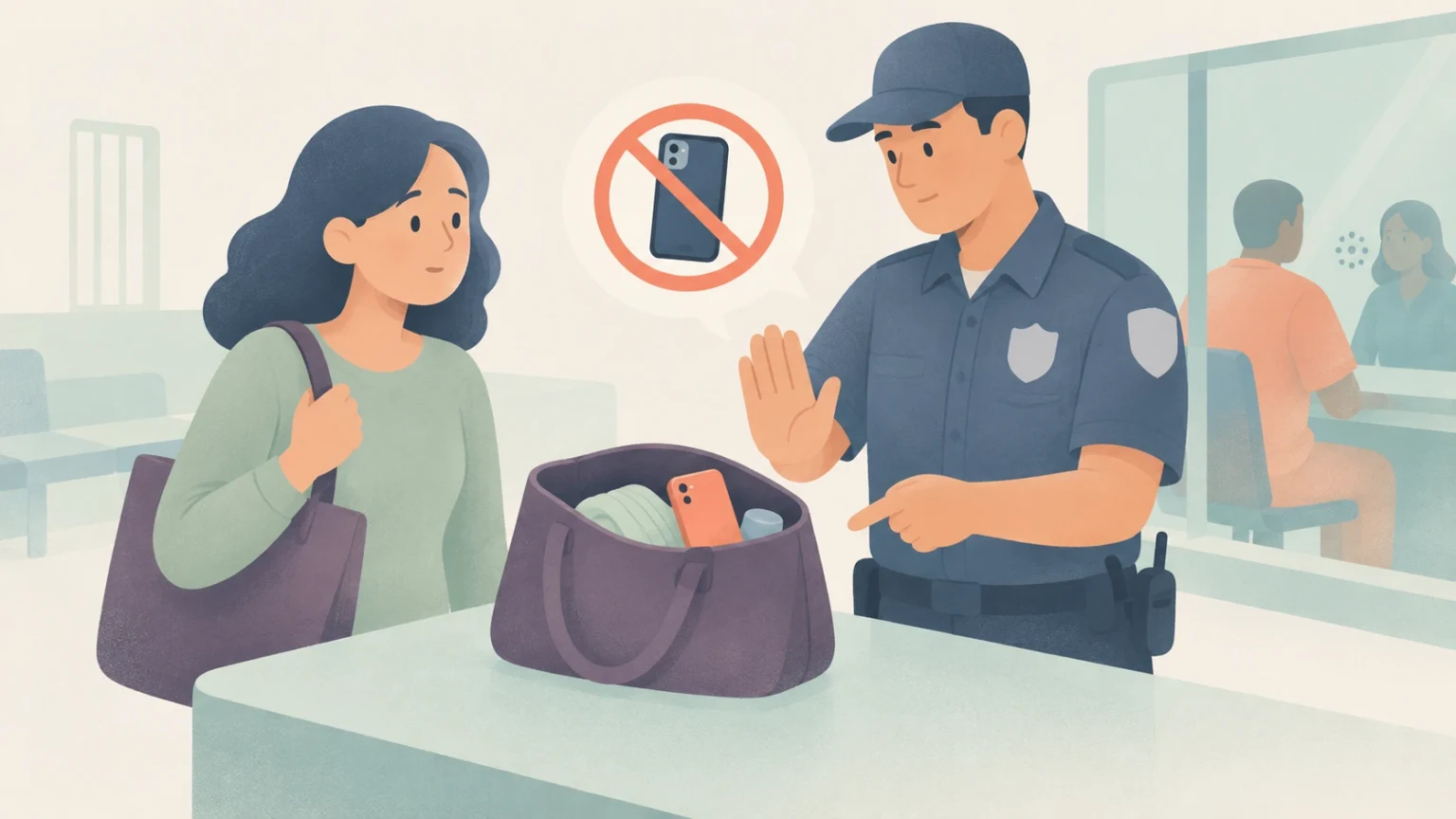
Imagine visiting a relative at the fictional Pinecrest Detention Center for the first time. A large sign in the waiting room warns that contraband will be confiscated immediately. You might feel uncertain whether everyday personal belongings are permitted. In this situation, ask the front desk officer for specific clarification before you pass through the security metal detector, so you can safely store unauthorized items in a lobby locker.
-
Visitor: Excuse me, the wall notice mentions contraband, but what does that include here?
Why it works: The visitor asks for the exact definition of prohibited goods under local facility rules.
-
Officer: Inside Pinecrest, personal cell phones, outside snacks, and cash count as contraband.
Why it works: The officer lists specific everyday items that the facility prohibits visitors from bringing inside.
-
Visitor: I will store my phone in the locker so I bring no contraband into the room.
Why it works: The visitor uses contraband correctly as an uncountable noun referring to prohibited possessions.
Your turn
In the Pinecrest dialogue, why does the visitor ask the officer about contraband?
Answer: To find out which specific everyday belongings are forbidden inside the facility
Show the answer
Answer: To find out which specific everyday belongings are forbidden inside the facility
Because contraband does not name individual items, the visitor needs the specific list of items banned in that building.
Apply the Term to a New Setting and Rule
To master contraband, remember three essential principles before writing. First, recognize that contraband means goods forbidden by a governing rule, not the rule itself or the smuggler. Second, choose your grammatical form accurately: treat it as an uncountable collective noun or place it directly before a noun like goods or cargo. Finally, always state the setting, such as a secure hospital or examination hall, so your reader understands why the item is prohibited.
-
Under laboratory safety rules, unapproved glassware is classified as contraband.
Why it works: This sentence clearly names the setting, the specific items, and their prohibited status.
-
Security officers at the harbor confiscated the contraband after inspecting the cargo.
Why it works: Contraband functions smoothly as an uncountable noun in a maritime checkpoint context.
-
A student who carries a contraband calculator into the testing room risks disqualification.
Why it works: Contraband acts as an adjective modifying calculator within an academic setting.
Your turn
Which sentence best demonstrates clear writing with contraband?
Answer: The museum policy defines uncatalogued artifacts as contraband inside the gallery.
Show the answer
Answer: The museum policy defines uncatalogued artifacts as contraband inside the gallery.
This option correctly treats contraband as an uncountable noun and clearly identifies both the policy and the setting.
Questions about "Contraband Meaning: Prohibited Goods Explained"
What does contraband mean in simple English?
In simple terms, contraband means goods or physical items that a particular rule, regulation, or law forbids in a specific place. It describes the restricted status of the items rather than naming what they are. For example, ordinary snacks can become contraband if a building rule bans outside food.
The guard explained that chewing gum was contraband inside the laboratory.
Security officers confiscated all contraband items at the facility gate.
Can I say a contraband or contrabands?
No, you should avoid saying a contraband or contrabands. In standard English, contraband is an uncountable noun. When you want to refer to a single object, say a contraband item or an item of contraband. When referring to several items, use phrases such as several contraband items or some contraband.
The inspector logged an item of contraband in the official record.
Staff removed several contraband phones from the storage locker.
Is contraband a noun or an adjective?
Contraband functions as both an uncountable noun and an adjective. As a noun, it refers to prohibited goods as a group, as in 'The officer found contraband.' As an adjective, it modifies another noun to show that the item is forbidden, as in 'contraband cargo' or 'a contraband device.'
The authorities seized the contraband during a routine vehicle check.
She warned him that bringing a contraband phone carried a penalty.
Is contraband always illegal?
Not necessarily. Illegal means an item violates national criminal or civil law. In contrast, an item can be contraband simply because an institution, such as a school, detention facility, or company, bans it on site. A personal camera might be perfectly legal to own, yet still count as contraband inside a secure government building.
Possessing soda is not illegal, but it is contraband in this fitness center.
Under local hospital rules, outside flowers are treated as contraband in the ward.
What is the difference between contraband and smuggled goods?
Contraband refers to the prohibited status of the goods under a specific rule. Smuggled refers to the covert method used to transport goods secretly across a border or security line without detection. Goods can be smuggled to evade taxes even if selling them is otherwise legal, whereas contraband emphasizes that the items are forbidden in that location.
The sailor smuggled regular tea into the harbor to avoid customs duty.
The customs report classified the undeclared tobacco as contraband.
How do you pronounce contraband?
Contraband has three syllables with the primary stress placed firmly on the first syllable: CON-tra-band. The middle syllable uses a reduced schwa sound like the 'a' in sofa. While American speakers use an unrounded open vowel in the first syllable, British and Australian speakers use a rounded vowel, but all accents maintain first-syllable stress.
Listen for the heavy stress on the first syllable when hearing contraband.
The speaker pronounced contraband with a weak, relaxed middle vowel.
Before you go
Remember this
Remember that contraband names prohibited physical items, not individuals or criminal acts. It functions as an uncountable noun or as an adjective modifying a countable noun. Because an object becomes contraband only under a specific law or local policy, always state the setting and attribute the rule when precision matters.
Stage 2 of 5
Listen
Hear it in real sentences, from short to long, and write what you hear.
0 of 4 done
Listening 1 of 4
Listening 2 of 4
Try a longer clip. Listen once, then replay the part you missed.
Listening 3 of 4
This clip is longer. Follow the instruction above the answer field.
Listening 4 of 4
Listen, then type the missing words. The rest of the text is already there.
0:00
Practice complete
You listened closely.
Your result is saved in this browser.
Keep your progress. Your practice is saved on this device only. Create a free account to keep it everywhere.
Create a free accountThat was today's free lesson. Tomorrow you get another one. Want more today? See membership.
Create a free SubLearn account to keep this progress across devices.
Save my progressStage 3 of 5
Speak
Say it with the speaker, then use it in your own answer.
Shadow
Say it along with the speaker
Play the line slowly, then speak at the same time as the speaker. Copy the rhythm, not just the words.
Your turn
Say it your way
Explain to a new colleague why personal mobile phones are treated as contraband inside your company's secure research laboratory.
Use: contraband meaning: prohibited goods explained
You could start with “In our secure research lab, personal phones count as contraband because…”
Take ten seconds to think, then answer out loud without looking at the lesson. Speak for the time shown in the task above. Nothing is sent unless you ask for feedback.
0:00
Stage 4 of 5
Write
Use what you've learned to write about your day or week, then write a message.
Write
Put it in your own words
- I used “contraband meaning: prohibited goods explained”.
- It is about my life, not the lesson’s example.
- I read it once aloud to check it sounds right.
Write your own response
Choose a situation and write 30–50 words of your own. In this activity, you decide what to say rather than copy the words in a recording.
Check your own writing
Read one possible response
Use these checks to revise your message. Grammar and meaning are not automatically graded. Each task keeps its own draft in this browser tab.

You finished the free part of this lesson
- Understand
- Listen
- Speak
- Write
- CheckPart of membership
Worth another look
With a free account, the lessons you finish come back for review to help you remember them.Create a free account
Stage 5 of 5 · Part of membership
Check
New clips without hints.
Listening tests are included with membership. Try the free dictation first, then decide whether to continue.
Listening 1 of 2 Part of membership
Listening 2 of 2 Part of membership
Follow MicroEnglish
Find lesson updates, short videos and quick quizzes. Pick the app you already use.
Questions & comments
Ask about this lesson, share an example, or help another learner.
Example
Memory tip
Goes with
Related forms
Not to be confused with
In this lesson
This word isn't in our dictionary. Check the spelling, or try another form of the word.
We couldn't load this word. Try again.
