
Micro-listening
Down the ground: cricket meaning explained
Does down the ground mean the ball hit the dirt?
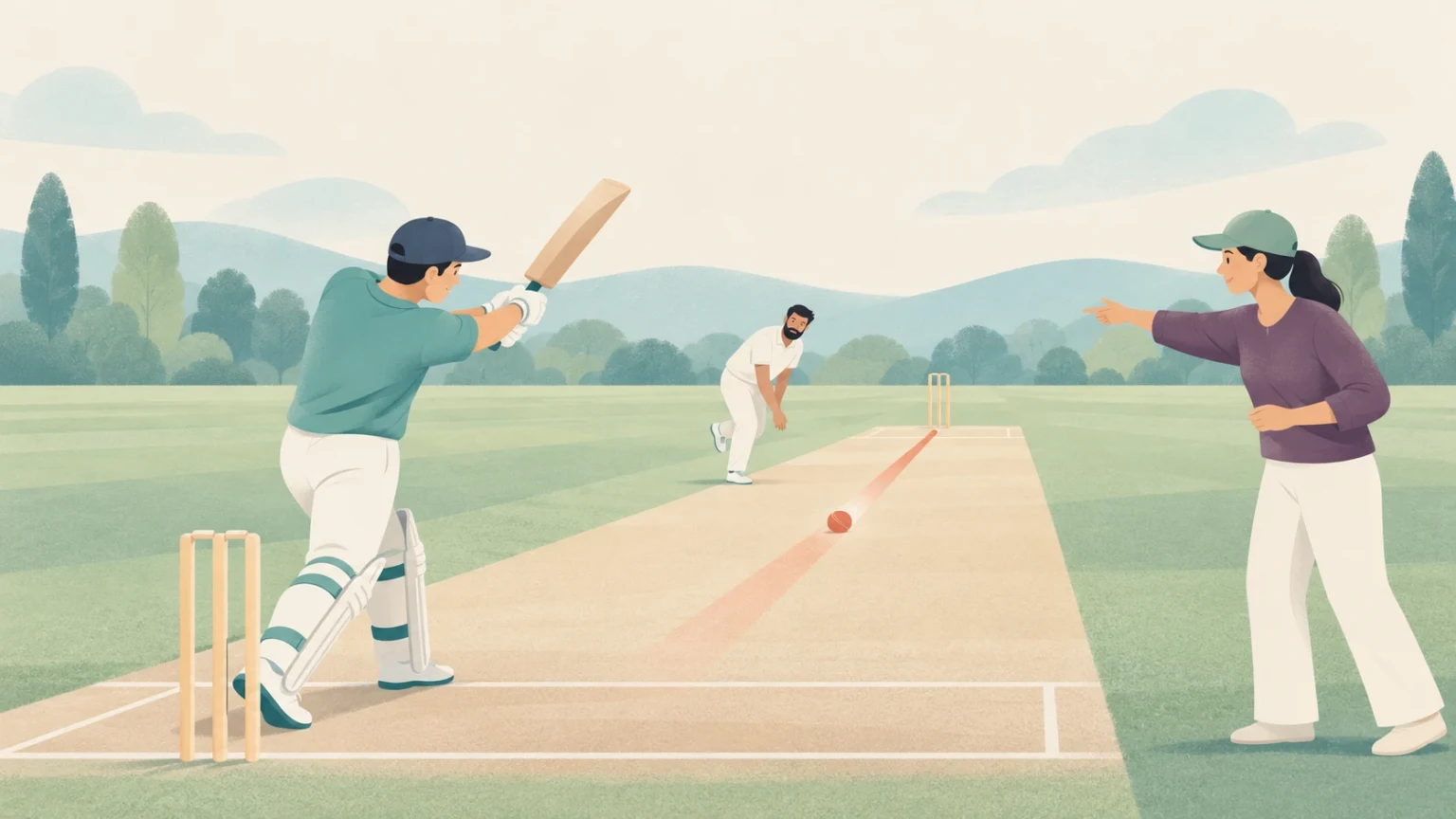
Down the ground refers to a straight trajectory along or parallel to the central line of the cricket pitch. When a batter plays down the ground, the ball travels directly forward past the bowler rather than sideways across the field. The phrase identifies direction alone.
Key points
- In cricket commentary, down the ground means straight ahead along the line of the pitch toward the bowler and the far boundary.
- When explaining the moment to people unfamiliar with cricket, use straight past the bowler to communicate the same idea clearly.
- Use down the ground when discussing cricket match commentary, reports, or tactical field settings.
This lesson has 5 stages. You can stop at any time and continue later.

Stage 1 of 5
Understand
What it means, when to use it, and mistakes to avoid.
The full explanation
Down the ground refers to a straight trajectory along or parallel to the central line of the cricket pitch. When a batter plays down the ground, the ball travels directly forward past the bowler rather than sideways across the field. The phrase identifies direction alone. It does not indicate whether the ball stayed on the turf or flew through the air, nor does it guarantee that the batter scored runs.
Priya drove a full delivery down the ground for four runs.
Why it works: Down the ground specifies the straight path past the bowler, and for four reports the score.
3 more examples
-
The opener chose to loft the ball down the ground over mid-on.
Loft indicates an aerial stroke, while down the ground confirms the straight direction.
-
Samir pushed a slower ball down the ground and hurried through for a single.
Push describes a controlled ground stroke aimed straight ahead to secure one run.
-
The captain stationed a fielder straight down the ground to prevent easy boundaries.
Straight down the ground describes the defensive area directly behind the bowler.
Read the full guide
Picture the central line of the pitch
A cricket pitch is a straight corridor between the two wickets. When commentators say down the ground, they describe a stroke traveling along or parallel to that central line, toward the bowler and the far boundary. It does not mean hitting into the dirt. Visualizing this straight path helps you follow the action immediately as the bowler releases the delivery.
-
The batter drove a delivery down the ground.
Why it works: The ball traveled along the straight central path of the pitch.
-
She punched a full delivery down the ground into open space.
Why it works: The direction was straight ahead, passing close to the bowler.
Your turn
Where does a ball travel when a commentator says it went down the ground?
Answer: Straight ahead along the pitch toward the bowler's end.
Show the answer
Answer: Straight ahead along the pitch toward the bowler's end.
Down the ground describes a straight path along the central line of the pitch toward and past the bowler.
Combine the direction with action verbs
Commentators pair down the ground with specific verbs that explain how the batter struck the delivery. Verbs such as drive or punch indicate controlled strokes along the turf. In contrast, verbs like loft or launch signal that the batter sent the ball high into the air over the bowler. Paying attention to the verb tells you both speed and elevation.
-
Elena chose to loft an off-break down the ground.
Why it works: The verb loft shows the ball flew through the air along the straight line.
-
Marcus will push a slower delivery down the ground.
Why it works: The verb push indicates a gentle stroke directed straight ahead.
You can practise this again in Contraband Meaning: Prohibited Goods Explained and Inevitable meaning: unavoidable results explained.
Your turn
Which verb tells a listener that a shot down the ground traveled through the air?
Answer: Lofted.
Show the answer
Answer: Lofted.
The verb lofted indicates that the batter hit the ball upward into the air rather than along the grass.
Separate the direction from the score
The phrase down the ground names only the path of the ball, not the scoring result. A straight stroke may produce four runs, a quick single, or a straightforward catch for a fielder. Listen for additional commentary phrases like for four or straight to mid-on to learn whether the stroke succeeded or handed an advantage to the bowling team.
-
He struck a drive down the ground for four.
Why it works: Down the ground names the path, while for four tells you the score.
-
Her firm stroke went down the ground into the hands of mid-off.
Why it works: The ball went straight ahead, but a nearby fielder stopped it.
Your turn
Why must you listen for phrases like 'for four' in addition to 'down the ground'?
Answer: Down the ground gives the direction, while for four reports the actual score.
Show the answer
Answer: Down the ground gives the direction, while for four reports the actual score.
The phrase describes the route of the ball; you need additional score details to know if runs were scored.
Distinguish straight strokes from square strokes
Cricket separates the field into straight zones and square zones. A square cut or pull sends the ball sideways across the field at roughly a right angle to the pitch. In contrast, playing down the ground keeps the ball traveling straight ahead toward the bowler's end. Deciding between these two directions is a primary tactical choice for batters.
-
Rather than cutting square, the opener drove down the ground.
Why it works: The batter chose a straight stroke rather than hitting across the pitch.
-
The bowler gave width, yet Maya still pushed down the ground.
Why it works: Maya declined the cross-field shot to play straight along the central line.
Your turn
How does a square shot differ from a shot down the ground?
Answer: A square shot travels sideways across the pitch, while down the ground travels straight ahead.
Show the answer
Answer: A square shot travels sideways across the pitch, while down the ground travels straight ahead.
Square shots travel across the field roughly perpendicular to the pitch, whereas down the ground means straight.
Identify fielders standing straight
Captains place defensive fielders in straight positions to block drives down the ground. Commentators frequently mention long-on, long-off, mid-on, or mid-off during an over. Recognizing those names helps you understand whether a straight stroke found an open gap or went directly to a waiting fielder near the boundary.
-
Long-off ran across as the ball raced down the ground.
Why it works: Long-off is a deep fielder positioned to defend straight drives.
-
The captain stationed mid-on closer to prevent singles down the ground.
Why it works: Mid-on waits near the bowler to intercept straight ground strokes.
Your turn
Which fielding position waits near the deep boundary to defend straight drives?
Answer: Long-off.
Show the answer
Answer: Long-off.
Long-off stands near the boundary straight past the bowler on the off side to stop straight drives.
Notice whether the shot stays grounded
A shot down the ground can travel along the grass or sail high into the stands. When commentators say along the carpet or firm drive, the ball remains grounded. When you hear lofted or clears the boundary, the stroke was aerial. Distinguishing ground strokes from aerial strokes tells you how much risk the batter took.
-
David punched a drive along the turf down the ground.
Why it works: The ball stayed on the grass while traveling straight ahead.
-
She launched a slower delivery down the ground into the stands.
Why it works: The stroke was aerial, carrying straight over the boundary rope.
Your turn
Which commentary phrase indicates that a straight stroke stayed on the grass?
Answer: Along the carpet.
Show the answer
Answer: Along the carpet.
The idiom along the carpet means the ball traveled smoothly along the grass surface.
Explain the phrase in everyday English
When speaking with friends who do not follow cricket, the phrase down the ground often causes confusion because ground sounds like soil or earth. To explain the action clearly in ordinary conversation, use straight past the bowler or straight ahead toward the boundary. This plain description gives listeners an accurate picture without sport-specific jargon.
-
The striker drove the delivery straight past the bowler.
Why it works: This plain phrasing explains the exact trajectory without cricket jargon.
-
He hit the delivery straight ahead into open outfield.
Why it works: Everyday listeners easily visualize a ball moving straight forward.
Your turn
What is the clearest way to explain 'down the ground' to someone who does not watch cricket?
Answer: Straight past the bowler.
Show the answer
Answer: Straight past the bowler.
Straight past the bowler provides a direct visual explanation without relying on cricket terms.
Recognize commentary rhythm and stress
In live cricket broadcasts, commentators speak quickly and pronounce down the ground with a distinct rhythm. The words down and ground carry heavy acoustic stress, while the intermediate article the reduces to a brief, weak sound. Tuning your ear to this rhythmic stress pattern lets you recognize the phrase even during noisy crowd reactions.
-
What a magnificent stroke down the ground!
Why it works: The commentator stresses down and ground to emphasize the straight path.
-
Driven firmly down the ground once again.
Why it works: The reduced article allows the speaker to maintain rapid descriptive pace.
Your turn
Which words carry the primary stress when a commentator says 'down the ground'?
Answer: The words down and ground.
Show the answer
Answer: The words down and ground.
Content words down and ground receive primary stress, while the unstressed article the is reduced.
Questions about "Down the ground: cricket meaning explained"
Does down the ground mean the ball hit the dirt?
No. In cricket commentary, down the ground refers to direction, not contact with the surface. The word ground here means the entire cricket field or playing arena. The phrase describes a stroke traveling straight along the pitch corridor toward the bowler and the far boundary. It can describe a rolling ball or an aerial six.
The batter lofted a six down the ground over the sightscreen.
Can commentators use down the ground as a verb phrase?
Yes. Commentators often say a batter decided to go down the ground or step down the ground. Going down the ground means choosing to attack straight ahead. Stepping down the ground describes a batter advancing down the pitch toward the bowler to strike the ball on the half-volley.
She stepped down the ground to attack the spin bowler.
What is the difference between a straight drive and a shot down the ground?
A straight drive is a specific batting stroke played with a vertical bat along the ground. Down the ground is broader because it describes any shot traveling in that straight direction, including aerial hits, lofted drives, and defensive pushes.
He played a defensive push down the ground to rotate the strike.
Can I use down the ground in non-sports conversations?
You should avoid using down the ground outside cricket or sports contexts. In everyday English, people will interpret the words literally as pointing toward the soil or floor. Use straight ahead, down the hall, or straight forward when giving normal directions.
Walk straight ahead toward the library entrance.
Before you go
Remember this
In cricket commentary, down the ground means straight ahead along the line of the pitch toward the bowler and the far boundary. It describes the path of the stroke, not the score or whether the ball touched the grass. When explaining the moment to people unfamiliar with cricket, use straight past the bowler to communicate the same idea clearly.
Stage 2 of 5
Listen
Hear it in real sentences, from short to long, and write what you hear.
0 of 4 done
Listening 1 of 4
Listening 2 of 4
Try a longer clip. Listen once, then replay the part you missed.
Listening 3 of 4
This clip is longer. Follow the instruction above the answer field.
Listening 4 of 4
Listen, then type the missing words. The rest of the text is already there.
0:00
Practice complete
You listened closely.
Your result is saved in this browser.
Keep your progress. Your practice is saved on this device only. Create a free account to keep it everywhere.
Create a free accountThat was today's free lesson. Tomorrow you get another one. Want more today? See membership.
Create a free SubLearn account to keep this progress across devices.
Save my progressStage 3 of 5
Speak
Say it with the speaker, then use it in your own answer.
Shadow
Say it along with the speaker
Play the line slowly, then speak at the same time as the speaker. Copy the rhythm, not just the words.
Your turn
Say it your way
Explain to a new cricket viewer why a batter might choose to hit down the ground rather than playing across the pitch. Speak for 20 to 30 seconds.
You could start with “When fielders protect the square boundary, a batter will often drive down the ground because…”
Take ten seconds to think, then answer out loud without looking at the lesson. Speak for the time shown in the task above. Nothing is sent unless you ask for feedback.
0:00
Stage 4 of 5
Write
Write your own response
AI feedback · it can make mistakes · Part of membership See membership
Check your own writing
Read one possible response
Draft saved on this device.
Use these checks to revise your message. Grammar and meaning are not automatically graded. Each task keeps its own draft in this browser tab.

You finished the free part of this lesson
- Understand
- Listen
- Speak
- Write
- CheckPart of membership
Worth another look
With a free account, the lessons you finish come back for review to help you remember them.Create a free account
Stage 5 of 5 · Part of membership
Check
New clips without hints.
Listening tests are included with membership. Try the free dictation first, then decide whether to continue.
Listening 1 of 2 Part of membership
Listening 2 of 2 Part of membership
Follow MicroEnglish
Find lesson updates, short videos and quick quizzes. Pick the app you already use.
Questions & comments
Ask about this lesson, share an example, or help another learner.
Example
Memory tip
Goes with
Related forms
Not to be confused with
In this lesson
This word isn't in our dictionary. Check the spelling, or try another form of the word.
We couldn't load this word. Try again.