Video suchen
How smart people say 'I hate this place' | English from movies
Video schließen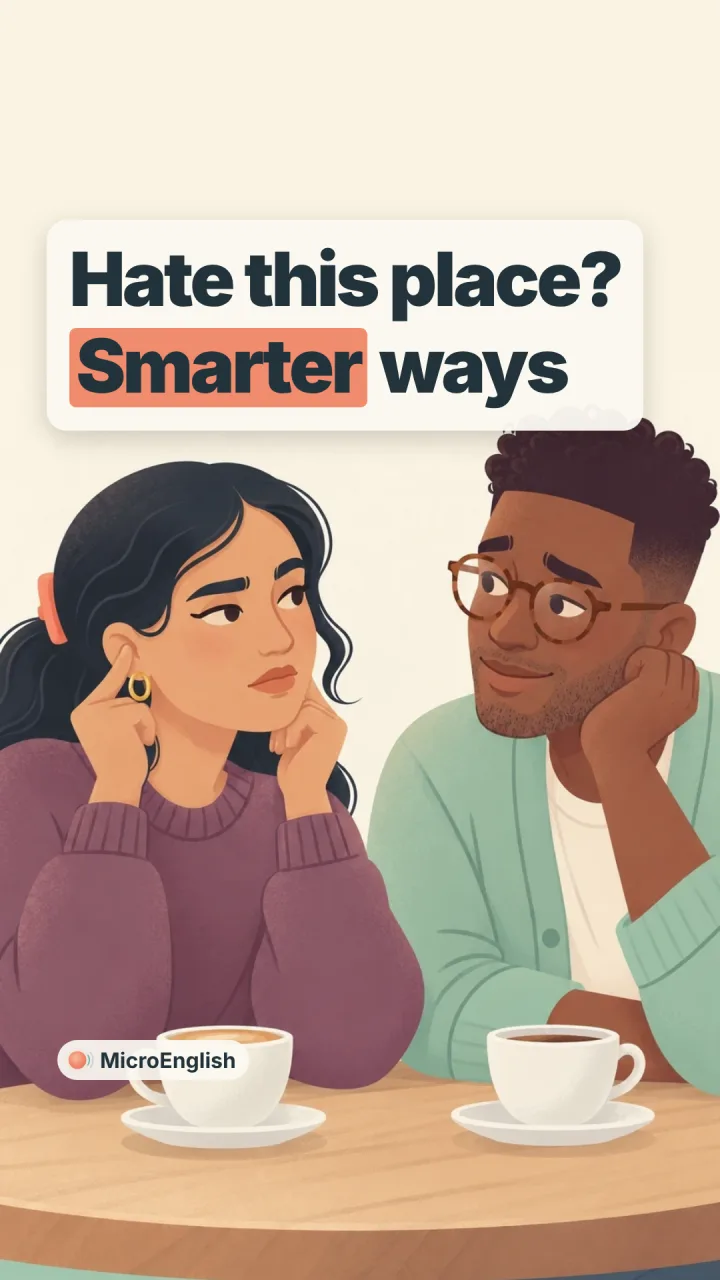
Das Video wird über YouTube abgespielt, sobald du auf „Abspielen“ klickst.
Falls der Player nicht lädt, öffne das Video auf YouTube.
Wähle eine Zeile aus, um sie noch einmal zu hören. Wähle ein beliebiges Wort aus, um seine Bedeutung zu sehen. Wichtige Wörter aus diesem Video sind unterstrichen.
-
Nadia I . Let's the .
-
Theo So you it ?
-
Tutor and .
-
If Not I .
-
Tutor but .
-
Over the Moon in Love It's not my cup of tea, but we do. ?
-
Tutor and .
-
Girl Haunts Boy we on?
-
Theo is so . we on?
-
Nadia Yes, . I for the to go.
Wähle zu jeder Frage eine Antwort und prüfe sie danach.
-
Frage 1
Your friend chose a restaurant, and it looks much worse than the photos. Which line is the most polite?
-
Frage 2
What does "my cup of tea" mean?
-
Frage 3
What does "Shall we move on?" do in a conversation?
-
Frage 4
Which line is too casual to say to your manager at a work dinner?
-
Frage 5
In "It's a bit too loud for me," why do the words "for me" matter?
Die kurze Antwort
How smart people say 'I don't like this place'
To say you don't like a place without sounding rude, describe your feeling softly or suggest leaving. Say "Not quite what I expected" when a place disappoints you, "It's not really my cup of tea" when it isn't your style, and "Shall we move on?" when you want to go somewhere else. Words like "quite," "really," and "a bit" make each line gentler than "I hate this place."
Wichtige Wörter aus diesem Video
Wähle ein beliebiges Wort aus, um seine Bedeutung zu sehen. Wichtige Wörter aus diesem Video sind unterstrichen.
Die Sätze einzeln erklärt
-
Not quite what I expected. So wirkt der Satz: Gentle and polite
Use it when a place disappoints you, for example a restaurant or hotel that looked better online. It sounds calm, so it works with friends and with people you don't know well. Don't use it to praise something that surprised you in a good way.
“Not quite what I expected.”
-
It's not really my cup of tea. So wirkt der Satz: Honest but kind
"Cup of tea" means something you like. Use this line when a place or activity isn't your style, but you don't want to say it is bad. It's a little informal, so it fits friends and coworkers better than a formal complaint.
“It's not really my cup of tea, but things we do. Right?”
-
Shall we move on? So wirkt der Satz: Clear and friendly
This is a soft way to suggest leaving. It invites the other person to agree instead of giving an order. Use it with people you are spending time with. With someone who is in charge, such as a tour guide, "Could we move on soon?" is more polite.
“Shall we move on?”
-
It's a bit too loud for me. So wirkt der Satz: Soft and specific
Use it when one thing, like noise, bothers you. "For me" shows that this is your feeling, not a fact about the place. You can change the adjective: too crowded, too hot, too busy.
-
Maybe we could try somewhere else? So wirkt der Satz: Polite suggestion
Use it when you want to leave and already have a plan to go to another place. "Maybe" and "could" make it soft. It's useful with a group, because nobody has to feel bad about the first choice.
-
I'm not really feeling this place. So wirkt der Satz: Casual and relaxed
Use it with close friends when the place just doesn't feel right to you. It's informal, so don't use it at work or with a host who chose the place.
Häufige Fehler
-
Noch nicht passend
It's not really my cup of coffee.So passt es It's not really my cup of tea.
"Cup of tea" is a fixed expression that means something you like. If you change "tea" to another drink, the expression stops working, and people will only hear a sentence about drinks.
-
Noch nicht passend
Shall we move?So passt es Shall we move on?
"Move" alone can mean changing seats or moving house. "Move on" means leaving this place or topic and going to the next one, which is what you want to say.
-
Noch nicht passend
Not quite what I expect.So passt es Not quite what I expected.
You had the expectation before you arrived, so use the past form "expected." "What I expect" talks about the present or future.

Leonie · KI-Tutor
Übe mit deinem KI-Tutor
Frag im privaten Chat nach oder übe die englischen Ausdrücke dieser Seite. Dein Tutor richtet sich nach dem Niveau, das du ausgewählt hast, oder nach den Angaben in deinem Konto.
Beispiel
Merkhilfe
Aus diesem Video
Die Erklärung zu diesem Wort konnte nicht geladen werden. Versuch es noch einmal.
143 Videos
-
 00:49
Kurzvideos
Change the game in English: flip the script | English from movies
-
 00:49
Kurzvideos
How smart people say you're welcome | English from movies
-
 00:50
Kurzvideos
How smart people say sit down | English from movies
-
 00:49
Kurzvideos
How smart people say I'm jealous | English from movies
-
 01:39
Kurzvideos
When you freeze at the café counter | Barista English
-
 00:50
Kurzvideos
Fish out of water: feeling out of place | English from movies
-
 00:49
Kurzvideos
How smart people say "What do you want?" | English from movies
-
 00:48
Kurzvideos
Boys vs girls: finding each other in a crowd | English from movies
-
 00:50
Kurzvideos
How smart people say change the subject | English from movies
-
 00:49
Kurzvideos
Two peas in a pod: say people are alike | English from movies
-
 00:49
Kurzvideos
How smart people say do me a favor | English from movies
-
 00:50
Kurzvideos
How smart people say I'm in a bad mood | English from movies
-
 00:53
Kurzvideos
How smart people say "we must win" | English from movies
-
 00:49
Kurzvideos
In the same boat meaning | English from movies
-
 00:49
Kurzvideos
How smart people say 'I hate this place' | English from movies
-
 00:48
Kurzvideos
Pull the plug meaning | English from movies
-
 00:52
Kurzvideos
Boys vs girls: ordering dessert in English | English from movies
-
 00:53
Kurzvideos
Boys vs girls: preparing for an interview | English from movies