
Wortgrenzen heraushören
Hör zunächst zu, ohne etwas einzugeben. Achte beim zweiten Mal darauf, wo ein Wort endet und das nächste beginnt. Spiele die ganze Wortgruppe erneut ab, um deine Vermutung zu prüfen.
Lektionen 217 bis 234 von 872
-

Suppose or supposed: Choose the right form
Suppose means to think something is probable or to offer a thought for consideration. In contrast, be supposed to indicates an obligation, an official guideline, an arrangement, or an intended outcome. Supposed without be functions as the standard past-tense form of suppose, meaning someone held an assumption in the past.
-

Encase or In Case: Choose the Right Form
Encase means to enclose, cover, or surround something completely with an outer material. For instance, a potter might encase a ceramic vase in cardboard, or a technician might encase wiring in rubber. In contrast, in case expresses preparation for a potential event. It tells why an advance action makes sense before a problem or situation develops. While incase is occasionally seen as an alternate spelling for the verb encase, the precautionary expression is always written as two words: in case.
-

Stative Verbs: Choose the Correct Tense
A stative verb expresses a state of being, a perception, a belief, an emotional preference, or a relationship of possession rather than an observable physical action. Because these situations describe ongoing conditions without active physical progression, standard English represents them using simple present or simple past tenses instead of continuous forms.
-

Adverb exercises: rules and clear practice
Adverbs supply specific details that make an action or description clearer to your listener. A manner adverb like carefully explains how an action takes place. A frequency adverb like usually tells how often an event occurs. Time adverbs like tomorrow and place adverbs like outside establish when and where actions happen, while degree adverbs like very or extremely show the intensity of an adjective or another adverb. Selecting the right adverb helps you convey your exact meaning without unnecessary words.
-

Run-on sentences: find and fix them
A run-on sentence joins independent clauses without the necessary punctuation or coordinating conjunction. A fused sentence pushes two complete thoughts together with no punctuation at all. A comma splice inserts only a comma between two independent clauses. In standard edited English, a comma alone is not strong enough to join two complete sentences.
-

Contraband Meaning: Prohibited Goods Explained
Contraband refers to goods or physical property that a governing authority forbids people from bringing in, taking out, or possessing in a controlled space. It does not refer to a person or to the general crime of smuggling. Because the prohibition stems from a specific law, regulation, or institutional guideline, an item can be contraband in one location while remaining entirely lawful in another.
-
Mitgliedschaft
7 Tage kostenlos auf alle Lektionen zugreifen
- 872 Lektionen mit Diktaten und Hörtests
- Drei Akzente: britisch, amerikanisch und australisch
- Entdecke die Bibliothek und speichere deinen Lernfortschritt
Keine Karte erforderlich. Wer danach weiterlernen möchte, kann ab $7.50 pro Monat eine Mitgliedschaft wählen.
Kostenlos testen -

Few or little: choose the right word
Both few and little indicate a limited quantity. The grammatical separation rests on how English categorizes the noun. Plural countable nouns, such as desks, messages, and colleagues, take few or a few because you can enumerate them one by one. Uncountable nouns, such as time, patience, and advice, take little or a little because they express an overall mass or concept without plural forms. When you omit the article a, both words emphasize scarcity. When you include the article a, the phrase highlights presence and usefulness.
-
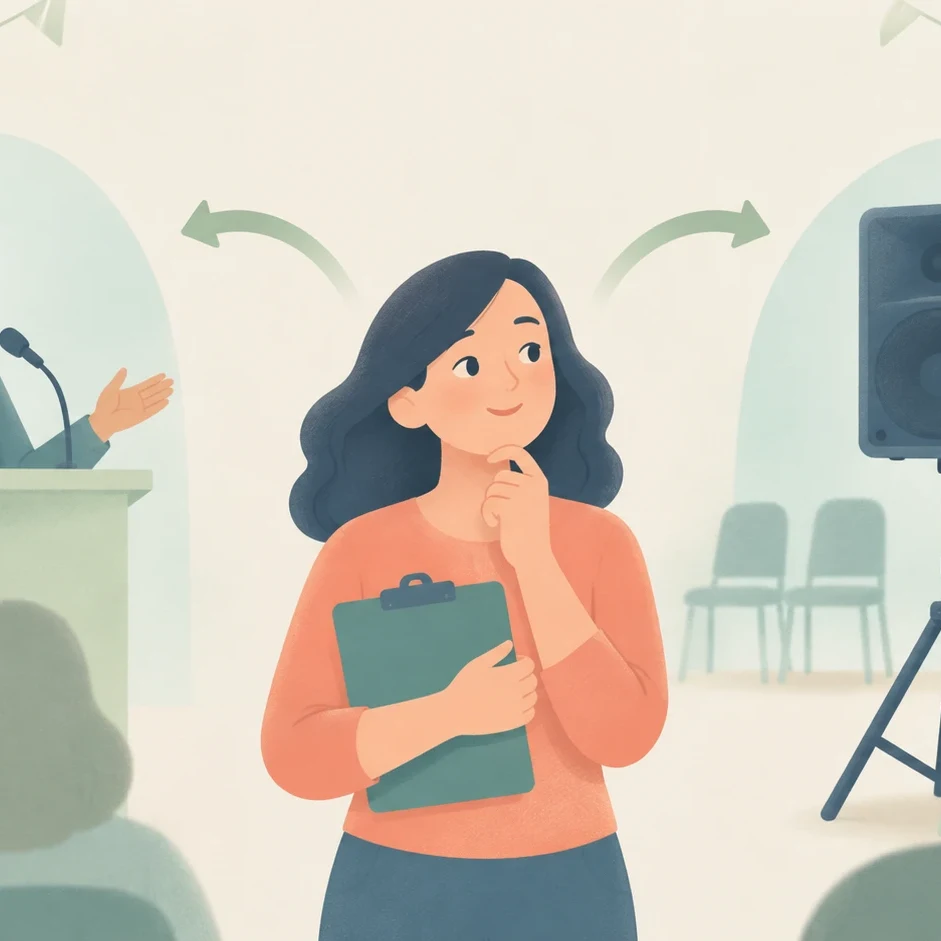
Ambiguous Meaning: Clarify Two Different Readings
An ambiguous statement allows two or more reasonable interpretations. An interpretation is simply a possible meaning that makes sense in the sentence. When wording is ambiguous, a listener cannot decide between those meanings without more facts.
-

Like and such as: give clear examples
Such as points directly to examples that belong to a broader category. When you mention board games such as chess and checkers, the items are real members of that group. Like primarily points to similarity, showing that two things share features. In everyday speech, speakers also use like to introduce examples, though such as states the category connection more directly.
-

Resign from or on: Choose the Right Preposition
To resign means to leave a formal job, post, or office through an official statement or notice. This differs from simply walking away from a physical location. When you name the job, position, or organization being vacated, use the preposition from. When you name the specific role or title being vacated, use as. When you specify the weekday or calendar date of the announcement, use on.
-

Assist with or in: Preposition Rules and Use
Assist means to help or give support. When you use assist as an active verb, the person receiving help follows immediately without a preposition: 'The agent assisted the passenger.' If you also want to name the task or problem, you add with: 'The agent assisted the passenger with the ticket change.' Each preposition after assist serves a precise communicative purpose.
-

English Punctuation Rules: Clear Sentence Guide
Punctuation defines the boundaries and relationships between words on a page. Without correct marks, readers cannot easily tell where one statement finishes and another begins, or whether words form a list or a single idea. Clear punctuation organizes your thoughts so that listeners and readers understand your exact message on the first reading.
-

Epic meaning: stories and grand scale
As a countable noun, an epic refers to an extended book, poem, or film focused on heroic figures who overcome formidable challenges during historic events. As an adjective, epic describes experiences, tasks, or events that involve remarkable effort, immense scale, or unforgettable drama. The adjective is widely used in casual conversation to convey enthusiasm or to underline the severity of an error.
-

Everyday English Words: Meanings and Examples
Book can name a text you read or mean reserve. Run can mean move fast on foot or manage an activity. Light can name a lamp or describe something that is not heavy. Flat describes level ground or a home in British English. Clear means easy to understand. Fair describes reasonable conditions or a community gathering. Fine can mean acceptable or a monetary penalty. Kind describes a caring person or a category. A bill is a statement of money owed. Match means a game or items that look good together. Sound is what you hear or how something seems. A break is a brief pause from work.
-

expedite meaning: speed up a process
To expedite something means to push a multi-step procedure forward so it finishes earlier than planned. It alters the schedule and pace of work, but it does not mean the task is completed immediately.
-

Vague Meaning: Choose Clearer Words
The adjective vague describes something that is not clearly expressed, detailed, or defined. It refers to statements that lack precision, memories that are faint, and physical outlines that lack distinct boundaries.
-

Amicable meaning: use and combinations
Amicable describes a relationship, interaction, or formal arrangement characterized by goodwill and the absence of hostility, especially when handling a sensitive issue or potential disagreement.
-

Wait vs Weight: Spot the Right Word
Wait is primarily a verb that describes pausing activity or staying in a place until a person, vehicle, or event arrives. Weight is a noun that describes the physical heaviness of an object, a person, or cargo. Both words share the phonetic sound /weɪt/, which makes listening context and sentence grammar the deciding factors for correct usage.
Noch kein Probeabo? Erhalte täglich eine kostenlose Lektion
7 Tage lang kommt jeden Tag ein kurzes Diktat per E-Mail. Übe, wo du gerade bist. Du brauchst kein Konto.
Du findest den gesuchten Ausdruck oder die passende Situation nicht?
Lektionsanfragen sind in der Mitgliedschaft enthalten.
Mitgliedschaft ansehen