Micro-listening
English Nouns: Rules for Everyday Use
The short answer
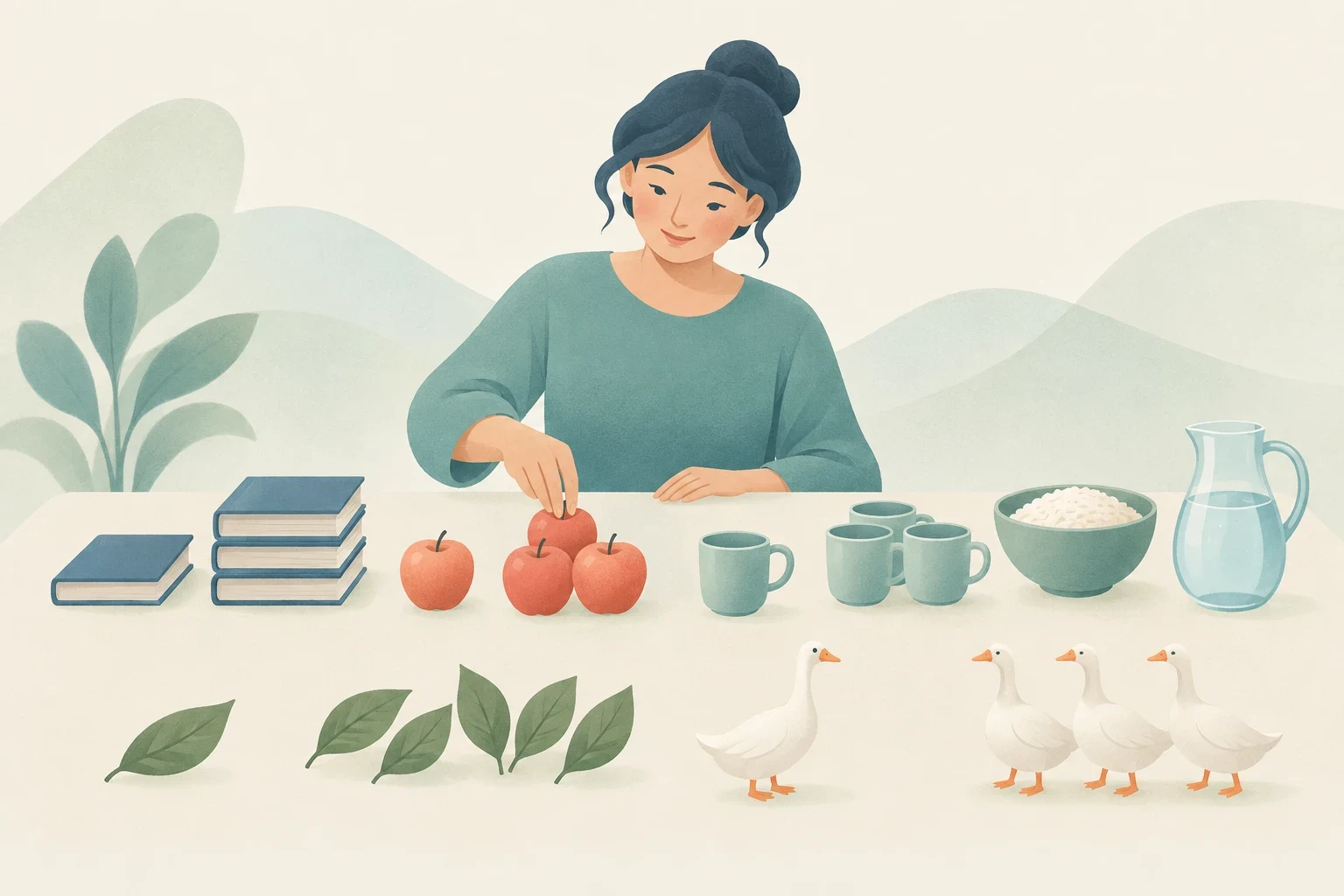
A noun is a word that identifies a person, place, animal, thing, or idea. Nouns can name the person who acts, the object that someone carries, or a location. They can be singular for one item, plural for several items, or uncountable for substances and concepts that do not take numbers directly.
Key points
- Decide whether your noun names a separate countable unit or an undivided substance.
- Add -s, -es, or -ies for regular plurals, and remember irregular forms like children and people.
- Use a unit phrase like a bottle of water to measure mass nouns.
This lesson has 5 stages. You can stop at any time and continue later.

Stage 1 of 5
Understand
What it means, when to use it, and mistakes to avoid.
Examples
David put three clean cups and a loaf of bread into the picnic basket.
Why it works: Cups is a plural countable noun, loaf is a countable unit, and bread is uncountable.
2 more examples
-
The children need some cold water after their game in the park.
Children is an irregular plural noun, water is uncountable with some, and park is singular with the.
-
Sarah bought a new pair of scissors for the project on Tuesday.
Sarah and Tuesday take capital letters as proper nouns, and pair of scissors serves as one countable unit.
Read the full guide
Identify people, places, things, and ideas in sentences
A noun is a word that names a person, place, animal, thing, feeling, or idea. Everyday words like friend, park, dog, cup, happiness, and idea are all nouns. A noun often tells you who performs an action, what someone brings, or where something happens after the word in. Sentence position alone does not prove a word is a noun, so always ask what person, place, or concept the word names.
-
My friend brought a warm blanket to the park.
Why it works: Friend names a person who acts, blanket names a thing, and park names a place after the word to.
-
Quiet happiness filled the bright room.
Why it works: Happiness names a feeling or idea, while room names a physical place.
Your turn
Which word in the sentence 'Her idea brought quiet joy to the family' names an abstract thought?
Answer: idea
Show the answer
Answer: idea
Idea names an abstract thought or concept, while family names people and brought is the verb.
Capitalize specific names, days, months, and languages
General nouns use lowercase letters, but proper nouns name specific individuals, places, or calendar periods and always begin with a capital letter. Capitalize people's names like Marcus, cities like Chicago, days like Friday, months like August, and languages like English. Ordinary nouns only take a capital letter at the start of a sentence. Never add a capital letter just because an object feels important to you.
-
Marcus meets his teacher every Monday to practice French.
Why it works: Marcus, Monday, and French are specific proper nouns and require capital letters, whereas teacher is a general noun.
-
We visit Toronto in July to see our cousins.
Why it works: Toronto and July are capitalized proper nouns naming a specific city and month.
You can practise this again in abstract nouns: everyday rules and examples and Material nouns: rules and simple examples.
Your turn
Which sentence uses capital letters correctly for names, days, and languages?
Answer: Marcus speaks Spanish with his doctor every Tuesday.
Show the answer
Answer: Marcus speaks Spanish with his doctor every Tuesday.
Marcus, Spanish, and Tuesday require capital letters, while doctor is a common noun that stays lowercase.
Decide whether a noun accepts numbers directly
Singular means one item, and plural means more than one item. Countable nouns name separate units that accept numbers directly, such as one cup or two cups. Uncountable nouns name materials, liquids, or general concepts that cannot combine with numbers directly, such as water or bread. Physical visibility does not decide countability. For example, furniture is uncountable even though you see it, while idea is countable even though you cannot touch it.
| Noun Type | Example Noun | Everyday Phrase | Language Choice |
|---|---|---|---|
| One countable item | cup | one cup on the tray | Requires a singular marker or number |
| Several countable items | cups | three cups on the tray | Takes a plural ending and direct number |
| Uncountable amount | water | some cold water in the jug | No direct number and no plural ending |
-
Lucas packed two cups, but he carried some fresh water in a jug.
Why it works: Cups follows the number two directly, while water takes some because it is an uncountable liquid.
-
She shared three good ideas about arranging the office furniture.
Why it works: Ideas is countable with the number three, while furniture is uncountable and remains singular.
Your turn
Which noun can combine directly with the number two without an extra unit word?
Answer: idea
Show the answer
Answer: idea
Idea is a countable noun, so you can say two ideas directly. Furniture and water are uncountable.
Add a marker before a singular countable noun
In everyday English, an ordinary singular countable noun cannot stand alone in a sentence. You must place a small marker before it, such as a, an, the, my, or this. Use a before a consonant sound, as in a blanket, and an before a vowel sound, as in an apple or an orange bag. Use the when your listener can already identify the specific item you mean.
-
Marcus handed me an apple and the clean knife from the table.
Why it works: Apple takes an because it starts with a vowel sound, while knife takes the because the listener knows which knife.
-
I left my blanket in this car yesterday.
Why it works: Blanket is marked by the possessive word my, and car is marked by the pointer this.
Your turn
Which phrase correctly marks a singular countable noun before a vowel sound?
Answer: an old jacket
Show the answer
Answer: an old jacket
Old begins with a vowel sound, so the singular countable noun jacket requires the marker an.
Spell regular plural endings with s, es, or ies
Most countable nouns form their plural by adding -s, such as cup becoming cups. Many nouns ending in -s, -x, -sh, or soft -ch add -es, as in box to boxes, brush to brushes, and sandwich to sandwiches. If the noun already ends in silent e, normally add only -s. If a consonant comes before y, change y to -ies, like baby to babies. After a vowel, simply add -s, like toy to toys. Never use an apostrophe for a plural.
-
The picnic basket holds four sandwiches and two boxes of berries.
Why it works: Sandwich and box both add -es to make the plural easy to pronounce.
-
The babies played happily with their new toys.
Why it works: Baby changes consonant plus y to -ies, while toy keeps y and adds -s after a vowel.
Your turn
What is the correct plural form of the word 'city'?
Answer: cities
Show the answer
Answer: cities
City ends with a consonant followed by y, so the y changes to -ies without an apostrophe.
Recognize irregular plural nouns that change spelling
Several common English nouns do not take the regular -s ending when plural. Instead, they change their vowel sound or adopt a special word pattern. In daily speech, people is the standard plural of person, while child changes to children. A few words ending in -f change to -ves, such as leaf to leaves, but other nouns simply add -s, such as roof to roofs. A few animal nouns like sheep never change spelling in the plural.
| Singular Form | Plural Form | Spelling Pattern | Example Sentence |
|---|---|---|---|
| person | people | Word changes completely | Five people waited by the park bench. |
| child | children | Adds -ren with vowel shift | Three children played near the fountain. |
| man / woman | men / women | Vowel letter changes | Two men and two women shared the meal. |
| foot / tooth | feet / teeth | Double o changes to double e | Cold grass cooled our tired feet. |
| leaf / roof | leaves / roofs | Some take -ves, others keep -fs | Autumn leaves fell onto the roofs. |
| sheep | sheep | No spelling change | Ten sheep grazed along the hill. |
-
Four children and several friendly people walked past our picnic table.
Why it works: Children and people are irregular plurals that do not take -s.
-
Dry leaves covered the path while two sheep rested under the tree.
Why it works: Leaves changes -f to -ves, whereas sheep remains identical in singular and plural.
Your turn
Which sentence uses irregular plural nouns correctly?
Answer: Two men and three children washed their feet.
Show the answer
Answer: Two men and three children washed their feet.
Men, children, and feet are the correct irregular plurals and do not take -s endings.
Keep uncountable nouns in their base singular form
Uncountable nouns name materials, liquids, and general concepts that English views as an undivided whole. Common examples include water, milk, bread, rice, information, advice, and furniture. Do not attach a, an, a number, or a plural -s ending directly to these words. Avoid the myth that uncountable items are impossible to count physically; grains of rice exist, but English grammar treats the whole substance as a single mass.
-
The guide gave us useful information and sound advice about the hiking path.
Why it works: Information and advice are uncountable nouns, so they have no plural -s and no article a.
-
We bought fresh bread and cold milk for lunch.
Why it works: Bread and milk are uncountable mass nouns used in their base singular forms.
Your turn
Which sentence avoids incorrect plural endings on uncountable nouns?
Answer: He gave me great advice and new information.
Show the answer
Answer: He gave me great advice and new information.
Advice and information are uncountable in everyday English and never take an -s ending.
Measure mass nouns and paired items with unit words
To express an exact amount of an uncountable noun, place a countable unit word before it. Combine a number, a container or unit noun, the word of, and the mass substance. Say a bottle of water or two bottles of water, and a piece of bread or two pieces of advice. Notice that the unit word becomes plural while the substance remains unchanged. Tools with two blades like scissors are plural, but a pair of scissors counts as one unit.
-
Marcus packed two bottles of water and three slices of bread.
Why it works: Bottles and slices take plural endings, while water and bread stay in their base mass form.
-
Elena borrowed that pair of scissors to open the package.
Why it works: Scissors is always plural, but a pair of scissors functions as one countable unit.
Your turn
Which phrase correctly counts an uncountable noun using a unit word?
Answer: two bottles of water
Show the answer
Answer: two bottles of water
The unit word bottle takes the plural ending -s, followed by of and the base noun water.
Select some, any, how many, or how much
Use some in positive statements with plural countable nouns and uncountable nouns. You also use some in polite offers and requests, such as asking for water. Use any in negative statements and open, neutral questions. When asking about quantity, use how many with plural countable nouns, as in how many cups. Use how much with uncountable nouns, as in how much water. This choice depends on whether the noun is countable.
-
Can I have some water, or do we not have any clean cups left?
Why it works: Some expresses a polite request for an uncountable noun, while any appears in the negative question about cups.
-
How many sandwiches do you want, and how much juice should I pour?
Why it works: How many pairs with countable sandwiches, while how much pairs with uncountable juice.
Your turn
Which question asks about the quantity of an uncountable drink correctly?
Answer: How much tea is in the thermos?
Show the answer
Answer: How much tea is in the thermos?
Tea is uncountable, so it pairs with how much and the singular verb is.
Match singular and plural verbs to the correct noun
Your verb must agree with the noun that controls the subject phrase. Singular countable nouns and uncountable nouns pair with is, as in the basket is ready and the water is cold. Plural countable nouns pair with are, as in the apples are ripe. In unit phrases, the unit word decides agreement: two bottles of water are ready. Similarly, scissors are sharp, but a pair of scissors is on the desk.
-
The cold milk is on the table, but the plates are in the basket.
Why it works: Uncountable milk takes singular is, while plural plates takes plural are.
-
That pair of scissors is blunt, while the small knives are very sharp.
Why it works: A pair of scissors uses singular is because pair is singular, while knives uses plural are.
Your turn
Which sentence matches the verb to the controlling noun correctly?
Answer: Two bottles of water are in the bag.
Show the answer
Answer: Two bottles of water are in the bag.
The plural unit noun bottles controls the subject, so it agrees with the plural verb are.
Notice when countability shifts with word meaning
Certain English nouns shift between countable and uncountable uses when their meaning changes. When chicken names an individual bird, it is countable: two chickens walked across the farm. When chicken refers to meat on a plate, it is uncountable: we ate some chicken for lunch. Similarly, coffee is an uncountable drink, but customers in a cafe often say two coffees to mean two prepared cups. This serving shortcut does not apply to every mass noun.
-
The farmer feeds six chickens every morning, but Marcus cooked some chicken for the picnic.
Why it works: Chickens refers to live animals, while chicken refers to food as an undivided mass.
-
She ordered two coffees and three teas for our morning break.
Why it works: Coffees and teas function as countable units meaning cups or servings in a cafe.
Your turn
In which sentence does 'coffee' refer to individual servings rather than the substance?
Answer: The waiter carried two coffees to table seven.
Show the answer
Answer: The waiter carried two coffees to table seven.
Two coffees means two cups or servings in a restaurant context, showing a countable shift.
Hear the three pronunciations of plural endings
Spoken plural endings produce three distinct sounds depending on the final sound of the base noun. After voiceless sounds like /p/, /t/, and /k/, the ending sounds like a sharp /s/, as in cups. After voiced vowels and consonants like /g/, /m/, or /d/, the ending sounds like a soft buzzing /z/, as in bags and apples. After hissing sounds like /s/, /z/, /ʃ/, or /tʃ/, you hear an extra syllable /ɪz/, as in boxes and sandwiches.
-
Elena packed three cups and four bags into the car.
Why it works: Cups ends with a voiceless /s/ sound, while bags ends with a voiced /z/ sound.
-
Marcus opened two boxes of sandwiches for lunch.
Why it works: Boxes and sandwiches both add an extra syllable ending pronounced /ɪz/.
Your turn
Which plural noun adds an extra spoken syllable when made plural?
Answer: boxes
Show the answer
Answer: boxes
Box ends in an /ks/ sound, so the plural ending adds an extra spoken syllable /ɪz/.
Distinguish missing supplies in spoken sentences
When you listen to people checking supplies, listen for the exact noun form to know what is needed. Notice whether the speaker names an individual tool, several separate items, an irregular plural group, or an uncountable liquid measured with a container. Separate the general meaning of what is missing from the exact grammar. Paying close attention to small words and plural endings ensures you write accurate messages and pack the right supplies.
-
Marcus checked the basket and asked for two bottles of water.
Why it works: Bottles provides the countable unit, while water remains in its uncountable singular form.
-
Elena reminded him that the children need clean paper cups.
Why it works: Children is an irregular plural, and cups is a regular plural ending in an audible /s/ sound.
Your turn
When someone says 'Bring two bottles of water', which word takes the plural ending?
Answer: bottles
Show the answer
Answer: bottles
Bottles is the countable unit noun that takes -s, while the substance noun water stays singular.
Avoid missing articles and unnecessary plural endings
Two common mistakes appear frequently in everyday English writing. First, learners sometimes leave singular countable nouns completely bare, writing 'bring cup' instead of 'bring a cup' or 'bring the cup.' Second, learners often attach an -s ending to uncountable nouns, writing 'furnitures' or 'informations.' Remember that singular countable items always need a marker, while uncountable substances and abstract advice never take a plural -s ending.
-
Please bring a blanket, because the grass is damp.
Why it works: Blanket requires the marker a, and grass stays in its uncountable form without -s.
-
We received new information about our picnic area yesterday.
Why it works: Information remains singular without an -s ending or an indefinite article.
Your turn
Which sentence corrects a common mistake with noun marking and endings?
Answer: Elena packed a blanket and some information.
Show the answer
Answer: Elena packed a blanket and some information.
Blanket correctly takes the marker a, and information remains uncountable without -s.
Review supply lists and write clear notes
Before you send a message about supplies, do a quick three-step review. First, verify that every singular countable item has a marker like a, an, or the. Second, check that regular and irregular plurals show their correct endings, such as cups or children. Third, confirm that uncountable nouns like water and bread have no plural -s and use containers or unit phrases when exact amounts matter.
-
I packed a picnic rug, four sandwiches, and two bottles of juice.
Why it works: The note combines a marked singular noun, a regular plural noun, and a counted mass noun.
-
The children need three clean plates and some fresh bread.
Why it works: Children is an irregular plural, plates has a plural -s, and bread uses some as an uncountable mass.
Your turn
What should you check before sending a message about supplies?
Answer: Ensure every singular countable noun has a marker and mass nouns lack plural endings.
Show the answer
Answer: Ensure every singular countable noun has a marker and mass nouns lack plural endings.
Singular countable nouns require markers, while uncountable nouns must not take plural endings.
Use it naturally
How people really use “water”
Neutral Fine almost anywhere, at work or with friends.
Words it often goes with
- clean waterWe need clean water for our drinks.
- cold waterI want some cold water after my walk.
- a bottle of waterShe takes a bottle of water to school.
What people also say
- “some water” instead of “a water” Use this when you mean the liquid without counting bottles or glasses.
Questions about "English Nouns: Rules for Everyday Use"
How can I tell if a word is a noun?
A noun names a person, place, thing, animal, or abstract idea. You can test a word by seeing if it can take a marker like a, an, or the, or if it can follow a possessive word like my. Nouns often perform actions as the subject of a sentence or receive actions after a verb.
The teacher explained an interesting idea to the class.
My dog chased the ball across the park.
Why can I say two ideas but not two informations?
English treats idea as a countable noun because an idea is an individual, separate thought. In contrast, information is an uncountable noun that refers to an undivided body of facts. To count information, you must use a unit word like piece, saying two pieces of information.
She shared three clever ideas during the morning meeting.
The officer gave us two pieces of useful information.
When do I add -s, -es, or -ies?
Most nouns add -s. Many nouns ending in -s, -x, -z, -sh, or soft -ch add -es. If the noun already ends in silent e, normally add only -s. After a consonant plus y, change y to -ies; after a vowel plus y, normally keep y and add -s. Check a dictionary for exceptions.
Marcus packed four cups and two boxes into the trunk.
The company opened two new factories in nearby cities.
Do I need a or an before every noun?
No. You only use a or an before singular countable nouns when mentioning a general item for the first time. Plural countable nouns and uncountable nouns do not take a or an. They can appear alone in general statements or combine with words like some, any, or the.
Elena bought an orange and some bread at the grocery store.
Cats like milk, but this cat prefers clean water.
Why do we say scissors are but a pair of scissors is?
Scissors is a plural-only noun because the tool consists of two connected cutting blades, so it takes the plural verb are. When you add the unit word pair, the singular noun pair becomes the subject of the sentence, so the verb changes to singular is.
These scissors are very sharp and cut paper easily.
A pair of scissors is lying on the kitchen counter.
Why can someone order two coffees?
Normally, coffee is an uncountable liquid. However, in cafes and restaurants, speakers use coffee as a countable noun to mean a cup of coffee or a single serving. Saying two coffees is an accepted everyday shortcut for two cups of coffee. This convenience applies to common drinks, not to all uncountable nouns.
Marcus ordered two coffees and a glass of cold water.
We drank some warm coffee while waiting for the morning bus.
Before you go
Remember this
Decide whether your noun names a separate countable unit or an undivided substance. Add -s, -es, or -ies for regular plurals, and remember irregular forms like children and people. Use a unit phrase like a bottle of water to measure mass nouns. Finally, pair singular and uncountable nouns with is, and pair plural nouns with are.
Stage 2 of 5
Listen
Hear it in real sentences, from short to long, and write what you hear.
0 of 4 done
Listening 1 of 4
Listening 2 of 4
Try a longer clip. Listen once, then replay the part you missed.
Listening 3 of 4
This clip is longer. Follow the instruction above the answer field.
Listening 4 of 4
Listen, then type the missing words. The rest of the text is already there.
0:00
Practice complete
You listened closely.
Your result is saved in this browser.
Keep your progress. Your practice is saved on this device only. Create a free account to keep it everywhere.
Create a free accountThat was today's free lesson. Tomorrow you get another one. Want more today? See membership.
Create a free SubLearn account to keep this progress across devices.
Save my progressStage 3 of 5
Speak
Say it with the speaker, then use it in your own answer.
Shadow
Say it along with the speaker
Play the line slowly, then speak at the same time as the speaker. Copy the rhythm, not just the words.
Your turn
Say it your way
Imagine you are going to the beach with your sister tomorrow. Speak for 30 to 60 seconds from memory. Say what food, drinks, and clothes you want to take and what you want to do there.
Use: some clean water a pair of
Take ten seconds to think, then answer out loud without looking at the lesson. Speak for the time shown in the task above. Nothing is sent unless you ask for feedback.
0:00
Hear how someone else might say it
Tomorrow, my sister and I are going to the beach. We want to take some clean water in two bottles. We also need four sandwiches and three apples. I have a pair of shorts and a blue shirt for the beach. My sister has a big bag for our things. We want to swim in the morning and eat lunch at twelve. After lunch, we can play with a ball. I want to take a book, too. I like reading in the sun.
Try once more and answer this: What food does your sister like?
Stage 4 of 5
Write
Use what you've learned to write about your day or week, then write a message.
Write
Put it in your own words
- I used “water”.
- It is about my life, not the lesson’s example.
- I read it once aloud to check it sounds right.
Write your own response
Choose a situation and write 30–50 words of your own. In this activity, you decide what to say rather than copy the words in a recording.
Check your own writing
Read one possible response
Use these checks to revise your message. Grammar and meaning are not automatically graded. Each task keeps its own draft in this browser tab.

You finished the free part of this lesson
- Understand
- Listen
- Speak
- Write
- CheckPart of membership
Worth another look
With a free account, the lessons you finish come back for review to help you remember them.Create a free account
Stage 5 of 5 · Part of membership
Check
New clips without hints.
Listening tests are included with membership. Try the free dictation first, then decide whether to continue.
Listening 1 of 2 Part of membership
Listening 2 of 2 Part of membership
Follow MicroEnglish
Find lesson updates, short videos and quick quizzes. Pick the app you already use.
Questions & comments
Ask about this lesson, share an example, or help another learner.
Example
Memory tip
Goes with
Related forms
Not to be confused with
In this lesson
This word isn't in our dictionary. Check the spelling, or try another form of the word.
We couldn't load this word. Try again.
