Micro-listening
Loose or lose: Four simple checks
How can I easily hear the difference between loose and lose when native speakers talk?
Loose functions as an adjective that indicates something is unbound, not firmly attached, or not fitting tightly. A loose cable or a loose coat shows this condition. Lose operates as a verb meaning to misplace an object, suffer defeat in a competition, or become separated from a possession.
Key points
- Check whether your sentence describes a loose fit or performs an action where you lose something.
- Loose keeps two letter o shapes and ends with an unvoiced hiss.
- Lose uses one letter o and closes with a voiced buzz.
This lesson has 5 stages. You can stop at any time and continue later.

Stage 1 of 5
Understand
What it means, when to use it, and mistakes to avoid.
Examples
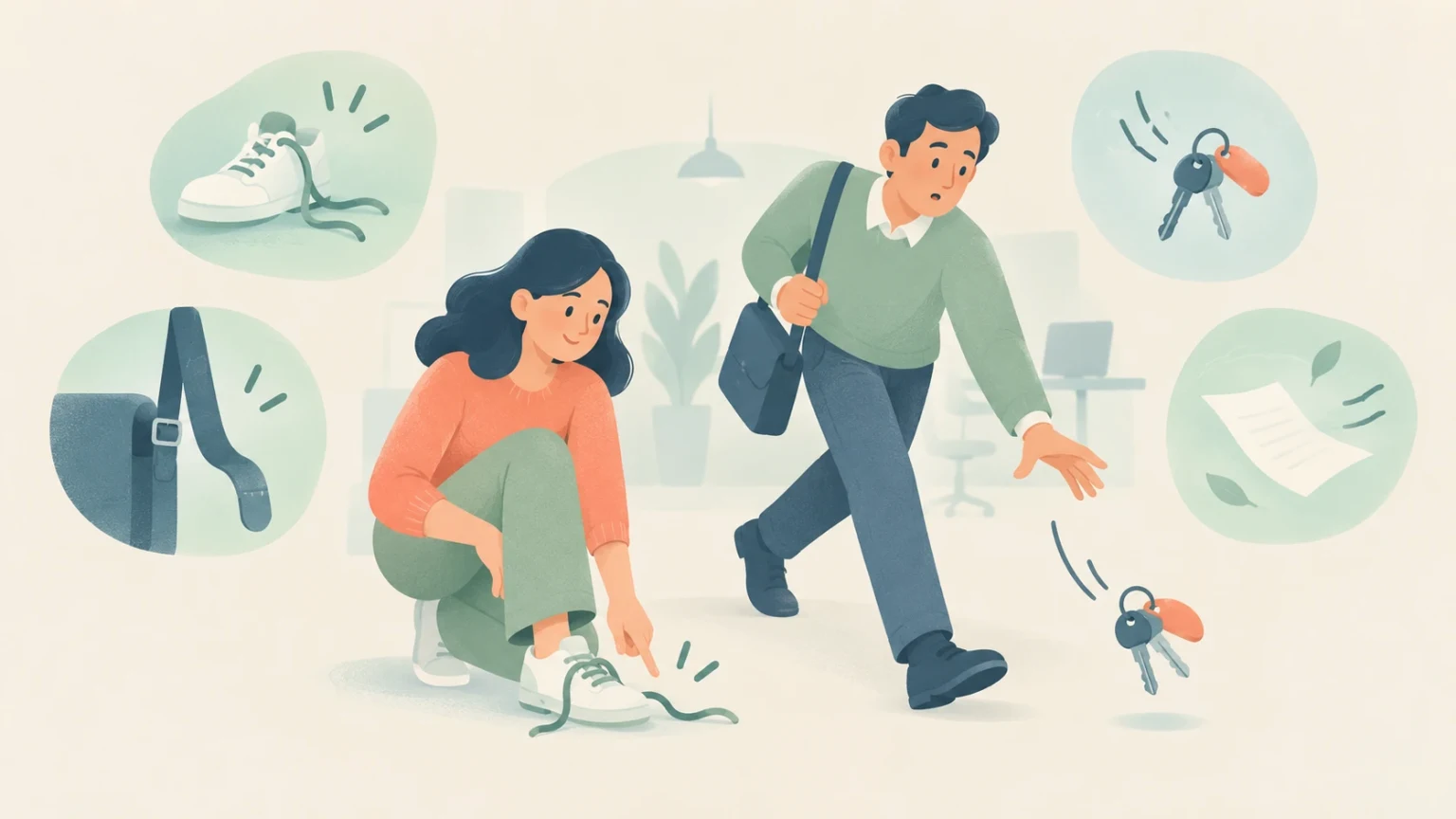
The strap on my laptop bag is loose, so I walk carefully.
Why it works: Loose describes the physical state of the strap.
3 more examples
-
If we miss the bus, we will lose our reservation at the clinic.
Lose is the action verb meaning to forfeit or miss out on the slot.
-
Please secure those loose documents in a red folder.
Loose shows that the papers are unbound and unfastened.
-
I always put my office keys in my pocket so I do not lose them.
Lose expresses the action of misplacing an item.
Read the full guide
Check whether you describe a fit or attachment
Begin by asking what state your subject has right now. When you say that a belt feels loose or a wire sits loose behind a computer monitor, you describe a condition. The word loose acts as an adjective that points out space, slack, or freedom from tight restraint. You are not describing any action or event of disappearance. Notice how the word sits after a linking verb or directly before a noun.
-
These running shoes feel loose around my heels.
Why it works: Loose describes the fit of the footwear.
-
A loose screw caused the desk lamp to wobble.
Why it works: Loose shows the mechanical state of the screw before the noun.
Your turn
Which sentence correctly describes a physical object that lacks tightness?
Answer: The battery cover is loose and rattles during movement.
Show the answer
Answer: The battery cover is loose and rattles during movement.
Loose correctly describes the physical state of the cover as an adjective.
Decide if a subject performs an action
Select lose when a person or group misplaces something, drops points, or misses an opportunity. Lose is an irregular verb that requires an actor. You can lose your umbrella on a train, lose patience during a long delay, or lose a football match in the final minute. If you can replace the word with misplace or drop, your sentence requires this verb form.
-
Keep your transit badge in your pocket so you do not lose it.
Why it works: Lose is the action of misplacing the badge.
-
Our local club might lose the match if their defense weakens.
Why it works: Lose functions as the main verb following the modal verb might.
You can practise this again in Lose your head and Speak English Online: Simple Daily Practice.
Your turn
Select the sentence where an action of misplacing or failing to keep occurs.
Answer: Be careful or you will lose your locker key in the crowd.
Show the answer
Answer: Be careful or you will lose your locker key in the crowd.
Lose functions as the base verb after the modal auxiliary will.
Use visual spelling clues to separate the words
A reliable visual habit helps you select the correct spelling under pressure. The adjective loose contains two letter o symbols, which you can imagine as extra room or two open circles inside a spacious room. The verb lose contains only one letter o, as if the missing letter was dropped or misplaced during writing. Matching this picture to the meaning prevents common slip-ups on forms.
-
There is loose gravel on the path, so drive at a moderate pace.
Why it works: Loose has two o letters and describes the gravel.
-
You will lose valuable minutes if you take the ring road now.
Why it works: Lose has one o letter and denotes spending or misplacing time.
Your turn
Which sentence uses the single letter o for an action verb?
Answer: We do not want to lose our seats before the performance begins.
Show the answer
Answer: We do not want to lose our seats before the performance begins.
Lose with a single o represents the action of failing to keep the seats.
Listen for the difference between s and z
Both words share the identical long vowel sound found in moon or tool, yet their final consonant changes completely. Loose concludes with a voiceless sibilant /s/, produced by passing air over the tongue without vibrating your vocal cords. In contrast, lose concludes with a voiced /z/ sound where your throat vibrates gently. Listening for this vibration helps you distinguish them in spoken speech.
-
Her silver necklace has a loose clasp.
Why it works: Loose ends with /s/ like the end of goose.
-
Did you lose your receipts from the stationery shop?
Why it works: Lose ends with /z/ like the end of choose.
Your turn
Which word ends with a voiced /z/ sound matching the verb form?
Answer: Lose
Show the answer
Answer: Lose
Lose ends with a voiced /z/ consonant, distinguishing it from loose.
Separate past tense lost from the verb loosen
Learners sometimes invent forms by adding endings to loose or lose without checking standard irregular patterns. The past tense of lose is lost, never loosed or losed. Meanwhile, if you want a verb that means to make an object less tight or release physical tension, English uses the separate verb loosen. Keeping these distinct words separate ensures that your verb tenses remain accurate in reports and stories.
-
He lost his apartment access card during his morning walk yesterday.
Why it works: Lost is the standard simple past form of the verb lose.
-
You should loosen the strap on your helmet before taking it off.
Why it works: Loosen is a regular verb meaning to make something less tight.
Your turn
Which sentence correctly uses the past form of lose?
Answer: She lost her passport while passing through security.
Show the answer
Answer: She lost her passport while passing through security.
Lost is the correct irregular past tense of lose.
Identify positions after linking verbs
Sentence structure gives you clear positional signals when you write. Linking verbs such as appear, feel, look, remain, seem, and taste connect a subject to a description rather than an action. Therefore, when you write after these verbs, you need the adjective loose to describe the condition. Placing an action verb like lose in that position produces an ungrammatical sentence that confuses readers.
-
The floorboards seem loose near the kitchen entrance.
Why it works: Loose follows the linking verb seem and describes the floorboards.
-
This shirt collar felt loose after several wash cycles.
Why it works: Loose follows felt to describe the shirt collar.
Your turn
Choose the sentence that correctly follows a linking verb with an adjective.
Answer: The connection looks loose after the storm.
Show the answer
Answer: The connection looks loose after the storm.
Looks is a linking verb that requires the adjective loose.
Catch common mix-ups in workplace notes
Workplace messages often discuss deadlines, business clients, and equipment settings where word confusion creates misunderstandings. A team can lose a client or lose data during a server migration, but they work with loose cables or loose packaging materials in the storeroom. Reviewing your drafts for noun modifiers versus verb actions protects your professional credibility before you press send on an email.
-
We cannot afford to lose another supplier during this quarter.
Why it works: Lose is the action verb with supplier as its direct object.
-
Please secure any loose wiring under the conference table.
Why it works: Loose modifies the noun wiring to describe its state.
Your turn
Which workplace note expresses the danger of misplacing customer accounts?
Answer: Our division might lose five major accounts if service stalls.
Show the answer
Answer: Our division might lose five major accounts if service stalls.
Lose correctly indicates failing to keep the customer accounts.
Apply a two-step check before sending
Before finalizing any document, run a simple two-step inspection on every instance of both words. First, test if the sentence describes an item that needs tightening or fastening; if it does, keep loose with two letters. Second, check if someone might misplace, forfeit, or fail to find something; if so, write lose with one letter. This brief pause catches errors reliably before your reader sees them.
-
A loose fitting caused the garden hose to leak water onto the patio.
Why it works: Loose describes the fitting that is not tight.
-
Do not lose your boarding pass before reaching the gate.
Why it works: Lose is the action of misplacing the travel document.
Your turn
Which rule helps you verify the spelling of lose in your writing?
Answer: Use lose whenever the meaning involves misplacing or failing to keep.
Show the answer
Answer: Use lose whenever the meaning involves misplacing or failing to keep.
Testing for misplacing or failing to keep confirms that the verb lose is required.
Questions about "Loose or lose: Four simple checks"
How can I easily hear the difference between loose and lose when native speakers talk?
Focus on the sound at the very end of the word. Loose ends with a voiceless /s/ sound, just like the ending of miss or bus. Your vocal cords stay still. Lose ends with a voiced /z/ sound, like the end of please or buzz, causing a gentle vibration in your throat. When native speakers talk quickly, the vowel in lose is also held slightly longer before the voiced consonant.
The knot became loose after the dog pulled on the rope.
I hope you do not lose your way in the unfamiliar subway station.
Is loosed ever the past tense of lose?
No, loosed is never the past tense of lose. The verb lose is irregular, and its past tense and past participle are both lost. The form loosed exists only as an uncommon, literary past tense of the verb loose, which means to release something from restraint, such as releasing arrows or freeing animals. In standard daily English, always write lost when referring to something you misplaced in the past.
We lost our train tickets yesterday afternoon.
She realized she had lost her umbrella on the subway.
When should I use loosen instead of loose?
Use loosen when you need an action verb that means to make something less tight, less firm, or less compact. While loose can occasionally function as a verb meaning to unleash, standard modern English uses loosen for physical adjustments like belts, ropes, screws, and neckties. If an action changes the tightness of an item, choose loosen.
He had to loosen his belt after the large holiday dinner.
Use a wrench to loosen the tight bolt on the wheel.
Why do English speakers say loose change instead of lost change?
Loose change means coins, especially coins you carry for small payments. The coins can be in a pocket, wallet, or purse. Lost change would mean coins you have misplaced. Here, loose is part of the usual expression for coins; it does not mean that they must be outside a coin purse.
I found some loose change at the bottom of my coat pocket.
She paid for the bus ticket with loose coins from her purse.
Before you go
Remember this
Check whether your sentence describes a loose fit or performs an action where you lose something. Loose keeps two letter o shapes and ends with an unvoiced hiss. Lose uses one letter o and closes with a voiced buzz.
Stage 2 of 5
Listen
Hear it in real sentences, from short to long, and write what you hear.
0 of 4 done
Listening 1 of 4
Listening 2 of 4
Try a longer clip. Listen once, then replay the part you missed.
Listening 3 of 4
This clip is longer. Follow the instruction above the answer field.
Listening 4 of 4
Listen, then type the missing words. The rest of the text is already there.
0:00
Practice complete
You listened closely.
Your result is saved in this browser.
Keep your progress. Your practice is saved on this device only. Create a free account to keep it everywhere.
Create a free accountThat was today's free lesson. Tomorrow you get another one. Want more today? See membership.
Create a free SubLearn account to keep this progress across devices.
Save my progressStage 3 of 5
Speak
Say it with the speaker, then use it in your own answer.
Shadow
Say it along with the speaker
Play the line slowly, then speak at the same time as the speaker. Copy the rhythm, not just the words.
Your turn
Say it your way
Explain to a new coworker why they should inspect their tool belt for loose items and how to avoid losing small screws during a home repair job.
You could start with “Before we start working on the house today, check your tool belt because…”
Take ten seconds to think, then answer out loud without looking at the lesson. Speak for the time shown in the task above. Nothing is sent unless you ask for feedback.
0:00
Stage 4 of 5
Write
Write your own response
AI feedback · it can make mistakes · Part of membership See membership
Check your own writing
Read one possible response
Draft saved on this device.
Use these checks to revise your message. Grammar and meaning are not automatically graded. Each task keeps its own draft in this browser tab.

You finished the free part of this lesson
- Understand
- Listen
- Speak
- Write
- CheckPart of membership
Worth another look
With a free account, the lessons you finish come back for review to help you remember them.Create a free account
Stage 5 of 5 · Part of membership
Check
New clips without hints.
Listening tests are included with membership. Try the free dictation first, then decide whether to continue.
Listening 1 of 2 Part of membership
Listening 2 of 2 Part of membership
Follow MicroEnglish
Find lesson updates, short videos and quick quizzes. Pick the app you already use.
Questions & comments
Ask about this lesson, share an example, or help another learner.
Example
Memory tip
Goes with
Related forms
Not to be confused with
In this lesson
This word isn't in our dictionary. Check the spelling, or try another form of the word.
We couldn't load this word. Try again.
