Micro-listening
Speak English Online: Simple Daily Practice
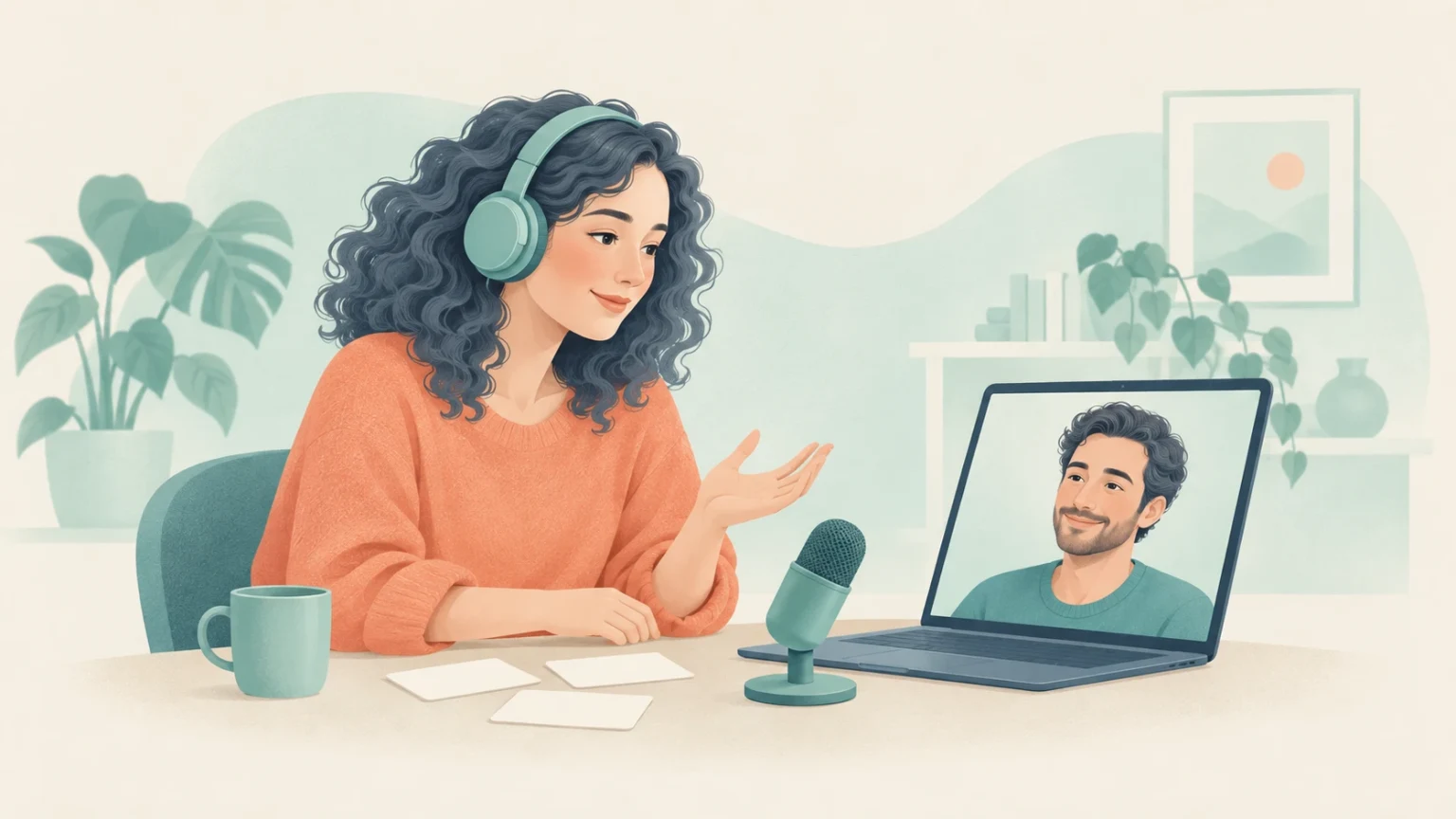
Is it better to practice speaking alone or with an online partner?
Speaking practice is an active process of turning thoughts into spoken words and noticing where communication succeeds or falters. When you record yourself or speak with a partner, you produce data about your vocabulary recall, sentence rhythm, and grammatical choices. Evaluating one specific feature after each attempt makes improvement deliberate rather than accidental.
Key points
- Try short recordings, keyword notes, and feedback on one clear point.
- Compare later attempts with earlier ones and adjust the routine to what you need.
- Select an everyday subject such as your daily commute, a recent meal, or an upcoming weekend project.
This lesson has 5 stages. You can stop at any time and continue later.

Stage 1 of 5
Understand
What it means, when to use it, and mistakes to avoid.
Examples
I set a sixty-second timer to describe my morning commute without reading.
Why it works: A time limit gives this practice task a clear end point.
2 more examples
-
What I mean is, the schedule changed at the last minute.
The speaker uses a repair phrase to regain fluency instead of freezing.
-
Could you tell me if my explanation of the problem sounded clear?
Asking a focused question yields practical, actionable feedback from a partner.
Read the full guide
Set a sixty-second speaking limit
Try recording an answer to an everyday question for about a minute. A short limit gives the task a clear end point. Adjust it if you need more time or a shorter attempt, and review the recording when you have the attention for it.
-
Today I will describe my morning routine for sixty seconds.
Why it works: A short time limit makes the task realistic to start and repeat.
-
I am going to speak about my favorite meal until the timer sounds.
Why it works: The speaker sets a clear time boundary for the task.
Your turn
Why is a one-minute timer helpful for everyday speaking practice?
Answer: It gives you a clear finish line so you can review what you said.
Show the answer
Answer: It gives you a clear finish line so you can review what you said.
A one-minute boundary keeps the task small and manageable, leaving enough time to analyze your speech.
Speak from keywords instead of a full script
Writing out complete sentences before you speak changes a conversation exercise into a reading test. When you read a script, your eyes stay glued to the screen, and your brain does not practice finding vocabulary under pressure. Instead, jot down three or four keywords that outline the sequence of your thoughts. Looking at brief keywords allows you to build original sentences spontaneously while keeping your topic organized.
-
My notes show only three words: train, delay, and meeting.
Why it works: Keywords remind the speaker of the order without supplying complete sentences.
-
I glanced down at my keyword list when I needed to remember the next topic.
Why it works: Looking at quick words helps you continue speaking naturally without reading.
You can practise this again in Speak Clear English: Grammar for Daily Speech and Speak English fluently: clear daily speaking steps.
Your turn
What happens when you read a full script during speaking practice?
Answer: You practice reading aloud rather than retrieving words spontaneously.
Show the answer
Answer: You practice reading aloud rather than retrieving words spontaneously.
Reading complete sentences does not train your brain to construct English sentences in real time.
Record your voice to gather objective evidence
A recording lets you review your speech after the attempt rather than judge every sentence while speaking. Listen for whether the main idea is clear and choose one point to work on. Recording may feel uncomfortable at first, so use a short task and a setting that suits you.
-
I saved a voice memo about my commute to review during my lunch break.
Why it works: The recording gives the learner speech to review later; it does not guarantee that self-criticism disappears.
-
Listening to the audio file showed me that my opening idea was clear.
Why it works: The speaker checks the primary message before worrying about small mistakes.
Your turn
What is the primary benefit of recording your short practice answers?
Answer: It provides concrete evidence of your speech so you can analyze it later.
Show the answer
Answer: It provides concrete evidence of your speech so you can analyze it later.
Audio recordings allow you to evaluate your pacing and clarity calmly after speaking.
Select one sentence to rewrite and restate
After listening to a recording, choose one sentence to revise. You might correct a verb or use simpler wording. Check the new version, say it aloud, and return to it later. A narrow focus keeps this review task specific.
-
I said I go yesterday, so I practiced saying I went yesterday three times.
Why it works: Focusing on one clear verb correction makes immediate improvement feasible.
-
My original sentence was too long, so I split it into two simpler thoughts.
Why it works: The revised structure makes the intended message clearer in this example.
Your turn
In this exercise, what is the purpose of choosing one specific change after listening to a recording?
Answer: It gives the revision task a clear focus.
Show the answer
Answer: It gives the revision task a clear focus.
One specific change gives this revision task a clear focus. It does not guarantee that the task will feel easy for everyone.
Use repair phrases when words disappear
Even advanced speakers forget specific terms in the middle of a sentence. When this happens, staying silent for ten seconds often increases nervousness. Instead, deploy a simple repair phrase such as 'What I mean is' or 'Let me put it another way.' These expressions give your brain several seconds to find alternative vocabulary while signaling to your listener that you still hold the floor.
-
I forgot the exact term, so I said, 'What I mean is, the cost was too high.'
Why it works: A repair phrase buys thinking time without creating uncomfortable silence.
-
Let me rephrase that so my point is easier to follow.
Why it works: The speaker politely restarts an idea without apologizing repeatedly.
Your turn
Which phrase helps you restart an explanation when you get stuck?
Answer: Let me put it another way.
Show the answer
Answer: Let me put it another way.
This phrase signals that you are rephrasing your thought and keeps the flow alive.
Ask open questions to keep discussions going
In an online exchange, conversations quickly stall if speakers only ask questions that require a yes or no. Questions like 'Did you have a good day?' often produce one-word answers. Replace them with open questions beginning with 'What,' 'Why,' or 'How.' Asking 'What was the most interesting part of your day?' invites your partner to share stories and gives you authentic listening practice.
-
How did you decide on your current career?
Why it works: Open questions invite extended responses that keep conversations natural.
-
What made you choose this city when you moved?
Why it works: Starting with what encourages the other person to share details rather than a single word.
Your turn
Which question invites the longest and most informative response from a partner?
Answer: What was the most difficult challenge in your project this week?
Show the answer
Answer: What was the most difficult challenge in your project this week?
An open question beginning with 'What' requires an explanation rather than a yes or no.
Ask for feedback on one specific skill
Asking a language partner or online tutor 'Was my English good?' usually produces vague polite compliments. People do not know whether you want advice on your accent, grammar, or vocabulary. Ask a targeted question instead, such as 'Was my main point clear?' or 'Which word sounded unnatural?' A concrete question gives your partner permission to share one practical correction that you can immediately apply.
-
Could you tell me if my explanation of the problem made sense?
Why it works: The speaker asks about message clarity rather than generic correctness.
-
Which preposition did I misuse when I described the schedule?
Why it works: Targeting a single grammatical feature makes the feedback actionable.
Your turn
Why is 'Was my main point clear?' better than 'Was my English good?'
Answer: It directs the listener to give actionable feedback about understanding.
Show the answer
Answer: It directs the listener to give actionable feedback about understanding.
Focused feedback requests give the listener a specific question to answer, yielding useful advice.
Repeat the same prompt after several days
Try answering the same prompt again later. Compare the recordings for specific changes, such as a clearer sentence or more suitable vocabulary. A familiar topic can reduce the need to invent new content, though improvement is not guaranteed on every attempt.
-
I answered the same interview question today that I attempted last Tuesday.
Why it works: Revisiting prompts allows direct comparison between earlier and later speech.
-
My second recording on the commute topic was twenty seconds faster.
Why it works: The later recording is an opportunity to compare delivery on a familiar topic; a faster answer alone does not establish why the performance changed.
Your turn
What is the benefit of repeating a speaking prompt one week later?
Answer: You can compare the two attempts on the same topic and identify changes.
Show the answer
Answer: You can compare the two attempts on the same topic and identify changes.
Similar prompts give you a basis for comparison, whether the next attempt is stronger or still needs work.
Questions about "Speak English Online: Simple Daily Practice"
Is it better to practice speaking alone or with an online partner?
Solo recordings and conversation with a partner practice different things. A recording lets you review your own speech, while a partner gives you live listening and response practice. Try either or both in a routine that suits your goals and comfort.
I record a solo voice memo on Tuesday and speak with a partner on Thursday.
Solo practice helps me test phrases before I use them in a live conversation.
Should I try to sound like a native speaker when practicing online?
Clear communication is much more practical than imitating a native accent. Focus on word stress, steady pacing, and pronouncing word endings clearly. Most international English conversations occur between non-native speakers where clarity and simplicity matter far more than sounding like someone from London or New York.
I focus on pronouncing the final consonant sounds so my partner understands me.
Speaking clearly at a calm pace helps more than speaking quickly.
What should I do if I completely freeze during an online call?
You can get stuck for several reasons, including an unfamiliar word or the pressure of answering quickly. When you feel stuck, take a breath, say a repair phrase like 'Let me rephrase that,' and simplify your idea. Break your thought into two short sentences using familiar words rather than hunting for an obscure vocabulary item.
Let me rephrase that using simpler words.
I stopped to take a breath before explaining the problem again.
How many times a week should I record my voice?
Three one-minute recordings a week could be a starting routine, not a promised dose for results. Allow time to review what you said and practice one change. Adjust the length and frequency to your goals, energy, and schedule.
I record one short audio update on Monday, Wednesday, and Friday morning.
Three short sessions a week are easier to maintain than one two-hour lesson.
Before you go
Remember this
Try short recordings, keyword notes, and feedback on one clear point. Compare later attempts with earlier ones and adjust the routine to what you need. These activities give you material to practice and review; progress varies.
Stage 2 of 5
Listen
Hear it in real sentences, from short to long, and write what you hear.
0 of 4 done
Listening 1 of 4
Listening 2 of 4
Try a longer clip. Listen once, then replay the part you missed.
Listening 3 of 4
This clip is longer. Follow the instruction above the answer field.
Listening 4 of 4
Listen, then type the missing words. The rest of the text is already there.
0:00
Practice complete
You listened closely.
Your result is saved in this browser.
Keep your progress. Your practice is saved on this device only. Create a free account to keep it everywhere.
Create a free accountThat was today's free lesson. Tomorrow you get another one. Want more today? See membership.
Create a free SubLearn account to keep this progress across devices.
Save my progressStage 3 of 5
Speak
Say it with the speaker, then use it in your own answer.
Shadow
Say it along with the speaker
Play the line slowly, then speak at the same time as the speaker. Copy the rhythm, not just the words.
Your turn
Say it your way
Describe an everyday routine or an upcoming trip for twenty to thirty seconds using two or three keyword notes. Focus on speaking at a steady pace without stopping.
You could start with “Today I want to talk about my morning routine before work…”
Take ten seconds to think, then answer out loud without looking at the lesson. Speak for the time shown in the task above. Nothing is sent unless you ask for feedback.
0:00
Stage 4 of 5
Write
Write your own response
AI feedback · it can make mistakes · Part of membership See membership
Check your own writing
Read one possible response
Draft saved on this device.
Use these checks to revise your message. Grammar and meaning are not automatically graded. Each task keeps its own draft in this browser tab.

You finished the free part of this lesson
- Understand
- Listen
- Speak
- Write
- CheckPart of membership
Worth another look
With a free account, the lessons you finish come back for review to help you remember them.Create a free account
Stage 5 of 5 · Part of membership
Check
New clips without hints.
Listening tests are included with membership. Try the free dictation first, then decide whether to continue.
Listening 1 of 2 Part of membership
Listening 2 of 2 Part of membership
Follow MicroEnglish
Find lesson updates, short videos and quick quizzes. Pick the app you already use.
Questions & comments
Ask about this lesson, share an example, or help another learner.
Example
Memory tip
Goes with
Related forms
Not to be confused with
In this lesson
This word isn't in our dictionary. Check the spelling, or try another form of the word.
We couldn't load this word. Try again.
