Idiom
To pull the plug
What does 'pull the plug' mean?
'Pull the plug' means deliberately stopping a project, event, service, or plan, often by withdrawing essential support. The organisers pulled the plug on the concert after the venue became unsafe. Use 'pull the plug on' before the affected activity, or use 'pull the plug' alone when the context is clear.
Key points
- It describes a firm decision to end something completely.
- Use 'pull the plug on' before an activity or project.
- Keep 'the' before 'plug' and use 'on'.
- The phrase can describe lost money, equipment, help, or permission.
Can you use "To pull the plug" yourself?
This lesson has 5 stages. You can stop at any time and continue later.

Stage 1 of 5
Understand
What it means, when to use it, and mistakes to avoid.
The full explanation
To 'pull the plug' means to deliberately stop an activity, service, or project from continuing. It often involves withdrawing financial support, practical help, or official permission.
The committee decided to pull the plug on the summer festival after ticket sales dropped.
Why it works: 'Pull the plug on' introduces the event that was canceled by an official group.
2 more examples
-
If we do not find a volunteer driver, we may have to pull the plug on the delivery service.
This shows that withdrawing practical support, not just money, can stop an activity.
-
The team wanted to launch the app, but the director pulled the plug at the last minute.
Here 'pulled the plug' stands alone because the context makes the project obvious.
Read the full guide
Use 'pull the plug' when someone decides to end an activity
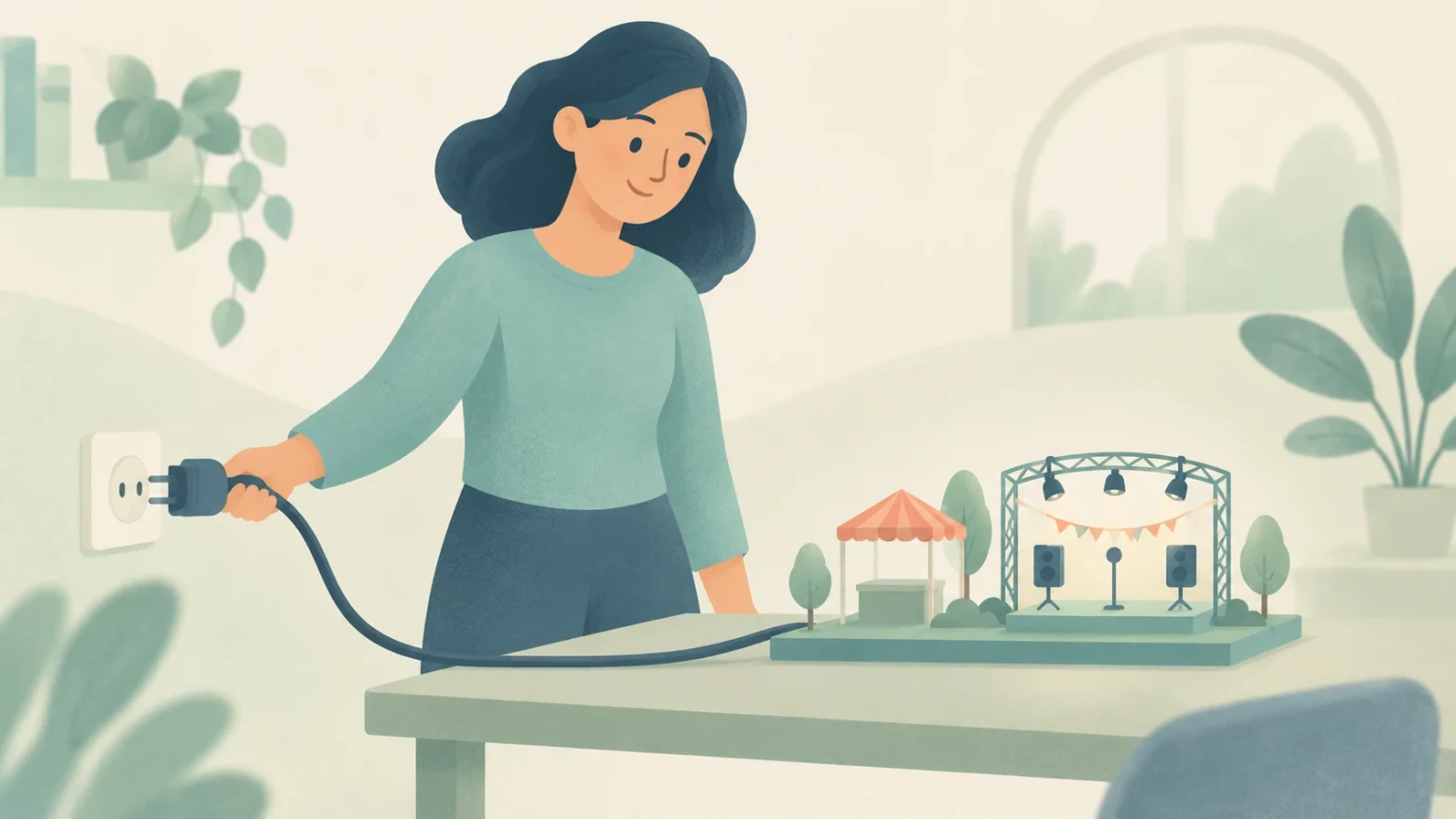
When an ongoing project, event, or service cannot continue, someone in charge must make the choice to stop it. In everyday English, speakers use the idiom 'pull the plug' to show that an active decision ended the process. The physical image comes from taking an electrical plug out of a wall socket so that electric current stops flowing and a machine shuts down. Figuratively, pulling the plug means deliberately withdrawing the support, money, or permission that keeps an activity going. You use this expression when an organizer or authority steps in and brings an operation to a full stop.
-
The school board decided to pull the plug on the late bus route.
Why it works: The board made an active choice to stop running the bus service.
-
Without a lead singer, the band had to pull the plug on the tour.
Why it works: Losing a key member forced the group to end their concert plans.
Your turn
What happens when an organizer pulls the plug on a project?
Answer: The organizer makes a deliberate decision to stop the project completely.
Show the answer
Answer: The organizer makes a deliberate decision to stop the project completely.
Pulling the plug means deliberately ending an activity rather than pausing it or handing it over.
Follow a decision to cancel a neighbourhood film night
Listen to this short dialogue between two residents discussing their neighborhood event: Maya: 'Are we still setting up the outdoor film night in the park this evening?' Sam: 'No, Elena had to pull the plug on the film night. The storm tore our only projection screen this morning, and the rental shops cannot deliver a backup before dark.' Maya: 'That makes sense. Without a screen, we cannot hold the event.' This exchange clearly establishes who makes the decision (Elena, the organizer), what ends (the neighborhood film night), and why (broken equipment that cannot be replaced in time).
-
Elena had to pull the plug on the film night because the screen was torn.
Why it works: Elena is the organizer who canceled the event due to broken equipment.
-
We were ready to set up chairs until Elena pulled the plug.
Why it works: The idiom stands alone here because both neighbors already know about the movie.
This also comes up in Project handover and Pull your weight.
Your turn
Why did the organizer pull the plug on the film night?
Answer: The screen was broken and no replacement was available.
Show the answer
Answer: The screen was broken and no replacement was available.
The event ended because the necessary equipment was damaged and could not be replaced.
Build the phrase with 'the plug on something'
To build this expression correctly, use the pattern 'someone pulls the plug on something'. The affected object can be an event, service, project, or plan. The article 'the' is fixed; never replace it with 'a'. Always follow the noun 'plug' with the preposition 'on', never 'of' or 'from'. If the topic was already mentioned, you can say 'pull the plug on it' or simply let 'pull the plug' stand alone. While speakers often pull the plug by withdrawing financial funding, loss of money is not required; withdrawing practical support, essential equipment, or official permission stops an activity just as effectively.
-
The council decided to pull the plug on the bus route.
Why it works: Use 'on' followed by a noun phrase for the canceled service.
-
The project lacked volunteers, so the director pulled the plug on it.
Why it works: The pronoun 'it' replaces the project without mentioning money.
-
We wanted to launch the app, but the manager pulled the plug.
Why it works: The idiom can stand alone when both speakers know the project.
Your turn
Which sentence uses the correct fixed pattern?
Answer: The city decided to pull the plug on the bike share program.
Show the answer
Answer: The city decided to pull the plug on the bike share program.
The fixed idiom uses the definite article 'the' and the preposition 'on'.
Change 'pull' to show when the decision happens
The word 'to' in our lesson title is simply an infinitive marker, not an obligatory part of every sentence. You do not keep 'to' when conjugating the verb in normal statements. Instead, the verb 'pull' inflects naturally across time into 'pull', 'pulls', 'pulled', and 'pulling'. You can also create questions such as 'Did they pull the plug?' or negatives like 'they didn't pull the plug'. Remember that hearing a question, a negative statement, or a proposed cancellation does not mean the activity actually ended; the project only stops when someone has taken the final step.
-
They may pull the plug on the experiment if results stay flat.
Why it works: Base form 'pull' after the modal auxiliary 'may'.
-
The council pulls the plug whenever a project exceeds budget.
Why it works: Third-person singular present form 'pulls'.
-
The director pulled the plug on the software project yesterday.
Why it works: Past simple form 'pulled' for a completed decision.
-
Management is pulling the plug on several underfunded initiatives.
Why it works: Present continuous form 'pulling' for an action underway.
-
Did the board pull the plug on the training program?
Why it works: Question with 'Did' using the base verb 'pull'.
-
They didn't pull the plug on the clinic, so it remains open.
Why it works: Negative with 'didn't pull the plug' showing the activity continues.
Your turn
What does the sentence 'The university didn't pull the plug on the language lab' mean?
Answer: The university decided to keep the language lab open.
Show the answer
Answer: The university decided to keep the language lab open.
The negative auxiliary 'didn't' shows that the decision to stop the lab was not taken, so the lab continues.
Distinguish ending an activity from pausing it or leaving it
Learners sometimes confuse pulling the plug with pausing an activity, reaching a natural finish, or leaving a group. Pulling the plug means deliberately stopping an activity before it completes naturally. If organizers postpone a workshop or put an idea on the back burner (/idioms/on-the-back-burner/), they have only paused it. Similarly, if one member decides to jump ship (/idioms/to-jump-ship/), that individual departs, but the project may continue. While the decision to pull the plug can feel sudden, the phrase does not require an immediate shutdown; the planned end date might take effect weeks later.
-
We did not pull the plug on the class; we only postponed it for two weeks.
Why it works: A postponement is a temporary delay, so the idiom does not apply.
-
Marcus chose to jump ship, but the studio did not pull the plug on the film.
Why it works: One person departed (/idioms/to-jump-ship/), but the production continued.
Your turn
In which situation is 'pull the plug' used correctly?
Answer: The publisher completely canceled the magazine after circulation collapsed.
Show the answer
Answer: The publisher completely canceled the magazine after circulation collapsed.
Pulling the plug describes a deliberate cancellation, not a brief pause or an individual departure.
Choose between 'pull the plug' and a neutral alternative
The idiom 'pull the plug' carries emotional energy and sounds forceful. In everyday conversation and informal workplace chats, it effectively describes sudden or difficult cancellations. However, in formal corporate statements, public announcements, or client emails, neutral alternatives such as 'cancel the event', 'discontinue the program', or 'end the service' sound more professional. Additionally, speakers must handle the phrase with care because in medical contexts it can refer to discontinuing life-support equipment. Because of that sensitive association, keep the idiom away from healthcare settings and choose neutral language instead.
-
Informal: The boss pulled the plug on our internal newsletter.
Why it works: Casual workplace conversation comfortably accepts the idiomatic phrase.
-
Formal: The agency will discontinue the weekend shuttle service this autumn.
Why it works: A formal customer announcement prefers a neutral verb like 'discontinue'.
Your turn
Which sentence is most appropriate for a formal public notice on a hospital website?
Answer: The health board will discontinue Saturday clinic hours starting next month.
Show the answer
Answer: The health board will discontinue Saturday clinic hours starting next month.
Formal public notices call for neutral terms like 'discontinue' rather than idioms with forceful or sensitive associations.
Hear 'pull the plug on' as a connected phrase
When native speakers say 'pull the plug on', the words link smoothly together into a single rhythmic unit. Pronounce the base verb 'pull' as /pʊl/ with a short vowel, distinct from the longer sound in 'pool'. The noun 'plug' is pronounced /plʌɡ/ with a short central vowel /ʌ/. The definite article 'the' is weak and unstressed, pronounced /ðə/. In the past tense, 'pulled' ends in /d/, but when followed immediately by the /ð/ sound in 'the', that /d/ often softens or blends directly into the consonant. Notice also that the final /ɡ/ of 'plug' connects cleanly to the vowel in 'on' /ɒn/.
-
They will pull the plug on Monday.
Why it works: The base verb 'pull' /pʊl/ links cleanly to the unstressed article 'the' /ðə/.
-
We must pull the plug on this contract.
Why it works: The noun 'plug' /plʌɡ/ connects its final /ɡ/ directly to the vowel in 'on'.
Your turn
Why can the past tense 'pulled the' be difficult to hear clearly in fast speech?
Answer: The final /d/ sound softens before the /ð/ sound in 'the'.
Show the answer
Answer: The final /d/ sound softens before the /ð/ sound in 'the'.
The consonant boundary between /d/ and /ð/ blends smoothly in connected speech.
Recall the phrase and explain a new cancellation
Now practice recalling and using the idiom in new situations. Think about an organizer facing unexpected obstacles, such as broken equipment or lost funding, who must take the final step to stop an event. To communicate the decision clearly, name the person in charge, use the exact phrase 'pull the plug on', and specify the affected activity. Watch out for grammatical traps: always use the definite article 'the' instead of 'a', and use the preposition 'on' rather than 'of'. With these rules in mind, you can draft clear messages explaining any cancellation.
-
Because the heating failed, the gym had to pull the plug on the evening yoga class.
Why it works: This sentence clearly states the cause, the decision-maker, and the canceled class.
-
The committee pulled the plug on the book fair when rainy weather damaged the tents.
Why it works: A concrete physical reason explains why the committee stopped the event.
Your turn
Which sentence correctly corrects the mistake in 'The club pulled a plug of the race'?
Answer: The club pulled the plug on the race.
Show the answer
Answer: The club pulled the plug on the race.
You must replace 'a' with 'the' and replace 'of' with 'on'.
Other meanings of "to pull the plug"
This lesson practises one meaning. You may also hear these.
To discontinue life-support treatment in a medical situation.
The family discussed whether to withdraw life support.
Common mistakes with "to pull the plug"
What learners often say, what to say instead, and why.
-
Not this:
The sponsor pulled a plug on the exhibition.Say: The sponsor pulled the plug on the exhibition.
The fixed expression requires the definite article 'the', not 'a'.
-
Not this:
The council pulled the plug of the ferry service.Say: The council pulled the plug on the ferry service.
The idiom uses the preposition 'on', never 'of'.
-
Not this:
The manager pull the plug on the website last week.Say: The manager pulled the plug on the website last week.
Use the past-tense form 'pulled' for a completed decision.
-
Not this:
The board pulled on the plug on the scheme.Say: The board pulled the plug on the scheme.
The fixed expression is 'pull the plug on', without an extra 'on'.
Use it naturally
How people really use “pull the plug on”
Informal Relaxed; better with friends and colleagues than in formal writing.
Words it often goes with
- pull the plug on a projectInvestors sometimes pull the plug on a project when its costs become too high.
- pull the plug on a serviceA business may pull the plug on a service that few customers use.
- pull the plug on a campaignThe company might pull the plug on a campaign if it fails to attract customers.
What people also say
- “They pulled the plug on the project.” instead of “They made a decision to discontinue the project.” The idiom sounds more conversational and emphasizes a deliberate decision to stop.
Questions about "To pull the plug"
What does 'pull the plug' mean?
It means to deliberately stop an ongoing activity, plan, or project from continuing. The phrase suggests an intentional choice by an organizer or authority who removes needed support, permission, or resources.
The committee chose to pull the plug on the winter festival.
Do I say 'pull the plug on' or 'pull the plug of'?
Always say 'pull the plug on'. The preposition 'on' connects the idiom to the affected project or event. Saying 'pull the plug of' is a common learner error that native speakers avoid.
The city will pull the plug on the street market.
Do not say that they pulled the plug of the market.
Can I use it when no money is involved?
Yes, you can use the idiom even when finances are not the issue. A person or group can pull the plug because of damaged equipment, missing volunteers, bad weather, or lack of time.
The club pulled the plug on the hike when heavy fog rolled across the ridge.
Can I leave out the words after 'plug'?
Yes, you can end the sentence right after 'plug' if the listener already knows which activity you are discussing. In that case, you do not need to add 'on something'.
We wanted to keep printing the brochure, but our manager pulled the plug.
Does it mean stop completely or just pause?
It means to stop completely. Pulling the plug brings an activity to a permanent end. If you are only pausing an event or delaying it until later, use words like 'postpone', 'delay', or 'put on hold'.
They did not just pause the service; they pulled the plug completely.
Is 'pull the plug' OK in a work email?
It is common in informal or internal workplace emails between colleagues. However, in formal corporate messages to clients or executives, neutral terms like 'cancel', 'discontinue', or 'terminate' sound more professional.
Internal note: We may pull the plug on the beta trial next Friday.
Formal notice: We will discontinue the trial service next Friday.
Before you go
Remember this
Remember that 'pull the plug on' describes a deliberate choice to end an activity by removing support. Keep 'the' fixed, use 'on' before the affected activity, and conjugate the verb 'pull' according to your timeframe.
Stage 2 of 5
Listen
Hear it in real sentences, from short to long, and write what you hear.
0 of 4 done
Listening 1 of 4
Listen, then type what you hear. Replay as often as you need.
0:00
- If we do not find a volunteer driver, we may have to pull the plug on the delivery service.
- The team wanted to launch the app, but the director pulled the plug at the last minute.
Read the transcript
The council will pull the plug on our community garden.
'Pull the plug on' shows that the council plans to stop supporting the garden.
Listen for
At natural speed these words change shape. Tap one to hear it again.
- listen for "plu-gon": the g in "plug" links to "on".
- listen for "o-nour": "on our" flows together, with the n joining the next vowel.
- In American English this t sounds like a quick, soft d.
Listen for
At natural speed these words change shape. Tap one to hear it again.
- listen for "plu-gon": the g in "plug" links to "on".
- listen for "o-nour": "on our" flows together, with the n joining the next vowel.
Listen for
At natural speed these words change shape. Tap one to hear it again.
- listen for "plu-gon": the g in "plug" links to "on".
- listen for "o-nour": "on our" flows together, with the n joining the next vowel.
- In American English this t sounds like a quick, soft d.
Listening 2 of 4
Listen, then type what you hear. Replay as often as you need.
0:00
- If we do not find a volunteer driver, we may have to pull the plug on the delivery service.
- The team wanted to launch the app, but the director pulled the plug at the last minute.
Read the transcript
Our music teacher must pull the plug on choir practice.
'Must pull the plug on' indicates a necessary decision to end choir practice.
Listen for
At natural speed these words change shape. Tap one to hear it again.
- listen for "plu-gon": there is no pause between "plug" and "on".
- listen for "mus(t) pull": the t may disappear as the speaker moves into "pull".
Listen for
At natural speed these words change shape. Tap one to hear it again.
- listen for "plu-gon": there is no pause between "plug" and "on".
- listen for "mus(t) pull": the t may disappear as the speaker moves into "pull".
Listen for
At natural speed these words change shape. Tap one to hear it again.
- listen for "plu-gon": there is no pause between "plug" and "on".
- listen for "mus(t) pull": the t may disappear as the speaker moves into "pull".
Try a longer clip. Listen once, then replay the part you missed.
Listening 3 of 4
Listen, then type what you hear. Replay as often as you need.
0:00
- If we do not find a volunteer driver, we may have to pull the plug on the delivery service.
- The team wanted to launch the app, but the director pulled the plug at the last minute.
Read the transcript
The company will pull the plug on our shuttle bus because fuel prices are rising quickly. Workers can take the city train until we discover a cheaper travel option.
The supervisor explains that high fuel costs forced the company to cancel the shuttle service.
Listen for
At natural speed these words change shape. Tap one to hear it again.
- listen for "plu-gon": "plug" connects smoothly to "on".
- listen for "o-nour": the n in "on" connects directly to "our".
- The last sound of the first word runs straight into the next word.
Listen for
At natural speed these words change shape. Tap one to hear it again.
- listen for "plu-gon": "plug" connects smoothly to "on".
- listen for "o-nour": the n in "on" connects directly to "our".
- The last sound of the first word runs straight into the next word.
Listen for
At natural speed these words change shape. Tap one to hear it again.
- listen for "plu-gon": "plug" connects smoothly to "on".
- listen for "o-nour": the n in "on" connects directly to "our".
- The last sound of the first word runs straight into the next word.
This clip is longer. Follow the instruction above the answer field.
Listening 4 of 4
Listen, then type the missing words. The rest of the text is already there.
0:00
- If we do not find a volunteer driver, we may have to pull the plug on the delivery service.
- The team wanted to launch the app, but the director pulled the plug at the last minute.
Read the transcript
The village committee says we should pull the plug on the annual baking competition. Three oven stoves broke yesterday, and repair technicians cannot arrive before Saturday morning. Baking eighty cakes in the small school kitchen is impossible without proper heat. We will organize an outdoor fruit market instead so that local bakers can still display their fresh produce.
The passage explains the cancellation of the baking competition due to broken ovens and offers an outdoor market instead.
Listen for
At natural speed these words change shape. Tap one to hear it again.
- The last sound of the first word runs straight into the next word.
- The last sound of the first word runs straight into the next word.
- The last sound of the first word runs straight into the next word.
Listen for
At natural speed these words change shape. Tap one to hear it again.
- listen for "plu-gon": the final g in "plug" joins directly to "on".
- The last sound of the first word runs straight into the next word.
- The last sound of the first word runs straight into the next word.
Listen for
At natural speed these words change shape. Tap one to hear it again.
- listen for "plu-gon": the final g in "plug" joins directly to "on".
- The last sound of the first word runs straight into the next word.
- The last sound of the first word runs straight into the next word.
Practice complete
You listened closely.
Your result is saved in this browser.
Keep your progress. Your practice is saved on this device only. Create a free account to keep it everywhere.
Create a free accountThat was today's free lesson. Tomorrow you get another one. Want more today? See membership.
Create a free SubLearn account to keep this progress across devices.
Save my progressStage 3 of 5
Speak
Say it with the speaker, then use it in your own answer.
Shadow
Say it along with the speaker
The council will pull the plug on our community garden.
Play the line slowly, then speak at the same time as the speaker. Copy the rhythm, not just the words.
Your turn
Say it your way
Speak for 30 to 60 seconds from memory. Your favorite podcast host has ended a paid weekly show. Tell a friend why the host decided to pull the plug on it, how you feel as a subscriber, and what you will listen to next.
Use: pull the plug on pulled the plug
Think for ten seconds, then answer out loud for as long as the task above asks, without looking at the lesson. Nothing is sent unless you ask for feedback.
0:00
Hear how someone else might say it
My favorite podcast host decided to pull the plug on her weekly history show. She explained that subscriptions no longer covered the cost of research and recording. She had tried shorter episodes, but that did not solve the problem, so she finally pulled the plug last week. I understand her decision, although I will miss listening on my way to work. Her stories always gave me something interesting to talk about. Next, I will try a free science podcast that my sister recommended. I might also listen to some old episodes again.
Try once more and answer this: What will you miss most about the show?
Stage 4 of 5
Write
Write about your own day or week using it, then write a message.
Write
Put it in your own words
- I used “pull the plug on”.
- It is about my life, not the lesson’s example.
- I read it once aloud to check it sounds right.
Write your own response
Choose a situation and write 30–50 words in your own wording. This is separate from typing the exact words in a recording.
Check your own writing
Read one possible response
Use these checks to revise your message. Grammar and meaning are not automatically graded. Each task keeps its own draft in this browser tab.

You finished the free part of this lesson
- Understand
- Listen
- Speak
- Write
- CheckPart of membership
Worth another look
With a free account, the lessons you finish come back for review to help you remember them.Create a free account
Stage 5 of 5 · Part of membership
Check
New clips without hints.
Listening tests are included with membership. Try the free dictation first, then decide whether to continue.
Listening 1 of 2 Part of membership
Listening 2 of 2 Part of membership
Follow MicroEnglish
New lessons, short videos and quick quizzes every day. Pick the app you already use.
Questions & comments
Ask about this lesson, share an example, or help another learner.
Example
Memory tip
Goes with
Related forms
Not to be confused with
In this lesson
This word isn't in our dictionary. Check the spelling, or try another form of the word.
We couldn't load this word. Try again.