Idiom
Grey area
Should I write 'grey area' with an 'e' or 'gray area' with an 'a'?
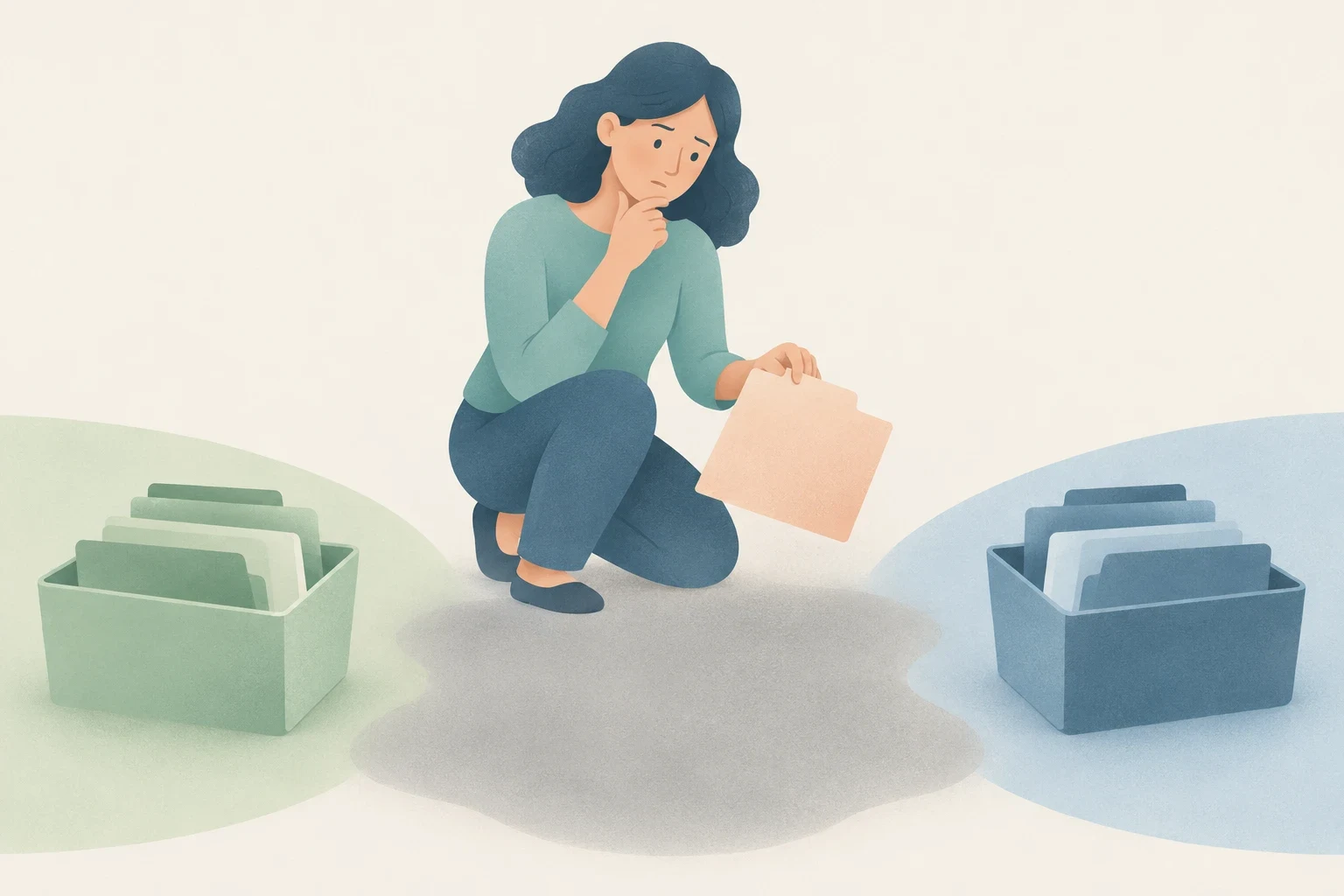
A grey area is an unclear situation where existing guidelines, laws, or moral standards do not provide an obvious answer. It sits between two definite categories, making a straightforward decision difficult.
Key points
- Use 'a grey area' with an indefinite article for one ambiguous topic, and use the plural 'grey areas' for several.
- Pair the phrase with adjectives like 'legal' or 'ethical' to specify the source of confusion.
- Treat the phrase as a countable noun phrase.
This lesson has 5 stages. You can stop at any time and continue later.

Stage 1 of 5
Understand
What it means, when to use it, and mistakes to avoid.
Examples
Using company equipment for personal projects over the weekend remains a grey area.
Why it works: The singular phrase 'a grey area' follows the linking verb 'remains' to show that workplace guidelines do not settle this matter.
2 more examples
-
Our compliance team identified several grey areas in the draft partnership agreement.
The plural form 'grey areas' combines with 'several' to describe multiple points of uncertainty in the document.
-
Online creators often operate in a legal grey area regarding fair use of digital images.
The adjective 'legal' defines the category of doubt, while the preposition 'in' describes the status of the creators.
Read the full guide
Deciding when a situation qualifies as a grey area
Deciding whether to use the phrase depends on whether existing rules offer an obvious yes or no answer. If a company rule explicitly bans personal phone calls during shifts, that rule is clear. However, if the rule allows urgent family calls without defining what counts as urgent, you encounter a situation that lacks boundaries. You use this expression specifically when instructions, standards, or boundaries leave room for doubt and interpretation.
-
Borrowing office supplies for a remote volunteer project falls into a grey area.
Why it works: The employee uses the phrase because written office policies do not clearly permit or forbid the action.
Your turn
Which situation is best described as a grey area?
Answer: A policy that permits reasonable personal use of company laptops without defining what counts as reasonable.
Show the answer
Answer: A policy that permits reasonable personal use of company laptops without defining what counts as reasonable.
A grey area involves genuine uncertainty where definitions or rules are incomplete, unlike explicit deadlines or clear speed limits.
Choosing between singular and plural forms
Grammatically, the word area is a countable noun, which means the idiom requires standard countable noun markers. You must include an article or determiner when referring to one unclear point, saying a grey area, this grey area, or that grey area. Leaving out the article produces ungrammatical phrasing. When an agreement or set of instructions contains multiple points of ambiguity, make the noun plural by adding an s to form grey areas.
-
The new safety manual still contains a few grey areas regarding chemical storage.
Why it works: The plural form 'grey areas' follows 'a few' because multiple sections in the manual lack clarity.
This also comes up in Up in the air and One-off.
Your turn
Which sentence uses the correct grammatical form for a single unclear topic?
Answer: The new attendance rule falls into a grey area.
Show the answer
Answer: The new attendance rule falls into a grey area.
Because 'area' is countable, a singular reference must include an article such as 'a'.
Selecting the correct preposition with grey area
Natural English relies on specific prepositions when connecting this idiom to verbs and clauses. Speakers use in to describe an ongoing condition or environment, saying that someone works or operates in a grey area. When describing an event or action that transitions into uncertainty, the preposition into pairs with verbs such as fall or move. When discussing the subject matter surrounding the confusion, around or regarding works best.
-
Freelance designers often operate in a grey area until local tax laws catch up.
Why it works: The preposition 'in' indicates the general status or context within which the designers conduct business.
Your turn
Which preposition naturally describes an action moving into an uncertain category?
Answer: The recent policy change pushes our marketing strategy into a grey area.
Show the answer
Answer: The recent policy change pushes our marketing strategy into a grey area.
Verbs expressing movement or change of category pair with 'into' when approaching a grey area.
Specifying the type of uncertainty with adjectives
While the noun phrase alone conveys ambiguity, adding a descriptive adjective before grey clarifies why the situation is hard to resolve. Professionals frequently refer to a legal grey area when statutes are silent, or an ethical grey area when personal values conflict with corporate expectations. You might also encounter regulatory or jurisdictional grey areas in public administration. Placing the modifier directly before the phrase creates concise, professional descriptions.
-
Accepting dinner invitations from potential vendors remains an ethical grey area.
Why it works: The adjective 'ethical' specifies that the difficulty concerns moral propriety rather than strict statutory law.
Your turn
How should you modify the phrase to show that unclear laws cause the problem?
Answer: Call it a legal grey area.
Show the answer
Answer: Call it a legal grey area.
Standard word order places the descriptive adjective directly before 'grey area'.
Distinguishing grey areas from loopholes and rule breaking
Learners sometimes confuse a grey area with a loophole or intentional wrongdoing. A loophole is a technical flaw in a written rule that allows someone to avoid an obligation legally. In contrast, a grey area represents a genuine lack of information or clarity where no definitive path has been established. Furthermore, existing in a grey area does not grant permission to act; it merely signals that the outcome remains unpredictable.
-
Finding a tax loophole saved the company money, but operating in an offshore grey area created new risks.
Why it works: The sentence contrasts an explicit technical exception with an unmapped, uncertain status.
Your turn
What is the difference between a loophole and a grey area?
Answer: A loophole is a gap someone may exploit, while a grey area has unclear boundaries.
Show the answer
Answer: A loophole is a gap someone may exploit, while a grey area has unclear boundaries.
Loophole emphasizes a gap or weakness that may be used to avoid a rule. Grey area emphasizes uncertainty. Neither expression establishes legal permission.
Recognizing the phrase in connected speech
In natural spoken English, fluent speakers link the vowel sounds between grey and area without pausing. The diphthong at the end of grey glides smoothly into the initial vowel of area, often producing a subtle transitional sound similar to a soft y sound. Additionally, speakers place primary sentence stress on the first syllable of area rather than on grey. Listening for this melodic rhythm helps you identify the phrase even when spoken rapidly in meetings.
-
Managers usually pause briefly before explaining that an expense report sits in a grey area.
Why it works: The vowel glide between 'grey' and 'area' occurs smoothly in spoken conversation without an abrupt stop.
Your turn
Where does primary stress typically fall in natural speech?
Answer: On the first syllable of 'area'.
Show the answer
Answer: On the first syllable of 'area'.
In connected speech, the first syllable of 'area' receives the dominant pitch and stress.
Avoiding common grammatical and vocabulary errors
Two common mistakes frequently appear in student writing and speech. The first mistake is omitting the indefinite article, producing incorrect phrases like this is grey area. Always remember that area is countable and requires an article in the singular. The second mistake is confusing British and American spelling conventions. While grey is standard in the United Kingdom and gray dominates in the United States, both spellings represent the exact same concept and pronunciation.
-
The committee agreed that copyright ownership for computer generated art is a gray area.
Why it works: Using the American spelling 'gray' remains fully acceptable and preserves identical meaning.
Your turn
Which of the following sentences contains an error?
Answer: Our department discovered that overtime compensation is grey area.
Show the answer
Answer: Our department discovered that overtime compensation is grey area.
Omitting the article 'a' before singular 'grey area' violates standard English countable noun rules.
Communicating uncertainty tactfully in professional communication
In business settings, declaring that something is simply right or wrong can sound aggressive or inaccurate when the facts remain unsettled. Using the phrase grey area allows you to acknowledge complexity respectfully without sounding dismissive. When presenting a proposal, you can identify uncertain elements directly, which invites constructive dialogue and encourages managers to seek official policy updates. Stating uncertainty clearly builds professional credibility and prevents costly misunderstandings.
-
Before we sign the vendor agreement, we should consult legal counsel regarding this grey area.
Why it works: The speaker uses the phrase constructively to recommend practical due diligence rather than assigning blame.
Your turn
Why is 'grey area' useful in business communication?
Answer: It describes ambiguity diplomatically without making premature conclusions.
Show the answer
Answer: It describes ambiguity diplomatically without making premature conclusions.
The phrase provides a calm, neutral way to frame an unresolved problem so colleagues can seek guidance.
Use it naturally
How people really use “grey area”
Neutral Fine almost anywhere, at work or with friends.
Words it often goes with
- legal grey areaThe use of those old recordings falls into a legal grey area.
- ethical grey areaAccepting an expensive gift from a customer can create an ethical grey area.
- fall into a grey areaSome shared household expenses fall into a grey area between personal costs and joint costs.
- remains a grey areaWhether guests can use the pool after checkout remains a grey area.
What people also say
- “It's a grey area.” instead of “It is a situation with unclear categories.” Use this short expression when the context already explains the uncertainty.
Questions about "Grey area"
Should I write 'grey area' with an 'e' or 'gray area' with an 'a'?
Both spellings are correct and have identical meanings. 'Grey' is standard in British, Australian, and international English, while 'gray' is the preferred spelling in the United States. Choose the variant that matches the spelling conventions of your organization or target audience, and remain consistent throughout your writing.
British publications usually write that tax compliance sits in a grey area.
American business contracts frequently refer to a regulatory gray area.
Is a grey area the same thing as a loophole?
A loophole is a gap or weakness in a rule that someone may use to avoid a restriction or obligation. A grey area is a situation whose boundaries or rules are unclear. Calling something a loophole does not prove that a particular action is lawful. The expressions can overlap in a discussion, but they emphasize different things.
The accountant exploited a tax loophole to lower the company bill.
Using personal phones during quiet shifts falls into a grey area because no policy addresses it.
Can I use 'grey zone' instead of 'grey area'?
Yes, but 'grey zone' often carries a more strategic, political, or military connotation, such as conflict that falls between peace and open war. In standard workplace, legal, and everyday discussions, 'grey area' is by far the more common and natural idiomatic expression.
Security analysts often study conflicts that occur in the grey zone between peace and war.
For everyday office policies, employees prefer to discuss a grey area.
Why is it incorrect to say 'this topic is grey area' without 'a'?
Because the noun 'area' is countable in English, singular instances must be preceded by a determiner or article, such as 'a', 'this', or 'the'. Saying 'is grey area' treats the phrase as an uncountable noun or adjective, which violates standard grammar rules.
Copyright ownership for artificial intelligence art is a grey area.
Several grey areas remain in the draft agreement.
Before you go
Remember this
Use 'a grey area' with an indefinite article for one ambiguous topic, and use the plural 'grey areas' for several. Pair the phrase with adjectives like 'legal' or 'ethical' to specify the source of confusion.
Stage 2 of 5
Listen
Hear it in real sentences, from short to long, and write what you hear.
0 of 4 done
Listening 1 of 4
Listen, then type what you hear. Replay as often as you need.
0:00
- Our compliance team identified several grey areas in the draft partnership agreement.
- Online creators often operate in a legal grey area regarding fair use of digital images.
Listening 2 of 4
Listen, then type what you hear. Replay as often as you need.
0:00
- Our compliance team identified several grey areas in the draft partnership agreement.
- Online creators often operate in a legal grey area regarding fair use of digital images.
Try a longer clip. Listen once, then replay the part you missed.
Listening 3 of 4
Listen, then type what you hear. Replay as often as you need.
0:00
- Our compliance team identified several grey areas in the draft partnership agreement.
- Online creators often operate in a legal grey area regarding fair use of digital images.
This clip is longer. Follow the instruction above the answer field.
Listening 4 of 4
Listen, then type the missing words. The rest of the text is already there.
0:00
- Our compliance team identified several grey areas in the draft partnership agreement.
- Online creators often operate in a legal grey area regarding fair use of digital images.
Practice complete
You listened closely.
Your result is saved in this browser.
Keep your progress. Your practice is saved on this device only. Create a free account to keep it everywhere.
Create a free accountThat was today's free lesson. Tomorrow you get another one. Want more today? See membership.
Create a free SubLearn account to keep this progress across devices.
Save my progressStage 3 of 5
Speak
Say it with the speaker, then use it in your own answer.
Shadow
Say it along with the speaker
Play the line slowly, then speak at the same time as the speaker. Copy the rhythm, not just the words.
Your turn
Say it your way
Speak for 30 to 60 seconds from memory. You and your sister are making a family recipe book. Decide where to put sweet dishes that could be either breakfast or dessert. Explain one difficult choice and suggest a way to organize the book.
Use: grey area
Take ten seconds to think, then answer out loud without looking at the lesson. Speak for the time shown in the task above. Nothing is sent unless you ask for feedback.
0:00
Hear how someone else might say it
My sister and I are putting together a family recipe book, and banana pancakes are a grey area. We usually eat them for breakfast, but our grandmother serves them with ice cream after dinner. I think the category depends on how you serve the dish, rather than the ingredients alone. My sister wants every recipe to appear in only one section. I'd put the pancakes under breakfast and add a short note in the dessert section. That way, readers could find them easily without us repeating the whole recipe.
Try once more and answer this: Which dish was the hardest to put in a category?
Stage 4 of 5
Write
Write your own response
AI feedback · it can make mistakes · Part of membership See membership
Check your own writing
Read one possible response
Draft saved on this device.
Use these checks to revise your message. Grammar and meaning are not automatically graded. Each task keeps its own draft in this browser tab.

You finished the free part of this lesson
- Understand
- Listen
- Speak
- Write
- CheckPart of membership
Worth another look
With a free account, the lessons you finish come back for review to help you remember them.Create a free account
Stage 5 of 5 · Part of membership
Check
New clips without hints.
Listening tests are included with membership. Try the free dictation first, then decide whether to continue.
Listening 1 of 2 Part of membership
Listening 2 of 2 Part of membership
Follow MicroEnglish
Find lesson updates, short videos and quick quizzes. Pick the app you already use.
Questions & comments
Ask about this lesson, share an example, or help another learner.
Example
Memory tip
Goes with
Related forms
Not to be confused with
In this lesson
This word isn't in our dictionary. Check the spelling, or try another form of the word.
We couldn't load this word. Try again.
