Finde deine nächste Lektion
Suche nach einem Ausdruck oder beschreibe, was du sagen möchtest. Wähle eine der derzeit verfügbaren Lektionen.
Lektionen 19 bis 36 von 39
Filter zurücksetzen-
English grammar: choose your lesson
English grammar describes predictable patterns words follow to express time, relationships, questions, and descriptions. Choosing a topic begins by identifying what you want to communicate.
-

Regular and irregular verbs: How past forms change
Regular past verbs use the suffix -ed or -d to express completed actions in past time. Irregular past verbs express past time through specific vowel or consonant changes, or by keeping an identical base form, rather than taking the regular suffix.
-
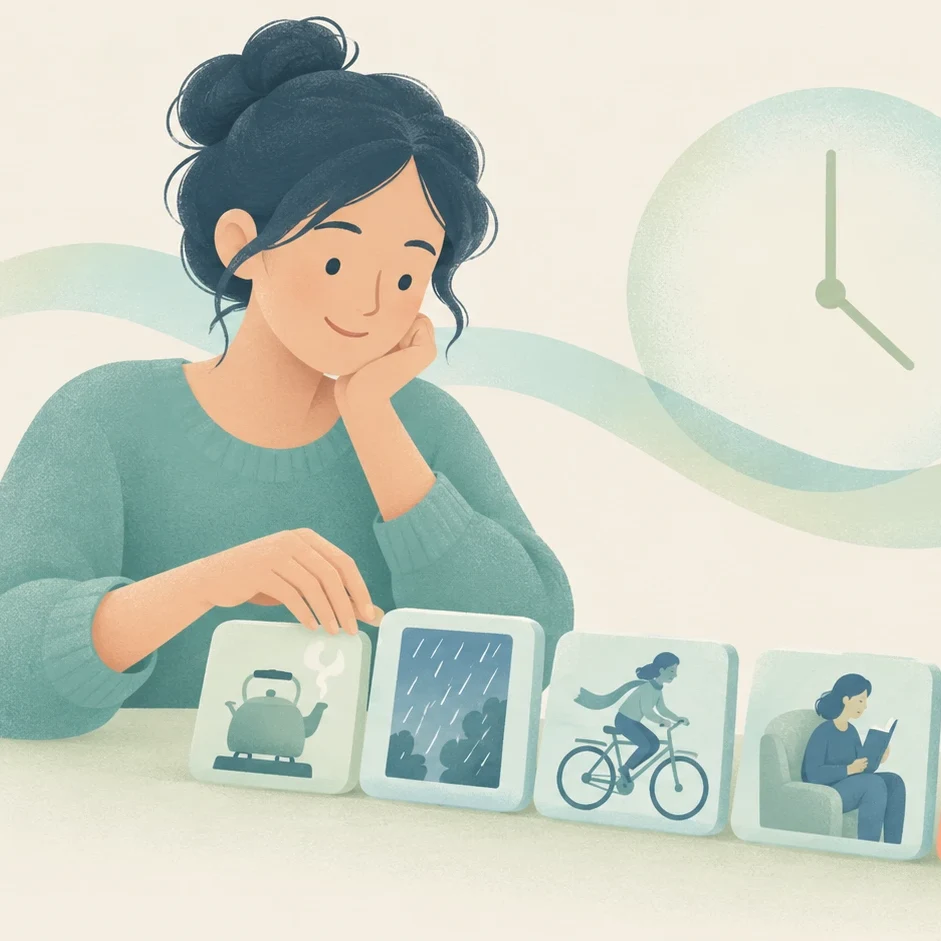
Past continuous: talking about past actions
The past continuous presents an activity as in progress at a specific past moment. It views an action from the inside as ongoing, without stating when it started or whether anyone completed it. It frequently supplies the background scene for a completed event or links two activities that were unfolding at the same time.
-

Bought or brought? Getting ready for a games night
Bought describes getting something by paying for it. It is the past form of buy. Brought describes bringing someone or something to a place. It is the past form of bring. The same object can appear with either verb: you bought a game yesterday and brought it here today.
-
Full stops: when to use them
A full stop marks the completion of an informative statement or an ordinary instruction. It tells the reader that one complete thought has finished so they can understand each action before moving to the next sentence.
-

Why English Class Matters: Practical Adult Skills
An English class is like a practical workshop. In class, you try out simple tools and see what works best. Reading exercises teach you to find facts quickly. Speaking tasks help you turn your thoughts into simple, clear sentences. Writing lessons show you how to name the person doing each action. Helpful feedback from your teacher shows you what to change next.
-
Mitgliedschaft
7 Tage kostenlos auf alle Lektionen zugreifen
- 570 Lektionen mit Diktaten und Hörtests
- Drei Akzente: britisch, amerikanisch und australisch
- Täglich neue Lektionen mit gespeichertem Lernfortschritt
Keine Karte erforderlich. Wer danach weiterlernen möchte, kann ab $7.50 pro Monat eine Mitgliedschaft wählen.
Kostenlos testen -

Practice speaking English: Ten simple steps
Speaking practice means producing audible English to express a thought, give instructions, or answer a question. Listening and reading build comprehension, but speaking demands that you organize words, control grammar, and produce sounds in real time.
-

Adverbs: Add Information to Actions
An adverb provides extra information about an action, an adjective, or another adverb. It answers five common questions: how, where, when, how often, or how much. While adjectives describe nouns, adverbs describe actions and qualities.
-

Simple Past Tense: Actions and Past States
The simple past places events and conditions in finished time before the present moment. You use it for single completed actions, ordered steps, or conditions that existed in the past. It shows that the action finished at a specific time, even when that time is understood from context rather than stated directly.
-

To, Too or Two: How to Choose
The word to points toward a destination or a receiver, and it connects a main verb to a base verb. The word too means also, or it shows that a quantity or quality exceeds what is suitable. The word two represents the count 2.
-

English exercises: choose what to practice
A targeted English exercise focuses on one clear language choice, such as dropping a silent letter before -ing, selecting singular or plural agreement for a group noun, or identifying the correct soundalike word through sentence meaning.
-

Dairy or Diary: How to Choose
Dairy names milk and food items made from milk, such as yogurt, butter, and cheese. It can also describe a business that bottles milk. A diary is a private book or digital record where you record daily events, personal thoughts, or schedule commitments.
-

A, an, and the: clear everyday rules
Articles indicate how familiar an item is to your listener. Use a or an when introducing an unspecified singular countable noun that your listener cannot identify yet. Use the when both of you can pinpoint the exact item, group, or amount through shared context, previous mention, or a clear description. Omit articles entirely when making broad statements about plural or uncountable nouns, or when requesting unspecified amounts.
-

John and I or John and me: Which Pronoun Fits?
The pronoun 'I' works as a subject. It names who carries out an action or who is described by the verb, whether alone or with someone else. The pronoun 'me' works as an object. It names who receives an action, who receives an item, or who follows a preposition such as 'for' or 'with'. When you link John to yourself with 'and', the pair functions as a single grammatical unit in the sentence.
-

English Adjectives: Describe People and Things
An adjective gives information about a noun or pronoun. It describes qualities such as size, age, color, condition, or emotion, showing which person or object you mean and what that person or object is like.
-

Then or Than: Choose the Right Word
Use then to show sequence, a specific point in time, or a consequence following a condition. Use than to introduce the second element in a comparison of size, price, speed, quality, or amount.
-

Where, Were, or Wear: Choosing the Right Word by Meaning
Where asks about or names a location. Were connects a plural subject or you to past facts, locations, and descriptions. Wear describes having clothing, footwear, or accessories on your body.
-

Choose I, me, my, or mine when sharing plans
A pronoun can replace a name or a thing already understood. Subject forms such as she name who does an action. Object forms such as her name who receives it. Ownership forms show who something belongs to.
Noch kein Probeabo? Erhalte täglich eine kostenlose Lektion
7 Tage lang kommt jeden Tag ein kurzes Diktat per E-Mail. Übe, wo du gerade bist. Du brauchst kein Konto.
Du findest den gesuchten Ausdruck oder die passende Situation nicht?
Lektionsanfragen sind in der Mitgliedschaft enthalten.
Mitgliedschaft ansehen