Micro-listening
John and I or John and me: Which Pronoun Fits?
Is 'me and John' always wrong?
The pronoun 'I' works as a subject. It names who carries out an action or who is described by the verb, whether alone or with someone else. The pronoun 'me' works as an object. It names who receives an action, who receives an item, or who follows a preposition such as 'for' or 'with'.
Key points
- When you link John to yourself with 'and', the pair functions as a single grammatical unit in the sentence.
- Look at the job of the whole pair in your sentence.
- If the pair acts or is described, use 'John and I'.
This lesson has 5 stages. You can stop at any time and continue later.

Stage 1 of 5
Understand
What it means, when to use it, and mistakes to avoid.
Examples
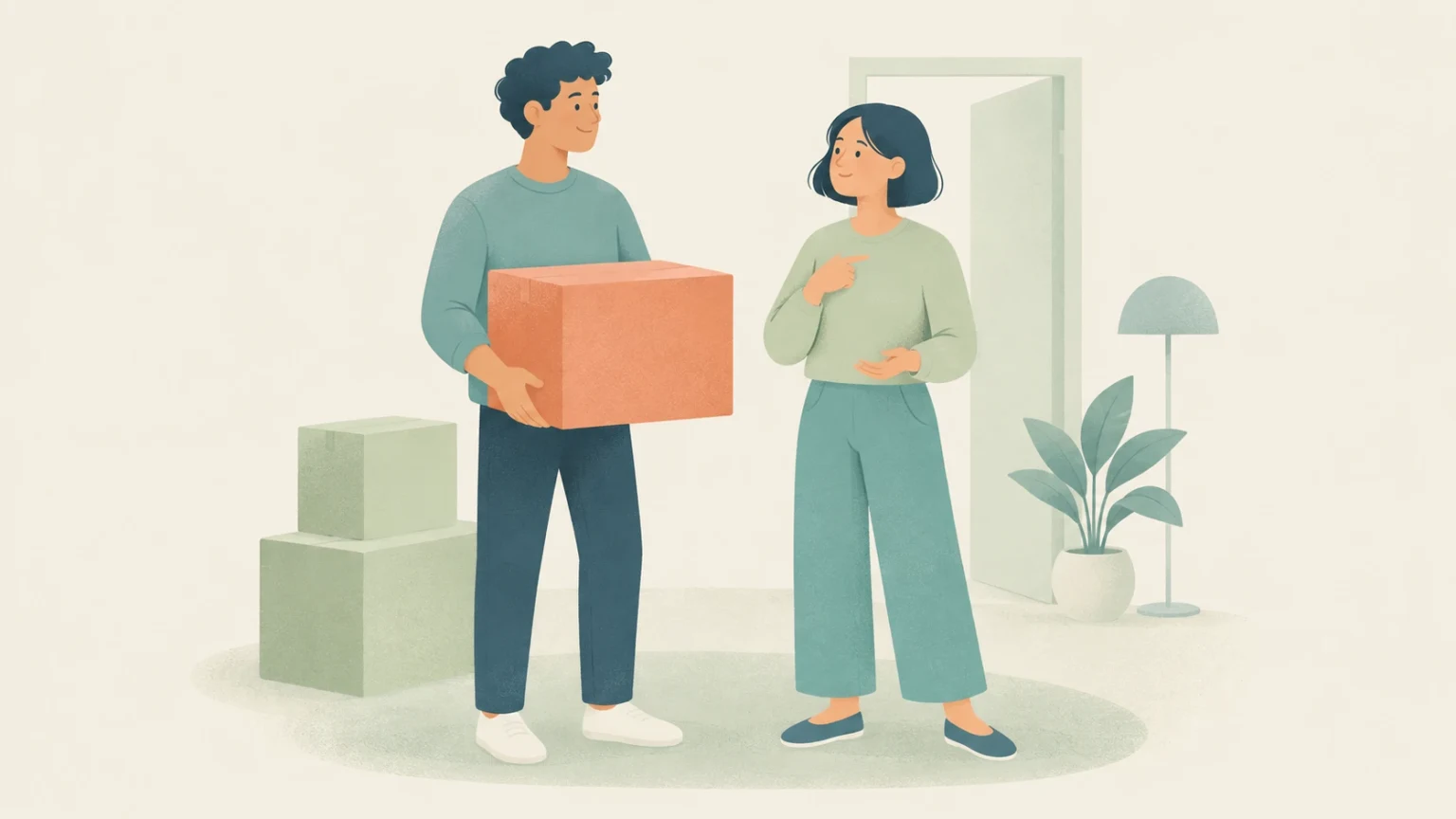
John and I are carrying the heavy boxes up the stairs.
Why it works: The pair performs the action of carrying, so the subject pronoun 'I' is correct.
2 more examples
-
Our new neighbour brought John and me a pot of tea.
The neighbour performs the action and the pair receives the tea, so the object pronoun 'me' is correct.
-
The landlord left an extra key for John and me on the counter.
The pair follows the preposition 'for', which requires the object pronoun 'me'.
Read the full guide
Decide Who Acts or Gets Described
When John and you carry out an action, the pair is the grammatical subject of the sentence. A subject also names who is described by a state of being. You use the subject pronoun 'I' in both situations. For example, you say 'John and I can carry the sofa' when you lift furniture together. You also say 'John and I are busy' when describing your current condition. Linking a name with 'and' never turns a subject into an object.
-
John and I can carry the sofa into the living room.
Why it works: The pair does the physical work, so 'I' is the required subject pronoun.
-
John and I are ready to unpack the kitchen supplies.
Why it works: The verb 'are' describes the condition of the pair, so the subject form 'I' is required.
Your turn
Which sentence correctly describes the two people moving furniture into the flat?
Answer: John and I can carry the bookcase upstairs.
Show the answer
Answer: John and I can carry the bookcase upstairs.
The pair performs the action of carrying, so standard English requires the subject pronoun 'I'.
Identify When Someone Helps or Contacts the Pair
When someone else performs the action toward the pair, John and you receive that action as objects. You also use the object form when someone gives an item directly to both of you. In standard English, the object pronoun for yourself is 'me'. Therefore, you say 'Can you help John and me?' rather than using 'I'. Similarly, when a landlord hands over keys, you say 'Give John and me a key'. The pronoun 'me' correctly marks the receiver of the action.
-
The removal driver called John and me early this morning.
Why it works: The driver acts on the pair by calling them, so the object pronoun 'me' is correct.
-
Our neighbour gave John and me a warm welcome to the building.
Why it works: The pair receives the greeting from the neighbour, making 'me' the appropriate pronoun.
You can practise this again in Much, many, or a lot of: which word fits? and Choose I, me, my, or mine when sharing plans.
Your turn
Which request correctly asks a helper for assistance with a heavy box?
Answer: Could you assist John and me with this heavy wardrobe?
Show the answer
Answer: Could you assist John and me with this heavy wardrobe?
The helper performs the assistance and the pair receives it, which requires the object pronoun 'me'.
Select Me After Common Prepositions
Prepositions are short connecting words that show direction, location, or relationship, such as 'with', 'for', 'to', and 'between'. In English, prepositions always govern object pronouns. You already know natural phrases such as 'with me', 'for me', and 'to me'. Adding John does not change that grammatical rule. You say 'with John and me' and 'for John and me'. The expression 'between John and me' also requires 'me' because 'between' is a preposition.
-
The building manager left a parcel for John and me.
Why it works: The preposition 'for' must be followed by an object pronoun, so 'me' is used.
-
Any private agreement stays between John and me.
Why it works: The word 'between' is a preposition, which requires the object form 'me'.
Your turn
Choose the correct phrase to complete: 'The caretaker walked up the stairs with ___.'
Answer: John and me
Show the answer
Answer: John and me
The preposition 'with' requires an object pronoun, making 'John and me' the correct standard choice.
Test the Pronoun by Removing the Name
To verify your pronoun choice in seconds, temporarily remove 'John and' from your sentence and read the remaining words. If the single pronoun sounds natural alone, that same pronoun belongs in the full pair. For example, 'Please help John and me' becomes 'Please help me', which proves that 'me' is correct. When checking sentences with the verb 'be', remember to adjust agreement. 'John and I are busy' becomes 'I am busy'. The pair takes 'are', while the single speaker takes 'am'. The following table outlines the three standard patterns: | Function | Full Sentence | Single-Person Check | Pronoun | |---|---|---|---| | Subject | John and I are ready | I am ready | I | | Verb Object | Call John and me later | Call me later | me | | Preposition Object | Bring lunch for John and me | Bring lunch for me | me |
-
John and I unpack boxes while the sun is still up.
Why it works: Removing 'John and' gives 'I unpack boxes', confirming that 'I' is the correct subject.
-
The painter showed John and me the new wall colour.
Why it works: Removing 'John and' gives 'The painter showed me', confirming that 'me' is the correct object.
Your turn
What is the single-person test sentence for 'The landlord gave John and me the lease'?
Answer: The landlord gave me the lease.
Show the answer
Answer: The landlord gave me the lease.
Removing 'John and' leaves 'The landlord gave me the lease', which shows that the object pronoun 'me' is correct.
Order Names Politely and Recognize Casual Speech
Placing another person's name before your own pronoun is a standard courtesy in English, but it does not determine grammar. Courtesy gives you the order 'John and I' or 'John and me', yet the sentence structure alone decides whether you need 'I' or 'me'. In casual conversation, native speakers frequently say 'me and John are ready'. You can recognize this common spoken phrase without adopting it in official emails, job applications, or academic reports. For professional communication, use 'John and I' for subjects.
-
John and I will sign the rental contract tomorrow morning.
Why it works: In professional correspondence, naming John first and using 'I' as the subject creates a polite, standard tone.
-
Me and John got some sandwiches from the corner shop.
Why it works: This phrasing is common in casual spoken conversation, but standard writing uses 'John and I'.
Your turn
Why is 'me and John are moving today' considered informal rather than standard written English?
Answer: Because standard writing uses the subject pronoun 'I' when the pair performs the action.
Show the answer
Answer: Because standard writing uses the subject pronoun 'I' when the pair performs the action.
Standard English requires the subject pronoun 'I' for actions, placing the other person first as 'John and I'.
Avoid Overcorrecting Me to I
Many English learners and native speakers mistakenly believe that 'John and I' is always more polite and correct than 'John and me'. This misconception leads people to write errors like 'for John and I' or 'between John and I'. Overcorrecting every pronoun to 'I' ignores the basic rule of prepositions and objects. Another frequent mistake is substituting 'myself' to appear elegant, as in 'Send the bill to John and myself'. Remember that 'myself' is only used when the speaker also did the action, like 'I cut myself'. Use 'me' after prepositions.
-
The cleaner left two fresh towels for John and me.
Why it works: Saying 'for John and I' is an overcorrection; the preposition 'for' requires 'me'.
-
You can send the delivery notice to John and me.
Why it works: Do not say 'to John and myself'; 'me' is the normal object pronoun after 'to'.
Your turn
Which sentence avoids the trap of false formality and overcorrection?
Answer: The electrician completed the repairs for John and me.
Show the answer
Answer: The electrician completed the repairs for John and me.
The preposition 'for' takes the object pronoun 'me'. Replacing 'me' with 'I' or 'myself' is an error.
Hear Pronouns in Moving-Day Speech
When people speak quickly, the word 'and' often weakens to a quick /ən/ or /n/ sound. You might hear 'John /ən/ I' or 'John /ən/ me'. However, the vowel in 'I' /aɪ/ and the vowel in 'me' /miː/ stay clear and distinct. Listen closely to whether the speaker makes the open /aɪ/ diphthong of 'I' or the long /iː/ vowel of 'me'. In our moving-day recordings, focus on this vowel sound right after John's name to identify the role in the sentence.
Worked moving-day dialogue: Caretaker: "Welcome to your new flat! Who needs a key for the front entrance?" Resident: "Please give John and me a key. John and I can carry the sofa and the heavy bookcase upstairs first." Caretaker: "The landlord left a spare key for you and John, so here it is. Can you manage the rest of the furniture?" Resident: "Yes, our neighbour offered to assist John and me later, but John and I can carry the wooden table ourselves."
-
John and I are lifting this table right now.
Why it works: The diphthong /aɪ/ is heard clearly before 'are', marking the subject of the clause.
-
Please pass John and me that roll of tape.
Why it works: The long vowel /iː/ sounds clearly after the weakened conjunction, marking the indirect object.
-
John and I can carry the sofa, so please give John and me a key.
Why it works: In our moving-day dialogue, the pair performs the carrying action as a subject but receives the key as an object.
Your turn
What phonetic difference helps you tell 'John and I' apart from 'John and me' when 'and' is reduced?
Answer: The pronoun keeps its distinct vowel sound, either /aɪ/ or /miː/.
Show the answer
Answer: The pronoun keeps its distinct vowel sound, either /aɪ/ or /miː/.
Even when 'and' reduces to /ən/, 'I' has an open diphthong /aɪ/ while 'me' has a high front vowel /miː/.
Write Moving-Day Messages and Test Your Memory
Now apply both patterns in a single message. Imagine you are moving into your new flat today. You want to tell a friendly neighbour what tasks you and John can manage yourselves, and what helpful item the neighbour could share with both of you. State what 'John and I' will do, and mention what can be brought 'for John and me'. Use the one-person drop test mentally before sending your text: 'I can carry' and 'Bring tea for me'. For related sentence structures about moving schedules, see /grammar/future-plans/, and practice connected reductions at /micro-listenings/1-2/. Use this check to review both pronouns.
-
John and I can carry our clothes, but please save some water for John and me.
Why it works: The first clause uses 'I' for the actors, and the second clause uses 'me' after the preposition 'for'.
-
Sarah and I can clean the hall, so leave the mop for Sarah and me.
Why it works: The same check applies with any name: 'I can clean' and 'leave the mop for me'.
Your turn
In the sentence 'Sarah and I can paint, but bring brushes for Sarah and ___', which pronoun completes the preposition phrase?
Answer: me
Show the answer
Answer: me
The preposition 'for' governs the pronoun, so 'for me' is correct. The full phrase is 'for Sarah and me'.
Use it naturally
How people really use “John and I”
Neutral Fine almost anywhere, at work or with friends.
Words it often goes with
- John and I areJohn and I are ready for lunch.
- for John and meAnna saved two seats for John and me.
- with John and meSam came to the museum with John and me.
Questions about "John and I or John and me: Which Pronoun Fits?"
Is 'me and John' always wrong?
No, 'me and John' is not always wrong, but its acceptability depends on grammar and social context. When used as an object, as in 'The driver drove me and John home', it is grammatically an object, though standard polite style prefers 'John and me'. In casual conversation, many native speakers say 'Me and John are ready' as a subject. While understood in informal speech, standard workplace and academic English requires 'John and I' for subjects.
The landlord met John and me outside the office.
In casual speech with close friends, someone might say that me and John bought pizza.
When should I say 'John and me' instead of 'John and I'?
Use 'John and me' whenever the pair receives an action from someone else or follows a preposition. When an action happens to both people, such as someone calling, helping, or inviting you, use 'John and me'. You also use 'John and me' after prepositions like 'to', 'for', 'with', 'from', and 'between'. If the pair is doing the action instead, use 'John and I'.
The removal company sent John and me an arrival notice.
Our neighbour baked these cookies for John and me.
How does taking John's name out help?
Removing John's name isolates the pronoun so you can test it alone against your existing language knowledge. Most learners instantly recognize that 'Please call I' sounds incorrect while 'Please call me' sounds natural. Because adding 'John and' does not change the grammatical job of the pronoun, whatever pronoun works alone is also correct for the pair.
Taking John out of 'The manager called John and me' leaves 'The manager called me'.
Taking John out of 'John and I carry the box' leaves 'I carry the box'.
Is it 'between John and I' or 'between John and me'?
The correct standard form is 'between John and me'. The word 'between' is a preposition, and in English, all prepositions require object pronouns. People sometimes say 'between John and I' because they have been taught that 'and I' sounds more polite, but that is a grammatical overcorrection. Always pair prepositions with 'me'.
This confidential agreement is strictly between John and me.
We divided the moving expenses evenly between John and me.
Does putting John first make the sentence more polite?
Yes, naming the other person first is an established courtesy in English conversation and formal writing. Saying 'John and I' or 'John and me' demonstrates politeness by acknowledging the other person before yourself. However, this courtesy is an etiquette preference, not a grammatical rule. Politeness alone does not make 'I' correct when the sentence actually requires the object pronoun 'me'.
Polite style places the other person first in 'John and I agreed to share the flat'.
Polite style also places the other person first in 'The landlord welcomed John and me'.
Can I use 'John and myself' to sound more formal?
No, you should avoid using 'John and myself' as a substitute for 'John and me' or 'John and I'. The pronoun 'myself' is a reflexive or emphatic pronoun, which should only be used when 'I' is already the subject of the same clause, as in 'I introduced myself'. Using 'myself' to sound formal in sentences like 'Contact John or myself' is a common error; simply say 'Contact John or me'.
Please direct any questions about the move to John and me.
I prepared the flat myself before John arrived.
Before you go
Remember this
Look at the job of the whole pair in your sentence. If the pair acts or is described, use 'John and I'. If someone acts on the pair or a preposition introduces it, use 'John and me'. Whenever you hesitate, remove 'John and' to hear the correct single pronoun.
Stage 2 of 5
Listen
Hear it in real sentences, from short to long, and write what you hear.
0 of 4 done
Listening 1 of 4
Listening 2 of 4
Try a longer clip. Listen once, then replay the part you missed.
Listening 3 of 4
This clip is longer. Follow the instruction above the answer field.
Listening 4 of 4
Listen, then type the missing words. The rest of the text is already there.
0:00
Practice complete
You listened closely.
Your result is saved in this browser.
Keep your progress. Your practice is saved on this device only. Create a free account to keep it everywhere.
Create a free accountThat was today's free lesson. Tomorrow you get another one. Want more today? See membership.
Create a free SubLearn account to keep this progress across devices.
Save my progressStage 3 of 5
Speak
Say it with the speaker, then use it in your own answer.
Shadow
Say it along with the speaker
Play the line slowly, then speak at the same time as the speaker. Copy the rhythm, not just the words.
Your turn
Say it your way
Speak for 30 to 60 seconds from memory about a day at a museum with John. Describe what you both do, what a guide shows you, and something a friend brings for you both.
Use: John and I John and me
Take ten seconds to think, then answer out loud without looking at the lesson. Speak for the time shown in the task above. Nothing is sent unless you ask for feedback.
0:00
Hear how someone else might say it
John and I are at a museum today. We want to learn about trains. First, we look at an old train near the door. A guide shows John and me some pictures of people who worked on it. We ask a few questions, and then we go inside the train. The seats are very small! At noon, our friend Anna brings sandwiches for John and me. We eat outside and talk about the morning. After lunch, we visit one more room before we go home.
Try once more and answer this: What was your favorite thing in the museum?
Stage 4 of 5
Write
Use what you've learned to write about your day or week, then write a message.
Write
Put it in your own words
- I used “John and I”.
- It is about my life, not the lesson’s example.
- I read it once aloud to check it sounds right.
Write your own response
Choose a situation and write 30–50 words of your own. In this activity, you decide what to say rather than copy the words in a recording.
Check your own writing
Read one possible response
Use these checks to revise your message. Grammar and meaning are not automatically graded. Each task keeps its own draft in this browser tab.

You finished the free part of this lesson
- Understand
- Listen
- Speak
- Write
- CheckPart of membership
Worth another look
With a free account, the lessons you finish come back for review to help you remember them.Create a free account
Stage 5 of 5 · Part of membership
Check
New clips without hints.
Listening tests are included with membership. Try the free dictation first, then decide whether to continue.
Listening 1 of 2 Part of membership
Listening 2 of 2 Part of membership
Follow MicroEnglish
Find lesson updates, short videos and quick quizzes. Pick the app you already use.
Questions & comments
Ask about this lesson, share an example, or help another learner.
Example
Memory tip
Goes with
Related forms
Not to be confused with
In this lesson
This word isn't in our dictionary. Check the spelling, or try another form of the word.
We couldn't load this word. Try again.
