Micro-listening
Prose or poetry: telling them apart
Can I make prose or poetry plural by adding an s?
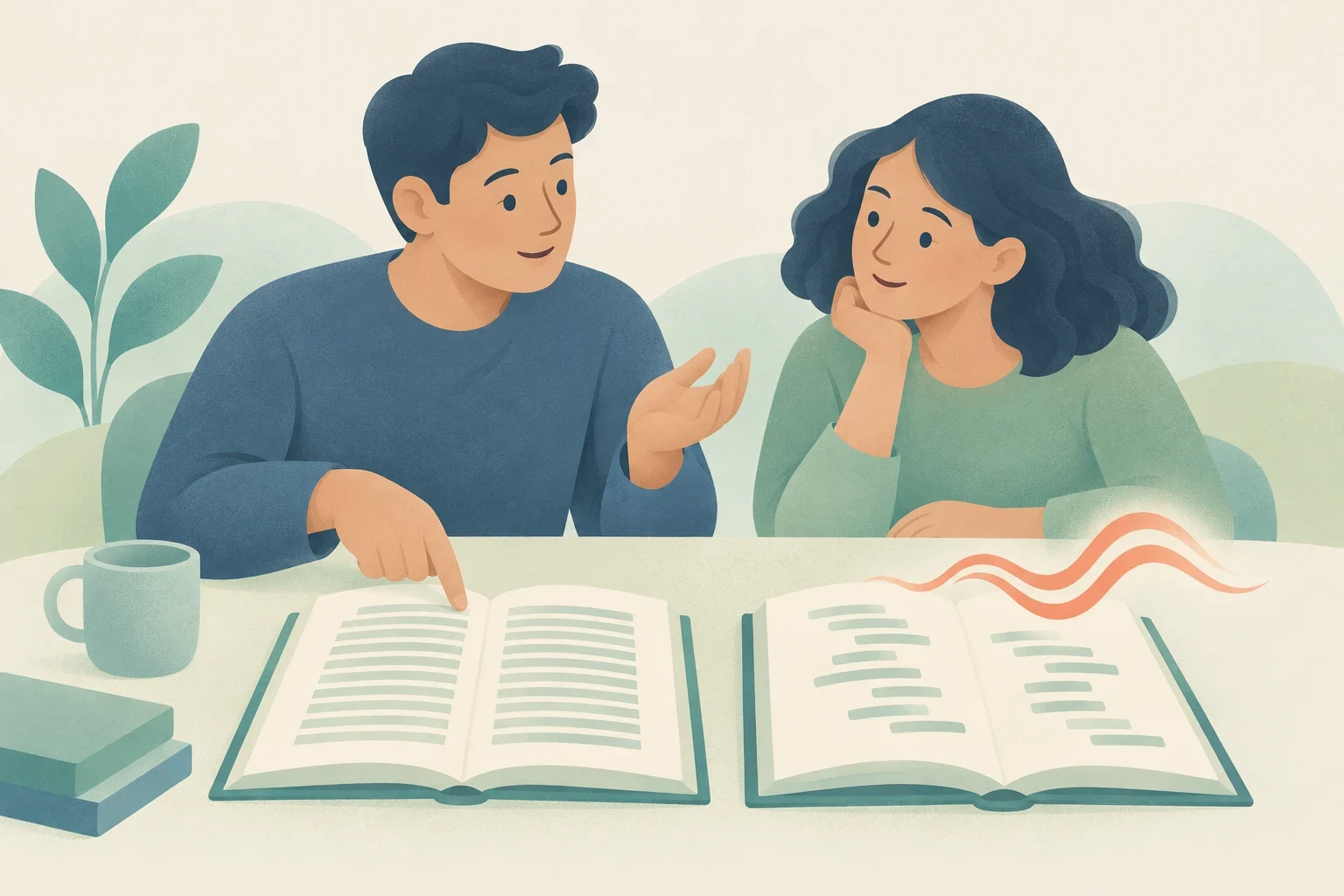
Prose refers to spoken or written language in its ordinary grammatical form, organized into sentences and continuous paragraphs without deliberate line breaks. Novels, essays, emails, and biographies are written in prose. Poetry refers to literary work composed in lines and stanzas, where line breaks, rhythm, and sound patterns actively influence how the reader interprets each idea.
Key points
- Neither form is superior; they simply organize language for different reading experiences.
- Prose relies on continuous paragraphs and complete sentences to explain events, ideas, and directions clearly.
- Poetry organizes language into lines and stanzas, using deliberate line breaks and rhythm to highlight images and emotional depth.
This lesson has 5 stages. You can stop at any time and continue later.

Stage 1 of 5
Understand
What it means, when to use it, and mistakes to avoid.
Examples
The city council published a detailed report outlining the new transit schedule.
Why it works: This is prose because information is presented in standard sentences suited for a paragraph.
3 more examples
-
Morning trains hum / through tunnels of quiet gray.
These lines represent poetry because deliberate line breaks pace the reader and highlight the visual image.
-
Maria read three classic poems before writing her prose summary of the author's life.
This sentence illustrates correct grammatical usage: countable poems for individual works and uncountable prose for the biographical summary.
-
The old wooden pier creaked under the weight of the returning fishermen.
This prose sentence reports a physical action straightforwardly without isolating words into verse lines.
Read the full guide
Check the visual layout across the page
The fastest way to identify whether an author wrote prose or poetry is to observe how words occupy space on the page. Prose normally runs from margin to margin, filling complete horizontal rows until a sentence ends or a paragraph breaks. Poetry introduces purposeful white space by cutting lines short long before reaching the right-hand margin. This visual architecture immediately indicates whether you are meant to read through unbroken narrative paragraphs or pause at designated line endings.
-
The city subway operates twenty-four hours a day on weekends.
Why it works: This sentence runs continuously to fill the space in a standard paragraph.
-
Night trains hum / beneath sleeping rooms.
Why it works: Intentional line breaks isolate each phrase to create space on the page.
Your turn
What is the most immediate visual sign that a text is poetry rather than prose?
Answer: Words arranged in deliberate line breaks with extra white space
Show the answer
Answer: Words arranged in deliberate line breaks with extra white space
Poetry breaks lines before the margin ends, creating visible white space, while prose fills paragraphs continuously.
Control your reading pace using line breaks
Punctuation helps guide pauses in both prose and poetry. A poetic line break can add emphasis or affect the pace, but it does not always require a pause. Sometimes the sentence continues straight into the next line. Read the sentence for meaning, then consider how the line break draws attention to particular words.
-
We stood near the harbor as cold mist gathered along the stone wall.
Why it works: Prose punctuation guides the breath naturally through the complete clause.
-
Cold mist gathered / along the stone wall.
Why it works: The line break draws attention to where the mist gathered. You can continue into the next line without a full pause.
You can practise this again in Gerund or Participle: Tell Them Apart and English articles: when to use them.
Your turn
How does a line break in poetry change how you read aloud?
Answer: It introduces a slight pause that highlights the words at the edges.
Show the answer
Answer: It introduces a slight pause that highlights the words at the edges.
Line breaks create intentional pauses, drawing attention to the final word of the line and the opening word of the next.
Listen for rhythm without expecting rhyme
Many English learners assume that every poem must rhyme, but modern poetry often avoids end rhymes completely. Instead, poets craft a deliberate cadence through syllable counts, stressed beats, and repeated vowel or consonant sounds. Prose can also sound rhythmic when an author writes carefully, but poetry treats musical cadence as a primary organizing principle. When evaluating a text, listen for repeated patterns and sound echoes rather than waiting for rhyming pairs.
-
Every morning brings quiet coffee, quiet streets, and quiet plans.
Why it works: Repeated words create a steady rhythmic pulse even inside ordinary prose.
-
Silver needles / stitch the gray cloud / to the roof.
Why it works: The three short lines create an exact beat without any rhyming words.
Your turn
Why is rhyme an unreliable test for deciding whether a text is poetry?
Answer: Many modern poems use free verse with rhythm instead of end rhymes.
Show the answer
Answer: Many modern poems use free verse with rhythm instead of end rhymes.
A large portion of modern poetry uses free verse, which relies on rhythm, sound echoes, and line breaks rather than end rhyme.
Evaluate compressed images and comparisons
Both prose and poetry use figurative language like metaphors, but poetry usually packs deep meaning into fewer words. A novelist might spend an entire paragraph describing how grief feels during an autumn morning, explaining the character's thoughts and actions step by step. A poet might connect grief to a single fallen leaf or a cold doorway in two lines. Notice whether the text explains ideas fully through continuous context or compresses emotions into compact sensory pictures.
-
The company reported lower quarterly earnings because office expenses increased.
Why it works: Factual prose states cause and effect directly without figurative language.
-
Winter entered our empty office / like an unpaid bill.
Why it works: A compact poetic comparison conveys mood and financial stress in two short lines.
Your turn
Can a prose passage contain poetic imagery and comparisons?
Answer: Yes, novels and essays frequently use vivid imagery within paragraphs.
Show the answer
Answer: Yes, novels and essays frequently use vivid imagery within paragraphs.
Imagery is a descriptive technique used in both prose and poetry; its presence alone does not make a text a poem.
Distinguish prose, poetry, and poem grammatically
A frequent error among intermediate learners is treating poetry and prose as countable items. You cannot buy three poetries or read several proses. Both prose and poetry are uncountable nouns naming forms or artistic categories. When you want to refer to a single creative work composed in verse, use the countable noun poem. When referring to a single short piece of prose, say a prose passage, an essay, or a story instead.
-
She wrote three poems for the local journal this spring.
Why it works: The countable noun poem takes the plural suffix -s when counting individual works.
-
Marcus reads classical poetry on the train, but he writes fiction in prose.
Why it works: Poetry and prose are uncountable nouns referring to entire forms of expression.
Your turn
Which sentence uses the words with correct grammatical number?
Answer: He read one poem from the anthology before going to sleep.
Show the answer
Answer: He read one poem from the anthology before going to sleep.
The word poem is countable and can take 'one', while poetry and prose are uncountable and cannot take numerical counters directly.
Classify texts you encounter in everyday life
In daily life, nearly all functional writing appears as prose. Emails, news articles, office memos, technical manuals, recipe directions, and medical reports rely on standard sentences organized into paragraphs to transmit clear facts. Poetry appears in more specialized settings, such as greeting cards, song lyrics, commemorative plaques, and literary anthologies. Recognizing the communication purpose of a document helps you predict whether prose clarity or poetic expression is appropriate.
-
Please submit your vacation requests by Friday afternoon so scheduling can finish.
Why it works: Workplace announcements rely on prose to deliver operational instructions clearly.
-
Years fly away, / friendship remains.
Why it works: A short greeting card verse uses line breaks and condensed emotion.
Your turn
In which document would you almost certainly expect prose rather than poetry?
Answer: A software installation user manual
Show the answer
Answer: A software installation user manual
Instructional manuals prioritize clear, step-by-step paragraphs, which is the primary domain of prose.
Identify prose poems and boundary forms
Some creative writing intentionally challenges standard boundaries. A prose poem looks like an ordinary paragraph on the page with no line breaks, but it relies on dense metaphor, vivid rhythm, and compressed emotional focus. Free verse, on the other hand, keeps line breaks without obeying strict meter or rhyme schemes. When a text seems difficult to classify, describe its exact features instead of guessing: mention its paragraph shape, line divisions, musical rhythm, and descriptive imagery.
-
The kitchen clock swallows the dark hour by hour, leaving cold crumbs of time upon the table.
Why it works: This sentence sits in a paragraph block but uses the dense metaphor of a prose poem.
-
The bus departs at midnight / carrying thirty strangers / toward the northern coast.
Why it works: This free verse stanza uses line breaks for pacing without any rhyming sounds.
Your turn
What defines a prose poem?
Answer: A text written in paragraph form that uses dense poetic imagery and rhythm
Show the answer
Answer: A text written in paragraph form that uses dense poetic imagery and rhythm
A prose poem looks visually like a prose paragraph on the page, but its compressed imagery, music, and figurative density belong to poetry.
Describe your reading preferences in conversation
When discussing literature with friends or colleagues, use standard English collocations to sound natural. Say that a book is written in prose, or that an author is known for their poetry. You can describe a novel as having poetic language when its descriptions are especially musical or imaginative. Using these terms accurately shows that you understand both the physical structure of texts and the artistic intentions behind different writing styles.
-
I usually unwind with prose essays, though I sometimes revisit poems by Mary Oliver.
Why it works: Natural conversational English balances the uncountable category prose with the countable plural poems.
-
His travel book is written in clear prose with vivid descriptive details.
Why it works: Using the preposition in before prose identifies the medium of the text.
Your turn
How should you answer if a colleague asks what style a memoir uses?
Answer: It is written in accessible prose with strong descriptive images.
Show the answer
Answer: It is written in accessible prose with strong descriptive images.
We say something is written 'in accessible prose', using prose as an uncountable noun describing the medium.
Use it naturally
How people really use “prose”
Neutral Fine almost anywhere, at work or with friends.
Words it often goes with
- clear proseThe guide uses clear prose to explain how to grow tomatoes.
- written in proseThe visitor guide is written in prose.
- prose summaryWe wrote a prose summary of the poem.
What people also say
- “I enjoy reading poetry.” instead of “I enjoy reading poetries.” Use poetry for the general form and poems for separate works.
Questions about "Prose or poetry: telling them apart"
Can I make prose or poetry plural by adding an s?
No. Both prose and poetry are uncountable nouns in standard English. You cannot write proses or poetries. When you need to count individual creative works, use the countable noun poem or the phrase prose piece.
She submitted three poems to the literary contest.
The magazine published an exceptional prose piece about train travel.
Does a text have to rhyme to be considered poetry?
Rhyme is never required in poetry. While many traditional poems use predictable rhyming patterns, modern poetry frequently relies on free verse. Free verse organizes language through line breaks, rhythm, and imagery rather than rhyming endings.
Walt Whitman wrote free verse poetry without end rhymes.
The poet relied on rhythm rather than matching sounds.
What does someone mean when they call a speech or novel poetic?
When listeners call prose poetic, they are describing its artistic style rather than its page layout. It means the author selected words with vivid sensory images, rhythmic cadence, and emotional depth while maintaining standard paragraph grammar.
His travel memoir is full of poetic descriptions of coastal towns.
The president closed her address with poetic phrasing about hope.
How can a piece of writing be both prose and a poem?
A prose poem borrows the visual shape of prose by using sentences inside paragraphs without line breaks. However, it preserves the condensed metaphor, rhythm, and emotional intensity typical of poetry.
Our literature seminar analyzed a short prose poem about memory.
Although printed as a paragraph, the text functioned as a lyrical poem.
Before you go
Remember this
Prose relies on continuous paragraphs and complete sentences to explain events, ideas, and directions clearly. Poetry organizes language into lines and stanzas, using deliberate line breaks and rhythm to highlight images and emotional depth. While prose prioritizes narrative flow, poetry gives space to sound and compact comparisons without requiring end rhyme. Examine the page layout first, listen to the rhythm aloud, and use the term poem when counting single creative pieces.
Stage 2 of 5
Listen
Hear it in real sentences, from short to long, and write what you hear.
0 of 4 done
Listening 1 of 4
Listening 2 of 4
Try a longer clip. Listen once, then replay the part you missed.
Listening 3 of 4
This clip is longer. Follow the instruction above the answer field.
Listening 4 of 4
Listen, then type the missing words. The rest of the text is already there.
0:00
Practice complete
You listened closely.
Your result is saved in this browser.
Keep your progress. Your practice is saved on this device only. Create a free account to keep it everywhere.
Create a free accountThat was today's free lesson. Tomorrow you get another one. Want more today? See membership.
Create a free SubLearn account to keep this progress across devices.
Save my progressStage 3 of 5
Speak
Say it with the speaker, then use it in your own answer.
Shadow
Say it along with the speaker
Play the line slowly, then speak at the same time as the speaker. Copy the rhythm, not just the words.
Your turn
Say it your way
Speak for 30 to 60 seconds from memory. You are making signs for a community garden. Explain how you would use prose for practical information and poetry to help visitors enjoy the garden. Give an idea for each sign.
Use: prose poetry
Take ten seconds to think, then answer out loud without looking at the lesson. Speak for the time shown in the task above. Nothing is sent unless you ask for feedback.
0:00
Hear how someone else might say it
I would make two kinds of signs for our community garden. Near the gate, I would use prose to explain when the garden opens and how visitors can help. Full sentences would make the rules easy to understand. Beside the flowers, I would put some poetry about the colors and the sounds of bees. I would use short lines so people could pause as they read. The poem would not need to rhyme. I think these signs would help people learn about the garden and enjoy a quiet moment there.
Try once more and answer this: Where would you put your signs?
Stage 4 of 5
Write
Use what you've learned to write about your day or week, then write a message.
Write
Put it in your own words
- I used “prose”.
- It is about my life, not the lesson’s example.
- I read it once aloud to check it sounds right.
Write your own response
Choose a situation and write 30–50 words of your own. In this activity, you decide what to say rather than copy the words in a recording.
Check your own writing
Read one possible response
Use these checks to revise your message. Grammar and meaning are not automatically graded. Each task keeps its own draft in this browser tab.

You finished the free part of this lesson
- Understand
- Listen
- Speak
- Write
- CheckPart of membership
Worth another look
With a free account, the lessons you finish come back for review to help you remember them.Create a free account
Stage 5 of 5 · Part of membership
Check
New clips without hints.
Listening tests are included with membership. Try the free dictation first, then decide whether to continue.
Listening 1 of 2 Part of membership
Listening 2 of 2 Part of membership
Follow MicroEnglish
Find lesson updates, short videos and quick quizzes. Pick the app you already use.
Questions & comments
Ask about this lesson, share an example, or help another learner.
Example
Memory tip
Goes with
Related forms
Not to be confused with
In this lesson
This word isn't in our dictionary. Check the spelling, or try another form of the word.
We couldn't load this word. Try again.
