Micro-listening
Parallel structure: make your lists easy to follow
What is parallel structure in English?
Parallel structure means using matching grammatical forms for connected ideas, especially in lists. For example, 'The team can organise supplies and greet guests' uses plain verbs after 'can'. Match the pattern chosen by words such as 'enjoy', 'can', or 'want to', but do not change correct tenses just to make them look alike.
Key points
- Parallel structure makes lists easier to follow.
- After 'enjoy', use -ing forms for activities.
- After 'can', use plain verbs without 'to'.
- Several verbs can share one 'to'.
This lesson has 5 stages. You can stop at any time and continue later.

At a glance
| Form | Use it for | Example |
|---|---|---|
| Things: noun phrases | Use matching things within one list. | Bring a folder, a pen, and a notebook. |
| After 'enjoy': -ing | Use -ing for each activity after 'enjoy'. | He enjoys cooking and gardening. |
| After 'can': plain verbs | Use plain verbs without 'to' or '-ing'. | We can sort papers and clean desks. |
| After 'want to': plain verbs | Several verbs can share the first 'to'. | They want to plan, practise, and perform. |
| After 'both': descriptions | Join two matching descriptions with 'and'. | The new room is both clean and welcoming. |
Stage 1 of 5
Understand
What it means, when to use it, and mistakes to avoid.
The full explanation
Parallel structure means giving connected ideas a similar grammatical shape. In everyday terms, a list of things should sound like a list of things, and a list of actions should follow one action pattern.
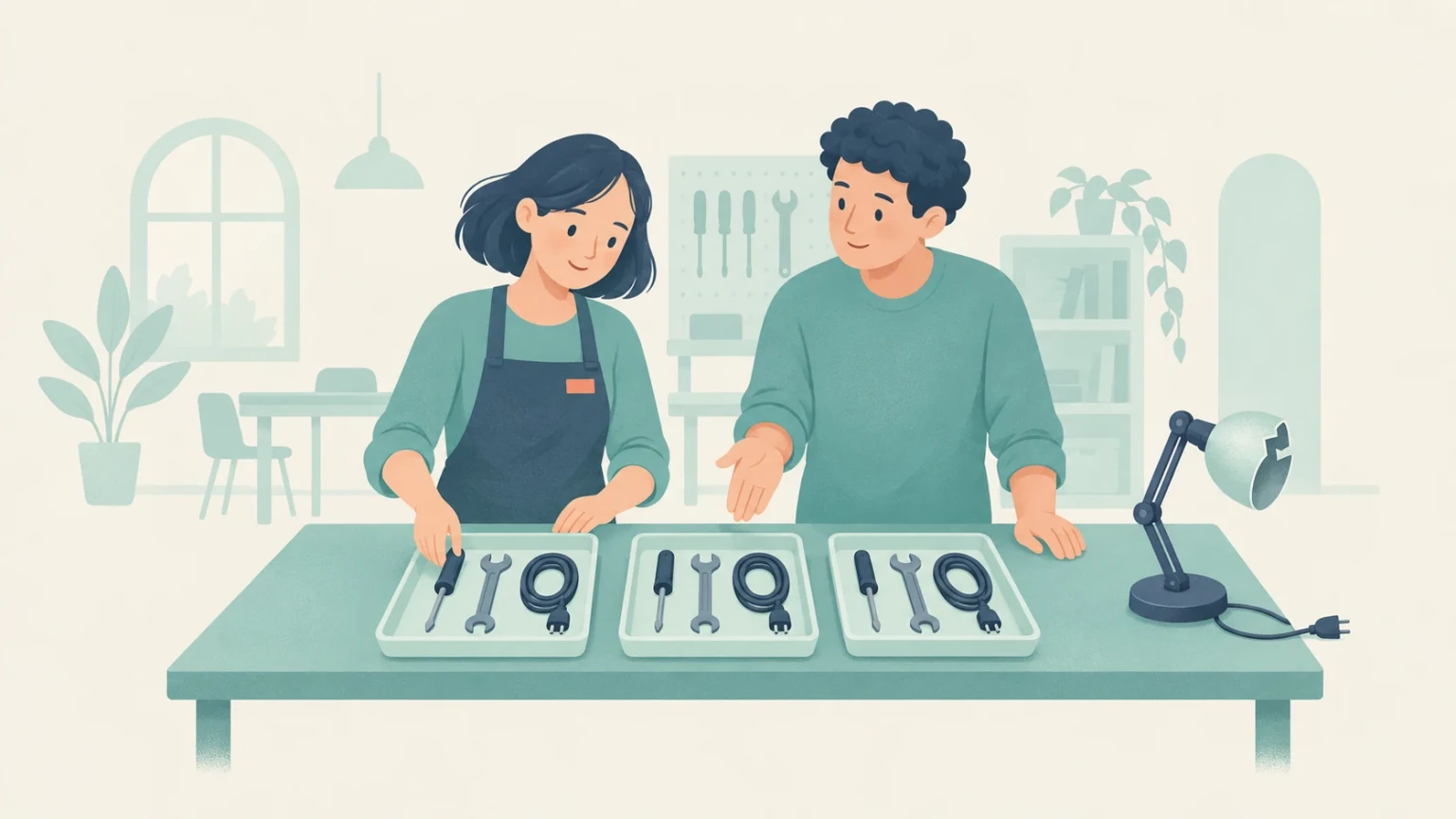
The repair table needs tape, scissors, and a small lamp.
Why it works: All three items name things, although the final item is longer.
2 more examples
-
Nora enjoys fixing chairs and painting shelves.
Both activities use the -ing form after enjoys.
-
We want to open early, welcome visitors, and explain the rules.
The three verbs share the first to.
Read the full guide
Decide which ideas belong in the same list
First decide what the speaker is grouping together. At a repair event, someone may name supplies, describe a room, or list jobs. These groups need different forms. Parallel structure means keeping the same pattern within a group. Start with the meaning: are all the items things, descriptions, or actions?
-
Please bring a brush, a cloth, and some soap.
Why it works: Each item names a supply. The words a and some can differ.
Your turn
Which ending keeps this list as three things? Bring a box, a bag, and...
Answer: a basket.
Show the answer
Answer: a basket.
A basket names a thing, just like a box and a bag.
Use -ing for activities after enjoy
The word before a list helps you choose the pattern. After enjoy, an action takes the -ing form. Adding another activity does not change that condition. If you enjoy repairing something and also enjoy painting something, keep both activities in the -ing form. Their objects can be different.
-
Luis enjoys repairing clocks and building small tables.
Why it works: Repairing and building both follow enjoys; clocks and tables do not need to match.
You can practise this again in Do or make: everyday collocations and Unusual names.
Your turn
Which sentence uses the correct pattern after enjoys?
Answer: Maya enjoys sorting buttons and sewing bags.
Show the answer
Answer: Maya enjoys sorting buttons and sewing bags.
Enjoys requires the -ing form for both activities.
Let to or can introduce several actions
A short word can introduce more than one action. In want to wash and dry, to belongs with both wash and dry. You can repeat it, but you do not have to. After can, use the plain verb without to or -ing. Listen back to the beginning to identify the pattern.
-
We want to wash the cups and dry them.
Why it works: Wash and dry share to.
-
You can move the chairs and sweep the floor.
Why it works: Can introduces both plain verbs.
Your turn
Complete the sentence: You can check the lamp and...
Answer: test the switch.
Show the answer
Answer: test the switch.
Both check and test follow can, so neither takes to or -ing.
Match descriptions around both and
Matching patterns also help when you describe something. Both can introduce two descriptions joined by and. Place it before the first description so the pair is easy to recognize. If the room is quiet and comfortable, both descriptions have the same job. Avoid switching from a description to an unrelated action.
-
The waiting area is both bright and comfortable.
Why it works: Both introduces two words that describe the waiting area.
Your turn
Which ending gives two matching descriptions? The instructions are both...
Answer: clear and useful.
Show the answer
Answer: clear and useful.
Clear and useful both describe the instructions; clarity names a quality.
Compare whole parts before correcting a sentence
Do not compare only the words touching and. A connected part may contain several words, or even a subject and a verb. Also, matching ideas do not always need identical tenses. Yesterday and tomorrow require different time forms. Correct an uneven activity list, but keep differences that communicate the intended time.
-
I cleaned the tools yesterday, and I will return them tomorrow.
Why it works: Each part has a subject and verb, but the times differ.
Your turn
Why should the example keep cleaned and will return?
Answer: The actions happen at different times.
Show the answer
Answer: The actions happen at different times.
Yesterday supports cleaned, while tomorrow supports will return.
Use the first item to follow spoken lists
In speech, small words such as to and and may be quiet. The main action words are often easier to hear. Keep the opening phrase in memory while listening to the rest of the list. A matching pattern can help you predict a form, but replay the message to confirm the actual words.
-
We need to count the chairs, wipe the tables, and lock the door.
Why it works: The quiet to introduces count, wipe, and lock.
Your turn
You hear “We need to count...” before a list. What should you do next?
Answer: Listen for more verbs that can share to.
Show the answer
Answer: Listen for more verbs that can share to.
The opening suggests a pattern, but the recording determines which words you write.
Check written lists, then recall the pattern
When writing a message, underline the items in each list. Read each one with the opening phrase to check that it fits. A colon can introduce a list too. After editing, cover the sentence and recall its pattern using new details. This tests whether you can build a fresh sentence rather than remember one example.
-
Please do three jobs: label the boxes, fold the cloths, and close the windows.
Why it works: Each instruction starts with a plain verb after the colon.
Your turn
Which list fits after “My duties include”?
Answer: welcoming visitors, checking tickets, and answering questions.
Show the answer
Answer: welcoming visitors, checking tickets, and answering questions.
All three duties use activity forms ending in -ing, and each fits after include.
Common mistakes
What learners often say, what to say instead, and why.
-
Not this:
Leah enjoys drawing maps and to write reports.Say: Leah enjoys drawing maps and writing reports.
'Enjoys' requires the -ing form for both connected activities.
-
Not this:
You can check the list and checking the shelves.Say: You can check the list and check the shelves.
Both verbs follow 'can', so both use the plain form.
-
Not this:
The office is both quiet and welcomingly.Say: The office is both quiet and welcoming.
'Both' introduces two matching descriptions, so use adjectives in both positions.
Use it naturally
How people really use “Parallel structure”
Neutral Fine almost anywhere, at work or with friends.
Words it often goes with
- use parallel structureYou can use parallel structure to make your lists clear.
- check for parallel structureRead your list aloud and check for parallel structure.
- maintain parallel structureKeep the same verb form to maintain parallel structure.
Questions about "Parallel structure: make your lists easy to follow"
Do I need to repeat to before every verb in a list?
No. When several verbs belong to the same opening phrase, they can share to. Repeating to is also correct and can make separate actions more noticeable. Keep each verb in the plain form in either pattern.
I hope to visit the market and buy some bread.
I hope to visit the market and to buy some bread.
Can one item in a list be much longer than the others?
Yes. Match the grammatical job and form, not the number of words. One action may include extra information about a person or place. Check that every activity still fits the words introducing the list.
She enjoys swimming, cycling, and walking with her sister after work.
Does a verb after and always need an -ing ending?
No. And connects ideas but does not choose their verb form. Look at the words introducing the actions. Enjoy takes -ing activity forms, while can takes plain verbs without to.
They enjoy singing and dancing.
They can sing and dance.
What should I do when I cannot hear to or and clearly?
Listen again to the whole phrase, including its opening words. Small words may be quieter than the action words. Use the pattern to check a possible answer, but do not add a repeated to unless you hear it.
We decided to stop, rest, and drink some water.
Before you go
Remember this
Find the connected ideas, check the opening phrase, and keep the appropriate pattern. During dictation, use grammar to check what you heard. During writing, try each list item with the same opening words.
Stage 2 of 5
Listen
Hear it in real sentences, from short to long, and write what you hear.
0 of 4 done
Listening 1 of 4
Listening 2 of 4
Try a longer clip. Listen once, then replay the part you missed.
Listening 3 of 4
This clip is longer. Follow the instruction above the answer field.
Listening 4 of 4
Listen, then type the missing words. The rest of the text is already there.
0:00
Practice complete
You listened closely.
Your result is saved in this browser.
Keep your progress. Your practice is saved on this device only. Create a free account to keep it everywhere.
Create a free accountThat was today's free lesson. Tomorrow you get another one. Want more today? See membership.
Create a free SubLearn account to keep this progress across devices.
Save my progressStage 3 of 5
Speak
Say it with the speaker, then use it in your own answer.
Shadow
Say it along with the speaker
Play the line slowly, then speak at the same time as the speaker. Copy the rhythm, not just the words.
Your turn
Say it your way
Speak for 30 to 60 seconds from memory about a museum visit you are planning with a friend. Say three things you want to do there, two activities your friend enjoys, and three things you will carry in your bag. Keep the forms in each list similar.
Use: We want to enjoys
Take ten seconds to think, then answer out loud without looking at the lesson. Speak for the time shown in the task above. Nothing is sent unless you ask for feedback.
0:00
Hear how someone else might say it
I'm planning a museum visit with my friend Ben this Saturday. We want to see the dinosaur room, try the science games, and visit the space exhibition. Ben enjoys taking photos and learning about animals, so I think he'll love it. I'll bring a sandwich, a water bottle, and a notebook in my bag. We can eat lunch outside or buy something in the cafe. After lunch, I'd like to draw a dinosaur. Ben can help me because he's good at drawing.
Try once more and answer this: Which part of the museum do you want to visit first?
Stage 4 of 5
Write
Use what you've learned to write about your day or week, then write a message.
Write
Put it in your own words
- I used “Parallel structure”.
- It is about my life, not the lesson’s example.
- I read it once aloud to check it sounds right.
Write your own response
Choose a situation and write 30–50 words of your own. In this activity, you decide what to say rather than copy the words in a recording.
Check your own writing
Read one possible response
Use these checks to revise your message. Grammar and meaning are not automatically graded. Each task keeps its own draft in this browser tab.

You finished the free part of this lesson
- Understand
- Listen
- Speak
- Write
- CheckPart of membership
Worth another look
With a free account, the lessons you finish come back for review to help you remember them.Create a free account
Stage 5 of 5 · Part of membership
Check
New clips without hints.
Listening tests are included with membership. Try the free dictation first, then decide whether to continue.
Listening 1 of 2 Part of membership
Listening 2 of 2 Part of membership
Follow MicroEnglish
Find lesson updates, short videos and quick quizzes. Pick the app you already use.
Questions & comments
Ask about this lesson, share an example, or help another learner.
Example
Memory tip
Goes with
Related forms
Not to be confused with
In this lesson
This word isn't in our dictionary. Check the spelling, or try another form of the word.
We couldn't load this word. Try again.
