Micro-listening
Deer or deers: how to choose
Is the plural form deer or deers?
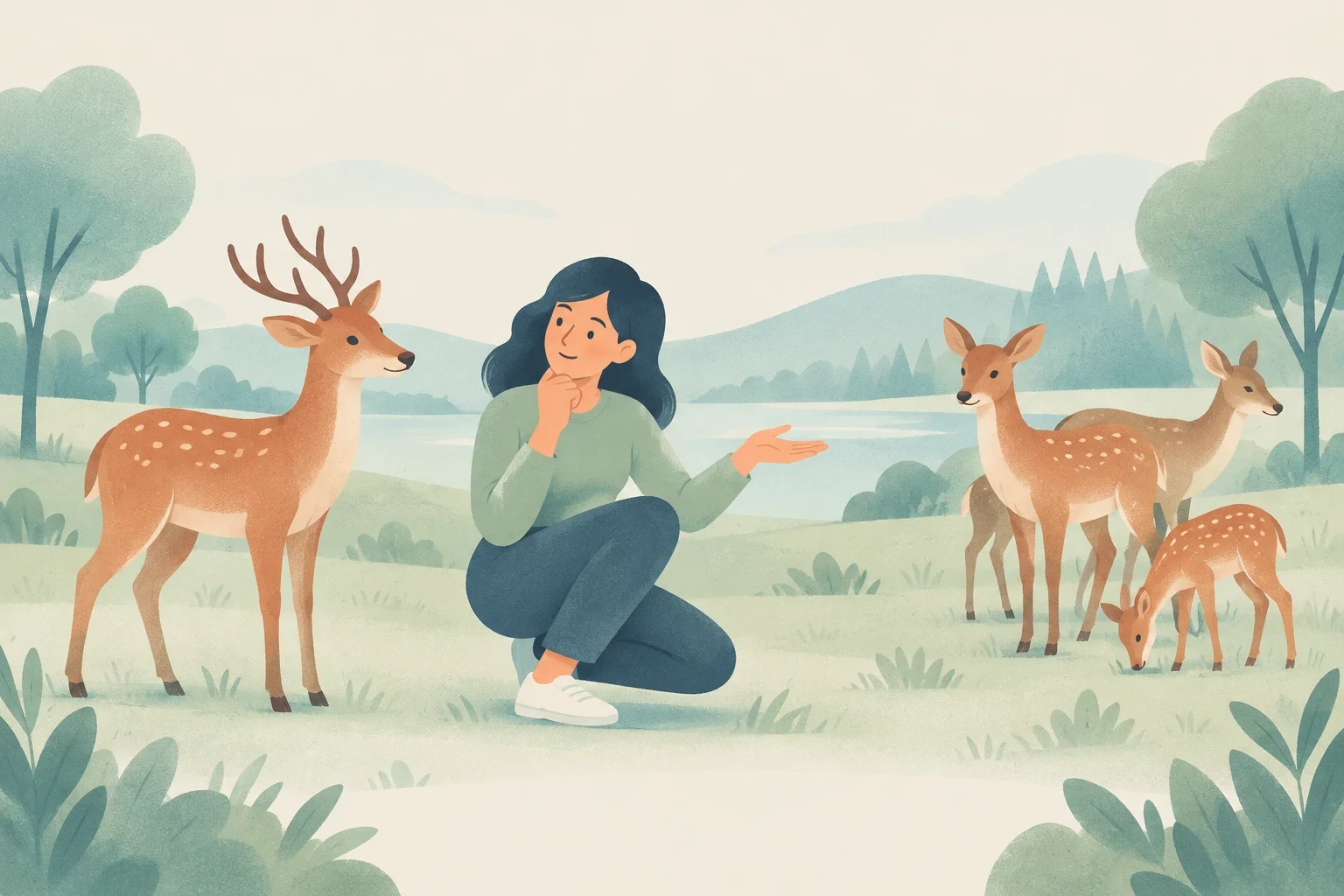
Deer refers to a hoofed forest animal. The word has an unchanged plural form in standard English, meaning that the singular and plural forms look and sound exactly the same. The quantity comes from surrounding words such as determiners, numbers, and verbs.
Key points
- Use deer for both one animal and several in everyday writing.
- Numbers and words such as several show the count, and is or are shows singular or plural agreement.
- Deers is a recorded variant, not the normal choice taught here; different species of deer is a clear way to refer to kinds.
This lesson has 5 stages. You can stop at any time and continue later.

At a glance
| Pattern | Singular (One) | Plural (Two or More) |
|---|---|---|
| Unchanged (deer) | One deer is in the park. | Two deer are in the park. |
| Unchanged (sheep) | One sheep was on the hill. | Ten sheep were on the hill. |
| Regular (dog) | One dog is barking. | Two dogs are barking. |
Stage 1 of 5
Understand
What it means, when to use it, and mistakes to avoid.
Examples
A solitary deer was grazing near our backyard garden.
Why it works: The words A solitary and was indicate that the sentence describes one animal.
3 more examples
-
Several deer were drinking from the shallow stream at sunrise.
Several and were show a plural count, while deer remains unchanged.
-
We photographed five deer resting peacefully under the pine trees.
The number five shows how many animals were present, so no s is added to deer.
-
The conservation report compared different species of deer across North America.
Different species of deer is the natural and clear way to discuss biological varieties without needing deers.
Read the full guide
Decide Between Deer and Deers for Any Count
A deer is a large wild animal with long legs. We say one deer and two deer. When we count more than one, the word deer stays the same. In English, singular means one and plural means more than one. Most nouns add a letter to show a plural count, but deer does not change. Whether you see a single animal grazing alone or five animals moving together across a meadow, the noun remains deer. You never need an added letter for normal counting.
-
One deer crossed the quiet meadow at dawn.
Why it works: One indicates a single animal, and the noun takes the form deer.
-
Five deer crossed the quiet meadow at dawn.
Why it works: Five indicates several animals, yet the noun remains deer without any extra letter.
Your turn
Which phrase uses the usual everyday plural to describe four animals by a stream?
Answer: four deer
Show the answer
Answer: four deer
The selected answer uses deer, the usual everyday plural, with the appropriate determiner or verb. Deers is a less common recorded variant, so this question specifies everyday usage.
Show Quantity Using Words Before Deer
Because deer does not add a plural ending, quantity words before the noun show how many animals you mean. Deer is countable, which means you can count the animals directly: a deer, one deer, two deer, several deer, or many deer. When you use the deer, the article alone does not reveal the count. Demonstrative words provide clarity: this deer and that deer describe one animal nearby or farther away, while these deer and those deer describe two or more animals. You can review article choices in /micro-listenings/a-an-and-the-choose-an-article-listening-practice/ to practice choosing between definite and indefinite forms.
-
This deer looks younger than that deer by the gate.
Why it works: This and that indicate a singular animal in each position.
-
These deer often visit our garden during winter.
Why it works: These shows that multiple animals are visiting, while deer remains unchanged.
You can practise this again in their there they're: choose the right word and Each or Every: Which Word to Choose.
Your turn
Which phrase uses the usual everyday plural for several animals close to you?
Answer: these deer
Show the answer
Answer: these deer
The selected answer uses deer, the usual everyday plural, with the appropriate determiner or verb. Deers is a less common recorded variant, so this question specifies everyday usage.
Match Your Verb to the Intended Number
Your verb must reflect the number of animals you are describing, rather than the spelling of the noun. Because deer lacks a final s in both singular and plural uses, learners sometimes select a singular verb by mistake. Use is or was when you refer to one deer. Use are or were when you describe two or more deer. If your subject is the deer, check your mental picture of the scene before you write the verb, ensuring that your sentence matches the actual count.
-
The deer was drinking water when the branch snapped.
Why it works: The singular past verb was shows that the speaker is describing one animal.
-
The deer were drinking water when the branch snapped.
Why it works: The plural past verb were reveals that two or more animals were present.
Your turn
Complete the sentence to describe three animals: 'Three deer ___ resting near the oak tree.'
Answer: are
Show the answer
Answer: are
Three establishes a plural count, so the plural present verb are is required.
Compare Number Patterns in a Quick Reference Table
A quick comparison helps you see how deer operates alongside other animal nouns. Deer follows the unchanged pattern found in sheep, where one sheep and three sheep share the same noun form. However, you should not assume that every animal noun behaves this way. Most English animal nouns are regular, such as dog and dogs or horse and horses. The following summary contrasts how determiners, nouns, and verbs align across different animal counts.
-
One sheep and one deer stood by the barn.
Why it works: Both sheep and deer keep their unchanged base forms for one animal.
-
Four sheep and four deer walked toward the woods.
Why it works: Both animal nouns stay unchanged after the plural number four.
Your turn
Which sentence uses the usual everyday noun forms and correct plural verb agreement?
Answer: Two deer are grazing near two sheep.
Show the answer
Answer: Two deer are grazing near two sheep.
The selected answer uses deer, the usual everyday plural, with the appropriate determiner or verb. Deers is a less common recorded variant, so this question specifies everyday usage.
Recognize deers as a less common variant
Deer is the usual plural, and deers is also recorded in dictionaries. You may encounter deers in specialist or older writing, but it is not restricted to exactly one meaning such as different species. For everyday counting, use deer. If you mean kinds, different species of deer is clear without relying on the less common plural.
-
The sanctuary protects three distinct species of deer.
Why it works: Using species of deer is clear, natural, and standard for both everyday and formal writing.
-
The research paper compared the native deers of North America.
Why it works: Deers is a recorded plural variant. This sentence alone does not establish whether the paper compares individual animals or species.
Your turn
Which is the usual everyday wording for seeing six individual animals in the park?
Answer: I saw six deer in the park.
Show the answer
Answer: I saw six deer in the park.
The selected answer uses deer, the usual everyday plural, with the appropriate determiner or verb. Deers is a less common recorded variant, so this question specifies everyday usage.
Correct Common Traps with Numbers and Verbs
Three common errors appear frequently in student writing. The first issue is using the less common two deers where ordinary everyday wording calls for two deer. The second mistake is treating deer as uncountable by saying much deer instead of many deer or several deer; deer is countable, so use quantity words suited for separate items. The third mistake is pairing a plural determiner with a singular verb, such as writing these deer is instead of these deer are. Memorizing these three fixes prevents the most frequent slip-ups.
-
We did not see many deer along the hiking trail.
Why it works: Many is used because deer is countable, even though it has no plural ending.
-
These deer are looking for fresh grass under the snow.
Why it works: These and are correctly agree with a plural group of animals.
Your turn
Which sentence contains no grammatical errors?
Answer: These deer are resting under the tall trees.
Show the answer
Answer: These deer are resting under the tall trees.
Because these refers to a plural group, the verb are is required, and deer stays in its base form.
Listen for Quantity Clues Around Unchanged Nouns
When you listen to spoken English, you cannot tell if deer is singular or plural from the word alone. The pronunciation is identical whether the speaker means one animal or ten. While American speakers usually pronounce the final r sound, British and Australian speakers often omit it before a consonant or pause. However, no accent adds an s sound to the animal noun. To understand how many animals the speaker saw, you must listen carefully for nearby determiners like one or several, and for verbs like is or are.
-
That deer was standing motionless beside the highway.
Why it works: The auditory clues That and was inform the listener that only one animal is present.
-
Those deer were standing motionless beside the highway.
Why it works: The auditory clues Those and were inform the listener that multiple animals are present.
Your turn
A speaker says: 'The deer were moving slowly.' How do you know how many animals there are?
Answer: The plural past verb were indicates more than one animal.
Show the answer
Answer: The plural past verb were indicates more than one animal.
Singular and plural deer sound identical; the verb were is the grammatical clue that indicates a plural subject.
Apply the Rule When Writing Wildlife Captions
You are sending a wildlife-camera photo to a friend when you notice two more animals in the background. Your caption needs to change from one deer to three deer, including the verb. Consider this exchange between two park volunteers: 'Look, a deer is eating near the trail,' says Mark. Elena zooms in on the screen and replies, 'Wait, two more just walked out; now three deer are eating together.' Mark updates the photo caption from 'A deer is by the path' to 'Three deer are by the path.' Notice how Elena changes both the quantity number and the verb while keeping the noun deer unchanged.
-
Draft caption: One deer was spotted near our campsite at dusk.
Why it works: A correct singular caption using one and the singular verb was.
-
Revised caption: Three deer were spotted near our campsite at dusk.
Why it works: The plural caption changes one to three and was to were, while deer remains unchanged.
Your turn
Which update uses the usual everyday plural and correct verb agreement for four animals instead of 'One deer is resting'?
Answer: Four deer are resting.
Show the answer
Answer: Four deer are resting.
The selected answer uses deer, the usual everyday plural, with the appropriate determiner or verb. Deers is a less common recorded variant, so this question specifies everyday usage.
Questions about "Deer or deers: how to choose"
Is the plural form deer or deers?
Deer is the usual plural in everyday English. Use one deer, two deer, and many deer. Dictionaries also record deers, but deer is the standard everyday choice to learn and use here.
I saw one deer near the gate, and my sister saw five deer near the barn.
Why do we say two deer without an s?
English has a small group of animal nouns that do not add an s in the plural. Words like deer and sheep keep the exact same spelling in both singular and plural forms. The number before the word tells the listener how many animals are being counted.
The guide pointed at two deer resting beside the trail.
Should I say the deer is or the deer are?
Both can be correct depending on the situation. Use the deer is when you mean a single animal, and use the deer are when you mean more than one animal. Because the noun does not change, the verb is what shows whether the subject is singular or plural.
The deer is drinking from the garden pond.
The deer are moving together toward the pine trees.
Is deer a countable noun?
Yes, deer is a countable noun. You can count these animals using numbers such as one deer, two deer, or ten deer. You also use countable determiners like many deer and several deer. It is an error to treat deer as uncountable by saying much deer.
We counted eight deer in the meadow before sunset.
There were many deer in the valley this winter.
Is deers ever correct in English?
Yes. Dictionaries record deers as a plural variant, although deer is the usual form. Do not assume deers can only mean different species. In everyday writing, use deer; for kinds, different species of deer is clear.
The museum exhibit highlighted several different species of deer.
Before you go
Remember this
Use deer for both one animal and several in everyday writing. Numbers and words such as several show the count, and is or are shows singular or plural agreement. Deers is a recorded variant, not the normal choice taught here; different species of deer is a clear way to refer to kinds.
Stage 2 of 5
Listen
Hear it in real sentences, from short to long, and write what you hear.
0 of 4 done
Listening 1 of 4
Listening 2 of 4
Try a longer clip. Listen once, then replay the part you missed.
Listening 3 of 4
This clip is longer. Follow the instruction above the answer field.
Listening 4 of 4
Listen, then type the missing words. The rest of the text is already there.
0:00
Practice complete
You listened closely.
Your result is saved in this browser.
Keep your progress. Your practice is saved on this device only. Create a free account to keep it everywhere.
Create a free accountThat was today's free lesson. Tomorrow you get another one. Want more today? See membership.
Create a free SubLearn account to keep this progress across devices.
Save my progressStage 3 of 5
Speak
Say it with the speaker, then use it in your own answer.
Shadow
Say it along with the speaker
Play the line slowly, then speak at the same time as the speaker. Copy the rhythm, not just the words.
Your turn
Say it your way
Describe an outdoor scene where you notice two animals by a lake and then spot two more joining them, explaining the count and verbs clearly.
Use: deer or deers: how to choose
You could start with “When I walked down to the lake,…”
Take ten seconds to think, then answer out loud without looking at the lesson. Speak for the time shown in the task above. Nothing is sent unless you ask for feedback.
0:00
Stage 4 of 5
Write
Use what you've learned to write about your day or week, then write a message.
Write
Put it in your own words
- I used “deer or deers: how to choose”.
- It is about my life, not the lesson’s example.
- I read it once aloud to check it sounds right.
Write your own response
Choose a situation and write 30–50 words of your own. In this activity, you decide what to say rather than copy the words in a recording.
Check your own writing
Read one possible response
Use these checks to revise your message. Grammar and meaning are not automatically graded. Each task keeps its own draft in this browser tab.

You finished the free part of this lesson
- Understand
- Listen
- Speak
- Write
- CheckPart of membership
Worth another look
With a free account, the lessons you finish come back for review to help you remember them.Create a free account
Stage 5 of 5 · Part of membership
Check
New clips without hints.
Listening tests are included with membership. Try the free dictation first, then decide whether to continue.
Listening 1 of 2 Part of membership
Listening 2 of 2 Part of membership
Follow MicroEnglish
Find lesson updates, short videos and quick quizzes. Pick the app you already use.
Questions & comments
Ask about this lesson, share an example, or help another learner.
Example
Memory tip
Goes with
Related forms
Not to be confused with
In this lesson
This word isn't in our dictionary. Check the spelling, or try another form of the word.
We couldn't load this word. Try again.
