Micro-listening
Breathe when public speaking: Pause before each point
Will my audience think I forgot my speech if I pause for two seconds?
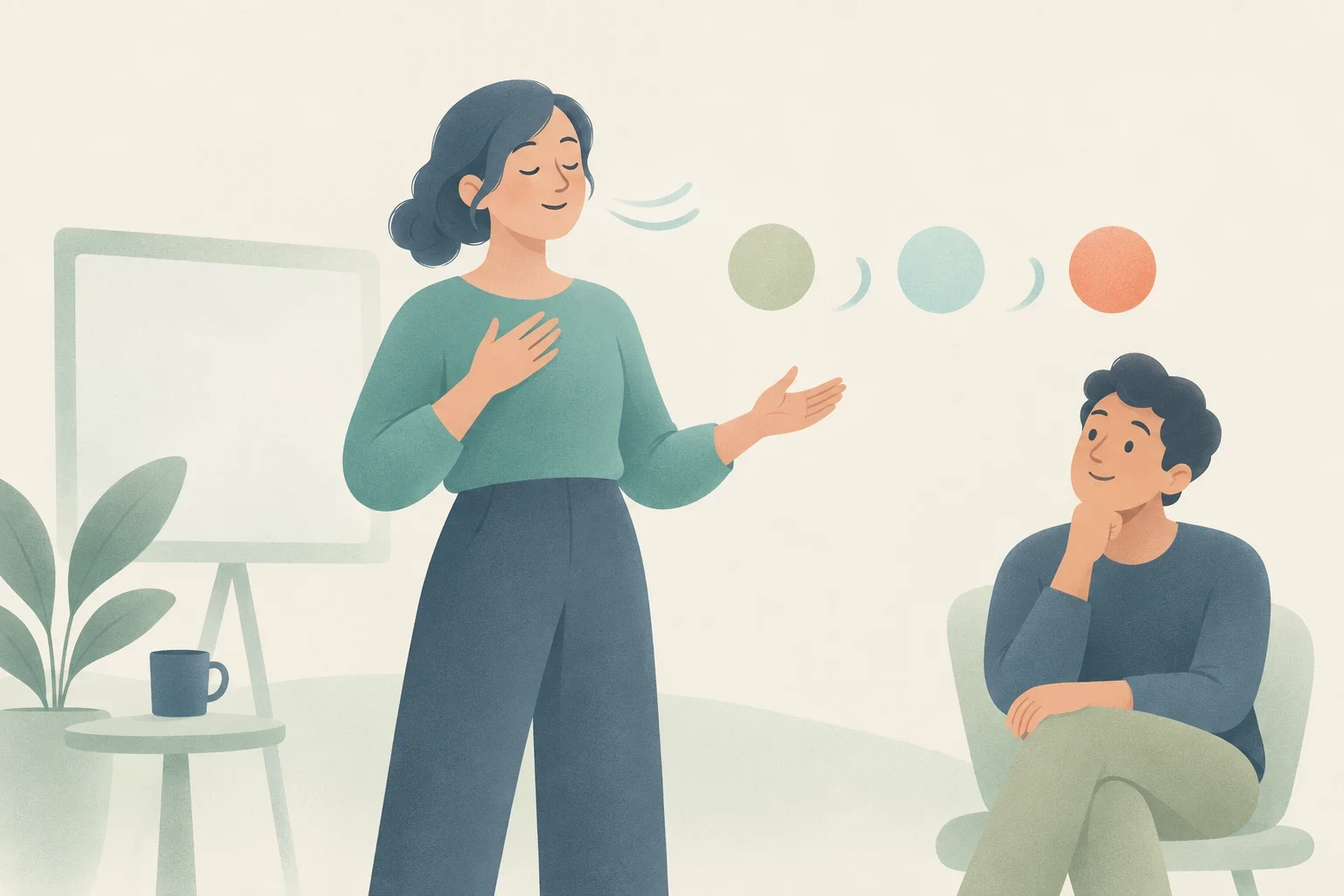
Breathing for public speaking means giving yourself permission to stop between thoughts. You do not need deep lung expansions or complicated counting exercises. You simply pause at punctuation marks and let your body take in air naturally before starting the next sentence.
Key points
- Begin your presentation with one short prepared sentence after a calm breath.
- Complete each idea fully, stop at the period, and let your lungs refill without hurry.
- Clear speaking depends on comfortable pauses between ideas rather than forced breath control.
This lesson has 5 stages. You can stop at any time and continue later.

Stage 1 of 5
Understand
What it means, when to use it, and mistakes to avoid.
Examples
Good morning. Today I will share three updates about the warehouse schedule.
Why it works: A short, direct opening sentence gives you an immediate place to pause before introducing details.
3 more examples
-
The client approved the design yesterday. [pause] Next week we will order the parts.
Stopping completely at the end of the first sentence lets you inhale naturally before moving forward.
-
Before we review the budget, I will pause to check the screen.
This neutral announcement explains a short pause without showing anxiety.
-
My next point is the new staff parking policy.
A simple signpost helps you restart smoothly after a quiet breath.
Read the full guide
Take a quiet breath before your opening sentence
Before your first sentence, look at your listeners and check your opening line. Give yourself a brief pause, then start with one clear point. You can practice this sequence aloud with your notes before the presentation.
-
Good afternoon. I will present our quarterly safety numbers.
Why it works: Starting with a short sentence after one quiet breath sets a manageable speaking rhythm.
Your turn
What should you do during the first two seconds before you begin speaking?
Answer: Pause, look at your listeners, and allow one easy breath before speaking.
Show the answer
Answer: Pause, look at your listeners, and allow one easy breath before speaking.
A brief pause gives you a moment to check your opening line before speaking.
Limit your first statement to one basic fact
Keep your opening focused on one fact: who you are or what the talk covers. Finish that thought, pause, then give the details. Read your opening aloud and shorten it if several ideas compete for attention.
-
Today I will explain our new customer feedback process.
Why it works: The opening names the topic and gives the speaker a clear place to pause.
You can practise this again in Public speaking nerves: Four recovery steps and Public speaking: steps for clear delivery.
Your turn
Why can a short opening sentence help listeners follow a presentation?
Answer: It introduces one clear point before the speaker adds details.
Show the answer
Answer: It introduces one clear point before the speaker adds details.
The opening gives listeners the topic. A pause separates that introduction from the details that follow.
Practise pausing between complete ideas
Practice pausing when you finish an idea. In the example below, the first sentence reports sales and the second reports expenses. A short pause separates those two figures. You can mark that pause in your notes rather than joining every point with and or so.
-
Sales rose by ten percent in July. [pause] Expenses dropped during the same month.
Why it works: A distinct pause between sentences gives listeners time to process the first statistic.
Your turn
What vocal signal indicates that a sentence has finished and a pause is starting?
Answer: Dropping your vocal pitch slightly and closing your mouth for a moment.
Show the answer
Answer: Dropping your vocal pitch slightly and closing your mouth for a moment.
A slight drop in pitch signals a completed idea to listeners and marks the pause boundary.
Breathe naturally instead of taking giant gasps
Use an ordinary, comfortable breath during your practice pauses. You do not need to perform a dramatic gasp for the audience. Read one short sentence, pause, and then read the next. Keep the exercise focused on where ideas end and begin.
-
Our team tested three options. [quiet breath] We chose the lowest bid.
Why it works: The pause gives the speaker a break between reporting the test and announcing the choice.
Your turn
What should you practice between the two sentences?
Answer: A brief, comfortable pause before the next idea.
Show the answer
Answer: A brief, comfortable pause before the next idea.
This exercise practices a pause between ideas. It does not require forced breathing.
Insert visual pause markers directly into your outline
If you notice that you rush through your notes, mark places to pause with slashes. Put a slash after a complete idea or before the next main point. Practise the passage aloud and move the marks if the pauses interrupt the meaning.
-
Project status: on schedule / Next inspection: Thursday morning.
Why it works: A slash between notes reminds the speaker to pause rather than connect two ideas without breathing.
Your turn
How do slash marks in your speaking notes help your delivery?
Answer: They serve as visible reminders to pause, look up, and breathe.
Show the answer
Answer: They serve as visible reminders to pause, look up, and breathe.
Visual markers remind your eyes and voice to pause before launching into the next thought.
Connect points with short signpost phrases
After pausing, you might worry that listeners think you forgot your words. A signpost phrase bridges the gap between your pause and your next topic. Using phrases like 'Moving to our second topic' or 'On the other hand' gives your voice a clear direction and gives your audience an auditory cue to follow.
-
That covers the timeline. [pause] Turning now to the project costs, here are the numbers.
Why it works: The transitional phrase restarts speech cleanly after an intentional silence.
Your turn
Which signpost phrase works best to restart after a breathing pause?
Answer: Moving to our second point, let us look at the survey results.
Show the answer
Answer: Moving to our second point, let us look at the survey results.
A clear transition signals where the presentation is going after a pause.
Recover your rhythm if you begin speaking too quickly
If you notice that you are rushing, pause and look at your next keyword. Start the next sentence at a pace that lets you say each word clearly. You can also use the example below to explain why you are taking a moment.
-
Let me pause for a second while I advance the slide.
Why it works: Giving a practical reason for pausing buys you time to reset your breathing without losing authority.
Your turn
What can you do if you notice that you are rushing through your points?
Answer: Pause, check your next keyword, and continue more slowly.
Show the answer
Answer: Pause, check your next keyword, and continue more slowly.
Checking the next keyword gives you a clear point to return to. Continue at a pace that keeps the words clear.
Prioritize comfort over rigid speaking exercises
Keep this speaking practice comfortable. Stop an exercise if it makes you feel unwell; do not push through it to finish a sentence. You can practice organizing your notes without doing a breathing exercise. This lesson teaches presentation language, not how to assess or treat breathing symptoms.
-
I will take a moment here to review our final action items.
Why it works: The sentence lets the speaker pause while checking the next point.
Your turn
What should you do if a practice exercise makes you feel unwell?
Answer: Stop the exercise rather than push through it.
Show the answer
Answer: Stop the exercise rather than push through it.
Completing a presentation exercise is not a reason to continue when you feel unwell.
Use it naturally
How people really use “pause”
Neutral Fine almost anywhere, at work or with friends.
Words it often goes with
- pause beforeI pause before each new point.
- pause betweenTry to pause between sentences.
- pause to checkI will pause to check my notes.
- a short pauseA short pause gives everyone time to think.
What people also say
- “Take a short pause.” instead of “Make a short pause.” Use take when you mean a brief break in speaking.
Related forms
- pause verbPause when you reach the end of a sentence.
- pause nounThere was a brief pause before the next question.
Questions about "Breathe when public speaking: Pause before each point"
Will my audience think I forgot my speech if I pause for two seconds?
A pause can mark the end of one idea and give listeners time to follow it. You can show that you are moving on by using a phrase such as My next point is. You do not need to fill every brief silence, but no fixed pause length guarantees what every listener will think.
Our sales target increased this quarter. [pause] Here are the regional figures.
Should I take a very deep breath right before I start talking?
For this exercise, use a comfortable breath and start with a short sentence. You do not need a forced gasp. The aim is to practice clear ideas and pauses, not a special breathing technique.
Take a relaxed breath before you begin your opening sentence.
What should I do if I run out of breath in the middle of a sentence?
Pause instead of forcing out the remaining words. If you simply lost your place, check your notes before continuing. If you feel unwell, stop the exercise; this lesson cannot tell you what is causing a breathing symptom.
We reviewed three supplier contracts. [pause] All three met our quality standards.
Let me pause a moment to check the numbers.
What is the best way to mark pauses on my speaking outline?
Use a simple visual mark such as a forward slash or a double slash between independent thoughts. Place these marks after key conclusions and before important transitions. When your eyes reach a slash, treat it as a cue to look up at your listeners and breathe quietly.
Quarterly profit rose five percent / Next, we review warehouse costs.
Before you go
Remember this
Begin your presentation with one short prepared sentence after a calm breath. Complete each idea fully, stop at the period, and let your lungs refill without hurry. Clear speaking depends on comfortable pauses between ideas rather than forced breath control.
Stage 2 of 5
Listen
Hear it in real sentences, from short to long, and write what you hear.
0 of 4 done
Listening 1 of 4
Listening 2 of 4
Try a longer clip. Listen once, then replay the part you missed.
Listening 3 of 4
This clip is longer. Follow the instruction above the answer field.
Listening 4 of 4
Listen, then type the missing words. The rest of the text is already there.
0:00
Practice complete
You listened closely.
Your result is saved in this browser.
Keep your progress. Your practice is saved on this device only. Create a free account to keep it everywhere.
Create a free accountThat was today's free lesson. Tomorrow you get another one. Want more today? See membership.
Create a free SubLearn account to keep this progress across devices.
Save my progressStage 3 of 5
Speak
Say it with the speaker, then use it in your own answer.
Shadow
Say it along with the speaker
Play the line slowly, then speak at the same time as the speaker. Copy the rhythm, not just the words.
Your turn
Say it your way
Speak from memory for 30 to 60 seconds. You work at a library. Explain to new volunteers how to welcome visitors and help them find books. Pause between points and let yourself breathe naturally.
Use: I will pause My next point is
Take ten seconds to think, then answer out loud without looking at the lesson. Speak for the time shown in the task above. Nothing is sent unless you ask for feedback.
0:00
Hear how someone else might say it
Good morning, everyone. Today I will explain how we help visitors at the library. First, welcome each person with a smile and ask what they need. Give them time to answer. I will pause here so you can look at the welcome desk. My next point is finding books. Ask for the title or the writer's name, then check the computer. If you cannot find the book, ask a staff member for help. You do not need to know every answer on your first day.
Try once more and answer this: What should I do if I cannot find a book?
Stage 4 of 5
Write
Use what you've learned to write about your day or week, then write a message.
Write
Put it in your own words
- I used “pause”.
- It is about my life, not the lesson’s example.
- I read it once aloud to check it sounds right.
Write your own response
Choose a situation and write 30–50 words of your own. In this activity, you decide what to say rather than copy the words in a recording.
Check your own writing
Read one possible response
Use these checks to revise your message. Grammar and meaning are not automatically graded. Each task keeps its own draft in this browser tab.

You finished the free part of this lesson
- Understand
- Listen
- Speak
- Write
- CheckPart of membership
Worth another look
With a free account, the lessons you finish come back for review to help you remember them.Create a free account
Stage 5 of 5 · Part of membership
Check
New clips without hints.
Listening tests are included with membership. Try the free dictation first, then decide whether to continue.
Listening 1 of 2 Part of membership
Listening 2 of 2 Part of membership
Follow MicroEnglish
Find lesson updates, short videos and quick quizzes. Pick the app you already use.
Questions & comments
Ask about this lesson, share an example, or help another learner.
Example
Memory tip
Goes with
Related forms
Not to be confused with
In this lesson
This word isn't in our dictionary. Check the spelling, or try another form of the word.
We couldn't load this word. Try again.
