اصطلاح
Eye to eye
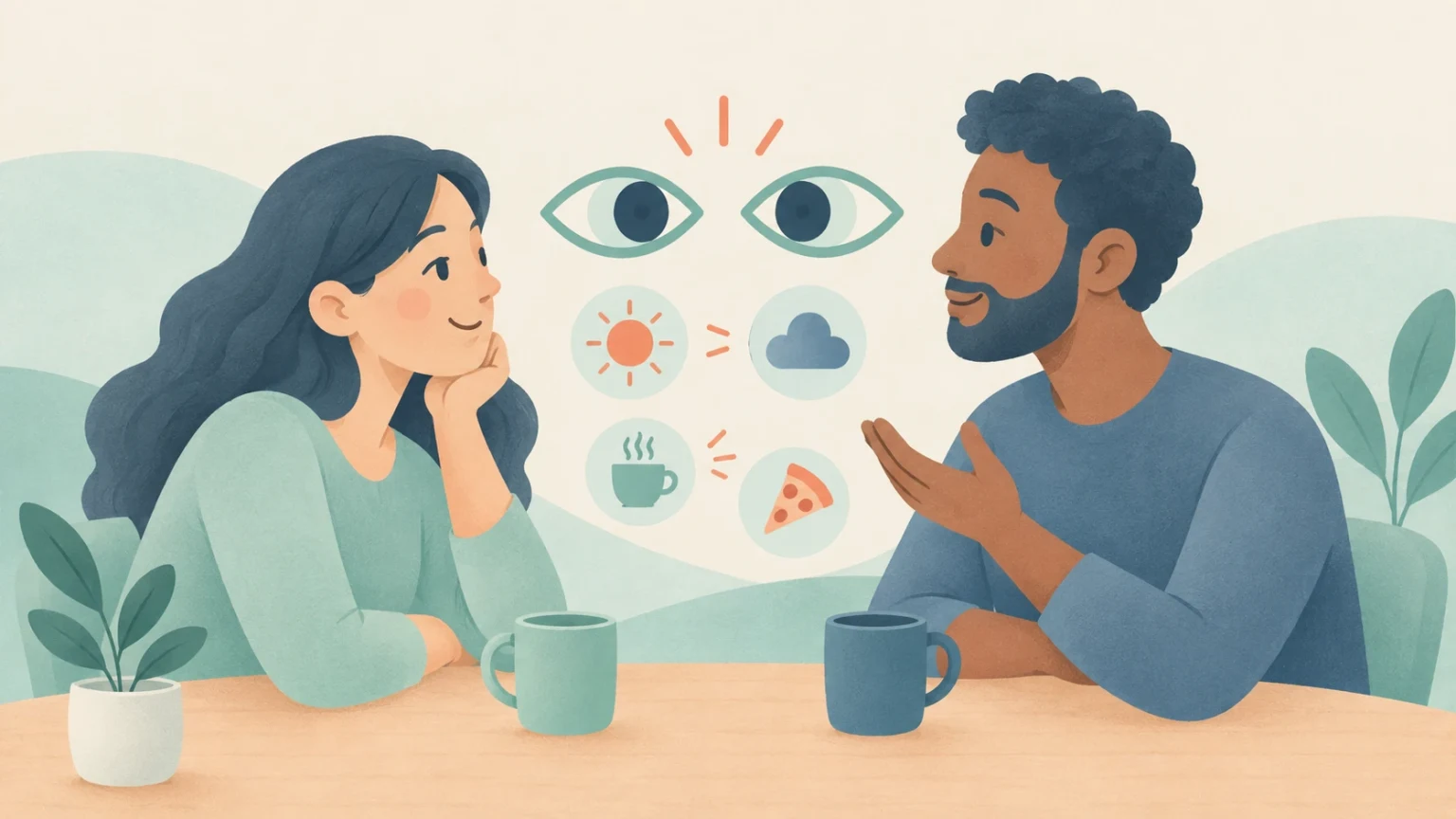
What does 'see eye to eye' mean?
To see eye to eye means to share the same opinion or agree with someone about a specific matter.
نکتههای اصلی
- Use 'see eye to eye' to describe shared opinions.
- Add 'with' for the person, add 'on' or 'about' for the topic, and change only the verb 'see' for tense or person.
- Use 'see eye to eye' with the preposition 'with' to introduce the person, and 'on' or 'about' to introduce the subject.
این درس 5 مرحله داره. هر وقت بخوای میتونی توقف کنی و بعداً ادامه بدی.

مرحلهٔ 1 از 5
یادگیری
معنی و کاربرد رو یاد بگیر و اشتباهات رایج رو بشناس.
تماشا و یادگیری
Eye to eye
Learn to use 'see eye to eye' naturally to describe shared opinions and disagreements in everyday conversation.
خط 1 از 6 · Theo
Theo: No. We don't ... eye it?
این جمله رو بلند بگو، بعد ادامه بده.
پخش ویدیو ادامه پیدا نکرد. دوباره امتحان کن یا متن زیر رو بخون.
مراحل تمرین
با ویدیو تمرین کن 15 دقیقه
یه بخش کوتاه رو میبینی، به یه سؤال جواب میدی و چیزی که شنیدی رو تمرین میکنی. بعدش هم میتونی از معلم کمک بگیری.
بخش اول رایگانه. با اشتراک میتونی بخش ۲ رو ادامه بدی و تمرین بیشتری بخوای.
لغات اصلی این ویدیو
مثال
راهنمای بهخاطرسپردن
با این کلمهها به کار میره
شکلهای مرتبط
با اینها اشتباه نگیر
از همین ویدیو
معنی این کلمه باز نشد. دوباره امتحان کن.
مثالها
I see eye to eye with my manager on the project deadline.
چرا درسته: 'With' introduces the person who shares the opinion, and 'on' introduces the topic.
2 مثال دیگر
-
My parents do not see eye to eye about moving to a smaller house.
The negative auxiliary 'do not' shows a difference of opinion on the topic introduced by 'about'.
-
Did you and your coworker see eye to eye during the budget meeting?
In a question with 'did', use the base verb form 'see', never 'saw'.
خواندن راهنمای کامل
Decide whether people share an opinion
When you want to describe agreement between two people, you can use the complete expression see eye to eye. This expression means that both people hold the same view on a particular matter. It does not mean looking directly into someone's physical eyes. People often use this phrase when discussing a single topic where their thoughts align. Sharing an opinion on one decision does not mean you agree on every topic or that you share the same personality.
-
The designers see eye to eye on the website layout.
چرا درسته: Both designers hold the same view regarding how the website should look.
-
Carlos and his tenant see eye to eye about the lease terms.
چرا درسته: Both parties agree on the conditions written in the rental contract.
نوبت تو
What does it mean if two colleagues see eye to eye on a project deadline?
پاسخ: They share the same opinion about when the project should finish.
نمایش پاسخ
پاسخ: They share the same opinion about when the project should finish.
The idiom describes shared opinions about a specific topic, not physical eye contact or universal agreement.
Identify disagreement in everyday conversation
Sam and Priya are discussing whether to adopt a rescue dog for their home: Sam: "A rescue dog would bring so much energy to our flat. Let us adopt one this weekend!" Priya: "I love animals too, Sam, but our third-floor flat is far too small for an energetic dog." Sam: "We could take turns walking the dog in the park every morning." Priya: "Even with daily walks, a big dog needs outdoor space. We simply do not see eye to eye on getting a pet right now." Even though both housemates love animals, they do not share the same opinion about keeping a pet in their small flat.
-
Sam and Priya do not see eye to eye about adopting a dog.
چرا درسته: Their opinions differ specifically on whether to keep a dog in their small apartment.
-
They love dogs, but they do not see eye to eye on apartment pets.
چرا درسته: Personal affection for animals does not prevent disagreement about living conditions.
این عبارت رو توی Have a word و The elephant in the room هم میبینی.
نوبت تو
In the conversation between Sam and Priya, which point represents their actual disagreement?
پاسخ: Whether keeping an energetic dog in their small apartment is a good idea
نمایش پاسخ
پاسخ: Whether keeping an energetic dog in their small apartment is a good idea
Both housemates like animals, but their opinions clash over keeping a dog in their small third-floor flat.
Add the person and the topic smoothly
You can expand the basic expression step by step to add specific details. Start with the core statement: We see eye to eye. Next, add the person using the preposition with: I see eye to eye with my housemate. Then, add the topic using on or about: We see eye to eye on the rent. Finally, you can combine both pieces: I see eye to eye with my housemate about the cleaning schedule. When the context is already obvious to your listener, you can omit either addition.
-
I see eye to eye with Nina on the kitchen cleaning schedule.
چرا درسته: With introduces the person, while on introduces the specific topic.
-
The roommates see eye to eye about splitting utility bills.
چرا درسته: About introduces a simple noun phrase naming the shared topic.
نوبت تو
Which sentence correctly connects both the person and the topic?
پاسخ: I see eye to eye with my roommate on the utility bill.
نمایش پاسخ
پاسخ: I see eye to eye with my roommate on the utility bill.
English uses 'with' to introduce the person and 'on' or 'about' to introduce the topic.
Express differences and ask questions
To express disagreement, place an auxiliary verb and not before see. Say we don't see eye to eye, or he doesn't see eye to eye with us. For the past tense, use saw in positive statements and didn't see in negative statements. After did or didn't, always return to the base verb see. Notice the difference between we don't see eye to eye and we don't always see eye to eye. Adding always softens the disagreement and shows that you still agree on other points.
-
Marcus doesn't see eye to eye with his brother on politics.
چرا درسته: Does not with the base verb see marks disagreement for a third-person singular subject.
-
Do you and your landlord see eye to eye about repairs?
چرا درسته: The auxiliary do begins the question, followed by the subject and the base verb see.
نوبت تو
How does adding 'always' change the meaning of 'We don't see eye to eye'?
پاسخ: It softens the statement by acknowledging occasional agreement.
نمایش پاسخ
پاسخ: It softens the statement by acknowledging occasional agreement.
'We don't always see eye to eye' means you agree sometimes, which sounds calmer and less absolute than a total disagreement.
Select between the idiom and plain words
The idiom see eye to eye belongs in casual speech, friendly emails, and ordinary workplace discussions. In contrast, formal contracts, official reports, and legal correspondence call for plain verbs like agree or concur. Another related idiom is on the same page, which you can read about in /idioms/on-the-same-page/. While see eye to eye focuses on shared opinions, on the same page often refers to shared understanding or working with identical information. Choosing plain phrasing prevents informal expressions from distracting readers in serious documents.
-
Both companies agreed to the revised delivery schedule.
چرا درسته: Plain phrasing suits formal commercial agreements and legal contracts.
-
The supervisors see eye to eye on weekly production targets.
چرا درسته: The idiom fits relaxed spoken discussion between colleagues at work.
نوبت تو
Where is the plain verb 'agree' a better choice than 'see eye to eye'?
پاسخ: In a formal contract drafted by company lawyers
نمایش پاسخ
پاسخ: In a formal contract drafted by company lawyers
Formal business contracts and legal documents require plain, literal vocabulary rather than colloquial idioms.
Avoid common errors with the fixed form
Because see eye to eye is a fixed expression, you must protect its exact structure. Keep both uses of eye singular; never say see eyes to eyes. Connect people with with rather than to; saying see eye to eye to someone is incorrect. Do not insert the verb be before see, as in are see eye to eye. When asking past questions with did, use the base form see, never saw. Finally, write the verb phrase as separate words without hyphens unless it appears before a noun as a compound modifier.
-
Did you see eye to eye with the contractor on the price?
چرا درسته: After did, the base form see is required, not saw.
-
We see eye to eye on the proposal.
چرا درسته: Both nouns remain singular eye, and the verb phrase contains no hyphens.
نوبت تو
Which sentence contains a grammatical error?
پاسخ: My coworkers are see eye to eye on the plan.
نمایش پاسخ
پاسخ: My coworkers are see eye to eye on the plan.
Do not add the auxiliary verb 'are' before the base verb 'see'; say 'My coworkers see eye to eye.'
Recognize the spoken chunk in fast speech
In natural speech, native speakers pronounce eye to eye as a single connected unit. The word to is usually reduced to a weak form with a schwa vowel, sounding like /tə/. The entire three-word unit therefore sounds like /aɪ tə aɪ/. In very careful or deliberate speech, a speaker might pronounce to with a full vowel as /tuː/, but the weak reduction is far more common. Remember also that the noun eye sounds identical to the pronoun I. Rely on sentence structure to tell them apart.
-
I see eye to eye with Clara on this topic.
چرا درسته: The first /aɪ/ is the pronoun I, while the later /aɪ/ sounds form the idiom.
-
They rarely see eye to eye about money.
چرا درسته: In fluent speech, eye to eye flows together as one rhythmic chunk.
نوبت تو
How is the preposition 'to' most commonly pronounced inside the phrase 'eye to eye'?
پاسخ: As a weak syllable with a neutral schwa vowel /tə/
نمایش پاسخ
پاسخ: As a weak syllable with a neutral schwa vowel /tə/
Connected speech typically reduces 'to' to the weak vowel /tə/, linking the two identical 'eye' sounds.
Recall the pattern and write your own sentence
Testing your recall helps lock the idiom into memory. First, complete this supported gap task: 'My brother and I do not s__ e__ t_ e__ about money.' Answer: 'see eye to eye'. Next, complete an agree-or-disagree paraphrase task: rewrite 'We disagree about the schedule' using the idiom. Answer: 'We do not see eye to eye on the schedule'. Finally, write an original personal sentence about a real disagreement from memory without checking the model. Example response: 'My flatmate and I do not see eye to eye about cleaning the kitchen.'
-
My sister and I do not see eye to eye about where to spend the holidays.
چرا درسته: The sentence uses the negative present form to describe a real personal disagreement.
-
We saw eye to eye on the renovation budget from day one.
چرا درسته: The past form saw accurately describes an agreement reached in the past.
نوبت تو
Which sentence correctly paraphrases 'My roommate and I disagree about the heating bill'?
پاسخ: My roommate and I do not see eye to eye on the heating bill.
نمایش پاسخ
پاسخ: My roommate and I do not see eye to eye on the heating bill.
The negative form 'do not see eye to eye on' correctly paraphrases disagreement while keeping singular 'eye' and preposition 'on'.
کاربرد در جمله
«see eye to eye» رو چطور به کار ببریم؟
خنثی تقریباً در هر موقعیتی، از محیط کار تا جمع دوستان، به کار میره.
کلمههایی که معمولاً همراهش میان
- see eye to eye withI see eye to eye with my coach on the value of regular practice.
- see eye to eye onWe see eye to eye on the best way to welcome new members.
- see eye to eye aboutMy cousin and I see eye to eye about protecting local parks.
- rarely see eye to eyeThose two critics rarely see eye to eye when they discuss modern art.
عبارتهای جایگزین
- «We see eye to eye on this.» بهجای «We have an identical opinion concerning this.» This sounds more relaxed in everyday conversation.
پرسشهایی دربارهٔ «Eye to eye»
What does 'see eye to eye' mean?
To see eye to eye means to share the same opinion or agree about a specific issue. It does not refer to physical eye contact. When two people see eye to eye, their thoughts on a topic match.
My sister and I see eye to eye on most family decisions.
Do I use 'with', 'on' or 'about' after it?
Use 'with' before the person you agree with, and 'on' or 'about' before the topic. You can use either preposition for the topic with no difference in meaning. Both additions are optional if the context is already clear.
I see eye to eye with Daniel on the schedule.
We do not see eye to eye about dinner plans.
How do I say that we disagree?
Place an auxiliary verb and 'not' before 'see'. In the present tense, say 'do not see eye to eye' or 'does not see eye to eye'. To soften the disagreement, add 'always', as in 'We do not always see eye to eye.'
My manager and I do not see eye to eye on the marketing strategy.
We do not always see eye to eye, but we work well together.
Does it mean we agree about everything?
No, it does not mean complete agreement on every topic. You can see eye to eye on one specific subject while holding opposite opinions on another. It also does not imply a deep friendship or identical personalities.
We see eye to eye on the budget, but we disagree about hiring.
Can I use 'see eye to eye' at work?
Yes, it is very common in spoken workplace conversations and everyday team emails. For formal contracts, legal documents, or official company policies, use the plain verb 'agree' instead.
Our team sees eye to eye on the launch date.
Is the past form 'saw eye to eye'?
Yes, in positive past sentences, change 'see' to 'saw'. In negative past sentences or questions with 'did', keep the base verb 'see'. Never change the noun 'eye' to plural.
We saw eye to eye on the price immediately.
Did you see eye to eye with your supervisor?
قبل از رفتن
این نکته رو یادت نگه دار
Use 'see eye to eye' to describe shared opinions. Add 'with' for the person, add 'on' or 'about' for the topic, and change only the verb 'see' for tense or person.
مرحلهٔ 2 از 5
شنیدن
از جملههای کوتاه شروع کن و کمکم برو سراغ جملههای بلندتر. گوش بده و هرچی میشنوی بنویس.
از ویدیو اومدی اینجا؟ هر چهار تمرینِ شنیدن، خواندن، گفتن و نوشتن رو اینجا کامل انجام بده. بازگشت به ویدیو
0 از 4 انجام شده
تمرین شنیداری 1 از 4
گوش بده و هرچی میشنوی بنویس. هر چند بار که لازم داری، دوباره پخشش کن.
0:00
- My parents do not see eye to eye about moving to a smaller house.
- Did you and your coworker see eye to eye during the budget meeting?
تمرین شنیداری 2 از 4
گوش بده و هرچی میشنوی بنویس. هر چند بار که لازم داری، دوباره پخشش کن.
0:00
- My parents do not see eye to eye about moving to a smaller house.
- Did you and your coworker see eye to eye during the budget meeting?
یه فایل بلندتر رو امتحان کن. یه بار گوش بده، بعد قسمتی که متوجه نشدی رو دوباره پخش کن.
تمرین شنیداری 3 از 4
گوش بده و هرچی میشنوی بنویس. هر چند بار که لازم داری، دوباره پخشش کن.
0:00
- My parents do not see eye to eye about moving to a smaller house.
- Did you and your coworker see eye to eye during the budget meeting?
این فایل بلندتره. طبق راهنمای بالای کادر پاسخ پیش برو.
تمرین شنیداری 4 از 4
گوش بده و کلمههای جاافتاده رو بنویس. بقیهٔ متن از قبل نوشته شده.
0:00
- My parents do not see eye to eye about moving to a smaller house.
- Did you and your coworker see eye to eye during the budget meeting?
تمرین تمام شد
تمرین شنیداری این درس رو انجام دادی.
نتیجهات توی همین مرورگر ذخیره شده.
پیشرفتت رو نگه دار. تمرینت فقط در همین دستگاه ذخیره شده. اگه یه حساب رایگان بسازی، از دستگاههای دیگه هم بهش دسترسی داری.
ساخت حساب رایگاندرس رایگان امروز تموم شد. فردا یه درس دیگه داری. امروز تمرین بیشتری میخوای؟ اشتراکها رو ببین.
یه حساب رایگان SubLearn بساز تا با دستگاههای دیگه هم به همین پیشرفت دسترسی داشته باشی.
ذخیرهٔ پیشرفتممرحلهٔ 3 از 5
صحبت کردن
اول همراه گوینده تکرار کن. بعد چیزی که یاد گرفتی رو توی جواب خودت به کار ببر.
تکرار همزمان
همراه گوینده بگو
جمله رو با سرعت کم پخش کن و همزمان با گوینده بگو. به آهنگ حرف زدنش هم دقت کن و مثل خودش بگو.
نوبت توئه
با کلمات خودت بگو
Speak for 30 to 60 seconds from memory. Imagine you are visiting an art museum with a friend. Describe a painting you both like and another that gets different reactions. Explain where your opinions match and where they differ.
از این عبارت استفاده کن: see eye to eye do not see eye to eye
ده ثانیه فکر کن. بعد بدون نگاه کردن به درس، بهاندازهٔ زمانی که در تمرین بالا گفته شده، با صدای بلند جواب بده. تا وقتی درخواست بازخورد نکنی، چیزی فرستاده نمیشه.
0:00
یه نمونهٔ دیگه از این پاسخ رو بشنو
I'm at an art museum with my friend Maya. We see eye to eye about a painting of a crowded train station. We both love the warm colors and the way the artist captures people rushing around. However, we do not see eye to eye on a huge painting of three black squares. Maya thinks it expresses loneliness, while I find it a little boring. She points out the empty space around each square, which helps me understand her reaction. I'd like to look at it again before we leave.
یه بار دیگه امتحان کن و به این سؤال جواب بده: What detail in the painting caught your attention first?
مرحلهٔ 4 از 5
نوشتن
با جملههای خودت پاسخ بده
بازخورد هوش مصنوعی؛ ممکن است اشتباه کند · ویژهٔ مشترکان دیدن اشتراکها
نوشتهات رو خودت بررسی کن
دیدن یک نمونه پاسخ
پیشنویس روی این دستگاه ذخیره شد.
با این سؤالها نوشتهات رو بررسی کن. گرامر و معنی بهصورت خودکار نمره نمیگیرن. پیشنویس هر موضوع جداگانه توی همین برگهٔ مرورگر میمونه.

بخش رایگان این درس رو تمام کردی
- یادگیری
- شنیدن
- صحبت کردن
- نوشتن
- آزمونویژهٔ مشترکان
این بخشها رو دوباره تمرین کن
با یک حساب رایگان، درسهایی که تموم میکنی دوباره برای مرور پیشنهاد میشن تا بهتر توی یادت بمونن.ساخت حساب رایگان
برای ادامهٔ تمرین
مرحلهٔ 5 از 5 · ویژهٔ مشترکان
آزمون
فایلهای صوتی تازه رو بدون راهنما امتحان کن.
برای آزمونهای شنیداری اشتراک لازمه. اول دیکتهٔ رایگان رو امتحان کن، بعد برای ادامه تصمیم بگیر.
تمرین شنیداری 1 از 2 ویژهٔ مشترکان
تمرین شنیداری 2 از 2 ویژهٔ مشترکان
MicroEnglish رو دنبال کن
برای دیدن درسها، ویدیوهای کوتاه و سؤالهای تمرینی، از همون برنامهای دنبالمون کن که استفاده میکنی.
سؤالها و نظرها
دربارهٔ درس سؤال بپرس، یه مثال بنویس یا به یه زبانآموز دیگه کمک کن.
مثال
راهنمای بهخاطرسپردن
با این کلمهها به کار میره
شکلهای مرتبط
با اینها اشتباه نگیر
در این درس
این کلمه در واژهنامهٔ ما نیست. املایش رو بررسی کن یا شکل دیگری از اون رو بنویس.
معنی این کلمه باز نشد. دوباره امتحان کن.