
Wortgrenzen heraushören
Hör zunächst zu, ohne etwas einzugeben. Achte beim zweiten Mal darauf, wo ein Wort endet und das nächste beginnt. Spiele die ganze Wortgruppe erneut ab, um deine Vermutung zu prüfen.
Lektionen 451 bis 468 von 872
-

Free TOEFL preparation: A daily study plan
Use each practice attempt to decide what to work on next. Try a specific task, check what caused difficulty, and choose a follow-up exercise. Your study log should show the problem you found and how you plan to practice it.
-

Practice English speaking: Five daily exercises
A speaking activity is an intentional spoken drill with an explicit goal and time limit. Instead of attempting an open-ended conversation with no clear direction, you assign yourself a narrow communicative job. That job might involve explaining why an order arrived late, requesting a meeting change, or contrasting two commuter routes. The defined boundary frees mental energy so you can concentrate on correct verbs, connectors, and audible pronunciation.
-

Has or have: choose the right verb
Have indicates possession, relationships, routines, and physical characteristics. Has is the third-person singular form of have, used with he, she, it, and singular nouns. In compound tenses, both words function as auxiliary verbs before a past participle.
-

Regular and irregular verbs: How past forms change
Regular past verbs use the suffix -ed or -d to express completed actions in past time. Irregular past verbs express past time through specific vowel or consonant changes, or by keeping an identical base form, rather than taking the regular suffix.
-

Non-Finite Verbs: Forms and Everyday Uses
A finite verb anchors a clause: it may show tense or be a modal such as can. Non-finite forms do not show tense on their own or change to agree with a subject. An infinitive uses the base form, with or without to. A gerund uses -ing to name an activity. Present participles end in -ing; past participles may end in -ed or have irregular forms such as broken and written. Participles can describe nouns or combine with helping verbs.
-

English Infinitives: When to Use To
An infinitive names an action without being tied to a specific time or person. The main verb in the sentence carries the tense, while the infinitive completes the thought. In 'She wants to travel,' the verb 'wants' shows the present tense, and 'to travel' identifies what she wants.
-
Mitgliedschaft
7 Tage kostenlos auf alle Lektionen zugreifen
- 872 Lektionen mit Diktaten und Hörtests
- Drei Akzente: britisch, amerikanisch und australisch
- Entdecke die Bibliothek und speichere deinen Lernfortschritt
Keine Karte erforderlich. Wer danach weiterlernen möchte, kann ab $7.50 pro Monat eine Mitgliedschaft wählen.
Kostenlos testen -

disposition meaning: character and tendency
Disposition refers primarily to a person's or animal's habitual nature, temperament, or customary state of mind. It also describes a recurring inclination or tendency to act in a particular manner. In specialized legal or administrative contexts, the word describes an orderly arrangement, the transfer of property, or the official settlement of a case.
-
More than or more then: choose the right word
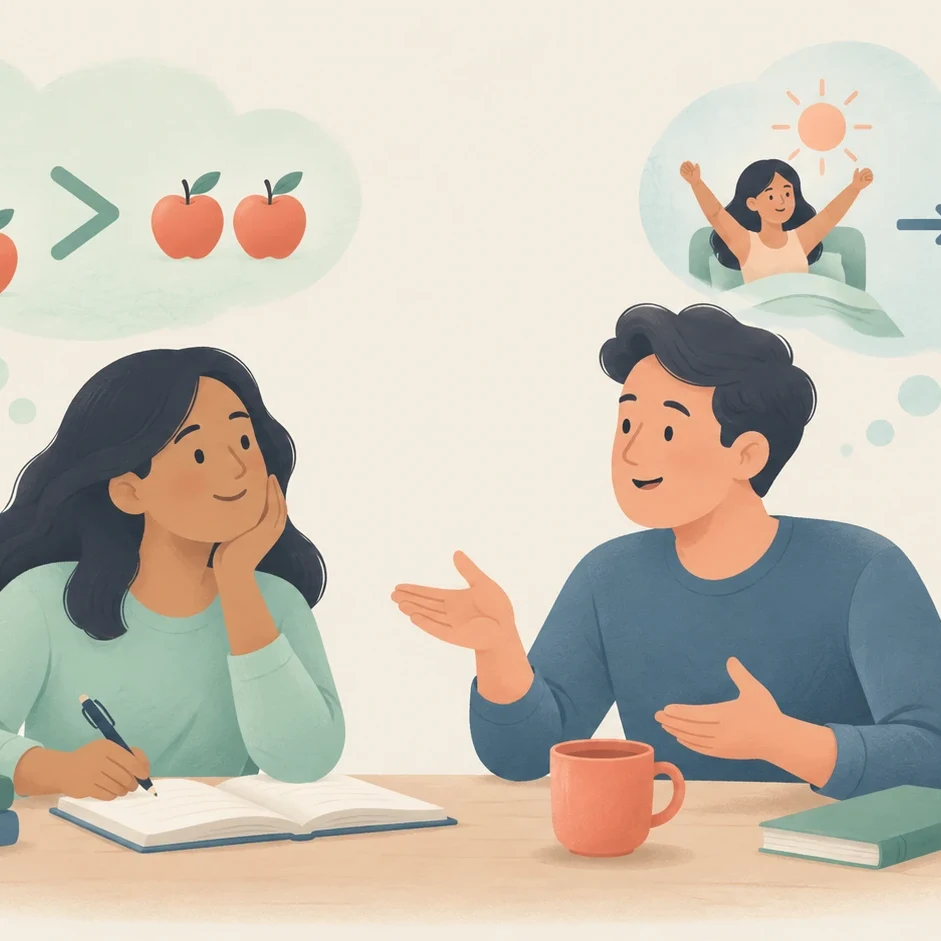
'More than' is a comparative phrase where 'than' introduces the second element, benchmark, or threshold of a comparison. It means an amount greater than a specified number or quality. 'Then' is an adverb of time, order, or condition, meaning 'after that', 'at that time', or 'in that case'. The form 'more then' has no grammatical standing as a comparative phrase.
-

How to use semicolons: guide for clear sentences
A semicolon marks a pause stronger than a comma but softer than a period. It indicates that the following statement directly explains, balances, or completes the statement before it without needing a coordinating conjunction.
-

Past perfect progressive: when to use it
The past perfect progressive highlights the duration or ongoing process of an activity that occurred before a later moment in the past. It shows that the earlier action was in progress up to or close to that second past event, often explaining a visible result or state at that time.
-

paradox meaning: clear everyday examples
A paradox is a statement or situation that seems contradictory or contrary to expectation. Some reveal a truth when explained. Others, especially in logic, expose a contradiction or unresolved problem.
-

Could, would, or should: choose the right verb
Could indicates that something is possible or available as an option. Would describes what happens under a specific condition or in an imagined reality. Should indicates that an action is advisable, desirable, or expected.
-

Ad Hoc: Meaning and Daily Use
Ad hoc means arranged for a particular purpose or situation rather than as a general or standing arrangement.
-

English Collocations: Natural Word Pairs
A collocation is a pair or group of words that habitually appear together in natural speech and writing. While another word combination might communicate your basic idea, it sounds odd to an everyday listener because it breaks standard usage habits.
-

In or within: Choose the right word
The preposition in indicates location inside a place or marks a point after a period passes. The preposition within also means inside, but it explicitly emphasizes the boundaries enclosing a space, amount, distance, or period. In two hours means when two hours have passed. Within two hours means at any point before two hours expire.
-

Using Commas: Where Commas Belong
A comma is a punctuation mark that separates grammatical units inside a sentence. It clarifies how phrases connect, shows where an introductory setup ends, divides series items, and sets off details that can be lifted out without breaking the main thought.
-

One of the Examples Is: Choosing Verbs
One of the examples refers to a single member of a set of examples. In this pattern, use a plural count noun after one of the. The main statement concerns one member, so its verb is normally singular. This is a grammatical pattern, not a claim about whether selection from a one-item set is mathematically possible.
-

If Clauses: Real and Imagined Situations
An if clause sets up a requirement that must be met before a particular result can occur. Depending on how likely or realistic that requirement is, English shifts the tense structure to reflect certainty, possibility, or hypothetical distance.
Noch kein Probeabo? Erhalte täglich eine kostenlose Lektion
7 Tage lang kommt jeden Tag ein kurzes Diktat per E-Mail. Übe, wo du gerade bist. Du brauchst kein Konto.
Du findest den gesuchten Ausdruck oder die passende Situation nicht?
Lektionsanfragen sind in der Mitgliedschaft enthalten.
Mitgliedschaft ansehen