Áudio curto em inglês
English prepositions: choose the right word
How do I choose the right English preposition?
Choose the English preposition by identifying the relationship between the words, such as place, time, movement, method, purpose or a familiar word pairing. For example, say, 'The parcel arrived by train.' Use 'to' for a destination and 'by' for a travel method; learn common verb and adjective pairings as complete phrases.
Pontos principais
- Use 'at' for precise places and clock times.
- Use 'in' for enclosed spaces, months, seasons and years.
- Use 'on' for surfaces, days and dates.
- 'By' can show methods and deadlines; 'for' can show purpose or duration.
Esta aula tem 5 etapas. Você pode parar quando quiser e continuar depois.
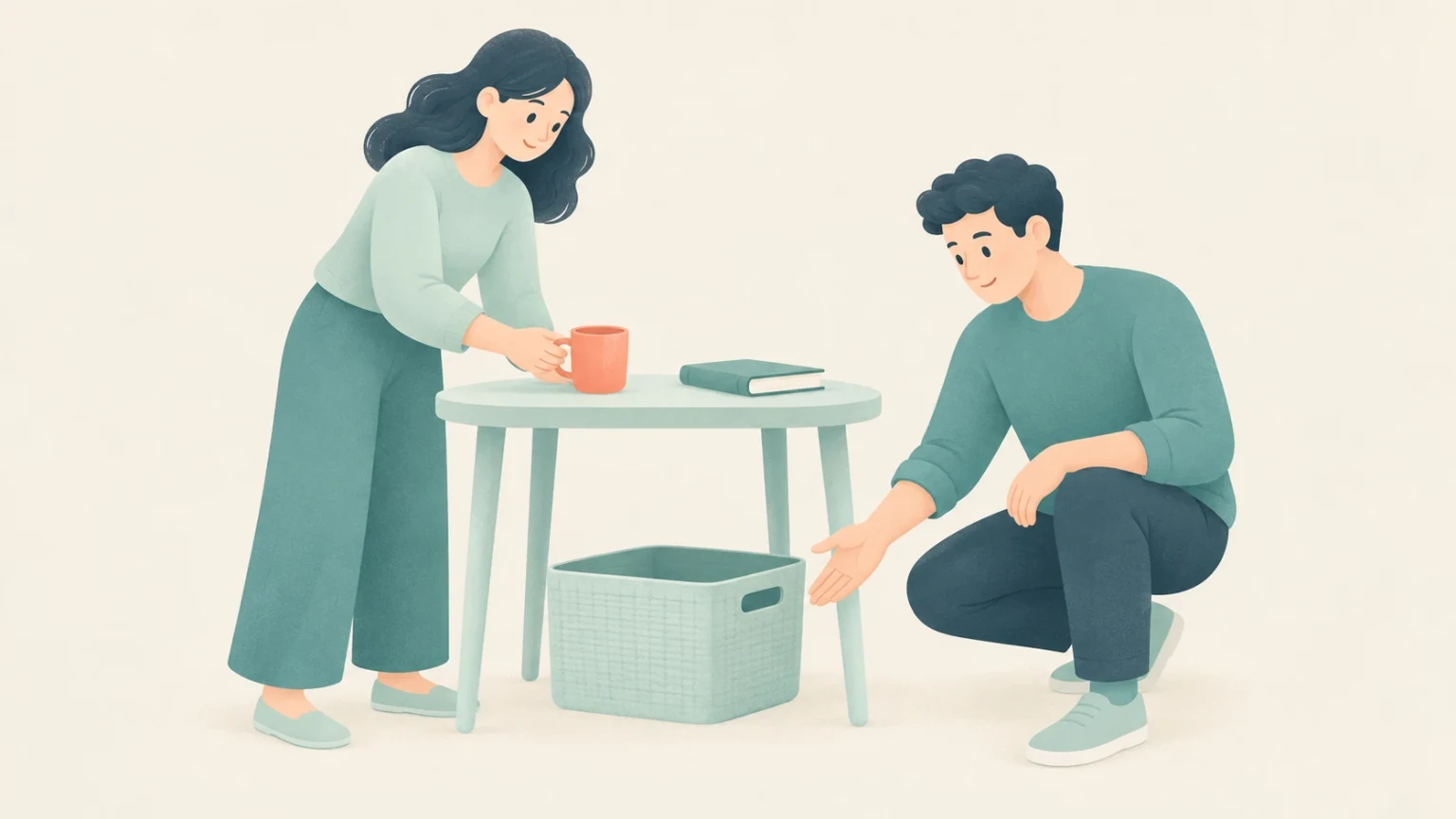

Em resumo
| Forma | Use para | Exemplo |
|---|---|---|
| 'at' | A precise point in space or time. | We met at the station at six. |
| 'in' | An enclosed space or a longer calendar period. | The keys are in the drawer; the course starts in May. |
| 'on' | A surface, day or date. | The notice is on the door; the meeting is on Tuesday. |
| 'by' | A method or a completion deadline. | She sent it by post; please reply by noon. |
| 'for' and 'with' | 'For' can show purpose or beneficiary; 'with' can show a tool or companion. | He bought a gift for Jo and cut the ribbon with scissors. |
| 'to' | A destination or direction of movement. | They walked to the library. |
Etapa 1 de 5
Entender
O que significa, quando usar e quais erros evitar.
A explicação completa
English prepositions establish relationships between a noun or pronoun and other words in a sentence. They specify position in space (at the entrance, on the desk, in the cabinet), position in time (at six, on Tuesday, in July), direction of movement (to the office), methods or deadlines (by email, by Friday), reasons and recipients (for our client), and instruments or companions (with a wrench, with a colleague). Understanding the category of connection helps you choose the natural word every time.
The technician placed the diagnostic tool on the metal cart.
Por que funciona: 'On' identifies placement on an open horizontal surface.
Mais 3 exemplos
-
Our division head scheduled the planning session at ten.
'At' specifies a precise clock time for the scheduled event.
-
Marcus submitted the project expenditure report by courier.
'By' introduces the transmission method used for delivery.
-
She opened the storage container with a small brass key.
'With' introduces the mechanical tool used to unlock the container.
Leia o guia completo
Identify the connection before choosing a word
When you pick an English preposition, start by observing how two ideas relate in space, time, or purpose. Translating single prepositions directly from your native language often creates confusion because one word in your language may correspond to three different English words. Ask yourself what kind of link exists between the action and the noun that follows. Are you pointing to an exact spot, naming an enclosed area, marking a deadline, or identifying a tool? That simple relationship narrows your decision immediately.
-
The technician left the spare cables on the workbench.
Por que funciona: Use 'on' because the workbench provides an open horizontal surface.
-
The training session starts at nine in Room 204.
Por que funciona: Use 'at' for the clock time and 'in' for the enclosed room.
Sua vez
Which question best helps you select the correct preposition in a new sentence?
Resposta: What type of relationship connects the action to the following noun?
Mostrar a resposta
Resposta: What type of relationship connects the action to the following noun?
Prepositions signal spatial, temporal, or functional relationships, so identifying that connection directs you to the proper word.
Distinguish specific points from surfaces and containers
Spatial prepositions become straightforward when you visualize geometric dimensions. Use 'at' when you treat a place as a single point, address, or target location without focusing on its interior. Use 'on' when an object rests on a horizontal or vertical surface, such as a table, a wall, or a screen. Use 'in' when something sits inside a container, a room, a vehicle with sides, or a defined geographical territory. Visualizing the boundary guides your word choice.
-
We met the client at the building entrance before lunch.
Por que funciona: Use 'at' because the entrance serves as a specific meeting point.
-
The technician placed the sensor on the metal wall.
Por que funciona: Use 'on' because the sensor attaches to an upright surface.
-
All original contracts remain in the locked cabinet.
Por que funciona: Use 'in' because the cabinet encloses the documents.
Você pode praticar isso novamente em Prepositions of Movement: Choose the Route e Reflexive Pronouns: Choose the Right Form.
Sua vez
Which preposition correctly completes: 'The visitor signed the guest register ___ the front desk'?
Resposta: at
Mostrar a resposta
Resposta: at
The front desk functions as a specific station or service point where an interaction takes place.
Match calendar units to precise times and periods
Time prepositions follow a clear hierarchy based on calendar precision. Use 'at' for exact moments, including clock times, meal times, and brief holiday periods like at noon, at five, and at dinner. Use 'on' for specific calendar days, dates, and named weekdays like on Tuesday or on July 14. Use 'in' for longer stretches of time that surround an event, including months, seasons, years, decades, and centuries. Thinking of time from narrow points to wide spans keeps these markers organized.
-
The financial audit begins at nine on Monday morning.
Por que funciona: Use 'at' for the clock hour and 'on' for the specific day.
-
Our department launched the software upgrade in November.
Por que funciona: Use 'in' because November is an extended calendar month.
Sua vez
Which preposition completes: 'The new factory will open ___ 2028'?
Resposta: in
Mostrar a resposta
Resposta: in
Years represent extended time spans, which always take 'in' in standard English.
Separate where you travel from how you travel
Learners often confuse the destination of a journey with the method used to complete it. Use 'to' to indicate the direction, endpoint, or recipient of movement, such as walking to the office or shipping goods to Chicago. In contrast, use 'by' to identify the mode of transportation or the medium of communication, such as traveling by train or replying by email. When you name a specific vehicle with an article, shift to 'in a car' or 'on a bus'.
-
The engineering group commuted to the testing facility by train.
Por que funciona: Use 'to' for the facility destination and 'by' for the transport method.
-
Please send your completed invoice to accounting by email.
Por que funciona: Accounting receives the document, while email provides the transmission medium.
Sua vez
Which sentence separates destination and method correctly?
Resposta: We traveled to Seattle by plane.
Mostrar a resposta
Resposta: We traveled to Seattle by plane.
'To' introduces Seattle as the endpoint, while 'by' specifies the airplane as the travel method.
Distinguish reasons and beneficiaries from tools
When describing an action, be careful to distinguish why something happens from what physical instrument accomplishes it. Use 'for' to explain the purpose, the beneficiary, or the reason behind an activity, answering questions like why or for whom. Use 'with' to introduce the tool, instrument, material, or accompanying person involved in the work. Mixing these prepositions changes the meaning of your sentence and can confuse listeners about who or what performed the task.
-
Marcus assembled the shelving unit with a cordless drill.
Por que funciona: Use 'with' because the drill is the mechanical tool used to assemble the unit.
-
Marcus bought several spare brackets for our storage room.
Por que funciona: Use 'for' because the storage room is the intended recipient and purpose.
Sua vez
Which preposition correctly fills the blank: 'She sliced the heavy cardboard ___ a utility knife'?
Resposta: with
Mostrar a resposta
Resposta: with
A utility knife is a physical instrument, so English uses 'with' to mark the tool.
Track completion deadlines versus continuous duration
Managing schedules requires choosing the right preposition for limits and durations. Use 'by' to specify a deadline, which means an event or task must be finished at or before a cutoff point. Use 'until' when an action or state continues without interruption up to a specific boundary. Use 'for' when you want to measure the total amount of elapsed time, such as two hours or five years. Confusing 'by' with 'until' is one of the most common workplace communication errors.
-
All department managers must submit their budget drafts by Friday.
Por que funciona: Use 'by' because Friday afternoon marks the final deadline for submission.
-
The technician worked on the server until midnight.
Por que funciona: Use 'until' because the repair activity continued uninterrupted up to that hour.
-
The committee reviewed the proposals for three hours.
Por que funciona: Use 'for' to express the total duration of the review session.
Sua vez
Which word correctly completes: 'Please submit your timesheet ___ five o'clock today'?
Resposta: by
Mostrar a resposta
Resposta: by
Five o'clock is a deadline or cutoff time for submission, which requires 'by'.
Link common verbs to their fixed prepositions
Many English verbs connect to their objects through specific prepositions that cannot be swapped or translated literally. For example, English speakers say 'listen to music', 'wait for a bus', 'depend on the weather', and 'apply for a position'. Memorizing these combinations as single lexical units saves thinking time during speech. Instead of trying to deduce the preposition from an abstract rule, practice the verb and preposition together whenever you learn a new action.
-
The project delivery date depends on supplier availability.
Por que funciona: The verb 'depend' takes the preposition 'on' to introduce the controlling factor.
-
Two qualified candidates applied for the supervisor role.
Por que funciona: The verb 'apply' takes 'for' when introducing the targeted job or grant.
Sua vez
Which preposition follows the verb in: 'We are waiting ___ the delivery truck'?
Resposta: for
Mostrar a resposta
Resposta: for
The verb 'wait' regularly pairs with 'for' when introducing the person or thing expected.
Connect descriptive adjectives to standard particles
Adjectives often require fixed prepositions to link their descriptive quality to a noun or gerund. Common workplace and daily expressions include 'interested in renewable energy', 'responsible for safety inspections', 'good at troubleshooting', and 'worried about inflation'. Because these pairings do not follow an absolute mathematical logic, hearing them in full sentences helps lock them into your memory. Always write down the adjective together with its accompanying preposition in your vocabulary notes.
-
Sophie is responsible for onboarding new engineers.
Por que funciona: The adjective 'responsible' takes 'for' followed by the task or duty.
-
Our senior programmer is skilled at debugging legacy code.
Por que funciona: Expressions of skill such as 'good at' or 'skilled at' take 'at' before an activity.
Sua vez
Which preposition correctly follows the adjective in: 'Liam is interested ___ project management'?
Resposta: in
Mostrar a resposta
Resposta: in
The adjective 'interested' pairs with 'in' to identify an area of study or enthusiasm.
Erros comuns
O que os alunos costumam dizer, o que dizer em vez disso e por quê.
-
Não isto:
The workshop begins on nine.Diga: The workshop begins at nine.
'At' is used for an exact clock time.
-
Não isto:
We travelled by Bristol by train.Diga: We travelled to Bristol by train.
'To' marks the destination; 'by' marks the travel method.
-
Não isto:
She opened the parcel for a knife.Diga: She opened the parcel with a knife.
'With' introduces the tool used to do something.
-
Não isto:
Please send the form until Friday.Diga: Please send the form by Friday.
'By' sets a deadline; 'until' describes something continuing up to a point.
Perguntas sobre "English prepositions: choose the right word"
Why do native speakers say both 'at the bank' and 'in the bank'?
The choice depends on your focus. Use 'at' when you treat the building as an activity point, service stop, or general location. Use 'in' when you want to emphasize physical presence inside the interior space or structure.
I deposited my paycheck at the bank during lunch.
It started raining, so we waited in the bank until the storm stopped.
How do I choose between 'by bus', 'on the bus', and 'in a car'?
Use 'by' without an article to name the travel method generally, such as by bus, by train, or by car. Use 'on' when you enter larger public transport vehicles where passengers can walk upright, such as a bus, train, or airplane. Use 'in' for smaller private vehicles like cars or taxis where you sit inside.
She goes to work by bus every morning.
We found two empty seats on the bus.
Three passengers sat quietly in the taxi.
What is the difference between completing a task 'by Friday' and 'until Friday'?
Use 'by' to set a deadline, meaning the action happens at or before that cutoff time. Use 'until' to show an ongoing action or continuous situation that continues up to that moment and stops.
Please submit the application by Friday afternoon.
The office will remain closed until Friday morning.
When should I say 'responsible for' instead of 'responsible to'?
Use 'responsible for' followed by an activity, task, or outcome that you manage. Use 'responsible to' when naming the authority, manager, or governing body you report to directly.
Our team is responsible for managing client accounts.
The regional manager is responsible to the company board.
Does 'on time' mean the exact same thing as 'in time'?
No, they convey different ideas. 'On time' means punctual according to a planned schedule or clock time. 'In time' means early enough to do something before a negative consequence occurs, often followed by 'for' or a to-infinitive.
The morning flight departed on time at nine.
We arrived in time to catch the last connecting train.
Antes de ir
Lembre-se disto
Determine the relationship before you select a preposition. Use at for precise points in space and clock times. Use in for enclosed areas, containers, and extended calendar spans. Use on for surfaces, days, and dates. Use by for methods, media, and deadlines. Use for for duration, purpose, and beneficiaries. Use with for tools and companions. Practicing these words within full phrases builds lasting fluency.
Etapa 2 de 5
Ouvir
Ouça frases reais, das curtas às longas, e escreva o que você ouve.
0 de 4 concluído
Escuta 1 de 4
Ouça e, em seguida, digite o que você ouve. Repita quantas vezes precisar.
0:00
Ler a transcrição
Our design team will gather at eleven.
Use 'at' before clock times to indicate a precise scheduled moment.
Ouça por
Em velocidade natural, essas palavras mudam de forma. Toque em uma para ouvi-la novamente.
- O último som da primeira palavra se conecta diretamente à próxima palavra.
- O último som da primeira palavra se conecta diretamente à próxima palavra.
- Uma palavra pequena como esta é dita rapidamente e suavemente, não como escrita.
Ouça por
Em velocidade natural, essas palavras mudam de forma. Toque em uma para ouvi-la novamente.
- O último som da primeira palavra se conecta diretamente à próxima palavra.
- O último som da primeira palavra se conecta diretamente à próxima palavra.
- Uma palavra pequena como esta é dita rapidamente e suavemente, não como escrita.
Ouça por
Em velocidade natural, essas palavras mudam de forma. Toque em uma para ouvi-la novamente.
- O último som da primeira palavra se conecta diretamente à próxima palavra.
- O último som da primeira palavra se conecta diretamente à próxima palavra.
- Uma palavra pequena como esta é dita rapidamente e suavemente, não como escrita.
Escuta 2 de 4
Ouça e, em seguida, digite o que você ouve. Repita quantas vezes precisar.
0:00
Ler a transcrição
Marcus sends every weekly update by email.
Use 'by' to express the method, channel, or medium of communication.
Ouça por
Em velocidade natural, essas palavras mudam de forma. Toque em uma para ouvi-la novamente.
- O último som da primeira palavra se conecta diretamente à próxima palavra.
- No inglês americano, este 't' soa como um 'd' rápido e suave.
Ouça por
Em velocidade natural, essas palavras mudam de forma. Toque em uma para ouvi-la novamente.
- No inglês americano, este 't' soa como um 'd' rápido e suave.
Tente um clipe mais longo. Escute uma vez, depois reproduza a parte que você perdeu.
Escuta 3 de 4
Ouça e, em seguida, digite o que você ouve. Repita quantas vezes precisar.
0:00
Ler a transcrição
Claire works in an office near downtown, so she stays in our city center for eight months every year.
Use 'in' for enclosed spaces or geographic regions, and 'for' to measure duration.
Ouça por
Em velocidade natural, essas palavras mudam de forma. Toque em uma para ouvi-la novamente.
- O último som da primeira palavra se conecta diretamente à próxima palavra.
- O último som da primeira palavra se conecta diretamente à próxima palavra.
- O último som da primeira palavra se conecta diretamente à próxima palavra.
Ouça por
Em velocidade natural, essas palavras mudam de forma. Toque em uma para ouvi-la novamente.
- O último som da primeira palavra se conecta diretamente à próxima palavra.
- O último som da primeira palavra se conecta diretamente à próxima palavra.
- O último som da primeira palavra se conecta diretamente à próxima palavra.
Ouça por
Em velocidade natural, essas palavras mudam de forma. Toque em uma para ouvi-la novamente.
- O último som da primeira palavra se conecta diretamente à próxima palavra.
- O último som da primeira palavra se conecta diretamente à próxima palavra.
- O último som da primeira palavra se conecta diretamente à próxima palavra.
Este clipe é mais longo. Siga a instrução acima do campo de resposta.
Escuta 4 de 4
Ouça e, em seguida, digite as palavras que faltam. O restante do texto já está lá.
0:00
Ler a transcrição
New trainees should arrive at eight so everyone can register in our main auditorium. You will travel by bus to our downtown campus, where instructors will welcome you with open arms. Please bring a notebook for our first discussion. We plan to conclude every workshop by four, so you can return home on our evening shuttle without any delay.
This message uses 'at' for hours, 'in' for enclosed spaces, 'by' for transport methods and deadlines, 'to' for destinations, 'with' for manner, and 'for' for purpose.
Ouça por
Em velocidade natural, essas palavras mudam de forma. Toque em uma para ouvi-la novamente.
- O último som da primeira palavra se conecta diretamente à próxima palavra.
- O último som da primeira palavra se conecta diretamente à próxima palavra.
- O último som da primeira palavra se conecta diretamente à próxima palavra.
Ouça por
Em velocidade natural, essas palavras mudam de forma. Toque em uma para ouvi-la novamente.
- O último som da primeira palavra se conecta diretamente à próxima palavra.
- O último som da primeira palavra se conecta diretamente à próxima palavra.
- O último som da primeira palavra se conecta diretamente à próxima palavra.
Ouça por
Em velocidade natural, essas palavras mudam de forma. Toque em uma para ouvi-la novamente.
- O último som da primeira palavra se conecta diretamente à próxima palavra.
- O último som da primeira palavra se conecta diretamente à próxima palavra.
- O último som da primeira palavra se conecta diretamente à próxima palavra.
Prática concluída
Você ouviu com atenção.
Seu resultado está salvo neste navegador.
Mantenha seu progresso. Sua prática é salva apenas neste dispositivo. Crie uma conta gratuita para mantê-la em todos os lugares.
Criar uma conta gratuitaEsta foi a aula gratuita de hoje. Amanhã você ganha outra. Quer mais hoje? Veja a assinatura.
Crie uma conta gratuita no MicroEnglish para manter este progresso em todos os seus dispositivos.
Salvar meu progressoEtapa 3 de 5
Falar
Diga junto com o falante e então use em uma resposta sua.
Imitar
Diga junto com o falante
Our design team will gather at eleven.
Reproduza a linha lentamente e, em seguida, fale ao mesmo tempo que o falante. Copie o ritmo, não apenas as palavras.
Sua vez
Diga do seu jeito
Describe your typical morning routine before work or class. Explain when you get up, where you prepare breakfast, how you travel to your destination, and what tools or equipment you bring with you.
Use: english prepositions: choose the right word
Você pode começar com “On weekday mornings, I usually wake up at…”
Pense por dez segundos e depois responda em voz alta pelo tempo que a tarefa acima pedir, sem olhar a lição. Nada é enviado a menos que você peça feedback.
0:00
Etapa 4 de 5
Escrever
Escreva sobre seu dia ou semana usando o que aprendeu e depois escreva uma mensagem.
Escrever
Coloque em suas próprias palavras
- Eu usei “english prepositions: choose the right word”.
- É sobre a minha vida, não o exemplo da aula.
- Eu li em voz alta uma vez para verificar se soa bem.
Escreva sua própria resposta
Escolha uma situação e escreva 30–50 palavras com suas próprias palavras. Isso é diferente de digitar as palavras exatas em uma gravação.
Verifique sua própria escrita
Leia uma possível resposta
Use essas verificações para revisar sua mensagem. Gramática e significado não são avaliados automaticamente. Cada tarefa mantém seu próprio rascunho nesta aba do navegador.

Você concluiu a parte gratuita desta aula
- Entender
- Ouvir
- Falar
- Escrever
- VerificarParte da assinatura
Vale a pena rever
Com uma conta gratuita, as aulas que você concluir voltam para revisão. Assim fica mais fácil lembrar delas.Criar uma conta gratuita
Etapa 5 de 5 · Parte da assinatura
Verificar
Novos clipes sem dicas.
Os testes de escuta estão incluídos na assinatura. Experimente o ditado grátis primeiro, depois decida se quer continuar.
Escuta 1 de 2 Parte da assinatura
Escuta 2 de 2 Parte da assinatura
Siga o MicroEnglish
Novas aulas, vídeos curtos e testes rápidos todos os dias. Escolha o aplicativo que você já usa.
Perguntas e comentários
Pergunte sobre esta aula, compartilhe um exemplo ou ajude outro aluno.
Exemplo
Dica de memória
Combina com
Formas relacionadas
Não confundir com
Nesta aula
Esta palavra não está no nosso dicionário. Confira a grafia ou tente outra forma da palavra.
Não foi possível carregar esta palavra. Tente novamente.