
Áudio curto em inglês
Couch potato: meaning and everyday use
What does 'couch potato' mean?
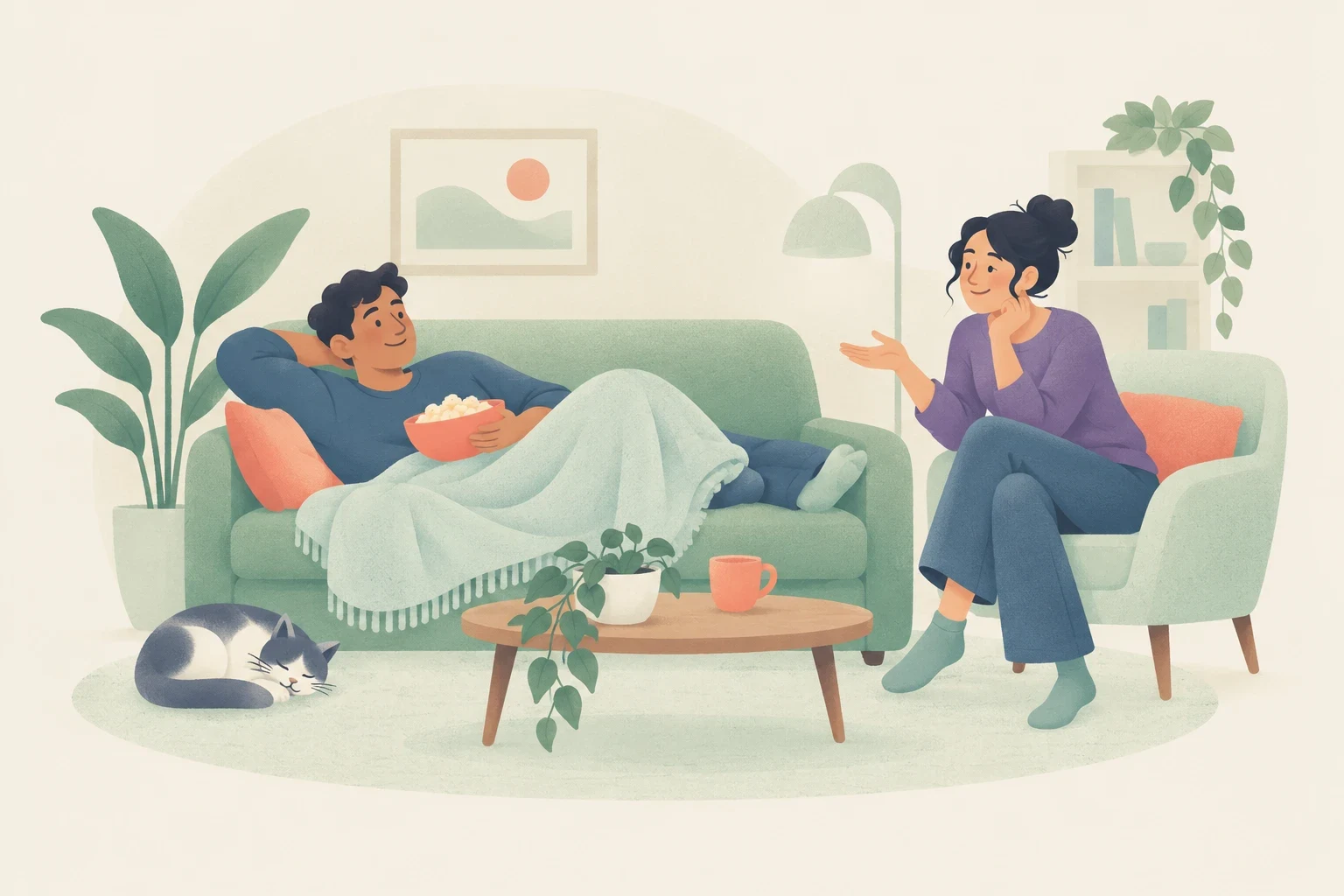
A 'couch potato' is someone who spends a lot of time sitting, usually watching television or other entertainment. The informal phrase can suggest laziness, so it is safest to use it playfully about yourself. For example: 'I was a couch potato on Sunday.' Say 'couch potatoes' for more than one person.
Pontos principais
- Use 'a couch potato' for one person.
- The plural is 'couch potatoes'; 'couch' stays unchanged.
- The phrase usually follows a form of 'be'.
- Calling yourself a couch potato can be playful.
Esta aula tem 5 etapas. Você pode parar quando quiser e continuar depois.

Etapa 1 de 5
Entender
O que significa, quando usar e quais erros evitar.
A explicação completa
The phrase couch potato refers figuratively to a person who spends many hours sitting down with little physical activity, typically consuming screen entertainment like television shows, films, or video games. The humor comes from comparing an inactive person on a sofa to a stationary vegetable. While it often implies laziness or a lack of exercise, the expression does not provide factual medical information, explain why someone needs rest, or indicate how energetic that person is at work or school.
I decided to be a couch potato on Saturday because I needed a break after my exams.
Por que funciona: The speaker uses the singular noun pattern playfully about their own planned rest.
Mais 3 exemplos
-
My brother and I were couch potatoes all afternoon while the heavy rain fell.
The plural form couch potatoes pairs with were to describe a shared indoor afternoon.
-
Instead of calling her assistant a couch potato, the manager explained that he needed rest after travel.
The sentence replaces an informal label with a respectful, objective description of circumstances.
-
Watching a two-hour documentary does not make someone a couch potato.
The example clarifies that enjoying one program does not justify a broad negative label.
Leia o guia completo
Recognize that the phrase describes a person
A couch is a sofa, which is a piece of furniture for sitting. A couch potato is an informal expression that describes a human being rather than a vegetable. When people use this phrase, they refer to someone who spends hours sitting down, usually watching television, playing video games, or streaming shows. Because the phrase can imply that the person is inactive or lazy, understanding the speaker's intent is essential before using it.
-
Liam spent Saturday afternoon on the sofa, calling himself a couch potato while watching football.
Por que funciona: Liam describes his own inactive afternoon using humorous imagery.
-
Sitting down to watch one movie does not turn you into a couch potato.
Por que funciona: Taking an occasional break is normal rest, not a permanent habit.
Sua vez
What does the expression couch potato literally describe in everyday conversation?
Resposta: A person who spends significant time sitting and watching entertainment
Mostrar a resposta
Resposta: A person who spends significant time sitting and watching entertainment
The idiom refers figuratively to an inactive person sitting on a sofa, never to actual food or furniture.
Master singular and plural noun patterns
The expression functions as a countable noun phrase. A noun is a word that names a person, place, or thing. For one individual, use the indefinite article and say a couch potato. For multiple individuals, change potato to potatoes while leaving couch unchanged: couch potatoes. You will almost always see this phrase following the verb be in present or past tenses, such as is, are, was, or were.
-
My brother was a couch potato throughout the rainy weekend.
Por que funciona: Singular subject with past tense was and the article a.
-
We were couch potatoes yesterday because the heavy snow kept us inside.
Por que funciona: Plural subject we pairs with were and the plural noun couch potatoes.
Você pode praticar isso novamente em under the weather: meaning and everyday use e Present Continuous: Form and Everyday Use.
Sua vez
Which sentence shows the correct plural form of the idiom?
Resposta: They were couch potatoes during the winter storm.
Mostrar a resposta
Resposta: They were couch potatoes during the winter storm.
The first word couch remains singular, while potato takes the regular plural ending -es.
Distinguish friendly self-humor from criticism
Language register tells you how formal or polite words sound in different social settings. Calling yourself a couch potato is usually seen as harmless self-directed humor. However, labeling someone else a couch potato can easily cause offense because it suggests that the person is lazy or unproductive. Tone and personal relationships matter greatly. Outside of close friendships, avoid using this phrase to describe other people.
-
I am being such a couch potato today, but I really need this rest.
Por que funciona: Self-directed humor softens the comment and explains a desire to relax.
-
My coworker rested at home after finishing a stressful project.
Por que funciona: A factual description avoids judging someone else's personal habits.
Sua vez
Why can calling a classmate a couch potato create a negative impression?
Resposta: It can imply that the person is lazy or unwilling to make an effort.
Mostrar a resposta
Resposta: It can imply that the person is lazy or unwilling to make an effort.
Using the label on another person often carries an unkind judgment about their character or productivity.
Navigate social plans and home relaxation
Consider an everyday social situation. A friend invites you on an evening walk, but you prefer to stay home and finish a television series. Describing your own choice playfully prevents your friend from feeling ignored. Notice how the speakers in the following dialogue express their preferences without turning an informal idiom into an unkind judgment about each other's lifestyle.
-
Tariq: 'Would you like to walk around the lake?' Sofia: 'Not tonight. I plan to be a couch potato and watch the season finale.'
Por que funciona: Sofia uses the idiom about herself to decline an invitation warmly.
-
Tariq: 'Enjoy your quiet evening; you had three difficult examinations this week.'
Por que funciona: Tariq responds neutrally by acknowledging Sofia's hard work rather than criticizing her.
Sua vez
In the dialogue, how does Sofia use the phrase couch potato?
Resposta: As a lighthearted excuse to decline an invitation and stay home
Mostrar a resposta
Resposta: As a lighthearted excuse to decline an invitation and stay home
Sofia applies the phrase to herself to decline the walk warmly without offending her friend.
Separate origin stories from daily usage
Many popular accounts trace couch potato to southern California in the 1970s, where humorists created cartoon characters that celebrated sedentary lifestyles in front of television screens. While these cultural stories provide amusing background details, linguists treat specific claims of invention with caution. In modern English, you do not need historical knowledge to use the phrase accurately in daily communication.
-
Popular media in the late twentieth century helped make the phrase familiar across English-speaking countries.
Por que funciona: Media exposure turned an informal Californian joke into an internationally recognized idiom.
-
Modern speakers use the phrase to describe passive screen time rather than historical cartoons.
Por que funciona: Contemporary meaning focuses on sitting and screen entertainment.
Sua vez
What is the most practical reason to study the origin of couch potato?
Resposta: It provides cultural background, but current social meaning is what guides daily use.
Mostrar a resposta
Resposta: It provides cultural background, but current social meaning is what guides daily use.
Historical background is interesting, but understanding modern register and meaning is what prevents communication errors.
Avoid common grammar and usage errors
Learners make three frequent errors with this idiom. First, they omit the article and say 'I was couch potato', which is ungrammatical. Second, they spell the plural as 'potatos' without an e. Third, they treat one quiet evening as proof that someone is permanently lazy. Remember that resting after a hard day is normal behavior, not a lifelong personal identity.
-
Incorrect: 'He is couch potato.' Correct: 'He is a couch potato.'
Por que funciona: The singular countable noun requires the article a.
-
Incorrect: 'They are couch potatos.' Correct: 'They are couch potatoes.'
Por que funciona: Potatoes requires -es in the plural.
Sua vez
Which sentence contains a grammatical error?
Resposta: Elena was couch potato on Sunday afternoon.
Mostrar a resposta
Resposta: Elena was couch potato on Sunday afternoon.
The singular countable expression requires the indefinite article 'a': 'a couch potato'.
Pronounce vowels and syllables accurately
Pay close attention to pronunciation when listening and speaking. In couch, produce the diphthong /aʊ/, similar to out or shout, followed by the crisp consonant /tʃ/. Do not confuse couch with coach, which uses /oʊ/. In potato, the first syllable has an unstressed schwa sound /pə/, while the primary stress lands firmly on the middle syllable: po-TAY-to.
-
Make sure couch sounds distinct from coach when speaking quickly.
Por que funciona: Couch has /aʊ/ as in loud; coach has /oʊ/ as in road.
-
Place the main vocal stress on the second syllable: po-TAY-to.
Por que funciona: Stressing the middle syllable creates natural English rhythm.
Sua vez
Which syllable carries the primary stress in the word potato?
Resposta: The middle syllable: po-TAY-to
Mostrar a resposta
Resposta: The middle syllable: po-TAY-to
In standard English, the middle syllable of potato carries the main vocal stress.
Recall the phrase and choose kinder words
Accurate recall and situational awareness allow you to speak English with confidence. When speaking about your own quiet weekend, you can choose this colorful idiom freely. However, when talking about colleagues, acquaintances, or family members, replace judgmental labels with clear factual descriptions. Stating what someone actually did respects their privacy and personal circumstances.
-
Instead of saying 'Lucas is a couch potato', say 'Lucas spent the evening resting at home.'
Por que funciona: A factual statement reports activity without judging character.
-
Instead of saying 'My coworkers are couch potatoes', say 'My coworkers enjoyed a quiet weekend indoors.'
Por que funciona: Neutral language prevents misunderstandings in professional environments.
Sua vez
What is the best way to describe a coworker who stayed home after a tiring week?
Resposta: Say that they spent a quiet evening resting at home.
Mostrar a resposta
Resposta: Say that they spent a quiet evening resting at home.
Factual descriptions of rest are professional, respectful, and free of judgmental stereotypes.
Erros comuns
Veja erros comuns, como corrigi-los e por que a correção funciona.
-
Evite esta forma:
I was couch potato after lunch.Diga: I was a couch potato after lunch.
The singular countable noun phrase needs the article 'a'.
-
Evite esta forma:
They were couch potatos during the storm.Diga: They were couch potatoes during the storm.
'Potato' takes -es in the plural; 'couch' stays unchanged.
-
Evite esta forma:
We was couch potatoes last night.Diga: We were couch potatoes last night.
The plural subject 'we' takes 'were', not 'was'.
Como usar na conversa
Como as pessoas realmente usam “couch potato”
Informal Descontraído; melhor com amigos e colegas do que em textos formais.
Palavras com as quais geralmente combina
- be a couch potatoI sometimes like to be a couch potato after a busy day.
- become a couch potatoI don't want to become a couch potato during my vacation.
- couch potatoes all eveningWe were couch potatoes all evening while we watched our favorite series.
O que as pessoas também dizem
- “I spent the evening watching TV.” em vez de “I spent the evening consuming television entertainment.” This sounds more natural in everyday conversation.
- “She spent the afternoon resting.” em vez de “She was a couch potato all afternoon.” This describes her activity without suggesting she was lazy.
Perguntas sobre "Couch potato: meaning and everyday use"
What does couch potato mean?
A couch potato is an informal noun for someone who spends a large amount of time sitting and watching entertainment such as television, films, or online videos. It paints a humorous picture of an inactive person who stays on a sofa like a vegetable.
My cousin turned into a couch potato during his summer break.
Is it rude to call someone a couch potato?
Yes, it can sound rude or judgmental when directed at another person. The expression often implies laziness or poor habits. While friends occasionally use it as gentle teasing, it is unsuitable for professional, academic, or sensitive conversations.
Instead of calling David a couch potato, our supervisor noted that he needed rest after a long trip.
Can I call myself a couch potato after one lazy evening?
Yes. English speakers frequently use the phrase as light self-directed humor to describe a single relaxing evening or weekend. To make it clear that you are describing one occasion rather than your permanent lifestyle, add a time phrase such as today or this afternoon.
I was a couch potato on Sunday and watched four comedy specials.
Is the plural couch potatos or couch potatoes?
The correct plural form is couch potatoes with an 'e'. In English, the noun potato adds -es in the plural. The first word, couch, functions as a noun adjunct and stays unchanged in the singular form.
We were complete couch potatoes during the rainy holiday.
How do you pronounce couch potato?
In couch, pronounce the vowel sound /aʊ/ as in now or cow, finishing with /tʃ/. In potato, the first syllable has a weak schwa sound, and the main stress falls firmly on the middle syllable, po-TAY-to.
Listen for the primary stress on the second syllable of potato.
Where did couch potato come from?
The phrase emerged in American popular culture during the 1970s alongside the rise of home television viewing. While early cartoonists and humor groups claimed credit for coining it, you should treat specific creator stories as informal history rather than absolute linguistic facts.
Popular magazines helped spread the phrase across North America during the late twentieth century.
Antes de ir
Lembre-se disto
A couch potato is an informal, countable noun for someone spending extended time sitting and consuming entertainment. Use 'be a couch potato' for singular subjects and 'be couch potatoes' for plural subjects. While playful for self-description, the phrase carries negative connotations of laziness when applied to others. In professional and unfamiliar contexts, describe actual events factually rather than using idiomatic labels.
Etapa 2 de 5
Ouvir
Ouça frases reais, das curtas às longas, e escreva o que você ouve.
0 de 4 concluído
Áudio 1 de 4
Ouça e escreva as palavras da gravação. Repita quantas vezes precisar.
0:00
Áudio 2 de 4
Ouça e escreva as palavras da gravação. Repita quantas vezes precisar.
0:00
Tente um áudio mais longo. Ouça uma vez e depois repita a parte que não conseguiu entender.
Áudio 3 de 4
Ouça e escreva as palavras da gravação. Repita quantas vezes precisar.
0:00
Este clipe é mais longo. Siga a instrução acima do campo de resposta.
Áudio 4 de 4
Ouça e escreva as palavras que faltam. O restante do texto já está preenchido.
0:00
Prática concluída
Você ouviu com atenção.
Seu resultado está salvo neste navegador.
Mantenha seu progresso. Sua prática é salva apenas neste dispositivo. Crie uma conta gratuita para mantê-la em todos os lugares.
Criar uma conta gratuitaEsta foi a aula gratuita de hoje. Amanhã você ganha outra. Quer mais hoje? Veja a assinatura.
Crie uma conta gratuita no MicroEnglish para manter este progresso em todos os seus dispositivos.
Salvar meu progressoEtapa 3 de 5
Falar
Fale junto com a gravação. Depois, use o que aprendeu em uma resposta sua.
Imitar
Fale junto com a gravação
Ouça a frase devagar. Depois, fale ao mesmo tempo que a gravação e tente acompanhar o ritmo, além das palavras.
Sua vez
Diga do seu jeito
Explain to a friend why you plan to spend Saturday afternoon on the sofa watching a show, using the phrase playfully about yourself.
Você pode começar com “I am going to be a couch potato this Saturday because…”
Pense por dez segundos. Depois, responda em voz alta pelo tempo indicado na tarefa, sem olhar a aula. Sua gravação só é enviada se você pedir feedback.
0:00
Etapa 4 de 5
Escrever
Escreva sua própria resposta
Feedback da IA · pode conter erros · Parte da assinatura Ver assinatura
Revise seu texto
Leia uma possível resposta
Rascunho salvo neste dispositivo.
Use essas verificações para revisar sua mensagem. Gramática e significado não são avaliados automaticamente. Cada tarefa mantém seu próprio rascunho nesta aba do navegador.

Você concluiu a parte gratuita desta aula
- Entender
- Ouvir
- Falar
- Escrever
- VerificarParte da assinatura
Vale a pena rever
Com uma conta gratuita, as aulas que você concluir voltam para revisão. Assim fica mais fácil lembrar delas.Criar uma conta gratuita
Etapa 5 de 5 · Parte da assinatura
Verificar
Novos clipes sem dicas.
Os testes de escuta estão incluídos na assinatura. Experimente o ditado grátis primeiro, depois decida se quer continuar.
Áudio 1 de 2 Parte da assinatura
Áudio 2 de 2 Parte da assinatura
Siga o MicroEnglish
Acompanhe as novidades sobre aulas, vídeos curtos e testes. Escolha o aplicativo que você já usa.
Perguntas e comentários
Pergunte sobre esta aula, compartilhe um exemplo ou ajude outro aluno.
Exemplo
Dica de memória
Combina com
Formas relacionadas
Não confundir com
Nesta aula
Esta palavra não está no nosso dicionário. Confira a grafia ou tente outra forma da palavra.
Não foi possível carregar esta palavra. Tente novamente.