Micro-listening
Phrasal verbs with break: meanings and everyday use
What do phrasal verbs with 'break' mean?
Phrasal verbs with 'break' have different meanings depending on the particle: 'break down' can mean stop working, while 'break into' means enter without permission. For example, an argument broke out during the meeting. Other forms describe groups or relationships separating, or someone leaving a group.
Key points
- 'Break down' describes equipment failure or explaining something in parts.
- Use 'break into' with the place or system entered.
- 'Break out' describes a sudden event and takes no direct object.
- 'Break up into' names the smaller groups formed.
This lesson has 5 stages. You can stop at any time and continue later.

At a glance
| Form | Use it for | Example |
|---|---|---|
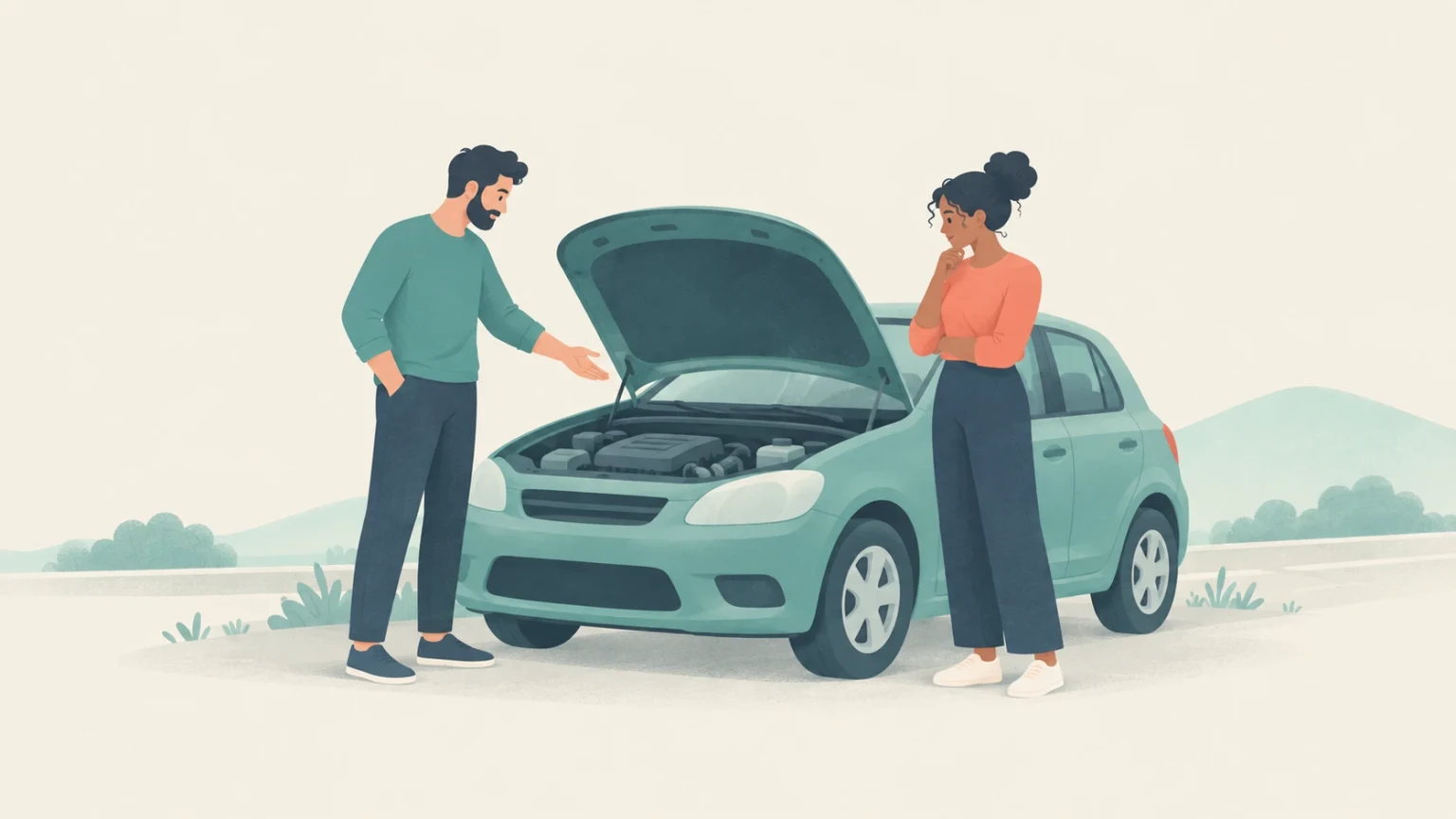
| break down | Equipment stops working, or information is explained in parts. | The lift broke down before the guests arrived. |
| break into | Enter a place or system without permission. | Someone broke into the locked storeroom. |
| break out | A sudden event begins; the event is the subject. | Laughter broke out during the speech. |
| break up | A gathering ends, or a partnership or group separates. | The band broke up after the tour. |
| break away from | A person or group leaves a larger group or organisation. | One cyclist broke away from the pack. |
Stage 1 of 5
Understand
What it means, when to use it, and mistakes to avoid.
The full explanation
While the standalone verb break suggests physical damage, adding particles such as down, into, out, up, or away produces distinct meanings. Break down indicates operational failure or step-by-step explanation. Break into marks unauthorized entry. Break out describes sudden disruptions such as fires, protests, or laughter. Break up indicates the separation of gatherings or personal partnerships, while break away describes departing from a larger group.
Our office air conditioner broke down during the hottest week of July.
Why it works: Broke down indicates that the cooling appliance ceased operating.
3 more examples
-
The trainer broke down the software workflow into four clear steps.
Broke down means explained an intricate process in smaller, sequential stages.
-
Police arrived promptly after an intruder broke into the storage facility.
Broke into indicates unauthorized, forced entry into a commercial building.
-
A loud cheer broke out across the hall when the results appeared.
Broke out indicates that the celebration started suddenly and audibly.
Read the full guide
Match the particle to your intended action
English phrasal verbs combine a familiar base verb with a small particle to express a completely new idea. When you see the verb break alone, you might think of shattered glass or snapped sticks. Adding particles such as down, into, out, up, or away immediately redirects the meaning toward machine failure, unauthorized visits, sudden outbreaks, or social division. Always inspect the surrounding sentence before selecting a particle.
-
The delivery truck broke down two miles outside the distribution center.
Why it works: Broke down indicates that the vehicle engine failed while driving.
Your turn
Why is it risky to translate the verb break without looking at its following particle?
Answer: Because the particle alters the core meaning to describe failures, entry, or separation.
Show the answer
Answer: Because the particle alters the core meaning to describe failures, entry, or separation.
Adding a particle like down, into, or out changes the action from physical damage to specialized actions like mechanical failure or sudden events.
Use break down when equipment stops functioning
When an engine, household appliance, elevator, or software application stops functioning due to an internal fault, use the phrasal verb break down. This expression emphasizes mechanical or technical failure rather than deliberate destruction. When commuters say that their bus broke down, they mean the vehicle experienced an operational problem that prevented travel, not that someone smashed the windows or dented the doors.
-
Our office printer broke down right as we prepared thirty presentation folders.
Why it works: Broke down highlights an unexpected mechanical failure of the printer.
You can practise this again in Phrasal Verbs: Understanding Meaning in Context and Everyday English Words: Meanings and Examples.
Your turn
Which sentence correctly describes a machine that stopped working due to mechanical trouble?
Answer: The warehouse forklift broke down during the morning shift.
Show the answer
Answer: The warehouse forklift broke down during the morning shift.
Break down is the correct phrasal verb for vehicles or machines experiencing mechanical failure.
Use break down to explain complex information
You can also use break down when analyzing complicated data, financial budgets, or multi-step procedures. In this context, break down means to divide a large, intimidating concept into smaller, digestible components so listeners understand each part clearly. This usage is separable, meaning you can place the noun object after down or directly between break and down. When replacing the noun with a pronoun, place the pronoun in the middle.
-
The trainer broke down the software workflow into five simple stages.
Why it works: Broke down shows dividing an intricate process into smaller learning segments.
Your turn
Where must the pronoun it appear when using break down to mean explaining something in parts?
Answer: Between break and down, as in break it down.
Show the answer
Answer: Between break and down, as in break it down.
When separable phrasal verbs take a pronoun object, the pronoun must sit between the base verb and particle.
Use break into for unauthorized building entry
Use break into when an intruder enters a private residence, office, vehicle, or digital database without permission. This expression usually implies forced entry, picked locks, smashed windows, or bypassed security protocols. Unlike ordinary entry through an unlocked door, break into carries legal, criminal, or security implications. Always place the destination or compromised target directly after the preposition into.
-
Burglars broke into the corner pharmacy through a damaged basement window.
Why it works: Broke into indicates illegal forced entry into the pharmacy building.
Your turn
Which situation requires the phrasal verb break into?
Answer: A trespasser forcing open a rear garage door without authorization.
Show the answer
Answer: A trespasser forcing open a rear garage door without authorization.
Break into describes forced or unauthorized entry into private property or secured spaces.
Use break out when events start suddenly
When an unwelcome or chaotic event begins abruptly and spreads fast, use break out. English speakers commonly pair this phrase with fires, riots, wars, epidemics, arguments, or panic. In this meaning, the event itself acts as the subject of the sentence, and the verb does not take a direct object. A rare positive use occurs when laughter or cheering erupts spontaneously across an assembled group.
-
An intense argument broke out over the delayed train announcement.
Why it works: Broke out shows that the dispute started suddenly and visibly.
Your turn
What role does the sudden event play in a sentence with break out?
Answer: The event serves as the grammatical subject of the sentence.
Show the answer
Answer: The event serves as the grammatical subject of the sentence.
When break out means to begin abruptly, the sudden occurrence functions as the subject (for example, a fire broke out).
Use break up to divide meetings or crowds
Use break up when an organized meeting, classroom session, party, or public assembly ends and people disperse. It also describes splitting a large group into smaller operational units for collaborative tasks. When speakers want to name the resulting units, they add the preposition into followed by nouns like pairs, teams, or groups. This phrasing emphasizes the transition from one large collective into several smaller components.
-
The workshop leader had the room break up into groups of four.
Why it works: Break up into denotes separating a large gathering into smaller working units.
Your turn
Which preposition naturally follows break up to specify the resulting smaller units?
Answer: into
Show the answer
Answer: into
English speakers use break up into when specifying the smaller groups or pairs formed from a larger crowd.
Use break up when personal partnerships end
In social and interpersonal contexts, break up describes the ending of a romantic relationship, musical band, or professional business partnership. When stating which person ended the relationship or who the former partner was, add the preposition with. The expression highlights the formal or emotional termination of the connection rather than physical relocation. It is among the most frequent everyday expressions for relationship conclusions.
-
After three years of touring, the rock band decided to break up peacefully.
Why it works: Break up signifies the permanent dissolution of the musical group.
Your turn
Which preposition connects break up to the former romantic or business partner?
Answer: with
Show the answer
Answer: with
Speakers use break up with someone to identify the person with whom a relationship has ended.
Use break away when leaving a group or system
Use break away when an individual runner, cyclist, or faction deliberately departs from a larger pack or organization. In athletic contests, breaking away means accelerating ahead of the chasing group to establish a solo lead. In political or organizational contexts, it refers to members separating from an established body to form an independent movement. The focus remains on escaping control, conformity, or group containment.
-
Two marathon runners broke away on the final stretch to contest the gold medal.
Why it works: Broke away indicates accelerating away from the main running pack.
Your turn
What distinguishing idea does break away communicate compared to break up?
Answer: It emphasizes an individual or faction departing from a pack to move independently.
Show the answer
Answer: It emphasizes an individual or faction departing from a pack to move independently.
Break away focuses on leaving a pack or governing collective to establish independent movement or leadership.
Common mistakes
What learners often say, what to say instead, and why.
-
Not this:
The technician broke down it into three parts.Say: The technician broke it down into three parts.
When 'break down' takes a pronoun object in this meaning, put the pronoun between 'break' and 'down'.
-
Not this:
A fire broke out the warehouse.Say: A fire broke out in the warehouse.
'Break out' does not take the event as a direct object; use a suitable preposition for its location.
-
Not this:
They broke up from smaller teams.Say: They broke up into smaller teams.
Use 'into' to name the smaller groups formed from a larger one.
-
Not this:
She broke away with the organisation.Say: She broke away from the organisation.
Use 'from' to name the group or organisation someone leaves.
Use it naturally
How people really use “broke down”
Neutral Fine almost anywhere, at work or with friends.
Words it often goes with
- broke down the instructionsThe teacher broke down the instructions into short, clear steps.
- broke down the processMy coworker broke down the process so I could follow it.
- broke down the costsThe organizer broke down the costs to show how we would spend the money.
- broke down on the wayOur bus broke down on the way to the beach.
What people also say
- “Our car broke down.” instead of “Our car had an operational failure.” Use this simple phrase in everyday conversation.
Questions about "Phrasal verbs with break: meanings and everyday use"
Can I put the object between break and down?
Yes, when break down means to analyze or explain something in parts, it is separable. You can place a noun after down or between break and down. However, when using a pronoun like it or them, you must place the pronoun in the middle. When break down describes machine failure or emotional distress, it does not take a direct object.
The consultant broke down the quarterly results clearly.
The consultant broke them down clearly.
What is the difference between break into and break in?
Both verbs refer to unauthorized entry, but break into requires a direct object naming the place or system entered. Break in is used without an object when the location is already obvious from the conversation. Break in can also mean wearing new shoes or using new equipment until it becomes comfortable.
Thieves broke into the jewelry shop overnight.
The security alarm rang while thieves tried to break in.
Can break out describe positive events?
Break out usually describes negative or chaotic events like wars, fires, fights, or contagious diseases. The primary common positive exception is laughter or applause, which can break out spontaneously in an audience when someone tells an amusing joke or finishes an inspiring speech.
Laughter broke out across the audience during the opening remarks.
How do break up with and break away from differ?
Use break up with when ending a personal, romantic, or close partnership. Use break away from when an individual or splinter group leaves a larger organization, political alliance, or physical pack to operate independently.
Elena decided to break up with her partner after five years together.
The regional branch chose to break away from the national union.
Before you go
Remember this
Identify the practical situation before choosing your particle. Use break down when machines stop operating or when dividing complicated tasks. Select break into for unauthorized or forced entry. Choose break out when unexpected events start abruptly. Use break up when crowds disperse or relationships end, and choose break away when an individual leaves a main group.
Stage 2 of 5
Listen
Hear it in real sentences, from short to long, and write what you hear.
0 of 4 done
Listening 1 of 4
Listening 2 of 4
Try a longer clip. Listen once, then replay the part you missed.
Listening 3 of 4
This clip is longer. Follow the instruction above the answer field.
Listening 4 of 4
Listen, then type the missing words. The rest of the text is already there.
0:00
Practice complete
You listened closely.
Your result is saved in this browser.
Keep your progress. Your practice is saved on this device only. Create a free account to keep it everywhere.
Create a free accountThat was today's free lesson. Tomorrow you get another one. Want more today? See membership.
Create a free SubLearn account to keep this progress across devices.
Save my progressStage 3 of 5
Speak
Say it with the speaker, then use it in your own answer.
Shadow
Say it along with the speaker
Play the line slowly, then speak at the same time as the speaker. Copy the rhythm, not just the words.
Your turn
Say it your way
Imagine you taught a friend a new board game at a cafe. Speak for 30 to 60 seconds from memory. Explain how you made the rules easy to understand, what confused your friend, and how you helped.
Use: broke down
Take ten seconds to think, then answer out loud without looking at the lesson. Speak for the time shown in the task above. Nothing is sent unless you ask for feedback.
0:00
Hear how someone else might say it
Last Saturday, I taught my friend Maya a new board game at a cafe. There were lots of rules, so I broke down the instructions into three simple steps. First, I showed her how to choose a card. Then we practiced moving the pieces and counting points. She was confused about when to take another card, so we played one round with our cards face up. That helped a lot. By the second round, she could play without help, and she even beat me!
Try once more and answer this: Which rule was the hardest to explain?
Stage 4 of 5
Write
Use what you've learned to write about your day or week, then write a message.
Write
Put it in your own words
- I used “broke down”.
- It is about my life, not the lesson’s example.
- I read it once aloud to check it sounds right.
Write your own response
Choose a situation and write 30–50 words of your own. In this activity, you decide what to say rather than copy the words in a recording.
Check your own writing
Read one possible response
Use these checks to revise your message. Grammar and meaning are not automatically graded. Each task keeps its own draft in this browser tab.

You finished the free part of this lesson
- Understand
- Listen
- Speak
- Write
- CheckPart of membership
Worth another look
With a free account, the lessons you finish come back for review to help you remember them.Create a free account
Stage 5 of 5 · Part of membership
Check
New clips without hints.
Listening tests are included with membership. Try the free dictation first, then decide whether to continue.
Listening 1 of 2 Part of membership
Listening 2 of 2 Part of membership
Follow MicroEnglish
Find lesson updates, short videos and quick quizzes. Pick the app you already use.
Questions & comments
Ask about this lesson, share an example, or help another learner.
Example
Memory tip
Goes with
Related forms
Not to be confused with
In this lesson
This word isn't in our dictionary. Check the spelling, or try another form of the word.
We couldn't load this word. Try again.
