अगला पाठ खोजें
कोई वाक्यांश खोजें या बताएँ कि आपको क्या कहना है। अभी उपलब्ध पाठों में से चुनें।
359 पाठों में से 91 से 108 तक
फ़िल्टर हटाएँ-

Articles exercises with answers: Choose A An The
Articles signal whether a noun refers to a general concept, an unidentified single item, or an item that the listener can identify. The indefinite articles a and an introduce one singular countable noun whose exact identity is not yet shared or important. The definite article the points to an identifiable noun, whether singular, plural, or uncountable. When you discuss plural categories or uncountable substances in general, English leaves out the article entirely.
-

Deer or deers: how to choose
Deer refers to a hoofed forest animal. The word has an unchanged plural form in standard English, meaning that the singular and plural forms look and sound exactly the same. The quantity comes from surrounding words such as determiners, numbers, and verbs.
-

Will or Going to: Choose the Right Future
Will can express decisions, promises, offers, and predictions. Be going to can express an intention or a prediction connected to the present situation. The choice often changes the emphasis rather than the basic time reference. Either form can work without an explicit future time phrase when the context is clear.
-

Daytime or day time: choose the right spelling
Daytime refers to the period of natural light between sunrise and sunset. It contrasts directly with nighttime. When used before another noun, daytime describes activities, conditions, or schedules that take place during those light hours. It does not mean any random point on a calendar day, nor does it refer to an exact clock hour.
-

Furthermore or Moreover: Adding Connected Points
Furthermore and moreover both add information or another supporting point. They often work in the same position and can be interchangeable. Context may give a point extra emphasis, but neither word imposes a fixed ranking of evidence.
-

Onto or Into: Choosing the Right Direction
Onto combines movement with arrival on a surface, such as a table, a roof, a stage, or a shelf. Into combines movement with arrival inside an interior, such as a room, a box, a vehicle, or a container. Both words follow dynamic verbs like put, step, drop, pour, and slide.
-
सदस्यता
7 दिनों तक सभी पाठ मुफ़्त खोलें
- सुनकर लिखने के अभ्यास और सुनने के टेस्ट वाले 596 पाठ
- तीन लहजे: ब्रिटिश, अमेरिकी और ऑस्ट्रेलियाई
- हर दिन नए पाठ। आपकी प्रगति भी सहेजी जाती है
कार्ड की ज़रूरत नहीं। उसके बाद जारी रखना चाहें, तो $7.50 प्रति माह से प्लान उपलब्ध हैं।
मुफ़्त आज़माना शुरू करें -

Adjective Order: Build Clear Natural Descriptions
An adjective gives specific qualities to a noun, such as size, age, shape, color, origin, or material. When you say a comfortable wooden chair, the words comfortable and wooden clarify what kind of chair you mean. Adjectives also complete sentences after linking verbs, as in the chair feels comfortable, where the word links back to describe the subject.
-

Resume experience lines: write clear bullet points
A resume experience line is an incomplete sentence that acts as a concise work record. It leaves out the subject pronoun because your name already appears at the top of the page. The initial verb tells the reader what action you took, while the following words give the context.
-

Emphasizing adjectives: four common choices
Emphasizing adjectives direct attention to a specific feature of a noun phrase. Own highlights that something belongs to a person or that they are personally involved. Very identifies a specific, exact person, thing, place, or time. Only restricts the situation by showing that no other choices exist or by limiting an exact count. Mere frames an amount, object, or obstacle as minor or surprisingly small. Rather than making a description generally stronger, each word performs a distinct semantic job.
-

English pronunciation: clear daily practice
English pronunciation is the deliberate production of vowel and consonant sounds, rhythm, syllable stress, and phrase boundaries to convey clear meaning in speech. It guides how a listener separates individual words and identifies the central focus of your message.
-

Stative Verbs: Choosing the Correct Form
A stative use describes a condition, relationship, perception, or attitude rather than an activity presented as unfolding. Such uses usually take simple forms. Some verbs also have dynamic meanings, and some allow continuous forms to emphasize a temporary experience.
-

Practice English speaking: Five daily exercises
A speaking activity is an intentional spoken drill with an explicit goal and time limit. Instead of attempting an open-ended conversation with no clear direction, you assign yourself a narrow communicative job. That job might involve explaining why an order arrived late, requesting a meeting change, or contrasting two commuter routes. The defined boundary frees mental energy so you can concentrate on correct verbs, connectors, and audible pronunciation.
-

Has or have: choose the right verb
Have indicates possession, relationships, routines, and physical characteristics. Has is the third-person singular form of have, used with he, she, it, and singular nouns. In compound tenses, both words function as auxiliary verbs before a past participle.
-

English Infinitives: When to Use To
An infinitive names an action without being tied to a specific time or person. The main verb in the sentence carries the tense, while the infinitive completes the thought. In 'She wants to travel,' the verb 'wants' shows the present tense, and 'to travel' identifies what she wants.
-
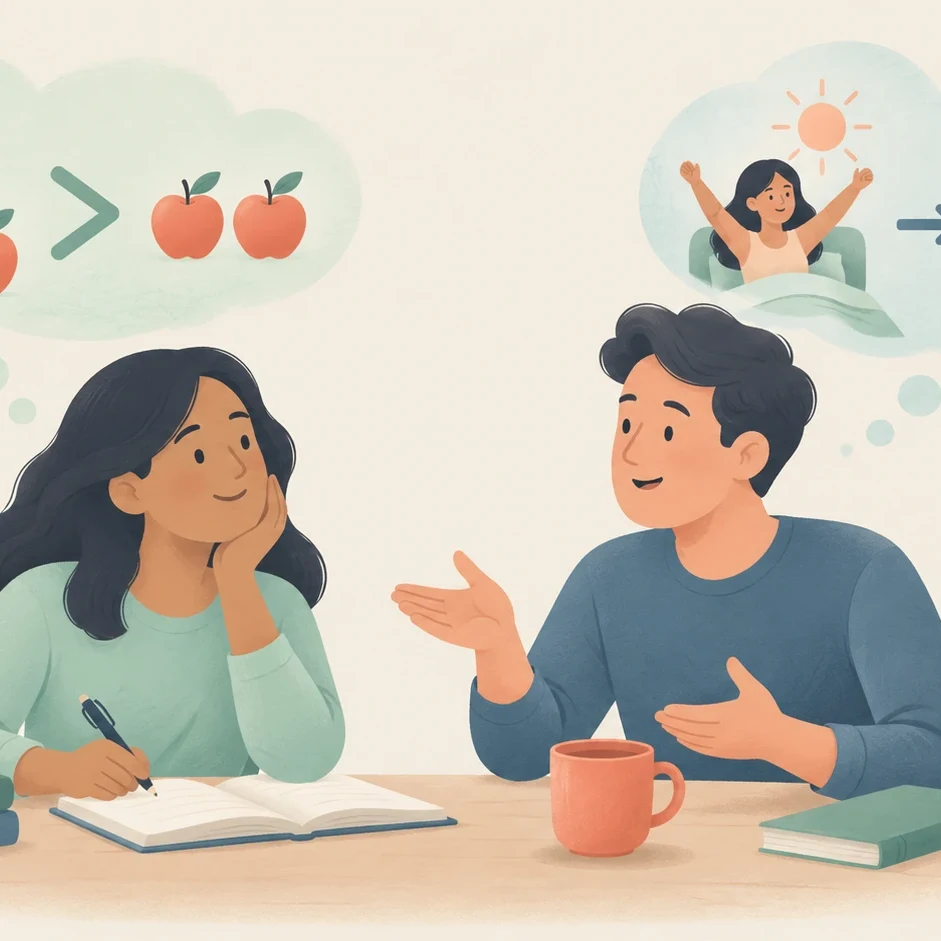
More than or more then: choose the right word
'More than' is a comparative phrase where 'than' introduces the second element, benchmark, or threshold of a comparison. It means an amount greater than a specified number or quality. 'Then' is an adverb of time, order, or condition, meaning 'after that', 'at that time', or 'in that case'. The form 'more then' has no grammatical standing as a comparative phrase.
-

How to use semicolons: guide for clear sentences
A semicolon marks a pause stronger than a comma but softer than a period. It indicates that the following statement directly explains, balances, or completes the statement before it without needing a coordinating conjunction.
-

Past perfect progressive: when to use it
The past perfect progressive highlights the duration or ongoing process of an activity that occurred before a later moment in the past. It shows that the earlier action was in progress up to or close to that second past event, often explaining a visible result or state at that time.
-

Could, would, or should: choose the right verb
Could indicates that something is possible or available as an option. Would describes what happens under a specific condition or in an imagined reality. Should indicates that an action is advisable, desirable, or expected.
अभी ट्रायल नहीं लेना चाहते? रोज़ एक मुफ़्त पाठ पाएँ
7 दिन तक रोज़ ईमेल में सुनकर लिखने का एक छोटा अभ्यास मिलेगा। जहाँ हैं वहीं अभ्यास करें। खाता बनाना ज़रूरी नहीं है।
अपने शब्दों या स्थिति से जुड़ा पाठ नहीं मिल रहा?
पाठ बनवाने के अनुरोध सदस्यता में शामिल हैं।
सदस्यता देखें